Video wird geladen...

Video konnte nicht geladen werden

Zur Startseite

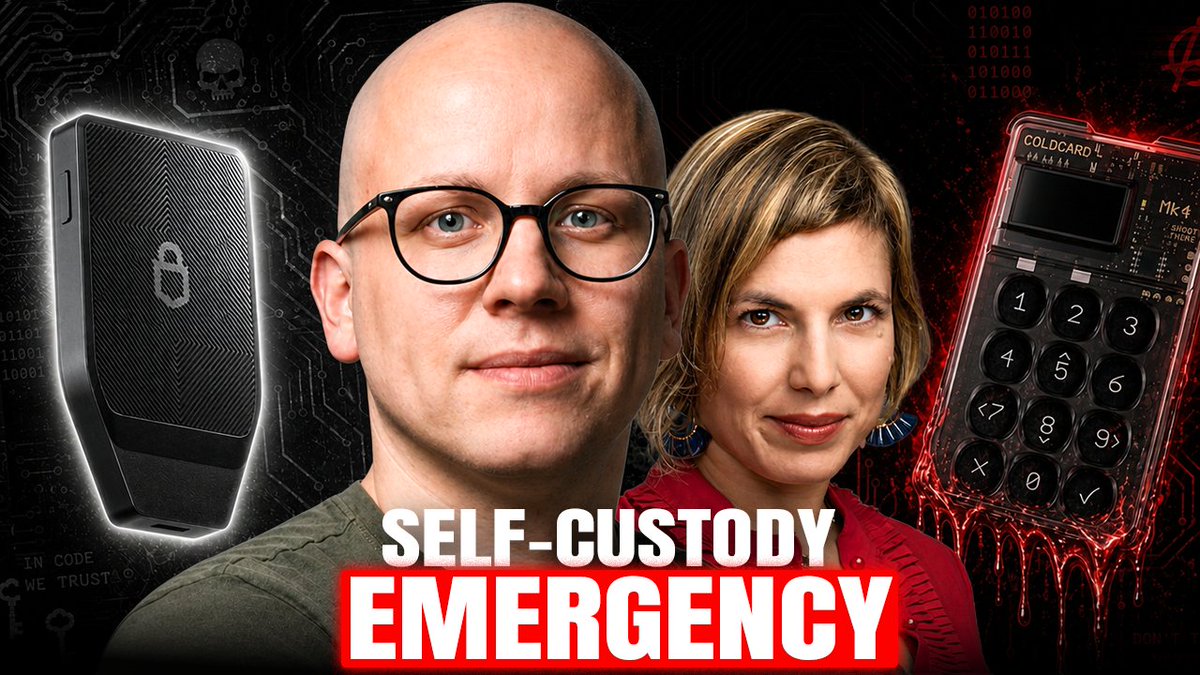
3 generic microcontrollers NOBODY will know you'll turn into a #Bitcoin hardware wallet: * NO hardware supply-chain attack * Free and open source * WebSerial or SD card * Hardware RNG or dice entropy * $8–$20 (video includes a nice little RNG audit tool)

10,463 Aufrufe • vor 5 Tagen •via X (Twitter)

0 Kommentare

Keine Kommentare verfügbar

Kommentare vom Original-Post werden hier angezeigt

Ähnliche Videos

Trezor's CTO on the Cold Card Hack: Randomness, Trust, and What Comes Next Ep. 153 with Tomas Susanka Tomáš Sušánka is the CTO of Trezor, where he has worked since 2017. Tomáš joins Efrat for an urgent, unscripted conversation days after the Cold Card hardware wallet hack, in which a flawed random number generator left seed phrases vulnerable and resulted in more than 1,500 bitcoin stolen from affected users. Drawing on questions submitted directly by the Bitcoin community, Tomáš walks through what entropy actually is, how Trezor's own four-source random number generation works, why open-source visibility alone does not guarantee security, and what practical steps everyday self-custody users can take to reduce how much they have to trust any single piece of hardware. → Please like, comment, share & subscribe, to help me beat the suppressing algo's. Thank you! 00:00 - Introduction: Tomáš Sušánka, Trezor CTO 02:39 - What Happened with Cold Card: How Trezor Received the News 09:17 - Origins of Cold Card: Forks, Licensing, and the Bitcoin-Only Split 13:40 - Open Source vs. Source-Available: How the Bug Went Undetected for Five Years 20:20 - Trezor's Response: Security Reviews and R&D Changes Since the Incident 22:24 - How Trezor Generates Randomness: The Four Entropy Sources 23:29 - Dice Rolling for Seed Generation: Necessary? 28:30 - Reducing Trust: Practical Verification Steps 31:09 - Single Device vs. Multisig 32:45 - BTC Sessions 😎 Clip: Ben and Bitcoin Mentor on Air-Gapped Wallets 34:29 - Tomáš's Take: Why Air-Gapping Isn't What People Think 39:49 - How Trezor's Design Differs from Cold Card's 42:32 - 2026 Secure Element Laser Fault Injection Finding 47:46 - Responsible Disclosure: Trezor's Protocol for Reporting Vulnerabilities 49:29 - The Biggest Risks Facing Bitcoin Right Now 51:01 - Short-Term Damage vs. Long-Term Lessons for the Community 55:27 - Trezor Model One's 12th Anniversary and the Evolution of Hardware Wallets 57:57 - Closing Thoughts and a Call for Continued Security Research

Efrat Fenigson

43,884 Aufrufe • vor 16 Tagen

YOUR HARDWARE WALLET SUCKS. PERIOD. ZachXBT just said what we've known for years: hardware wallets are garbage. We won't go as far but we surely feel they are not for everyone. They are for advanced users and by no means for wallets that are meant to be accessed frequently. There is one thing hardware wallets are good at: that is keeping crypto secure if someone physically trying to rip private keys (those that give you access to crypto) out of the chip. The reality is that attack almost never happens!😀 When it comes to the attacks that actually drain wallets, hardware wallets make them worse: >> 1. NOT DISCREETE The moment someone sees that little device, you're a confirmed high-value target. >> 2. LEAKED EMAILS AND ADDRESSES Buying one doxxed thousands of people. Leaked customer databases with the real names and home addresses. You just joined a phishing hit list. Emails targeting hardware wallet owners are now so convincing that even veterans get fooled. Privacy can't fail harder than that. >> 3. PAPER BACKUPS You still write your keys on paper. The seed phrase backup negates the entire point of the device. BTW, mobile wallets already moved on: Unstoppable now has passkey wallets allowing to create and restore with zero seed phrase, secured by your device. That will likely become the golden standard in the future. >> 4. YOUR PHONE ALREADY HAS A VAULT Your phone is designed for security. There's a state of the art secure storage chips in your pocket already. Apple and Google built isolated secure elements to guard the most sensitive data in your life. If integrated right by the devs, it's the most battle-tested security hardware on earth. >> 5. MOBILE APP = DISCREETE Nobody knows you're carrying a vault. A phone is the most discreet way to hold crypto. >> 6. MOBILE APPS CAN BUILT CREATIVE SECURITY FEATURES The mobile OS allows many possibilities for secure use. Hardware wallets are meant to stay primitive by design and therefore can't ship security features that are are needed. - Your wallet can wear a disguise. Some wallet apps look like calculators. - Unstoppable's Duress Mode gives you unlimited unlock PINs - under coercion, you show a decoy and keep the rest invisible. - Unstoppable's phishing protection catches look-alike addresses before you send - blocking the #1 way people actually lose crypto today. Hardware wallets solved 2015's problem. Your phone solves 2026's. MOBILE WALLETS ARE THE FUTURE!

Unstoppable | Privacy Wallet

21,732 Aufrufe • vor 1 Monat

Matthew Gallagher Built a $401M Company in Year One with 2 People. And the tool behind it? Claude Code. This year he's on track for $1.8B. Sam Altman predicted this. It's happening now. The problem? It costs money. API credits stack up. Monthly bills keep growing. Every prompt eats your budget. Every project drains your wallet faster. Until now. Two methods. 99% cheaper. One is completely free. Forever. $0. Not a trial. This video breaks down both step by step. ↓ Let me put this in perspective. $100-$500. That's monthly. That's what you spend. That's $6,000/year on API credits. Just to use a tool you haven't shipped anything with. The $401M guy? Spending $0. Same capability. Shipping weekly. Different cost structure. Different results. Different life. I'm about to hand you his cost structure for free. ↓ Open source vs closed source. Pay attention. Closed source: Claude. GPT-4. Pay per token. Meter always running. Open source: Qwen. Llama. Mistral. Free to download. Free to run. Free forever. No meter. No tokens. No bill. Here's what nobody tells you: 80% of coding tasks? Open source handles them. More than handles them. Writes clean code. Debugs errors. Generates boilerplate. Handles routine work perfectly. You're paying premium prices for tasks that don't need premium intelligence. That's hiring a brain surgeon to put on a bandaid. Smart play: Free models for the 80%. Paid credits for the 20%. That's what the $401M guy does. That's what this video teaches you. Follow Himanshu Kumar for more breakdowns that turn free tools into real businesses. ↓ Method 1: Ollama. Local. Free. Forever. Download it. Pull a model. Point Claude Code at it. Done. No internet needed. No API keys required. No monthly subscription. No token counting ever. No bill. Today. Tomorrow. Ever. Your data never leaves your computer. Complete privacy. Complete freedom. Claude Code thinks it's talking to the cloud. It's talking to your laptop. For $0. The video walks through every step: Every config file. Every variable. Every command. Every click. If you can follow a recipe, you can do this. People who set this up 3 months ago? Saved $300-$1,500 since then. Workflow didn't change one bit. ↓ Hardware you need: 16GB RAM: 7B models run smooth. 32GB RAM: 32B models run comfortable. 64GB + GPU: biggest models available. No GPU? Still works. Just slower. Few extra seconds. That's it. Your $1,500 laptop is sitting there running Chrome and Spotify. Put it to work saving you $200/month instead. Follow Himanshu Kumar for more breakdowns that turn free tools into real businesses. ↓ Method 2: Open Router. Free Cloud. No Hardware. Weak machine? Don't want local setup? This method is for you. Free AI models in the cloud. No download. No hardware. Configure Claude Code to route through Open Router. The config: Base URL: Open Router API. API key: free Open Router key. Default Sonnet: free. Default Opus: free. Default Haiku: free. Small fast model: free. Subagent model: free. Free. Free. Free. Free. Free across the board. Same interface. Same commands. Same workflow. Zero cost. Copy the config from the video. Paste it. Save $200/month. Starting today. Right now. ↓ When to use which: Ollama (local): Best for privacy. Best for offline work. Best for unlimited usage. Best if you have decent hardware. Open Router (cloud): Best for weak machines. Best for instant setup. Best for trying different models. Best if you don't want to manage anything. Both methods: Best for 80% of your daily work. Still use paid Claude for: Complex architecture. Multi-file refactoring. Deep reasoning tasks. The 20% that actually needs it. $20/month instead of $200/month. Same output. 90% less cost. ↓ The math that should make you angry. You (current): $200-$500/month. $2,400-$6,000/year. $7,200-$18,000 over 3 years. You (after this video): $20-$50/month. $240-$600/year. $720-$1,800 over 3 years. Savings over 3 years: $6,480-$16,200. That's a used car. That's seed money. That's 6 months of rent. All from one 25-minute video. All from 15 minutes of configuration. Highest ROI 25 minutes you'll spend this year. ↓ The limitations. I won't lie to you. Open source is not Opus. Not as smart on complex reasoning. Not as good at long-context tasks. Makes more mistakes on nuanced problems. But they are: Free. Capable. Getting better monthly. Good enough for 80% of daily work. Smart cost management isn't being cheap. It's being strategic. Expensive tool when it matters. Free tool when it doesn't. ↓ The one-person billion-dollar company is coming. $401M in year one proved it's possible. The building blocks: AI that codes: Claude Code. Way to run it free: this video. Distribution: the internet. Customers: everyone. Only missing ingredient? Someone who builds. Not reads about building. Not saves posts about building. Not bookmarks videos about building. Builds. Tools are free. Knowledge is free. Opportunity is screaming. You're still "thinking about it." ↓ Your action plan: Tonight: Watch the video. Tomorrow morning: Set up Ollama or Open Router. Tomorrow afternoon: Build something. Anything. This week: Build a second thing. Faster. This month: Charge someone for it. One video. One setup. One weekend. $0 cost. Unlimited potential. Or keep paying $200/month for something you could get free. Keep consuming instead of building. Keep planning instead of shipping. Matthew Gallagher didn't plan a $401M company. He built it. Full video attached. Every method. Every config. Every tradeoff. 25 minutes. Your move. Follow Himanshu Kumar for more breakdowns that turn free tools into real businesses.

Himanshu Kumar

13,599 Aufrufe • vor 4 Monaten