Video wird geladen...

Video konnte nicht geladen werden

Zur Startseite

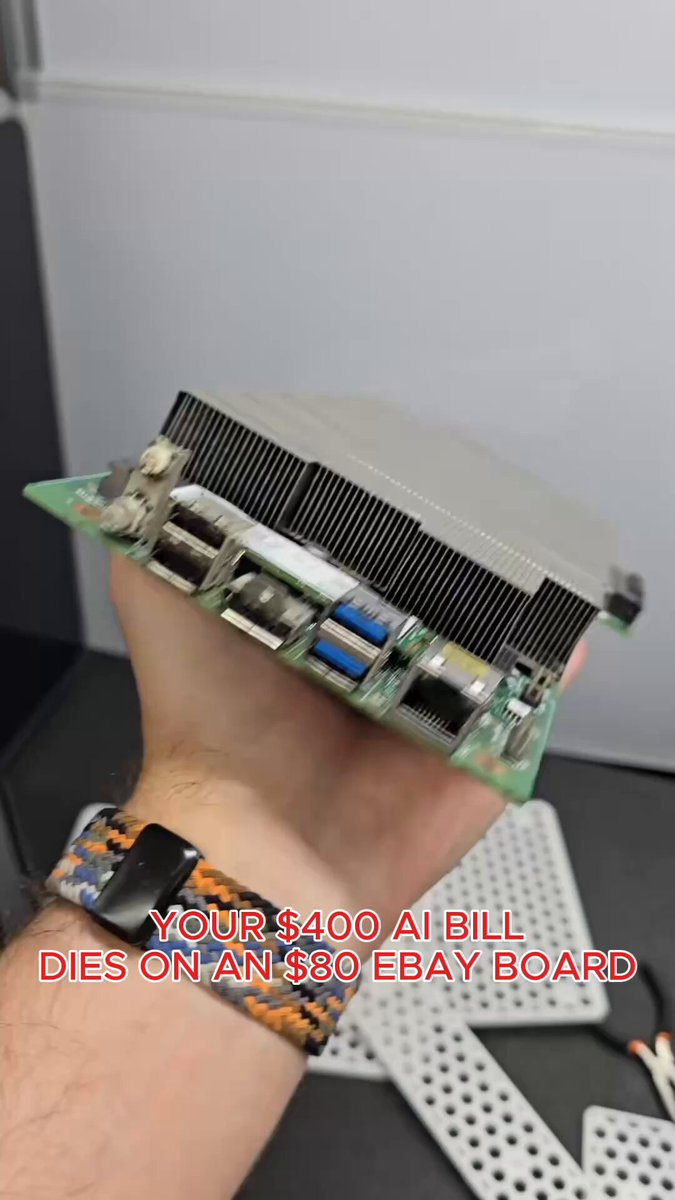
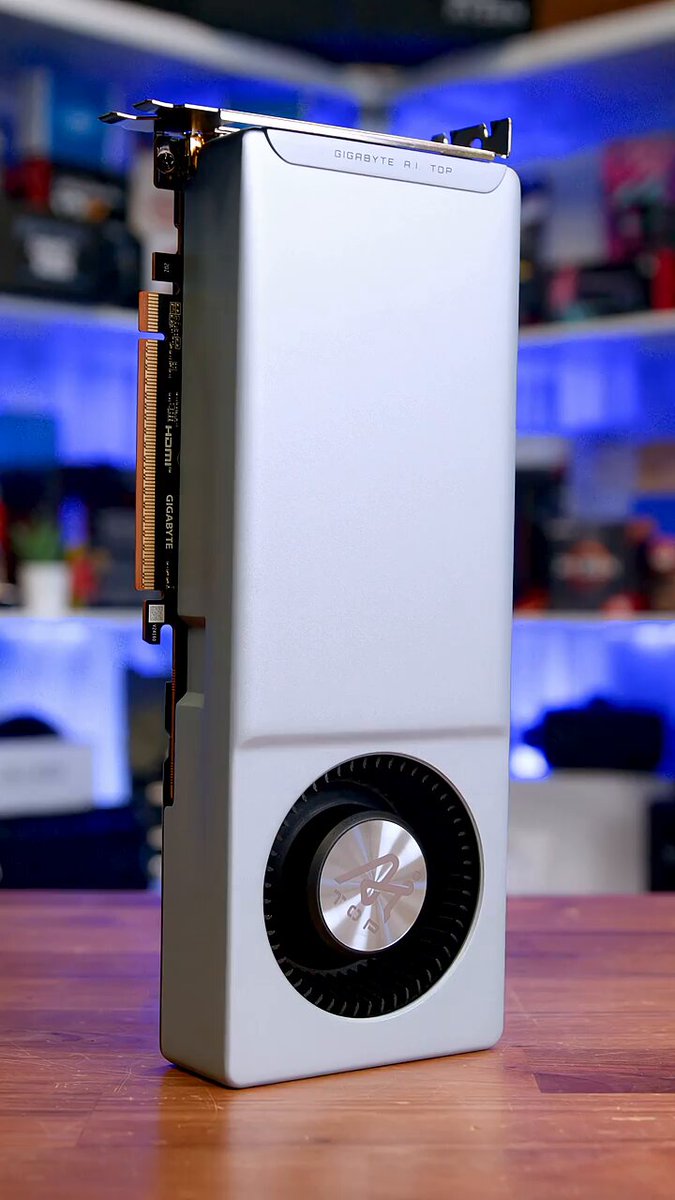
A $40 BC250 BOARD WITH 16GB GDDR6 GETS A GITHUB FIRMWARE FLASH, THE DEFAULT 8/8 CPU/GPU SPLIT REWRITES TO 0.5/15.5 AND OPENS 15.5GB OF UNIFIED MEMORY TO OLLAMA, DEAD CRYPTO HARDWARE JUST DOUBLED ITS AI CEILING 01:08 the operator points at the chart, "you only give 512 megs to...

25,619 Aufrufe • vor 1 Monat •via X (Twitter)

0 Kommentare

Keine Kommentare verfügbar

Kommentare vom Original-Post werden hier angezeigt

Ähnliche Videos

UC Berkeley just open-sourced FreeToken. (2–4x faster local LLM inference than Ollama) the results are wild: - Qwen3.6-35B on an 8GB GPU at 39.3 tokens/s - DeepSeek-V4-Flash 284B on a 32GB GPU at 22 tokens/s - GLM-5.2 753B on a 96GB GPU at 14.9 tokens/s a 35B model at 16-bit precision needs about 70GB just for its weights. even at 4 bits it is close to 18GB, and FreeToken serves it on an 8GB GPU. let me explain how: all three models mentioned above are Mixture-of-Experts, and that is what FreeToken takes advantage of. each layer holds hundreds of separate experts plus a small router that picks a few of them per token. Qwen3.6-35B activates roughly 3B of its 35B parameters per token. DeepSeek-V4-Flash picks 6 of 256 experts per layer, so 13B of its 284B run at a time. so compute was never the bottleneck. the weights a single step touches fit comfortably on a consumer GPU. every expert the router might pick still has to exist somewhere. they sit in system RAM, and the GPU keeps a cache of the ones the model has been using recently. so everything comes down to what happens when the router picks an expert that is not on the GPU. there are two ways to serve that miss: 1. copy it over PCIe and run it on the GPU 2. run it on the CPU, where it already lives both read from the same system memory, so they compete for one pool of bandwidth instead of adding to each other. existing engines pick one option and freeze it when the model loads. but routing changes on every token, so a fixed choice misses most of what the model asks for. FreeToken measures both bandwidths on your machine and splits each step's misses between the two paths in proportion. the GPU and CPU results then merge exactly, with no approximation. two machines with the same GPU can end up wanting opposite strategies, which I did not expect. a 5090 in a gaming desktop should push nearly everything over PCIe, while an 8GB laptop is better off computing most misses on the CPU. none of that is readable off a spec sheet, so the engine profiles it once per machine. the second half of the design is about agents. coding agents constantly rewrite their own history, and every edit normally forces thousands of tokens back through prefill. FreeToken saves its checkpoints at the exact boundaries agent frameworks cut on, so it only reprocesses the new part. its slowest first token stays under 44 seconds, while llama.cpp peaks at 232 and KTransformers at 946. it serves the OpenAI and Anthropic APIs under Apache 2.0, so Claude Code and Codex can point at it directly. releasing weights publicly decides who can download a model, not who can afford to run one. frontier open models keep shipping, and running them still assumes a rented cluster. meanwhile there are over a hundred million consumer machines with discrete GPUs sitting mostly idle. closing that gap was never a hardware problem, and work like this is what turns open weights into something you can actually use. paper: repo: almost every idea in this post, from why memory bandwidth decides the outcome to why moving weights costs more than computing on them, comes straight out of how a GPU is built. I wrote a detailed primer on that. the article is quoted below.

Akshay 🚀

303,127 Aufrufe • vor 2 Tagen

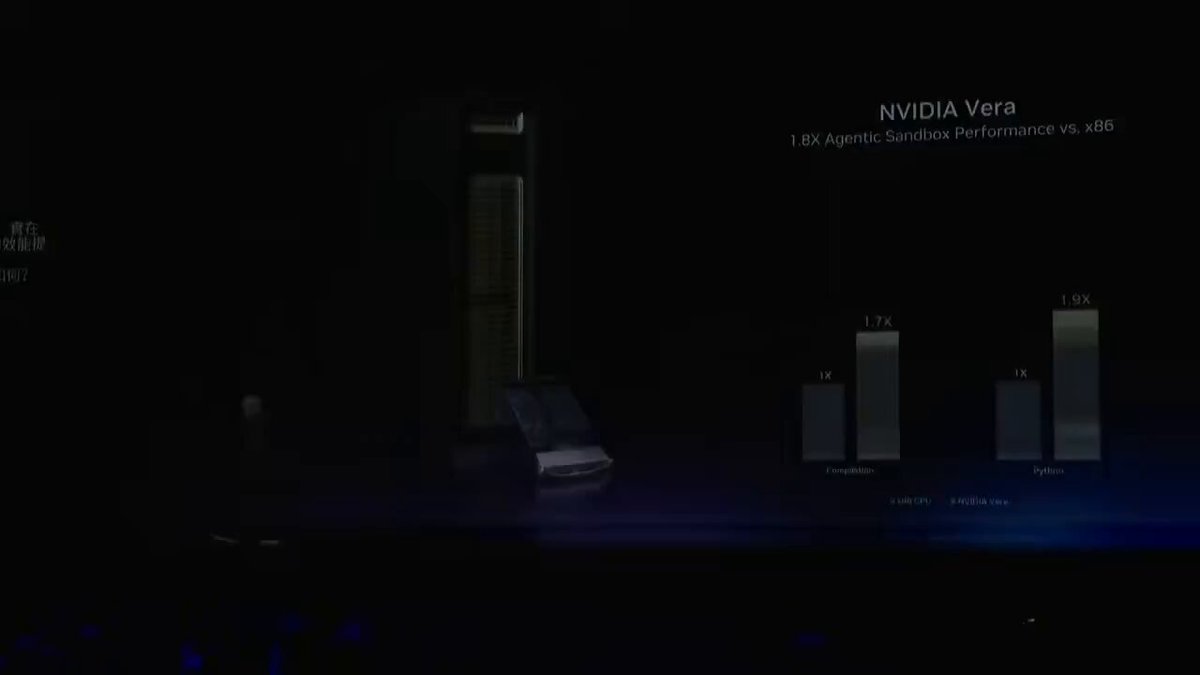
Jensen Huang just identified the next $200 billion market (Save this). The shift starts with a observation about agentic AI that changes everything about infrastructure. In the era of training and inference, the GPU was everything while CPU was a traffic cop, scheduling work, managing memory, dispatching tasks while the GPU did the heavy lifting. Agentic AI breaks that model entirely. An AI agent does not just run a single inference pass but rather it plans, calls tools, executes code in sandboxes, retrieves data from multiple sources and loops through complex multi-step reasoning sequences often thousands of times per second at scale. Every one of those operations runs through the CPU and the GPU sits idle waiting for the CPU to prepare the next task, supply the right context and execute the retrieval and tool calling logic fast enough to keep the accelerators fed. The CPU is now the conductor and the GPU is the orchestra and the bottleneck is the conductor falling behind. This is showing up in production AI factory utilization right now, which is exactly why Jensen built Vera from scratch rather than licensing x86. Vera achieves 40% lower peak memory latency than x86, 50% faster core to core communication, and 1.8 times the agentic sandbox performance of current x86 processors on a purpose-built architecture designed around the agentic loop. Now here is where the investment thesis gets interesting. The obvious beneficiary is Nvidia itself, and that thesis is real. Nvidia's CFO has guided for nearly $20 billion in Vera CPU revenue this fiscal year alone, a market Nvidia had zero presence in just three years ago. Intel held 60% of server CPU market share as recently as Q4 2025 and that transition is now happening at a pace Intel structurally cannot respond to. But the deeper question is, what architecture is Vera actually built on? Vera's Olympus cores are ARM compatible and every single Vera CPU deployed in every Vera Rubin rack in every data center in the world runs on ARM architecture. And ARM Holdings collects a royalty on every one of them. ARM does not make chips but rather licenses the instruction set architecture and CPU core designs that others build on top of. Every time Nvidia ships a Vera CPU, every time a hyperscaler deploys a Vera Rubin rack, every time an enterprise qualifies Vera for their AI factory, ARM earns a royalty. The secular tailwind here is almost perfectly constructed for ARM's business model. Amazon's Graviton, Microsoft's Cobalt, Google's Axion, Apple's silicon stack, and Qualcomm's data center push all run on ARM. And now Nvidia's Vera, which is projected to displace Intel as the largest server CPU supplier by revenue in a single fiscal year, is ARM. ARM's royalty rate on high end server chips is estimated at roughly 1 to 2% of chip selling price. At $5,000 per Vera CPU and 4 million units projected for FY2027, that is a royalty line growing from near zero to potentially $400 million to $800 million annually from Nvidia's data center CPU business alone before counting Amazon, Microsoft, Google, Apple, and Qualcomm. The total ARM addressable royalty base across all the silicon it already licenses is compounding at a rate that the current $130 billion market cap does not fully reflect. Jensen's CPU thesis is the most underappreciated catalyst in ARM's fundamental story, and the royalty compounding has barely started. Come join Milk Road Pro and get our full ARM royalty model and our entire AI trade thesis. Link below!

Milk Road AI

11,819 Aufrufe • vor 2 Monaten

The creator of High Bandwidth Memory (HBM) put a number on the AI build that should stop every infra investor cold. A cluster of a million GPUs runs at roughly 10-20% utilization (Save this). Kim Jung-ho spent thirty years building what feeds the GPU, and his claim is that the GPU is barely working. Here is what is actually happening. Every time a model generates output, the data has to be read out of memory, computed, and written back. The read and the write swallow almost the entire cycle. While that data moves, the GPU does nothing. It sits there, fully powered, fully paid for, waiting. By Kim's estimate the memory is doing only about 30 percent of the work it needs to do. The processor idles the rest. So a million installed GPUs run at 10 to 20 percent. You are not compute constrained. You are memory constrained, and the expensive part is standing around. Adding more GPUs does not fix this. It gives you more processors starving for the same data. Here is the part that decides the next decade. Memory can grow. When a cell cannot shrink any further, you stack it into a high-rise, layer on layer. A GPU cannot be stacked. It runs too hot and needs a cooler bolted to its back, so the one move that rescues memory is closed to the processor. The thing that can keep stacking compounds. The thing that cannot plateaus. The marginal dollar in an AI build now buys more by fixing the memory path than by bolting on another idle GPU. Which is why the companies that control memory bandwidth and supply are not suppliers to the AI trade. They are the AI trade.

Fireside Alpha

38,370 Aufrufe • vor 1 Monat