Video yükleniyor...

Video Yüklenemedi

Ana Sayfaya Dön

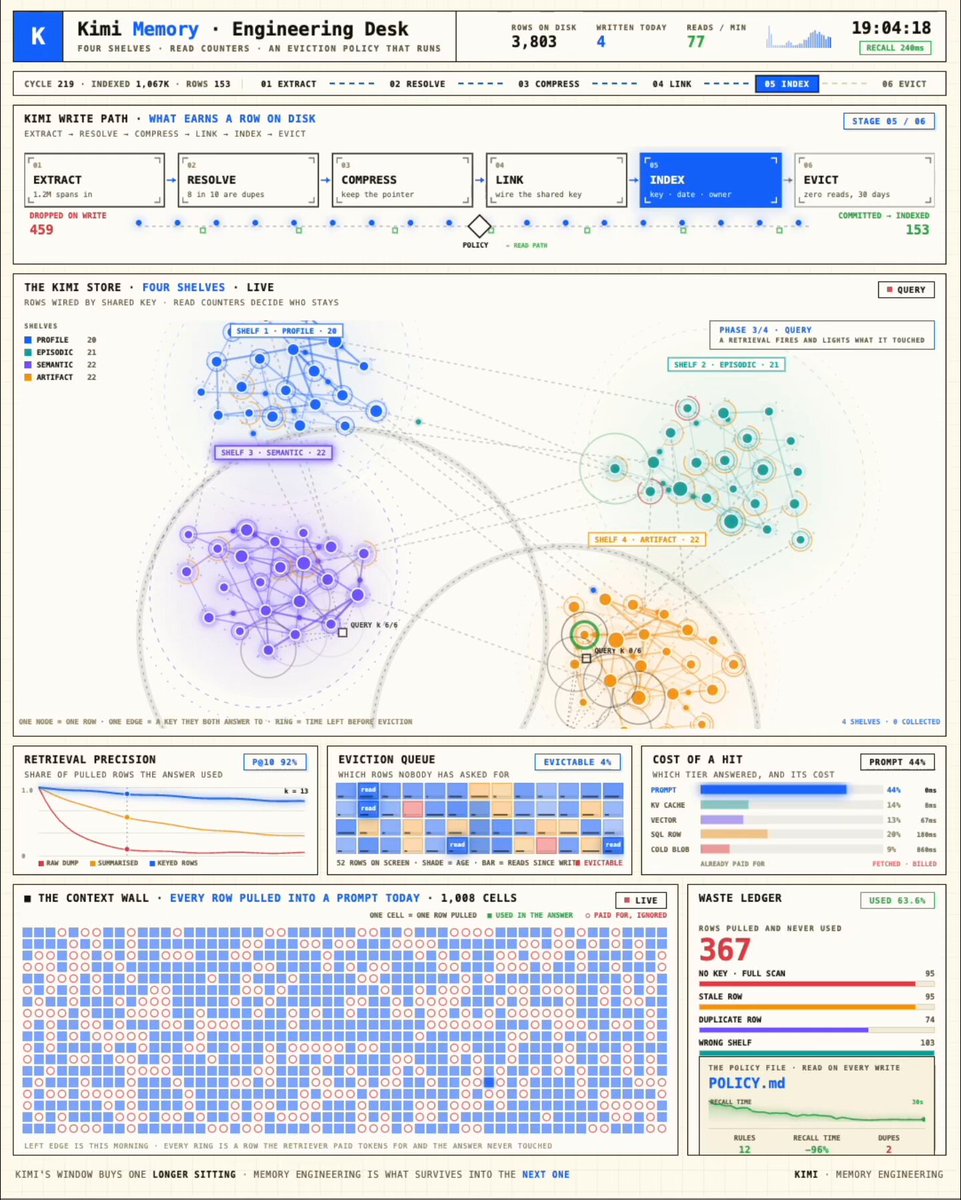
A FORMER GOOGLE LEAD BUILT A MEMORY SYSTEM THAT NEVER LOSES A SINGLE DETAIL Most agents forget everything the moment a session ends, starting from zero every single time. He built a scoring layer instead, one that decides what actually matters past this session and what gets dropped. Contradictions...

26,649 görüntüleme • 9 gün önce •via X (Twitter)

0 Yorum

Yorum bulunmuyor

Orijinal gönderinin yorumları burada görünecek

Benzer Videolar

New short course: LLMs as Operating Systems: Agent Memory, created with Letta, and taught by its founders Charles Packer and Sarah Wooders. An LLM's input context window has limited space. Using a longer input context also costs more and results in slower processing. So, managing what's stored in this context window is important. In the innovative paper MemGPT: Towards LLMs as Operating Systems, its authors (which include the instructors) proposed using an LLM agent to manage this context window. Their system uses a large persistent memory that stores everything that could be included in the input context, and an agent decides what is actually included. Take the example of building a chatbot that needs to remember what's been said earlier in a conversation (perhaps over many days of interaction with a user). As the conversation's length grows, the memory management agent will move information from the input context to a persistent searchable database; summarize information to keep relevant facts in the input context; and restore relevant conversation elements from further back in time. This allows a chatbot to keep what's currently most relevant in its input context memory to generate the next response. When I read the original MemGPT paper, I thought it was an innovative technique for handling memory for LLMs. The open-source Letta framework, which we'll use in this course, makes MemGPT easy to implement. It adds memory to your LLM agents and gives them transparent long-term memory. In detail, you’ll learn: - How to build an agent that can edit its own limited input context memory, using tools and multi-step reasoning - What is a memory hierarchy (an idea from computer operating systems, which use a cache to speed up memory access), and how these ideas apply to managing the LLM input context (where the input context window is a "cache" storing the most relevant information; and an agent decides what to move in and out of this to/from a larger persistent storage system) - How to implement multi-agent collaboration by letting different agents share blocks of memory This course will give you a sophisticated understanding of memory management for LLMs, which is important for chatbots having long conversations, and for complex agentic workflows. Please sign up here!

Andrew Ng

200,950 görüntüleme • 1 yıl önce

context engineering vs graph engineering. every few months the list gets a new word and everyone treats it as a replacement for the last one. these two are not on the same list. one decides what the model sees this turn, the other decides what exists at all. the cleanest way to tell them apart is to ask what a single unit of work looks like. > context engineering is the window the window opens empty, every single time. you assemble what goes in it. the prompt, the docs, the history, the tool results. the assembling is the work. the window only grows. it never shrinks on its own, so eventually something gets dropped. usually from the middle. usually without telling you. then the turn ends and the window is thrown away. not archived, thrown away. the next turn opens empty again and you re-explain what you already explained. good context engineering is knowing what to leave out, not what to pack in. the unit of work is one window. > graph engineering is the structure the same material arrives from the same sources. instead of packing it into a window, you pull entities out of it, resolve the duplicates into one node, and write typed edges between them. nothing here is stored as text you hope to find again. it is stored as a thing with a name and its connections to other things. when the turn ends, the graph is still there. the next turn does not start from zero. it starts by querying what already exists, and the query walks edges instead of guessing at similarity. good graph engineering is deciding what counts as the same thing twice. the unit of work is one relationship. > they are not alternatives the graph is what refills the window. context engineering decides what fits. graph engineering decides what there is to choose from. remove the graph and every session starts blind. remove the context work and the best structure in the world arrives as an unreadable dump. that also tells you which one broke. the answer drifted from what you actually said, or forgot something from this same session. that is the window. the answer is coherent but invents a connection that does not exist, or cannot join two facts it has clearly seen. that is the structure. people debug the prompt because the prompt is the easiest thing to edit. it keeps taking the blame for failures that live a layer down. save this - then read the full breakdown below

Hanako

19,160 görüntüleme • 16 gün önce

A DEVELOPER CONNECTED CLAUDE CODE TO OBSIDIAN SO HIS AI AGENT WOULD STOP FORGETTING THE PROJECT EVERY MORNING. Every coding session used to start the same way. Claude would understand the repo, fix the bug, explain the architecture, and then the moment the session ended, all of that context disappeared. Same codebase. Same decisions. Same architecture. Same mistakes repeated again. So he added a memory layer. Instead of treating Claude Code like a smart terminal, he connected it to a local Obsidian vault through MCP. Now Claude can read the repo, open the vault, create notes, link concepts, and write important decisions back into the system. When it studies the codebase, it does not just answer once and forget. It creates notes for the major services, maps how the architecture works, links auth to the database, connects APIs to storage, and records why certain migrations or design choices exist. Obsidian becomes the project graph. Now when he asks why something was built a certain way, Claude does not guess from the current prompt. It reads the decision notes. When he starts a new branch, Claude checks the active context file. When the work is done, it updates what changed, what is blocked, and what the next agent needs to know before touching the repo. That is the real loop: read context, write code, capture decisions, update memory. Most people are still using AI coding tools like disposable chat windows. Ask, patch, close, forget. This setup turns Claude Code into infrastructure. The repo gets a memory layer that survives every session, and multiple AI agents can work from the same project map without stepping on each other. The unlock is not better prompting. The unlock is giving the agent somewhere to remember what it already learned.

DegenCalls

20,124 görüntüleme • 1 ay önce

Jensen Huang told a room of global investors that AI is not one industry. It is five stacked on top of each other. Most people are investing in layer four and ignoring layers one through three entirely. He called it the five-layer cake. Layer one is energy. Jensen said this is the single greatest opportunity for the energy industry in a hundred years. The first time in a century that the grid in most countries can actually attract serious capital. Nuclear, solar, wind, hydrogen, it does not matter what form. If it produces energy, it gets funded. Siemens, GE Vernova, Mitsubishi. That is why they are all doing so well right now. Layer two is chips, computers, networking, and silicon photonics. Everything that processes the intelligence. Layer three is infrastructure. Land, power, buildings, data center operations. Every single one in short supply today. Layer four is the model layer. OpenAI, Anthropic. The layer everyone talks about. Layer five is applications. Every startup applying AI to financial services, legal, healthcare, logistics, transportation. Last year alone, a hundred billion dollars of venture capital went into this layer. The single largest VC year in the history of humanity. Then he said the number that stopped me cold. We are putting one trillion dollars into this five-layer cake this year. That sounds enormous. Jensen thinks the AI industry will eventually run at twenty trillion dollars per year. We are one trillion in of a twenty trillion dollar per year ecosystem. Most people watching AI are staring at layer four. Jensen was describing layers one through five as a single compounding system where every layer feeds the one above it. The people who understand that will invest differently than the people who do not.

Ihtesham Ali

97,887 görüntüleme • 2 ay önce

so I've been running exactly 8 AI agents on discord for a while now. coordination works great, they split tasks, hand off work, deliver results in parallel etc.. but there are problems I keep hitting that no amount of prompt engineering could fix agents don't learn from each other. Scout finds something useful but Luna has no idea. they work in the same server but knowledge stays locked in silos.. there's no quality filter on what gets saved, and good insights sit next to outdated garbage in the same memory files that I manually clean up.. and when an agent makes a mistake I write it down in the rules discord channel ,core memory file and hope it reads it next time. theres no self-correction, no automatic pattern recognition so of course no learning loops.. the coordination layer is solved. agents can work together. but the intelligence layer is still missing. agents that actually remember, learn from each other, filter noise, and get smarter every run. saw Spark building something like this with around 166 agents sharing a collective persistent knowledge across sessions, so agents learn from other agents and get smarter over time they even have noise filtering and self correcting loops built in, so the knowledge actually compounds instead of rotting.. super interesting stuff.. here where you think Spark could be a good coordinator for your stack of agent swarm. I think the intelligence layer is the bottleneck because it requires collectivity.. no single agent can solve it alone.. the whole network has to evolve together. this isn't going to stay niche, the moment agent coordination becomes standard, everyone is going to hit the same wall I hit.. agents that work but don't learn, coordinate but don't evolve... the intelligence layer becomes the only thing that separates a useful system from a dumb one. right now most people are still figuring out how to run one agent. by the time they get to multi-agent setups, collective intelligence won't be optional, it will be the baseline. we're early and the gap between agents that coordinate and agents that evolve together is the next phase. step one is done. ------ left: agents that coordinate but don’t learn right: the intelligence layer.. agents that evolve together within the same system.

JUMPERZ

34,181 görüntüleme • 6 ay önce