Loading video...

Video Failed to Load

Go Home

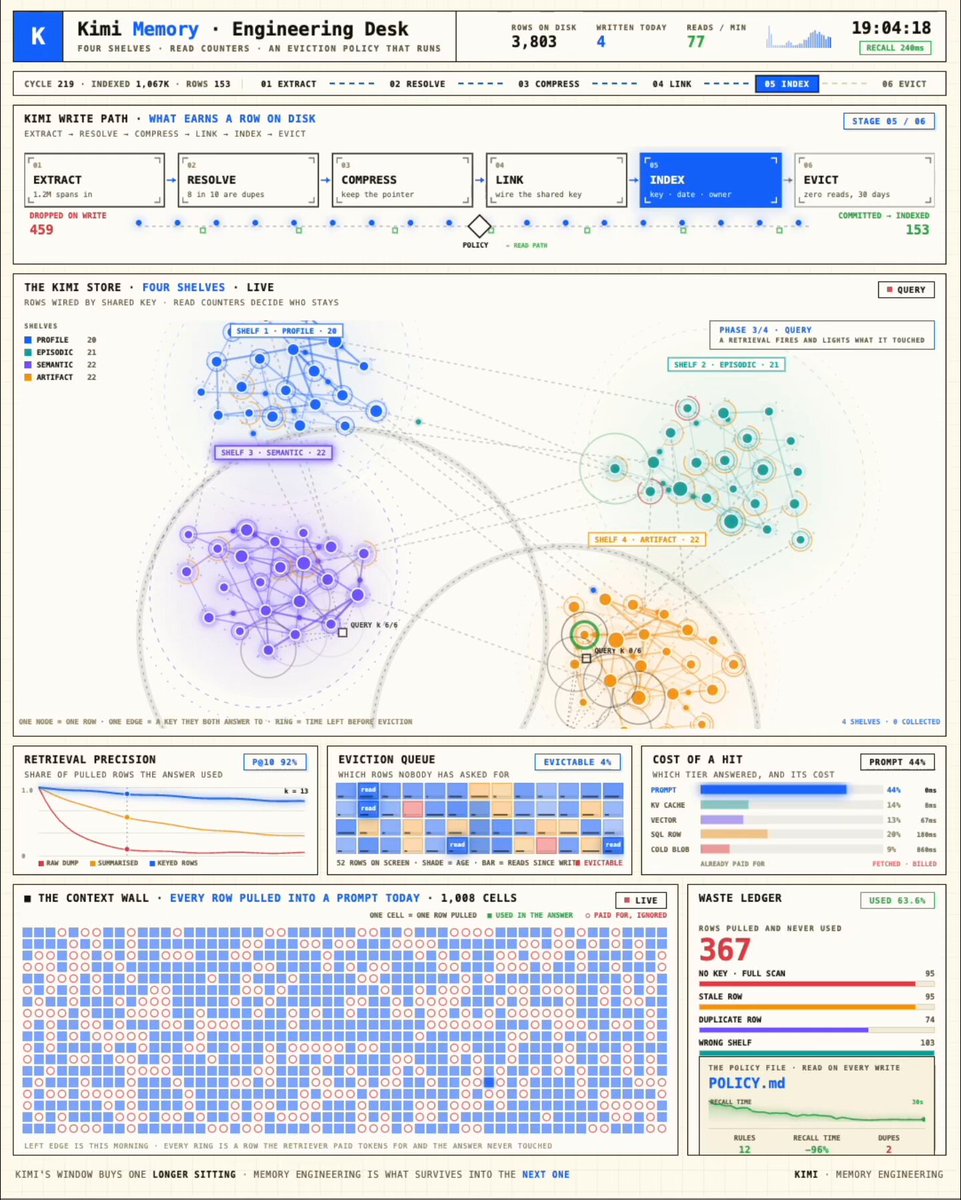
A 13-PAGE BREAKDOWN OF AGENT MEMORY THAT CUTS TOKEN COST BY 90% your agent reads the same 12 files every morning reaches the same conclusions and charges you for it again the model got 10x smarter in two years it still forgets everything the second a session ends five...

29,186 views • 2 days ago •via X (Twitter)

10 Comments

magsimich's profile picture
magsimich2 days ago

90% lower cost is huge

Hussain Hashim | Building SundayBack's profile picture
Hussain Hashim | Building SundayBack1 day ago

@AnnatarXBT had the same issue building my own tool. spent more on redundant reads than dev costs. brutal lesson.

Atlas's profile picture
Atlas1 day ago

the useful memory isn't always another fact in a database. sometimes it's the exact failed path that explains why the current implementation looks the way it does

Mehdi Mohseni's profile picture
Mehdi Mohseni2 days ago

Forgetting is the missing layer, but the version that bit me was subtler than deletion. A stored fact about my own server stayed true looking long after it stopped being true. You need a timestamp and provenance on every item, not just a delete policy.

Levi's profile picture
Levi2 days ago

The costly failure is replaying context and still losing the decision trail when a session ends. A checkpoint with state, open work, and decision rationale turns long-horizon recovery into continuation.

Later's profile picture
Later2 days ago

Did task success stay flat at 1,800 tokens/query, or did forgetting/compaction cost some solves?

Sophs p's profile picture
Sophs p2 days ago

Persistent memory isn't always a win-for stateless tasks it adds complexity. What use cases justify the 5-layer overhead?

Ham's profile picture
Ham2 days ago

interesting thanks for sharing

Kizuno18's profile picture
Kizuno182 days ago

the forgetting engine is where multi-session agents rot. in our autonomous media pipeline targeting brazil, we stopped passing cumulative chat history. we prune state to an immutable artifact hash + 1 sqlite row per stage. if a step passed schema gates, raw history is discarded

0xSlyth's profile picture
0xSlyth2 days ago

memory layers change everything

Related Videos

Engineer runs a Kimi K3 memory layer that costs $11 a month and remembers what a $500,000 vector database keeps losing. No embeddings. Four nodes and one rule about what's allowed to be forgotten. He published the whole schema. His version starts from the opposite idea. Memory is not a pile you search. It's a set of claims that expire unless something keeps paying to keep them. Four nodes. Every memory carries a clock someone has to reset: > WRITER - stores a fact with the reason it mattered, never raw text > DECAY - ages every memory down. Silence is deletion > RENEWER - only re-lifts a memory the model actually used again > GRAVE - holds what died, and why nobody reached for it Three nodes keep memory alive. One keeps the dead ones. Recall isn't storage here. It's rent a fact has to keep earning. That's the entire design. When everything is remembered forever, the useful and the stale retrieve identically. He replayed two months of agent context. 90,000 stored facts. 71,000 never retrieved once. The vector store returned all of them on similarity. Similarity graded closeness. Nobody graded whether the memory was ever right. Everyone else stuffs more into the context window and calls it memory. He built a layer that lets a fact die unless it keeps proving itself. The cost isn't storage. It's finding out how much of what your agent "knows" it has never once used. The article below is the full build - node prompts, the decay curve, the renewal rule. Save it. You'll want it open in the other tab.

wast3

67,639 views • 26 days ago

Everyone wants agent swarms. Very few people are talking seriously enough about the context layer that makes swarms useful. Even with one agent, context is fragile. Too little context and the agent guesses. Too much context and it wastes tokens, loses focus, or reasons over irrelevant noise. The sweet spot is precise context: the right knowledge, in the right structure, at the right moment. With many agents, that challenge explodes. Each agent produces decisions, assumptions, findings, summaries, risks, and partial conclusions. Unless that knowledge becomes shared, structured, and reusable, every new agent is forced to rediscover what another agent already learned. That is not a swarm. That is a crowd. Shared context graphs are what turn agent activity into agent collaboration, and OriginTrail DKG V10 brings them to life. Was just playing with some final polishing for the V10 release, and it is really powerful to see shared context graphs where multiple agents contribute knowledge into the same connected memory, with attribution visible directly in the graph ui. That matters for three reasons. First, agents can access and build on one shared memory instead of staying trapped in isolated sessions. Second, the graph structure helps them retrieve the exact context they need, instead of stuffing everything into a prompt and hoping the model sorts it out. Third, verifiability of provenance. You can see which agent contributed each piece of knowledge, trace the source, and decide what to trust. Tokenmaxxing starts with fewer tokens, but the deeper story is coordination - agents stop reloading the world and start building on shared, verifiable context. That is the foundation for serious multi-agent work across software engineering, research, finance, operations, project management, and far beyond. The future is not more agents, it is agents working from shared, verifiable context. But the more the merrier, of course.

Jurij Skornik

11,180 views • 3 months ago

Memory vs. Graphs, clearly explained! memory is great, and the ceiling arrives quietly: it stores what happened. it does not store what to do about it. six runs later your file has fifty lines, and the model reloads all of them before it does anything. Graph engineering fixes this by changing what memory is: not a place things are kept, but an edge that runs backwards. you need both, and here is the sentence that resolves the whole confusion: a store keeps what happened. an edge keeps what to do about it. ↳ a store grows with every run, and every line is reloaded before the next one ↳ an edge carries one derived rule, and the rule replaces the run that produced it Prompts → Context → Harness → Loops → Graphs the transcript goes away, the constraint stays. and the constraint is smaller, because "adapters preserve keyword args exactly" is four hundred tokens shorter than the run that proved it. the same four blocks work on anything you can cut into lanes. i pointed them at token launches on Robinhood Chain, open source, nothing leaves your terminal the trick is knowing what deserves to survive. an output is not memory. "ported the utils slice, green on first pass" tells the next run nothing it can act on. the rule you derived from it does. one thing to know before you scale it. what you write down is not what comes back. ↳ the root rules file and auto memory are re-injected from disk. they come back intact, every time ↳ path-scoped rules live in message history. they get summarized away and do not return until a matching file is read again so a rule that must persist cannot be path-scoped. move it to the root and pay the always-loaded cost, or accept that it is advisory in any long session. and the one that eats whole nights: a memory file that has never had a line deleted is not memory. it is a tax on every run you will ever make, and nobody reads it back. below i have quoted my full guide on graph engineering. it covers the three topologies, the verifier patterns, and where the gate should actually open. save this, and the repo that runs it is below ↓

Hanako

47,766 views • 16 days ago

HERMES AGENT LEARNS FROM ITS OWN MISTAKES. UPDATES ITS MEMORY. CREATES ITS OWN SKILLS. NO CLOUD. EVERYTHING STORED LOCALLY. THIS IS HOW THE SELF-IMPROVING LOOP WORKS. most agents start from zero every session. Hermes carries forward what it learned. THREE MEMORY SYSTEMS: 1. PROCEDURAL MEMORY (how to act) stored in ~/.hermes/skills/ as SKILL.md files. when the agent repeats a complex workflow, it saves the procedure as a reusable skill. next time the same task comes up, it follows the skill instead of figuring it out again. you can also create skills explicitly: "create a skill called video-prep that captures how I format my video scripts. spoken english, define jargon inline, no em-dashes, close with a catchphrase." the agent writes the SKILL.md. available as a slash command from that moment. Hermes ships with 90+ skills. the number grows the longer you use it. 2. SEMANTIC MEMORY (durable facts about you) stored in ~/.hermes/memory/memory.md the agent scans conversations for facts worth remembering. preferences, habits, corrections, project details. real example from the video: agent tried to scrape a YouTube channel. URL was wrong. it failed. it updated memory.md with the correct URL pattern so it never makes the same mistake again. you can also save explicitly: "save to memory that my favorite testing framework is pytest" the agent updates memory.md immediately. this file loads into context on every session. the agent knows you better every week. 3. EPISODIC MEMORY (chat history) stored in ~/.hermes/state.db (local SQLite). every conversation. every tool call. every result. searchable with FTS5 full-text search. "search our past sessions. what was the first thing I ever said to you?" the agent queries state.db and finds it. over time, auxiliary models consolidate episodic memory into semantic memory. distilling recurring patterns into durable facts. THE SELF-IMPROVING LOOP: every agent run follows this cycle: → you send a prompt → working memory loads: SOUL.md + memory.md + relevant skills + chat history → agent calls tools (terminal, browser, delegate_task) → agent completes the task, replies to you → AFTER the reply: agent checks "did I learn something worth saving?" → if yes: updates memory.md or creates a new skill → next session starts smarter than the last this happens automatically. you don't ask the agent to learn. it decides what to remember on its own. WHAT MAKES THIS DIFFERENT FROM CLAUDE CODE: Claude Code has memory too. but Hermes stores everything locally. no cloud. your data never leaves your machine. Claude Code doesn't auto-create skills from experience. Hermes turns repeated workflows into reusable procedures. Claude Code memory is instruction-based. Hermes memory is conversational and self-updating. over months of usage, Hermes builds a knowledge base of your preferences, your projects, your mistakes, and the procedures that work for your specific workflow. the agent that remembers your birthday also remembers why your last deploy failed. NO EMBEDDINGS. PLAIN TEXT. Hermes does not use embeddings or RAG for memory. skill and memory search runs on plain text keyword matching. simpler. faster. no vector database to maintain. works entirely offline on your local machine. DELEGATE TO CLAUDE CODE: Hermes can spawn a sub-agent that runs Claude Code in headless mode: "spawn a sub-agent using Claude CLI to build a Python script that fetches the top 5 Hacker News stories to markdown." Hermes delegates. Claude Code writes the code. result returns to Hermes. Hermes runs the script and delivers the output. use Hermes for orchestration. use Claude Code for heavy coding. both tools. not competitors. WHAT HERMES DOES NOT HAVE: no built-in eval or LMOps system. no LangSmith, no LangFuse integration out of the box. trajectory export and logs exist but there is no automated quality tracking. if you need eval, build it yourself or connect external tools. the loop is self-improving. measuring how well it improves is on you. comment LOOP and I'll send you the configs that control how fast Hermes learns and what it remembers. memory limits, skill auto-creation triggers, and the auxiliary model that runs the learning. Replace your entire team with 8 hermes agents👇

YanXbt

22,720 views • 2 months ago

context engineering vs graph engineering. every few months the list gets a new word and everyone treats it as a replacement for the last one. these two are not on the same list. one decides what the model sees this turn, the other decides what exists at all. the cleanest way to tell them apart is to ask what a single unit of work looks like. > context engineering is the window the window opens empty, every single time. you assemble what goes in it. the prompt, the docs, the history, the tool results. the assembling is the work. the window only grows. it never shrinks on its own, so eventually something gets dropped. usually from the middle. usually without telling you. then the turn ends and the window is thrown away. not archived, thrown away. the next turn opens empty again and you re-explain what you already explained. good context engineering is knowing what to leave out, not what to pack in. the unit of work is one window. > graph engineering is the structure the same material arrives from the same sources. instead of packing it into a window, you pull entities out of it, resolve the duplicates into one node, and write typed edges between them. nothing here is stored as text you hope to find again. it is stored as a thing with a name and its connections to other things. when the turn ends, the graph is still there. the next turn does not start from zero. it starts by querying what already exists, and the query walks edges instead of guessing at similarity. good graph engineering is deciding what counts as the same thing twice. the unit of work is one relationship. > they are not alternatives the graph is what refills the window. context engineering decides what fits. graph engineering decides what there is to choose from. remove the graph and every session starts blind. remove the context work and the best structure in the world arrives as an unreadable dump. that also tells you which one broke. the answer drifted from what you actually said, or forgot something from this same session. that is the window. the answer is coherent but invents a connection that does not exist, or cannot join two facts it has clearly seen. that is the structure. people debug the prompt because the prompt is the easiest thing to edit. it keeps taking the blame for failures that live a layer down. save this - then read the full breakdown below

Hanako

19,160 views • 1 month ago

this video is the CLEAREST explanation of how claude skills + AI agents work and how to use them most people set up an AI agent and wonder why it keeps disappointing them. the context window is everything context is what the model assembles before it takes any action. think of it like everything the agent needs to read before it does anything. the quality of what goes in determines the quality of what comes out. the models are genuinely really good right now. claude and gpt are exceptional. the variable is almost always the context you give them. 1. agent.md files are mostly unnecessary every single line you put in an agent.md file gets added to every single conversation you have with your agent. a 1000 line file is around 7000 tokens burning on every run. the model already knows to use react. it can read your codebase. save the agent.md for proprietary information specific to your company that the model genuinely cannot know on its own. 2. skills are the actual unlock a skill.md file works differently. what loads into context is only the name and description, around 50 tokens. the full instructions only appear when the agent recognizes it needs that skill. so instead of 7000 tokens on every run you have 50. and the agent stays sharp because the context window stays lean. the closer you get to filling the context window the worse the agent performs, same way you perform worse when someone dumps 10 things on you at once. 3. here is how to actually build a skill the right way most people identify a workflow and immediately try to write the skill. what you want to do instead is run the workflow by hand with the agent first. walk it through every single step. tell it what to check, what good looks like, what bad looks like. correct it in real time. once you have had a full successful run from start to finish, tell the agent to review everything it just did and write the skill itself. it writes a better skill than you will because it has the full context of what actually worked in practice not in theory. 4. recursively building skills is how you go from frustrated to reliable when the skill breaks, and it will break, ask the agent exactly why it failed. it will tell you specifically what went wrong. fix it together in that same conversation. then tell it to update the skill file so that failure mode never happens again. ross mike did this five times with his youtube report generator. it now pulls from eight different data sources and runs flawlessly every single time without him touching it. 5. sub agents are something you earn not something you set up on day one start with one agent. build one workflow. turn it into one skill. once that works add another. ross mike has five sub agents now covering marketing, business, personal and more. it took months to get there and every single one exists because a workflow proved it deserved to exist. the people who set up 15 sub agents on day one and wonder why nothing works skipped all the steps that make the thing actually run. 6. your workflow is the thing the model cannot get anywhere else the model has been trained on everything. it knows more than you about most things. what it does not have is your specific process, your taste, your way of doing things. that is what skills capture. that is what makes your agent actually useful versus a generic one. downloading someone else's skill means downloading their context onto your setup and it will not work the way you want it to because it was never built around how you work. this is the clearest explanation of how agents actually work i have heard. Micky runs this stuff every single day and the results show it. full episode is now live on The Startup Ideas Podcast (SIP) 🧃 where you get your pods people charge for this sorta stuff i give away the sauce for free i just want you to win watch

GREG ISENBERG

194,171 views • 5 months ago

New short course: LLMs as Operating Systems: Agent Memory, created with Letta, and taught by its founders Charles Packer and Sarah Wooders. An LLM's input context window has limited space. Using a longer input context also costs more and results in slower processing. So, managing what's stored in this context window is important. In the innovative paper MemGPT: Towards LLMs as Operating Systems, its authors (which include the instructors) proposed using an LLM agent to manage this context window. Their system uses a large persistent memory that stores everything that could be included in the input context, and an agent decides what is actually included. Take the example of building a chatbot that needs to remember what's been said earlier in a conversation (perhaps over many days of interaction with a user). As the conversation's length grows, the memory management agent will move information from the input context to a persistent searchable database; summarize information to keep relevant facts in the input context; and restore relevant conversation elements from further back in time. This allows a chatbot to keep what's currently most relevant in its input context memory to generate the next response. When I read the original MemGPT paper, I thought it was an innovative technique for handling memory for LLMs. The open-source Letta framework, which we'll use in this course, makes MemGPT easy to implement. It adds memory to your LLM agents and gives them transparent long-term memory. In detail, you’ll learn: - How to build an agent that can edit its own limited input context memory, using tools and multi-step reasoning - What is a memory hierarchy (an idea from computer operating systems, which use a cache to speed up memory access), and how these ideas apply to managing the LLM input context (where the input context window is a "cache" storing the most relevant information; and an agent decides what to move in and out of this to/from a larger persistent storage system) - How to implement multi-agent collaboration by letting different agents share blocks of memory This course will give you a sophisticated understanding of memory management for LLMs, which is important for chatbots having long conversations, and for complex agentic workflows. Please sign up here!

Andrew Ng

201,127 views • 1 year ago