Loading video...

Video Failed to Load

Go Home

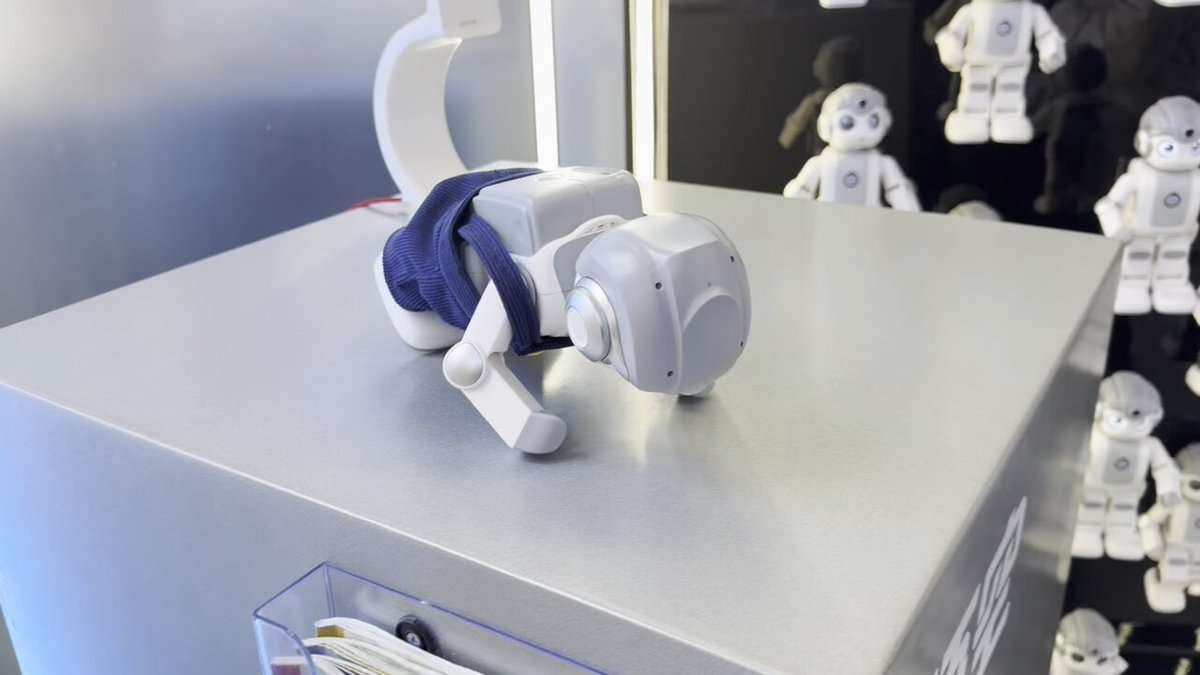
A humanoid labeled Dragongwing IQ10 went down on stage and needed human intervention before the presentation could continue. That failure is useful. Balance recovery nnee torque floor contact restart behavior. These are the details that decide whether humanoids can work outside a booth. #HumanoidRobot #Robotics #PhysicalAI #AIRobotics

18,539 views • 2 months ago •via X (Twitter)

0 Comments

No comments available

Comments from the original post will appear here

Related Videos

I spent a month in Shenzhen visiting factories and robotics companies, and the contrast with the U.S. was striking. While Figure and Boston Dynamics hide their humanoids behind closed doors, Chinese companies have massive showrooms open to the public. But what really stood out wasn't just the transparency, it was how good they are at selling. Take UBTech: they've already sold 1,200 humanoid units at $200k each to factories. And here's the kicker, these robots aren't even that useful yet. They can only pick up and drop boxes at 1/10th the speed of a human, and factories still need to hire system integrators to train them for specific tasks. My theory is that these factories are terrified of getting left behind in the robotics/AI wave. They're investing in new tech not because it's ready, but because they can't afford to wait. The second surprise was the breadth of their robotics portfolio. These companies aren't just building humanoids, they're deploying service robots everywhere: restaurants, hotels, apartments. Consumer robots are cleaning houses, pools, pet waste, dishes. They're covering the entire spectrum. But the education piece shocked me most. I picked up what I thought was a high school or college robotics textbook, it was for primary school. The government mandated AI and robotics education starting in elementary school. Almost every single school in China now has AI and robotics curriculum, complete with education robots so kids can learn by building. They're creating a generation that grows up fluent in robotics and AI. China owns the supply chain and the hardware stack. But here's what I think people are missing: the race isn't just about who can build robots faster or cheaper. The U.S. advantage has always been in the layer between hardware and human, the interaction design, the software intelligence, the intuitive interfaces that make complex technology feel natural. China is building the physical infrastructure, but they're also learning fast. Every deployed service robot, every classroom full of kids building with education kits, every factory running humanoids, that's all data collection at scale. The window for the U.S. to establish its wedge is narrowing. It's not enough to be better at AI or software anymore. We need to be building the integration layer, the intelligence that makes physical AI actually useful, not just impressive in a showroom. Because right now, China isn't just manufacturing robots. They're manufacturing a robotics-native culture, and that might be the most defensible moat of all.

Miyu Horiuchi

90,718 views • 6 months ago

Figure 03 just finished an 8-hour work livestream, imperfect, but already good enough to replace a lot of repetitive warehouse labor. 🤖 Brett Adcock put a team of F.03 robots on a factory-style package sorting task for a full shift. The job was simple and brutal: detect the barcode, pick the package, flip it label-side down, place it on the conveyor, repeat. Soft poly bags, rigid boxes, moving belts, messy orientations. That is exactly the kind of boring physical work factories pay humans to do all day. Early in the stream, the system handled 230 packages in 10 minutes. That is roughly 2.6 seconds per item — already in human-speed territory for this narrow workflow. The more important part: it was not one robot pretending to work all day. It was a team of Figure 03 robots keeping the line running. When one robot ran low on battery, it left the station and another robot stepped in. That is the real factory signal: not just autonomy, but shift continuity. F.03 is rated for about 5 hours of runtime, so the 8-hour result depends on fleet orchestration, charging, and handoff. That matters more than a single clean demo. The stream was not perfect. There were pauses, hesitations, missed orientations, and small recovery moments. Good. A perfect short clip hides failure. An 8-hour livestream exposes the parts that actually matter: endurance, recovery, throughput, and whether the robot can stay useful after the novelty wears off. Figure says this was fully autonomous on Helix-02, with zero human intervention. For logistics and manufacturing, that is the threshold worth watching. Not “can it do one impressive task?” Can it keep doing the boring task for an entire shift? Figure is not showing a general human replacement yet. But for structured, repetitive factory work, the gap just got much smaller. The timing is also interesting: Figure says BotQ has already delivered 350+ F.03 units and reached a 1 robot/hour production cadence. And F.04 is now in full design lock, with parts starting to ship. The next test is obvious. 8 hours was the proof of endurance. 24/7 is the proof of labor economics.

RoboHub🤖

16,818 views • 3 months ago

𝗥𝗼𝗯𝗼𝘁𝘀 𝗱𝗼𝗻’𝘁 𝗻𝗲𝗲𝗱 𝗺𝗼𝗿𝗲 𝗱𝗲𝗺𝗼𝗻𝘀𝘁𝗿𝗮𝘁𝗶𝗼𝗻𝘀. 𝗧𝗵𝗲𝘆 𝗻𝗲𝗲𝗱 𝘁𝗼 𝗹𝗲𝗮𝗿𝗻 𝗳𝗿𝗼𝗺 𝗳𝗮𝗶𝗹𝘂𝗿𝗲 — 𝗮𝗳𝘁𝗲𝗿 𝘄𝗮𝘁𝗰𝗵𝗶𝗻𝗴 𝗵𝘂𝗺𝗮𝗻𝘀. Most robot learning systems assume failure is the end of learning. In our new work, we study whether robots can improve after deployment by learning from their own failures, without any human intervention, teleoperation, or corrective labels. The key idea is simple: human videos contain structure about how the world works. We use them to learn cross-embodiment representations of action, dynamics, and value, enabling a shared predictive space between human behavior and robot experience. This allows a new learning loop: 👉 pretrain on human videos 👉 deploy robot policy 👉 observe failures 👉 reinterpret failures using human priors 👉 improve autonomously We evaluate this across 7 real-world manipulation tasks, showing: 📈 40% → 81% success rate 🏆 Strong improvements over π0.6 RECAP and RISE ✔️ Zero human intervention during post-deployment improvement 🧬 Generalizes across robot embodiments and policy backbones A key finding is that explicit failure repair significantly outperforms failure reweighting, yielding substantially larger gains under identical data conditions (+25 pts vs +5 pts on the same π0.5 base policy). Overall, the results suggest a shift in how we think about robot learning: Human videos are not only for pretraining policies. They can provide the structure needed for continual self-improvement after deployment. 📄 Paper: 🌐 Project: I am grateful for working with the fantastic leads Hanzhi Chen and Anran Zhang, and our collaborators Simon Schaefer, Kejia Chen, Shi Chen, Daniel Cremers. Special thanks to Stefan Leutenegger for co-advising this project with me. ETH Zürich TU München Microsoft Check out Hanzhi's 🧵 for more details

Oier Mees

12,277 views • 1 month ago

Trump has agreed to debate Harris on September 4th on Fox. There was no mention of RFK Jr. It’s critical whether you’re a Republican, Democrat, RFK, or other third party voter, that we advocate for RFK to be on that stage. A heavy majority of Americans agree that RFK should have a spot in the debate. 7/10 Americans wanted him on the stage during the last debate, that number is no doubt equal or larger this debate. After the disastrous first debate with Trump/Biden on CNN, it is hard to argue that if RFK were on the stage that day that he could have had a chance to be polling at levels near Trump/Harris currently. It does not mean that he would be, but 100% a rational conclusion that he could be. Americans need someone on the stage to ask difficult questions that the moderators are unwilling to bring up because of the unwritten rules of hosting presidential debates. If it is a debate only between Trump/Harris, Trump will spew his talking points about Harris’s disastrous past in politics, and Harris will spew her talking points of Trump being a racist and threat to Democracy. In reality Americans don’t want to hear these talking points anymore, we already get it at nausea everyday through social media. What America truly deserves is a presidential debate where Trump, Harris, RFK, Stein, West, and Oliver are on the stage but it’s a sad truth that at first we just need to fight to try and get a third candidate on the stage before 6.

End Tribalism in Politics

60,444 views • 2 years ago

This work makes a humanoid robot do simple parkour moves by looking with a depth camera and choosing the right move on the fly. The big deal is that it turns lots of small human moves into long, real-time robot behavior, without hand-coding every transition or retraining for each new course. A humanoid robot is usually good at steady walking, but it often fails when it has to do fast moves like jumping up, vaulting, or rolling, and then keep going to the next obstacle. The hard part is that you cannot easily collect training data for every possible obstacle shape, distance, and mistake, so robots end up learning a few moves that only work in a narrow setup. This work starts from short clips of real human parkour moves, like stepping over, vaulting, climbing, and rolling. It uses motion matching, which is basically a smart “pick the next clip that fits best right now” search, to stitch those short clips into a long, smooth plan that looks like a human doing a whole course. Then it trains a controller with reinforcement learning (RL), which means the robot learns by trial and error to copy that plan while staying balanced and not falling. After training separate expert controllers for different moves, it compresses them into 1 controller that uses only onboard depth sensing and a simple “go this fast in this direction” command. In real tests on a Unitree G1 humanoid, it can clear multiple obstacles in a row, adapt when obstacles get moved, and climb a wall up to 1.25m.

Rohan Paul

37,121 views • 5 months ago