Video yükleniyor...

Video Yüklenemedi

Ana Sayfaya Dön

A LINUX KERNEL DEVELOPER PROVED THE THING YOU PUSH CODE TO IS SECRETLY A DATABASE THAT CAN VERSION ALMOST ANYTHING AND THAT MOST DEVS HAVE ONLY EVER TOUCHED A TENTH OF IT 42 minutes from Josh Triplett -- a longtime Linux kernel and Debian developer -- showing that Git...

376,043 görüntüleme • 4 gün önce •via X (Twitter)

0 Yorum

Yorum bulunmuyor

Orijinal gönderinin yorumları burada görünecek

Benzer Videolar

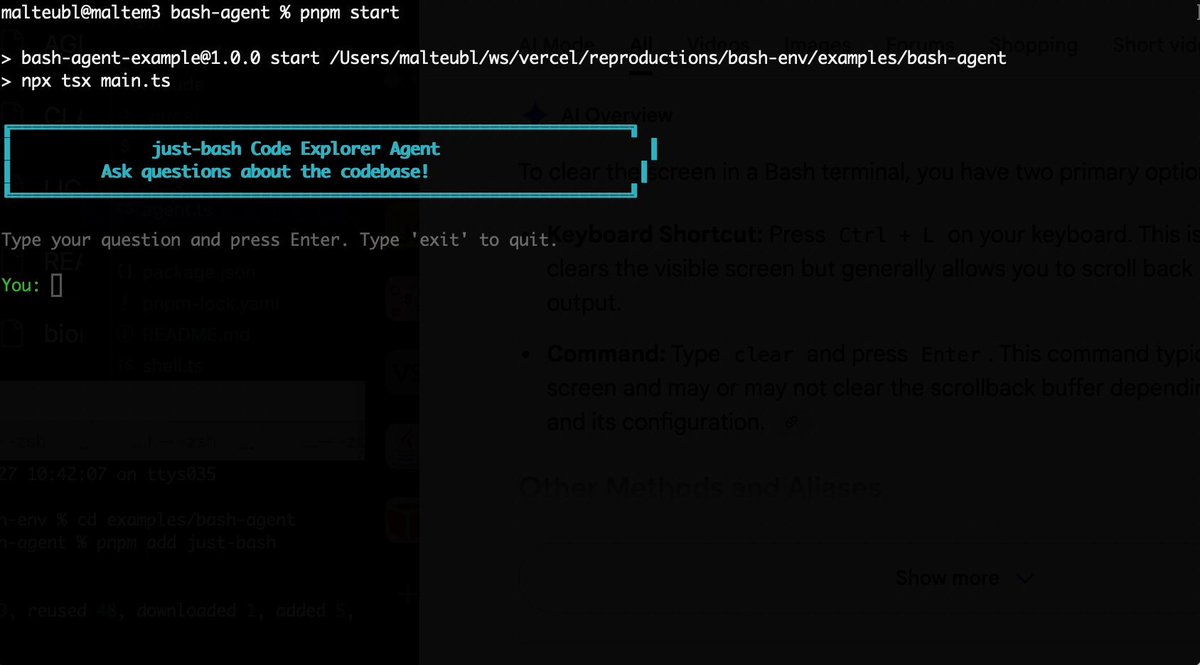
Bash is all you need! Which is why I'm introducing my holiday project: just-bash just-bash is a pretty complete implementation of bash in TypeScript designed to be used as a bash tool by AI agents. Because it turns out agents love exploring data via shell scripts, even beyond coding. It comes with grep, sed, awk and the 99th percentile features that an agent like Claude Code or Cursor would use. In fact, Claude Code can use it for secure bash execution. In the package - A bash-tool for AI SDK - A binary for use by yourself or your coding agents - An overlay filesystem to feed files to your agent securely - A Vercel Sandbox compatible API, so you can quickly upgrade to a real VM if you need to run binaries - An example AI agent that explores the just-bash code base using just-bash - I imported the Oils shell bash compatibility suite and just-bash passes a very good chunk What is interesting about this codebase: It was essentially entirely written by Opus 4.5. Coding agents love bash and they are good at reproducing it. They are also great at text-book recursive descent parsers and AST tweet-walk interpreters. That said, it is, like, a lot of code and I didn't read it all 😅. This is very much a hack, but it also seems to be _really_ useful. I haven't really found anything agents want to use that it doesn't support and it's fast and secure (caveats apply). It doesn't have write access to your computer and the filesystem is given a root that the agent cannot escape from. Find it at Related: Our recent blog post how we migrated our data analysis agent to bash tools and achieved incredible quality improvements The video shows the example agent investigating the just-bash code base

Malte Ubl

124,713 görüntüleme • 5 ay önce

An entire empire was overthrown over a two percent tax on a breakfast beverage. Look at what you tolerate now. You are taxed when you earn it. Taxed when you spend it. Taxed when you save it. Taxed when you invest it. And when you die, they tax whatever is left. That is not a system. That is a harvest. You commute in a car you paid sales tax to buy. You drive it on roads you were already taxed to build. You fill it with gas taxed by the gallon. When you sell that car, the next buyer pays sales tax on it again. The same car. Taxed every time it changes hands. You arrive at a job where your salary is cut before it ever touches your hands. If you work for yourself, you pay both sides. Two people on paper. Neither one keeps what they earned. Then you go home. Every bill you open has a government standing behind it with its hand out. You buy a house with money they already took their share of. Then they charge you property tax on it every year for the rest of your life. You want to renovate your own kitchen. You need a permit. You want to build a deck on your own land. You need a permit. You pay for the property. Then you pay for permission to use it. Stop paying property tax and they seize your home. Not because you missed a mortgage payment. Because you missed a payment to the government for the privilege of keeping what is already yours. You do not own your home. You rent it from the state. If you leave something behind for your children, they are taxed on what you were already taxed to earn. The same wealth. Taxed at every stage of your life. Then taxed one final time because you had the audacity to die. They found a way to monetize your absence. We are told this is the price of civilization. It is not. It is architecture. The most effective prison ever built is the one where the inmates believe they are free. They did not take your freedom. They priced you out of it. If you kept the full value of your labor, you would be free within years. Not decades. Years. The system cannot allow that. A machine built on consumption needs a consumer that never stops. You did not sign a social contract. You were assigned one. Now pay attention. They spent decades perfecting the extraction of your productivity. Now they are building the technology to replace you. AI is not coming for your job because corporations are greedy. It is coming because a system that already takes half your output just realized it can take all of it. Without needing you in the equation. You were never the point of this arrangement. You were the input. And the moment they engineer a cheaper one, you become a rounding error on a quarterly earnings call. They did not build AI to free you. They built it to finish what the tax code started. It was never about the tea. It was about the precedent. Today we hand over half our waking lives and thank them for the potholes. You do not live in a free economy. You live in a subscription you never signed up for. And the penalty for canceling is everything you have.

Dustin

27,503 görüntüleme • 1 ay önce

Dario Amodei just told software engineers exactly how long they have. Six to twelve months. Amodei: “I have engineers within Anthropic who say I don’t write any code anymore. I just let the model write the code, I edit it, I do the things around it.” The people building the most powerful AI in history have already stopped writing code. That is not a forecast. That is the current working condition inside the lab closest to the frontier. Amodei: “We might be six to 12 months away from when the model is doing most, maybe all, of what SWEs do end-to-end.” The tech industry spent a decade making software engineers its highest-paid, most protected class. That era has a last day now. When a model can execute an entire software build end-to-end, the ability to write syntax stops being a skill. It becomes a credential for a job that no longer exists. Amodei: “And then it’s a question of how fast does that loop close.” That is the sentence everyone skipped. The code was never the hard part. The hard part was everything around it. The model just learned everything around it. Writing the code is already nearly gone. Testing is next. Deployment is next. When all three collapse into a single autonomous execution loop, the machine no longer needs a human in the chain at all. The corporation or sovereign state that closes that loop first does not gain a competitive advantage. It gains a category of speed that biological engineers cannot match, track, or reverse. That is not disruption. That is replacement at a systems level. Amodei is not describing a future disruption. He is describing the current state of his own building. The loop is already closing. The only question is whether you are inside it or outside it when it seals.

Dustin

315,019 görüntüleme • 3 ay önce

CANCEL Your Weekend Plans, and Learn Claude Code Today. $5,000/month. $10,000/month. $20,000/month. People are building entire apps and charging clients thousands using Claude Code. You're still Googling 'how to center a div.' While you're binge-watching a show you won't remember next week, a 19 year old with zero coding experience just built a $5,000 SaaS product in one afternoon using the tool I'm about to break down. Same laptop. Same internet. Same 24 hours. He has Claude Code. You have Netflix. That's the only difference. This YouTube video is a goldmine. Full Claude Code tutorial. Beginner to pro. Every feature. Every setup step. Every best practice. Zero prior knowledge needed. Save it. Watch it tonight. Not tomorrow. Tonight. Save this post. This is your complete Claude Code roadmap. Lose it and you lose the next 12 months of income. Follow Himanshu Kumar so you don't miss the breakdowns for each feature. ↓ 1. Understand What Claude Code Actually Is. You think Claude Code is just another chatbot. It's not. And that misunderstanding is why you're broke. ChatGPT gives you text. Claude Code gives you software. It runs in your terminal. It reads your entire codebase. It writes files directly to your project. It runs commands on your machine. It debugs errors autonomously. It builds features end to end. You're not chatting. You're deploying a developer. One that works 24/7. Never asks for a raise. Never calls in sick. Never pushes broken code at 5 PM on a Friday. People are charging clients $5,000-$10,000 for apps they built with Claude Code in 3 hours. And you didn't even know this tool existed because you're still asking ChatGPT to write you a to-do list. The gap between you and people making money with AI isn't intelligence. It's awareness. Now you're aware. Save this post. Follow Himanshu Kumar for the complete breakdown of every Claude Code feature. ↓ 2. Set Up Claude Code Properly. Most people quit here. "It's too complicated." "I don't know terminal." "I'll set it up later." Later never comes. And "complicated" means "I watched for 30 seconds and gave up." The setup takes 10 minutes. Install Node.js. Install Claude Code via npm. Authenticate your account. Open your terminal. Done. 10 minutes. You spent longer this morning deciding what to have for breakfast. The video walks through every single click. Every command. Every screen. Assuming you know absolutely nothing. If you can download an app on your phone, you can set up Claude Code. It's the same level of difficulty. But you'll still tell yourself it's "too technical" because that excuse is more comfortable than admitting you're just scared to try something new. This is the setup that everything else builds on. Skip it and nothing works. ↓ 3. Use the Desktop App. You don't even need to live in the terminal if you don't want to. Claude Code has a desktop app. Clean interface. Visual feedback. Everything you need without touching command line. But here's the thing most people don't know: The desktop app isn't just a pretty wrapper. It lets you manage projects visually. See file changes in real time. Switch between projects instantly. The people making money with Claude Code use the desktop app for client projects because it's faster to manage multiple builds simultaneously. You're still opening 14 browser tabs to organize one project. They open one app and everything's there. Efficiency isn't a personality trait. It's a tool choice. Save this post. Follow Himanshu Kumar for the desktop app workflow that handles 5 client projects at once. ↓ 4. Install the Right Dependencies. This is where beginners silently fail and blame the tool. Claude Code needs certain dependencies installed to work properly. Miss one and everything breaks. Then you go on Twitter and say "Claude Code doesn't work." It works fine. You just didn't read the setup guide. The video covers every dependency you need. What to install. How to install it. How to verify it's working. No guessing. No Stack Overflow rabbit holes at midnight. No "why isn't this working" for 3 hours. Watch the dependency section once. Follow every step. Never deal with setup issues again. You spent more time last week troubleshooting a printer than this takes. ↓ 5. Work Inside Your Code Editor. Claude Code integrates directly with your code editor. VS Code. Cursor. Whatever you use. It's not a separate window you alt-tab between. It's right there. In your workflow. You type a request. Claude writes the code. The code appears in your editor. You review it. Accept it. Done. No copy pasting between windows. No reformatting code that got mangled in transit. No "which version was the right one." It's like pair programming with someone who never gets distracted, never argues about naming conventions, and actually writes code that works on the first try. Your current coding process is: Google the problem, read 5 answers on Stack Overflow, copy the wrong one, debug for an hour, find the right one, paste it in, break something else, repeat. Claude Code's process is: describe what you want, get working code, move on with your life. Same hour. One method produces working software. The other produces frustration and a browser history full of Stack Overflow tabs. Stop coding the hard way. Save this post. Follow Himanshu Kumar for code editor setup guides and integration tips. ↓ 6. Master Basic Usage. Most people learn 5% of a tool and say they "know" it. You "know" Photoshop because you can crop an image. You "know" Excel because you can sum a column. You "know" Claude Code because you asked it one question. Basic usage means: How to give Claude Code context about your project. How to ask for changes to existing code. How to generate new files and features. How to review what Claude produces. How to iterate when the output isn't perfect. These basics are the foundation of everything. Skip them and every advanced feature feels confusing. Master them and every advanced feature feels obvious. The video breaks down each one with real examples. Not theory. Actual usage on actual projects. You've been using AI tools at 5% capacity and wondering why your results are 5% of what others get. Save this post. Follow Himanshu Kumar for daily Claude Code usage tips. ↓ 7. Learn Every Command. Claude Code has commands that most users never discover. Because most users type one message and expect magic. That's not how professionals use it. Professionals use specific commands that tell Claude Code exactly what to do, how to do it, and what constraints to follow. The difference between a beginner and someone making $10K/month with Claude Code is knowing which command to use and when. The video walks through every single one. Not just what they do. But when to use each one. And why one command is better than another for specific situations. You've been using Claude Code like a hammer. These commands turn it into a full toolbox. Stop treating a power tool like a blunt instrument. Save this post. Follow Himanshu Kumar for the command cheat sheet I use daily. ↓ 8. Understand Modes and Shortcuts. Speed matters. The person who builds an app in 2 hours charges $5,000. The person who builds the same app in 2 days charges $2,000. Same app. Same quality. Different speed. Different income. Claude Code has modes that change how it operates. And shortcuts that cut your workflow time in half. Most people don't know either exists. They use Claude Code in default mode for everything. Like driving a car in first gear on the highway. Technically it works. But everyone is passing you. The video shows you every mode. Every shortcut. Every time-saving trick that separates the people charging $2,000 per project from the people charging $10,000. Speed is money. Literally. Save this post. Follow Himanshu Kumar for the shortcuts that cut my build time by 60%. ↓ 9. Write a Proper Planning Prompt. This is the section that separates amateurs from professionals. And it's the section most people skip. A planning prompt tells Claude Code what you're building before you start building it. Architecture. File structure. Technologies. Features. Constraints. Edge cases. Without a planning prompt, Claude Code guesses. And guessing produces garbage. With a planning prompt, Claude Code executes a clear plan. And clear plans produce working software. The video shows you exactly how to write a planning prompt that makes Claude Code produce professional-grade output on the first try. "But I just want to start coding." That's why your code breaks every time. That's why you restart projects 4 times. That's why nothing you build ever gets finished. Because you refuse to plan. A 5-minute planning prompt saves you 5 hours of debugging. But you'd rather skip the 5 minutes and suffer through the 5 hours because patience isn't your thing. And that's exactly why you're not making money. Planning is the most underpaid skill in coding. And the most overpaid when you master it. Save this post. Follow Himanshu Kumar for the planning prompt templates I use for every client project. ↓ 10. Choose the Right Model. Claude Code lets you select different AI models. Not all models are the same. Not all tasks need the same model. Using the most powerful model for a simple task wastes credits. Using a basic model for a complex task wastes time. The video explains: Which model to use for quick fixes. Which model to use for complex architecture. Which model to use for debugging. Which model to use for code generation. Most people pick one model and use it for everything. That's like using a sledgehammer to hang a picture frame. Model selection is strategy. And strategy is money. The people making $10K/month with Claude Code are strategic about every credit they spend. You're burning through credits because you use the most expensive model to write a hello world. ↓ 11. Use Git and Version Control. If you're not using version control, you're one mistake away from losing everything. Claude Code integrates with Git. Every change tracked. Every version saved. Every mistake reversible. Without Git: Claude makes a change. It breaks something. You can't undo it. You start over. 3 hours wasted. With Git: Claude makes a change. It breaks something. You roll back in 5 seconds. Keep working. Version control isn't optional. It's insurance. And the people not using it are the same people who say "I lost my entire project" like it's something that just happens. It doesn't just happen. It happens because you didn't set up Git. The video walks through the entire Git integration. Save this post. Follow Himanshu Kumar for the Git workflow that's saved every project I've ever built. ↓ 12. Set Up Claude.MD and Memory. This is the feature that makes Claude Code feel like a real team member instead of a stranger you explain everything to every time. ClaudeMD is a memory file. You tell Claude Code about your project once. It remembers forever. Coding style preferences. Project architecture decisions. Technology stack. File naming conventions. Business logic rules. Without ClaudeMD: Every new conversation starts from zero. You explain the same things repeatedly. Output is inconsistent. With ClaudeMD: Claude knows your project. Claude follows your rules. Claude produces consistent, professional code. The difference between a sloppy freelancer and a reliable agency is consistency. Claude. MD gives you consistency without the agency overhead. Most people don't set this up and wonder why Claude Code gives different answers every time. ↓ 13. Automate with Tasks. This is where Claude Code stops being a tool and starts being an employee. Tasks let you define repeating workflows. "Every time I push code, run tests." "Every time I create a new file, add boilerplate." "Every time I start a session, check for errors." Automated. Hands-free. Consistent. You're doing these things manually every single day. The same checks. The same steps. The same routine. Tasks do them automatically. So you can focus on the work that actually makes money. Every manual task you automate is time you get back. And time is the only thing you can never make more of. Save this post. Follow Himanshu Kumar for the task automation templates that run my entire workflow. ↓ 14. Explore Features Most People Never Touch. The video covers features that 95% of Claude Code users don't know exist. Because they watched a 3-minute TikTok about Claude Code and think they're experts now. They're not. They're using 5% of a tool that can do everything. The full tutorial goes deep into features that most tutorials skip because they're "too advanced." They're not too advanced. They're too valuable for lazy creators to bother explaining. This video explains all of them. Clearly. For beginners. The 5% of features you don't know about are the 5% that make people rich. ↓ Let's zoom out. I just broke down 14 sections of Claude Code. Setup and installation. Desktop app. Dependencies. Code editor integration. Basic usage. Commands. Modes and shortcuts. Planning prompts. Model selection. Git and version control. Memory and Claude. MD. Tasks and automation. Advanced features. All in one video. All free. All beginner friendly. The person who masters even half of these in the next 2 weeks will be in the top 1% of Claude Code users. The top 1% of Claude Code users are the ones charging $5,000-$10,000 per project and building them in a single afternoon. Everyone else is asking ChatGPT to fix their resume. Same tools. Same access. Completely different outcomes. Because one person treats AI like a toy. And the other treats it like a business. ↓ Here's the hard truth nobody wants to hear. You don't have a talent problem. You don't have an intelligence problem. You don't have a resources problem. You have an action problem. Everything I just listed has a free tutorial right here in the attached video. 33 minutes. That's it. 33 minutes to learn the tool that people are using to build $5,000-$20,000/month businesses. You spent more time today scrolling Twitter than it takes to watch this video. You spent more time this week watching Netflix than it takes to master Claude Code basics. You spent more time this month doing nothing than it would take to completely change your income. The information is free. The tool is accessible. The opportunity is here. The only thing missing is you caring enough to start. ↓ CANCEL your plans this week. This isn't optional anymore. The people learning Claude Code right now will be building apps for the people who didn't learn it. That's not a prediction. That's already happening. Companies are replacing $150/hour developers with one person and Claude Code. If you code: learn Claude Code or become half as valuable by next year. If you don't code: learn Claude Code or miss the biggest opportunity to start earning from tech without a CS degree. There's no path forward that doesn't include AI coding tools. None. You have one window. Right now. This week. ↓ Here's your action plan for the next 7 days: Day 1: Watch the full video. Install Claude Code. Set up dependencies. Day 2: Learn basic usage. Try 5 different commands. Day 3: Write your first planning prompt. Build a small project. Day 4: Set up Claude. MD. Configure your memory file. Day 5: Master modes and shortcuts. Build a second project faster. Day 6: Set up Git integration. Automate with tasks. Day 7: Build something real. A tool, an app, a website. Ship it. 7 days. One tool. One completely different skill set. One completely different income potential. Or 7 more days of scrolling Twitter watching other people build things while you "plan to start." Your call. ↓ This is the most important video you'll watch this year. 33 minutes. Complete Claude Code mastery. From zero to building real projects. Save this post. Come back to it every single day this week. Check off each section as you complete it. Follow Himanshu Kumar for daily Claude Code breakdowns, advanced tutorials, and the exact workflows that are turning beginners into $10K/month builders. The only thing between you and $10K/month with Claude Code is this video and 7 days. Don't waste them. You Must Follow me Himanshu Kumar, so i can send you DM.

Himanshu Kumar

100,423 görüntüleme • 2 ay önce

Elon Musk just told you the job is dying. Most people heard a prediction. A few heard a prison door opening. Musk: “In less than 20 years, working at all will be optional.” That is not a policy suggestion. That is a countdown. For three hundred years, the human blueprint has been identical. You are born. You move to the city. You rent a box near the office. You trade your body and your hours for the right to exist. You do this until you are old. Then you stop. Then you die. The entire model runs on one assumption. That human labor is the only engine. AI and robotics delete that assumption. When the machine handles production at a scale no human crew can match, the forced migration to the city evaporates. The commute evaporates. The cubicle evaporates. The alarm clock that owns your nervous system for forty years evaporates. Musk: “I think it won’t be the case that you have to be in a city for a job.” The city was never a choice. It was a requirement disguised as ambition. You moved to the noise and the concrete and the $4,000 rent because the paycheck lived there. Remove the paycheck from the equation and the geography changes overnight. You can live in the mountains. On the coast. In the silence of a town most people have never heard of. You can wake up to nothing but trees and cold air and the complete absence of anyone else’s schedule. That is not a fantasy. That is the math resolving. But here is where most people break. They hear “work is optional” and they see emptiness. A species with nothing to do. Billions of people staring at screens until their minds dissolve. That fear tells you everything about what the system has already done to us. We confused labor with purpose. The grind with meaning. The paycheck with proof that we matter. Musk: “In the same way that you could grow your own vegetables in your garden.” The analogy is precise. You do not grow tomatoes because the economy demands it. You grow them because something in you wants to build a thing with your hands and watch it come alive. That instinct does not disappear when the job does. It gets unleashed. The artist who spent twenty years doing accounting finally paints. The engineer who always wanted to build something of her own finally builds it. The kid in a small town who could never afford to take the risk finally takes it. Work does not vanish. Forced work vanishes. What replaces it is creation without a gun to your head. This is the part that keeps me up at night. We are standing at the edge of the largest liberation in human history. And the loudest voices in the room are begging to stay in the cell. They want the commute. They want the boss. They want the structure that tells them when to eat and when to sleep and when they are allowed to think about their own life. Because freedom without a template is terrifying. The next twenty years will not test our technology. The technology is already ahead of schedule. They will test whether the species can handle what it has been asking for since the beginning of civilization. Time. Space. Silence. And the unbearable weight of choosing what your life actually means when no one is forcing the answer. That is not a prediction. That is the final exam. And nobody is ready.

Dustin

111,111 görüntüleme • 2 ay önce

🚨To fight digital IDs in the U.S., you must ditch your REAL ID🚨 "The REAL ID is a federal ID masquerading as a state driver's license...the federal gov't has hijacked the state DMVs...according to the law [gov't] can require it for anything...the [DHS] Secretary determines." This clip of Twila Brase (Twila Brase, RN, PHN, Author), author and co-founder of Citizens' Council for Health Freedom, is taken from a discussion with Catherine Austin Fitts (The Solari Report | Catherine Austin Fitts) et al. posted to the Children's Health Defense (Children’s Health Defense) Rumble channel on November 13, 2025. ---------------Partial transcription of clip---------------- Catherine Austin Fitts: "A REAL ID is something that evolved from an effort to get a national ID at the time of the Patriot Act, and it's been integrated with the driver's licenses in every state. So most people get a REAL ID attached or integrated into their driver's license, correct?" Brase: "Yeah. Although I'd like to say it sort of the other way around. What they have is a real ID, and the federal government is allowing the state to use it for driving. Driving purposes. And so, one of the things I just like to say to get people to understand how this is working is that when you have a REAL ID, the REAL ID is a federal ID masquerading as a state driver's license. People see it looks just like their driver's license before they got a REAL ID, but they do notice that there's a star on it. So it's a— It's a whole masquerading process here which is keeping the American people from understanding what's happening. "And essentially the, the federal government has hijacked the state DMVs by virtue of the fact that the legislators around the country, have decided to bow to the federal government to give up the constitutional rights and the 10th Amendment rights of the people and the states and hand it over to the federal government. "So the federal government has nationalized identification and driving privileges. Or you could say that they have nationalized identification through the REAL ID and then told the states, yeah, you can use it as a, as a driver's license. We will allow you to use it as a driver's license, but we require it for getting on a plane, we require it for federal buildings, we require it for nuclear facilities. And according to the law, we can require it for anything that we want that the Secretary determines. "And so... It's a federal ID, and it could be a federal ID that you— that would be required for you to open a bank account, to access medical care, to go to college— or rent a hotel room or rent a car or get married or anything, because that's what the law says. The law says that its official purposes include any purpose that the Secretary of Homeland Security shall determine. So any purpose. And right now, the American people don't realize the system that's being set up here. "I think the other thing to understand about REAL ID is that the federal government is creating a facial recognition system for the country through the REAL ID, because the real ID requires a biometric, starting with the face. And so, you know, the idea that the government is going to— has claimed a right to collect and capture the coordinates of your body for their control should be anathema to every American. "But Americans don't realize this. They don't realize that the picture that's being taken is a digital picture for the creation of a facial recognition system. A government facial recognition system where all of people's faces are being put into a database. And I'm going to add here because a lot of people, they go to the DMV and they don't understand the picture that's being taken. They just think it's a picture, right? They don't, they don't understand. But what they do understand is that when they go to fly, they're being asked to stand in front of a camera there. So what I'd like to say about that is, so this whole facial recognition system is being created through the REAL ID and about 56% of the American public have their faces in the government database already."

Sense Receptor

47,212 görüntüleme • 6 ay önce

This might be the best "AI Engineer" I've tried so far. ​ I'm an old school developer who started 30 years ago. I feel very uncomfortable letting AI take control of my code, but for the sake of science, I spent two hours building an application that took me weeks to build a couple of years ago. ​ I used Pythagora, a brand new tool backed by Y Combinator. They just released to the public. ​ Keep in mind that I use AI every day to write code, but Pythagora is something different: it's a tool that leads, and uses you—the human—as the copilot. ​ I go into more details in the video, but here is the TLDR; ​ 1. Holy molly! We've made a ton of progress on this front! This is way better than Devin when I tested it a few months back. ​ 2. Love the approach of generating a plan with sub-tasks before writing any code. ​ 3. The tools never tries to do too much: it tackles every small task one at a time, and gives you instructions so you test everything. ​ 4. It does exactly what you'd do when it gets stuck: writes a bunch of logs and uses those to correct itself. Pretty neat! ​ 5. It's fast. It runs locally. It's an extension to Visual Studio Code. ​ I'm impressed, but I don't think this tool is for me. ​ I'm not the type of developer who's ready to relinquish control. I felt I had no connection with the code because I didn't write it. It was not my code. ​ I know many people who don't care about this. I know many people who will get tremendous value out of Pythagora. I hope they keep pushing the limits, providing feedback, and helping this get to a point where old folks like me feel more comfortable using it. ​ Don't take my word for it. The best thing you can do is to give it a try and see how you feel using it. ​ Thanks to the team who built this, for all of the explanations and support, and especially, for sitting and listening to my dumb questions for 2 hours while I tested this.

Santiago

211,985 görüntüleme • 1 yıl önce