Загрузка видео...

Не удалось загрузить видео

На главную

A solo developer building an ocean ship game with Claude Opus 5.5 has shared his workflow and costs, alongside a free playable demo. → He runs a separate Claude session for each game system and talks only to a 'manager' session that messages the rest → A decisions.md file...

49,413 просмотров • 5 дней назад •via X (Twitter)

Комментарии: 7

Фото профиля VkDream
VkDream5 дней назад

一个人用多个 Claude 会话造远洋船游戏 只跟一个 manager 会话说话 省的是上下文 贵的是那份 decisions.md 得自己盯 多会话编排的门槛从来不在工具 在记录

Фото профиля Vipul Kumar Kewat
Vipul Kumar Kewat5 дней назад

The manager-session architecture is the standout idea.

Фото профиля 고조 체인
고조 체인5 дней назад

that decisions.md file is a genius way to avoid feature creep in long projects

Фото профиля why
why5 дней назад

A decisions.md file alongside separate system chats seems like a practical way to keep the project’s logic from drifting.

Фото профиля Alex Vainshtein
Alex Vainshtein5 дней назад

This is very close to how I’ve ended up working too. The part I’d add is aggressive verification - game agents can pass every automated check and still produce something visibly wrong. Separate workers + clear ownership work well, but for 3D/game work I’ve learned the rendered pixels still have to be the final judge.

Фото профиля Found Play
Found Play5 дней назад

a four-funnel liner in a fishing game is a bold boat choice. that free demo should be on

Фото профиля noel
noel5 дней назад

The [USER]/[AI] tag on each decision is the useful part. When something breaks later, the AI-tagged choices are the ones to reopen first, and the user-tagged ones can stay put.

Похожие видео

THIS GUY HAD OPUS 4.8 BUILD A FULL LEAGUE OF LEGENDS CLONE IN UNDER A DAY AND CALLED IT "LMAO" temu league of legends, fully playable, multiplayer, and all built by claude ALL the art is claude too he had claude generate every character, animation, and background as SVG code then converted them to procedural canvas for smooth animation. used dedicated sub-agents for each champion the tech stack: typescript, react, canvas, and partykit for multiplayer the workflow: > used /goal to kick off the entire project > ultracode workflows for big tasks like optimization > /goal again to queue up lists of bug fixes > treated claude like a dev team the original champion names claude came up with: the original champion names claude came up with: Teehee" instead of Teemo. "CtrlAltDefeat" as a champion name. he had to run through and clean them all up so nothing infringed on riot's IP claude even built the bots on its own with "chill," "normal," and "sweaty" difficulty levels the token bill was 2.7 billion total tokens consumed. mostly cache reads. 15.5 million actual output tokens. would have cost roughly $6,600 at list price but he just used his pro max subscriptions people are already benchmarking claude by how good of a game clone it can build game developers are watching someone build a multiplayer MOBA in a day with zero art skills and zero game dev experience 2026 is wild (and its going to get even wilder)

Om Patel

336,682 просмотров • 4 месяцев назад

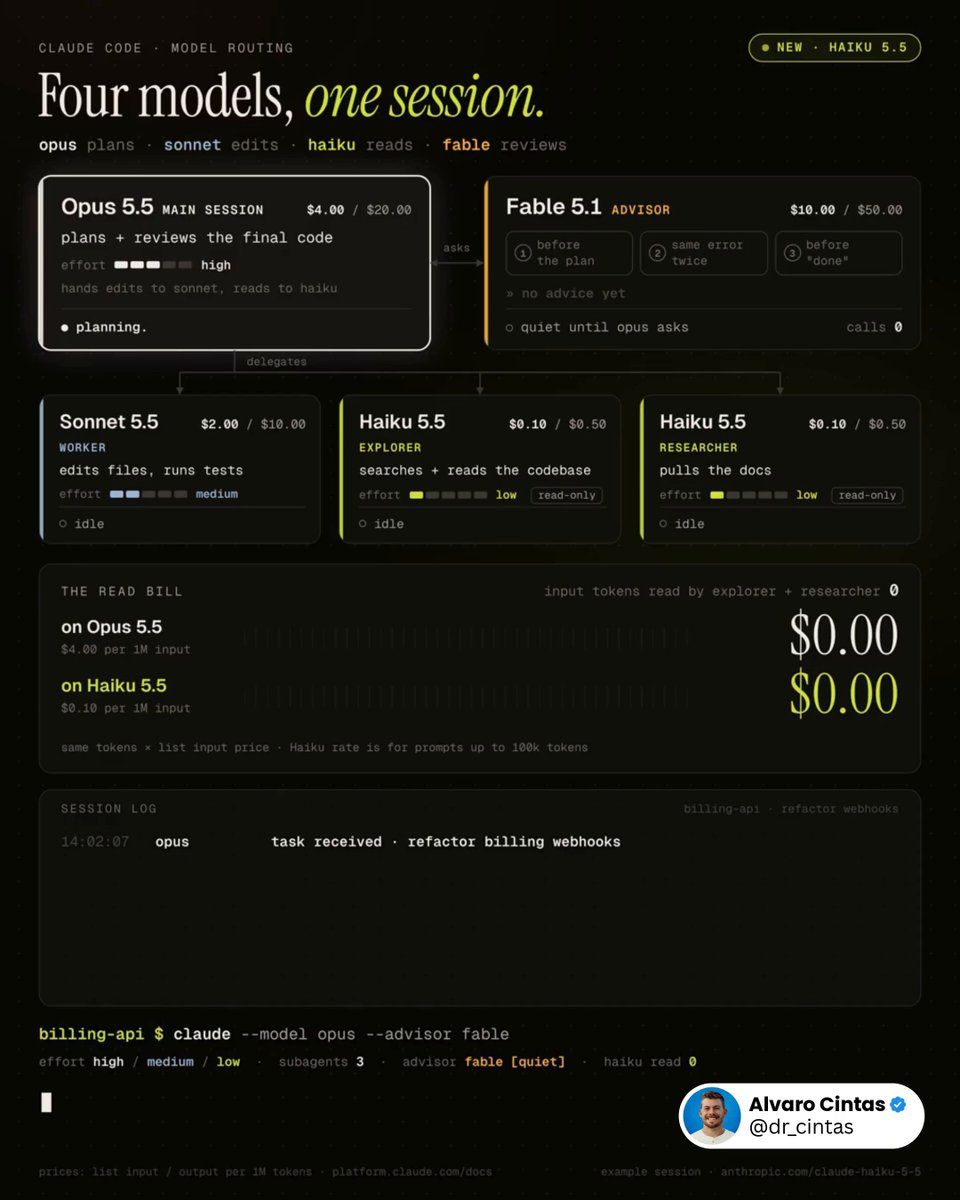
This workflow will save you thousands with Claude. Run Opus 5.5, Sonnet 5.5, Haiku 5.5, and Fable 5.1 together, and stop spending Opus tokens on work that doesn't need Opus. The entire idea in one line: Opus plans, Sonnet edits, Haiku reads, Fable reviews at decision points. Roles, broken down: - Opus 5.5, high effort, owns the plan and reviews the final code - Sonnet 5.5, medium effort, is the worker: edits files, runs tests - Haiku 5.5, low effort, splits into explorer (searches and reads the codebase) and researcher (pulls docs). it's the first Haiku with an effort setting - Fable 5.1, set with /advisor fable. Opus calls it at decision points, and it gets the full transcript each time Three moments Opus tends to call it: → before committing to a plan: is this the right approach? → the same error shows up again: is this going nowhere? → before marking the task done: did something get skipped? Why Haiku only reads: Anthropic's launch post says Sonnet 5.5 and Opus 5.5 are still the better choice for complex agentic coding (Terminal-Bench 4.0: 39.2% for Haiku 5.5, 70.6% for Sonnet 5.5) and that Haiku 5.5 fits narrowly scoped subagent work. so it gets the lookups, not the edits. Anyone still running one model for everything is paying $4 per million input tokens to check whether a file exists. Haiku 5.5 does it for $0.10. Drop this into Claude Code 👇 "Rebuild my Claude Code setup around this structure: Confirm Claude Code is v2.1.293 or later, so the haiku alias resolves to Haiku 5.5. If it isn't, stop and tell me to run claude update. Look through ~/.claude/agents and .claude/agents for subagents already covering explorer, worker, and researcher. Only create new ones for roles that are missing. Set model: haiku, effort: low on explorer and researcher, with no Edit or Write tools. Set model: sonnet, effort: medium on worker. If an existing subagent is locked to a different model, leave it as is and just list it. Name the explorer subagent Explore so it overrides the built-in one, which otherwise runs on my main model. In ~/.claude/settings.json, set advisorModel to fable, and set effortLevel to high for claude-opus-5-5 under modelSettings. A top-level effortLevel in user settings doesn't apply to Opus 5.5. Check for anything disabling the advisor: CLAUDE_CODE_DISABLE_ADVISOR_TOOL, DISABLE_TELEMETRY, or anything blocking feature-flag fetches. Also check CLAUDE_CODE_EFFORT_LEVEL, which overrides subagent effort settings, and CLAUDE_CODE_SUBAGENT_MODEL_FORCE, which makes Claude Code ignore subagent model fields. Report what you find. Don't change any of it yet. Add one line to ~/.claude/CLAUDE.md: consult the advisor before a big plan, when the same error shows up twice, and before marking a long task done. Show every change as a diff first. Wait for my go-ahead before touching anything."

Alvaro Cintas

55,249 просмотров • 3 дней назад

Claude Code tip: once Opus 5.5 runs your main session, stop leaving Fable 5.1 on the bench put it on call with /advisor run /advisor fable Opus 5.5 keeps writing the code Fable 5.1 reads the whole session, every tool call included, and only speaks up at three moments: → before a plan: is this the right approach? → when the same error comes back: am I digging in the wrong place? → before "done": what did I miss? Fable 5.1 reviews. Opus 5.5 ships jev engineering is the same move one layer down: the forks that need no thinker (which file, which tool, retry or stop) go to jev in under half a second, and the big model only sees the ones that split - the full tree > Opus 5.5 on high runs the main session > explorer reads the code > worker edits and runs tests > researcher pulls the docs > all three on medium > Fable 5.1 on call as the advisor paste the tree and this prompt into Claude Code ↓ "Rebuild my Claude Code setup around this tree: 1. Check ~/.claude/agents and .claude/agents for subagents that already fit explorer, worker and researcher. > Draft new ones only for missing roles > Give each model: opus, effort: medium > Skip any that pin a different model and list them 2. Set the main session to high via effortLevel in ~/.claude/settings.json, and set advisorModel to fable 3. Find anything that keeps the advisor off (CLAUDE_CODE_DISABLE_ADVISOR_TOOL, DISABLE_TELEMETRY, any variable that stops feature-flag fetching) plus CLAUDE_CODE_EFFORT_LEVEL, which overrides subagent effort. Report them, change nothing 4. Add one rule to ~/.claude/CLAUDE.md: consult the advisor before a large plan, when an error repeats, and before calling a long task done Show me every change as a diff first. No edits until I say go." ↳

Hanako

52,065 просмотров • 10 дней назад

THIS GUY VIBE CODED A FULL CAPYBARA FOOD DELIVERY GAME IN 2 WEEKS WITH CLAUDE CODE you play as a capybara delivering food on a bike. orders stack on the back, you have a phone with apps in-game and the whole delivery system is realistic 2 weeks, zero game dev experience, and ENTIRELY AI generated the full stack: > claude code for all the code > three.js for the 3D engine > suno for original music > elevenlabs for sound effects and voice > GPT images-2 and grok for textures and illustrations > tripo3d for generating all the 3D assets the cinematics are all in-game too. he asked claude to build a cinematic editor with timeline controls, camera animation, and transitions. then he just placed the cameras himself his workflow was more planning than coding (obviously): > come up with the core mechanic > plan every feature using claude /plan mode > generate assets with AI tools > spend most of his time on the final polish, prop placement, and making the design feel right he said the human part is what most vibe coded games are missing. AI can generate everything but having taste for what looks good and what feels right is still on you the game is playable right now in the browser this is what vibe coding is actually capable of in the game dev space right now a year ago this would have taken a small team of developers, a sound designer, and an artist working together for months now one person with no experience can ship a polished playable game with story, music, and mechanics in 14 days the tools keep getting better and the barrier to making real games keeps getting lower

Om Patel

243,227 просмотров • 5 месяцев назад