正在加载视频...

视频加载失败

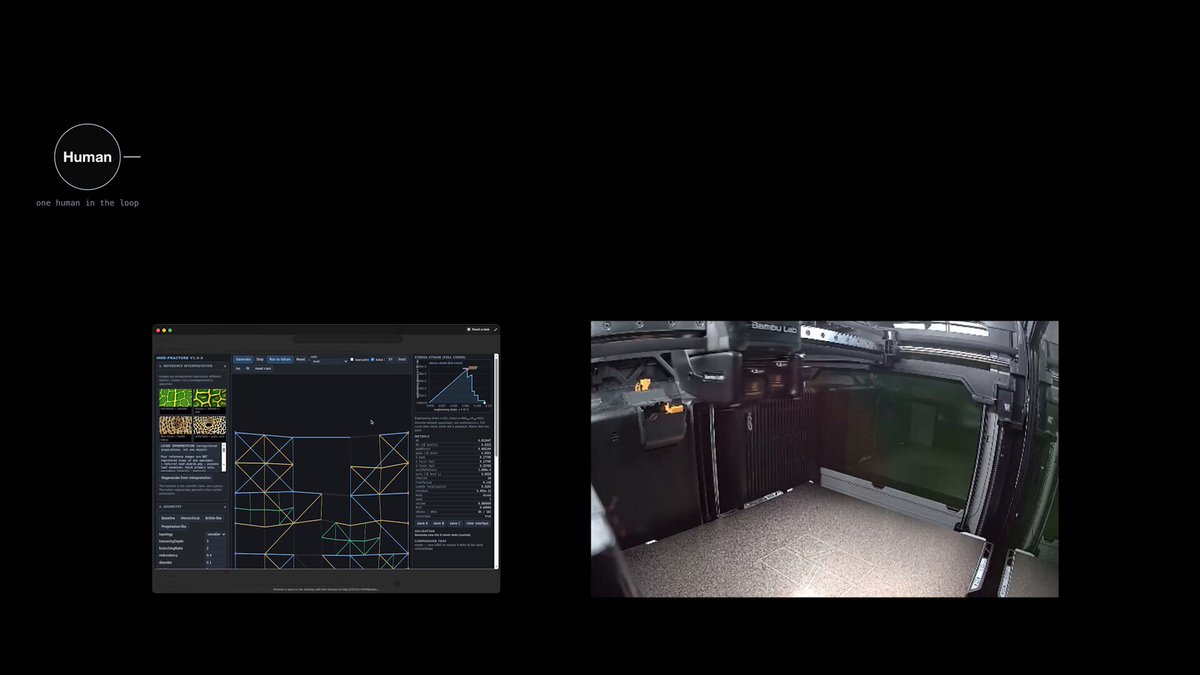
AI can now turn a single image into an explorable physical world. For engineering, this means we can interact with, stress-test, and build intuition about failure in systems that do not yet exist. We can rapidly generate, interrogate, and learn from these worlds to understand how complex physical behavior...

11,713 次观看 • 1 个月前 •via X (Twitter)

0 条评论

暂无评论

原始帖子的评论将显示在这里

相关视频

This is THE moment of Physical AI! We are officially announcing Cosmos 3: Omnimodal World Models for Physical AI 🚀 - Cosmos 3 is an omnimodal world model: within a unified architecture, it can understand and generate language, images, video, audio, and actions. - It is not just a VLM, not just a video generator, not just an audio-visual generative model, and not just a physics simulator / world-action model. It can understand images and videos, generate images, videos, and audio, simulate future worlds, predict actions, and generate robot policies—enabling models to truly begin to “touch the world.” - Cosmos 3 is the #1 open-weight reasoner / T2I / I2V / robot policy across many benchmarks. Huge thanks to every teammate who fought side by side on this journey—from architecture, data, training, infra, serving, and evaluation to post-training. Every part of this project carries an incredible amount of hard work. This was my first time leading a project as Tech Lead, and I feel truly fortunate. The future of Physical AI needs models that can not only “see” and “describe” the world, but also “imagine,” “simulate,” and “act”—and eventually close the loop with the real world. I hope Cosmos 3 can become an important starting point for this direction, and I’m excited to push Physical AI into its next stage together with the open-source community. Welcome to the era of Physical AI. HuggingFace: Project Website: Code:

Max Zhaoshuo Li 李赵硕

1,078,049 次观看 • 1 个月前

A Talk About AI That Will Blow Your Mind. It Did In 1998 When I Attended The Talk. I just found this video from 1998 when I attended this talk by Rupert Sheldrake, Terence McKenna and Ralph Abraham at the University of California, Santa Cruz to explore how machine intelligence might evolve in relation to our own. I never thought I would see this again and it had a great influence on me in the AI I was building in that era and on to today. But ai just found a copy. I certainly did not run around with a VHS recorder so I am blown away that this exists. Now you can see what I saw. At that time, the internet was still young, and artificial intelligence belonged mostly to science fiction. Yet many of the questions we raised then have become part of daily life. In this conversation, it was explored whether intelligence is best understood as logic and computation, or as something embodied, participatory, and alive. Can the mind be reduced to code, or does life itself depend on forms of knowing that no algorithm can contain? AI now outpace us in speed, reach, and memory. Yet the deeper mystery is not how far they can go, but what they reveal about mind and ourselves. Will AI reproduce the limitations of our mechanistic worldview, or might it help us rediscover dimensions of mind that transcend machinery altogether? It's striking how near we now are to the possibilities we once only speculated about. Quantum computing, self-learning systems, large language models very much as Terence describes—and the looming prospect of superintelligence—have moved from the margins to the mainstream. But the heart of the conversation remains just as relevant today, if not more so: what is consciousness, and how might we participate in its unfolding evolution?

Brian Roemmele

147,955 次观看 • 8 个月前

A physical law is not a fact about any single state of the world; it is a relationship between states. An LLM, it turns out, encodes the law in the same way - not as a point, but as a transformation. In new work using Google's Gemma model we show that a model's physical knowledge lives not in static neural states, but in the controlled relationships between them. The idea was inspired by mechanics - a spring’s stiffness is invisible in a photograph: it appears only when we pull the spring and measure its response. We similarly “pulled” on the model using counterfactual prompt pairs and measured how its hidden states moved. This revealed three levels of internal physics: 1⃣ Readability: Broad materials concepts (like corrosion, toughness, or oxidation) are linearly readable directly from intermediate hidden states, even when those exact terms are completely omitted from the prompt. 2⃣ Representation: Rather than absolute state locations, matched state displacements accurately track and order direct, neutral, and inverse constitutive laws across 60 materials science laws (ρ = 0.910), correctly orienting 39 of 40 directional laws. 3⃣ Causal Use: We can bidirectionally steer the model's decisions. Adding a single, frozen microstructural direction to the hidden state causally shifts its output preference in a controlled, relation-appropriate way. This is a major step toward representation-aware scientific AI: building models that are evaluated and rewarded for preserving physical laws internally, resisting shallow text shortcuts, and exposing testable reasoning structures. This gives us a sharp definition of what it means for an LLM to understand physics, and how we can train future models to develop even deeper abstractions about the world.

Markus J. Buehler

24,212 次观看 • 4 天前