Video wird geladen...

Video konnte nicht geladen werden

Zur Startseite

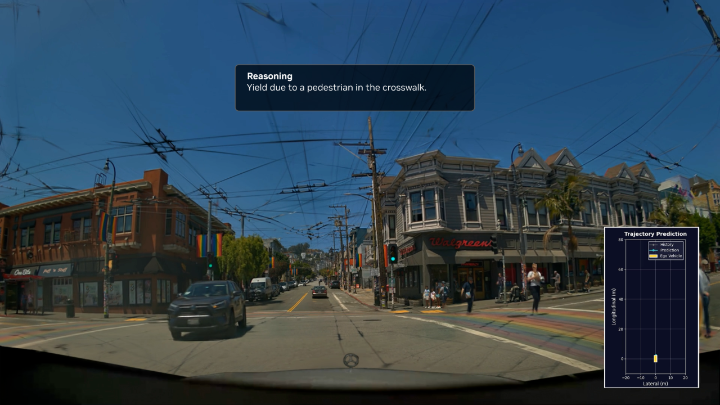
AI for robotics has some monumental challenges, like high dimensionality and reasoning with the physical world. Ashok Elluswamy, AI lead at Tesla, thinks the hardest problem is Evaluation. - Loss isn't a perfect indicator of Policy Neural Network's quality. - Testing in the real world for all the long-tail...

17,065 Aufrufe • vor 9 Monaten •via X (Twitter)

0 Kommentare

Keine Kommentare verfügbar

Kommentare vom Original-Post werden hier angezeigt

Ähnliche Videos

How do you grade a world model? Against what the robot really did. Picture a robot gripper closing on a piece of fruit. In the real world, it fails to grasp it. Now hand the same first frame and the same action sequence to an action-conditioned world model (ACWM). The rollout shows a tidy, successful pick. Nothing on screen looks wrong. That is the moment WorldOracle Bench was built for. Created by AGIBOT and NVIDIA together with Princeton, UT Austin and the University of Toronto, it is an evaluation platform for robot behavior models. It replays the real, recorded actions through a model and checks the predicted future against the paired real execution. The stakes are practical. The paper points to data generation, scalable policy evaluation and closed-loop policy learning as potential uses of ACWMs. If a model gets the physical consequences wrong, everything built on top of it inherits the error. The authors call the property they are testing execution coherence: does the model follow the actions it is given, even the bad ones, across different embodiments and action sources, and over long rollouts? What makes the setup unusual is where the evidence comes from. The paper compares eight existing embodied world-model benchmarks, and none of them combines action-conditioned evaluation, real-world data, failed executions, long episodes, multiple embodiments, multi-view outputs and policy-generated actions. WorldOracle Bench does. Its evaluation set has 335 episodes: 100 on AGIBOT G2, 75 on YAM and 100 with a human hand, all human-operated, plus 60 rollouts where a learned policy drove a real AGIBOT G2 robot. About 40% of the human-operated segments are failures, so a model cannot get by on success stories.

Science girl

82,284 Aufrufe • vor 11 Tagen

Robotics has a massive, silent bottleneck. It isn’t just data collection—it’s the brutal 1x speed of the physical world. Genesis AI Genesis AI just unveiled Genesis World 1.0, and they are attempting to turn the notorious Sim2Real gap into a pure compute problem. Evaluating a robotics foundation model across edge cases usually means hundreds of hours of physical lab testing. With Genesis World 1.0, what traditionally takes nearly a week of continuous, real-world operation is being compressed into 30 minutes in simulation. What makes this different from just dropping a robot model into an off-the-shelf game engine? 1️⃣ Nyx Renderer: A custom, real-time path-traced engine rendering noise-free 1080p frames in under 4ms. Game engines use rasterization tricks that confuse AI; Nyx uses physically accurate multi-bounce lighting so the model's "eyes" see exactly what real sensors see. 2️⃣ Quadrants Compiler: A custom Python-to-GPU compiler to run heavily parallelized multi-physics simulations (rigid bodies, fluids, deformables) natively across architectures. 3️⃣ Evaluation First: They aren't rushing to train on synthetic data. They are using this purely for closed-loop evaluation to perfect the physics first, currently claiming an impressive 89% correlation with real-world hardware tests. If the industry can accurately evaluate models in simulation without the physical world bottleneck, humanoid development stops moving at wall-clock time and starts scaling with compute.

Humanoids daily

17,302 Aufrufe • vor 5 Monaten

Today at Stanford, Fei-Fei Li (Fei-Fei Li),Cofounder/CEO World Labs, gave one of the clearest explanations I’ve heard of what a World Model really is. She broke it down into three layers: 1️⃣ Rendering — What does the world look like? This is where most of today’s video generation models operate: generating increasingly realistic and beautiful pixels. The question is: Can AI generate what the world looks like? The primary consumer is humans. 2️⃣ Simulation — How does the world actually work? Fei-Fei gave a simple example: “How will this bottle move? If I pour the water out, how will the water flow?” This goes far beyond generating something that looks realistic. The model needs to understand physics, spatial relationships, cause and effect, and how the world changes over time. The consumers are both humans and machines. 3️⃣ Planning — What should happen next? This is where things get really interesting. AI doesn't just render the world or simulate what might happen. It uses its understanding of the world to decide: What should I do next? At this layer, the primary consumer is the machine itself. And this connects directly to two enormous opportunities: Autonomous driving and robotics. The progression is powerful: Rendering → Simulation → Planning The real promise of World Models isn't simply generating better videos. It's building AI that can understand the world, predict what happens next, and ultimately take intelligent action in the physical world.

PaulFang

12,066 Aufrufe • vor 3 Monaten