Video wird geladen...

Video konnte nicht geladen werden

Zur Startseite

AI has transformed how video is created. We think the next wave is about understanding it. Over the past few years, we've seen remarkable advances in video generation, editing, avatars, and creative tooling. An increasingly important problem is teaching machines to search, analyze, reason over, and extract insight from...

36,205 Aufrufe • vor 2 Monaten •via X (Twitter)

0 Kommentare

Keine Kommentare verfügbar

Kommentare vom Original-Post werden hier angezeigt

Ähnliche Videos

New short course Multimodal RAG: Chat with Videos, developed with Intel and taught by vasudevlal! In this course, you’ll work with LLaVA (Large Language and Vision Assistant), a Large Vision Language Model (LVLM) that can process both images and text. For example, given an image of a person doing a handstand on a skateboard at the beach, LLaVA doesn't just caption the scene, it’s able to predict possible outcomes, like the person losing balance or falling off. By understanding not just what's in a video frame, but what might happen next, your application can provide more insightful answers to questions about video. You'll build a full multimodal RAG pipeline that can chat about video content: - Use the BridgeTower model to create joint text-image embeddings in a 512-dimensional multimodal semantic space. - Learn video processing techniques to extract keyframes, generate transcripts using Whisper, and create captions. - Use the LanceDB vector database to store and retrieve high-dimensional multimodal embeddings. - Integrate the LLaVA model, combining CLIP's (Contrastive Language Image Pretraining) vision transformer with Llama, for advanced visual-textual reasoning. Your final system will ingest video data, generate embeddings for frames and text, perform similarity searches for relevant content, and use the retrieved multimodal context to inform LVLM-based response generation. The result is a system capable of answering nuanced questions about video content, effectively chatting about the video it has processed. Please sign up here!

Andrew Ng

107,548 Aufrufe • vor 1 Jahr

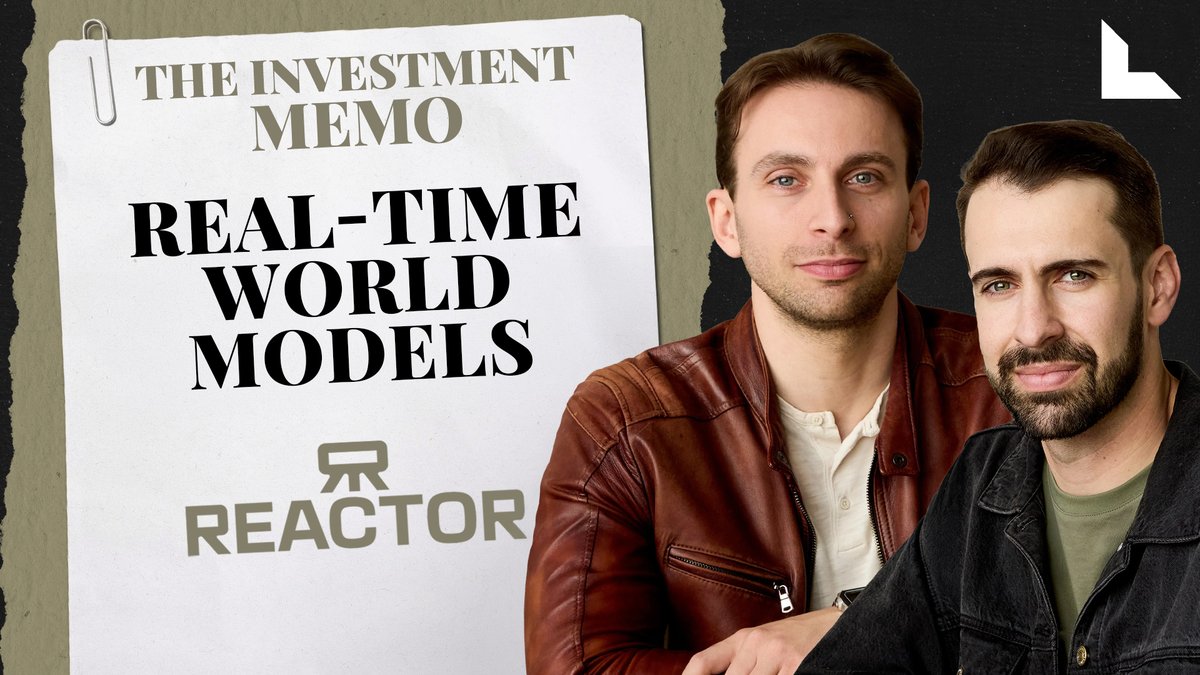
Real-time world models represent a fundamental shift in AI. reactor is building the platform for real-time generative video infrastructure, supporting developers who need the tech for use across entertainment, physical AI, and robotics. Co-founders Alberto and Bryce Schmidtchen joined us last week on The Investment Memo, hosted by Partners Bucky Moore and Amber Yang, to talk about the era of world models. The conversation centered around the infrastructure Reactor is building, why real-time models are the edge right now, and current use cases for the product. Alberto and Bryce agreed that world models are shaping the way simulations are created, and that developers need a streamlined platform that can support their ideas. We believe Reactor is positioned to be at the frontier of research into real-time generative models. We look forward to seeing how these models apply across industries. Chapters 00:00 Introduction & Overview of Reactor 01:08 Meet the Hosts & Founders 02:18 The Origin Story: From 3D Assets to World Models 05:07 Real-Time Video Applications Across Industries 06:55 The Open Source World Model Explosion 07:23 Why Infrastructure Is the Opportunity 08:42 Parallels to Past Technology Waves 09:51 Bridging the Research-to-Production Gap 13:13 What Developers Are Building with World Models 16:41 Lessons from Luma AI 18:23 What Apple Vision Pro Taught Bryce About Real-Time Systems 20:48 Company Values & Team Culture 22:40 Series A: What the Capital Unlocks 24:13 Reactor's Five-Year Vision 26:09 Closing Remarks

Lightspeed

144,561 Aufrufe • vor 1 Monat

“Liam was … we spent a lot of time together and we were together a few weeks before he passed away. […] •An acoustic version of “Through the Dark” was what I wanted to do [at the Grammys]. And that was the plan for a little while to do that separate from Immemorium. And then sadly, the artist I had in mind couldn't make it. […] •We like half filmed a video many years ago called ‘Infinity’ and we never finished the video because […] the boys changed their mind and they decided to go with another single [‘History’]. […]So we had these like this half video of like two hour shoot. So for years the fans have always been going, ‘when's the Infinity video?’ ‘We want the Infinity video.’ But it never existed. There never was one. […] We like took a bit from ‘This Is Us’. We took a bit from the Where We Are Tour at San Siro. And then we took a little bit from Wembley Stadium. And then also from that Infinity video that's never been seen. So people could just see like his joy and love for life. There was so many clips, but he's just laughing and like loving life and like enjoying it and looking at the camera. And like, if you look at it, the consistency of every single one of those clips is significant because he's looking over Verona and celebrating with his hands in the air and smiling. And then he's looking at Wembley Stadium, he's smiling, and then San Siro and he's laughing. And then we're doing the Infinity video and he's laughing. And like, that was really beautiful just to show across the period of like a few years, his joy and kindness and love for life.” - Ben Winston about Liam’s Tribute at the Grammys, Rolling Stone Music Now

HSNews

203,067 Aufrufe • vor 1 Jahr

99% of AI applications are cool-looking demos. Impressive, but don't get fooled by the hype. It takes a lot to build enterprise-grade products that deliver real value. I have at least three weekly conversations with companies that want to use a Large Language Model with their data. The demand is huge! Here is one idea about what you can do to help. The use cases that most of these companies want to solve are similar: They have an extensive knowledge base and want to build a simple application that uses that information to answer questions. In other words, they need help building Retrieval Augmented Generation (RAG) applications they can use in many different scenarios: 1. To train new employees 2. To help their support team 3. To search old meetings and documents 4. To help with their research However, building these systems is not straightforward. Yes, there's a lot of information online, but there aren't enough people who know how to create solutions that work. Here is the idea: Today, you can build an enterprise-grade RAG application without writing code. A couple of MIT PhDs with 10+ years of experience building AI applications created . It's a no-code platform for building applications using Large Language Models. They are partnering with me on this post. You can use Stack AI to create, test, and deploy an end-to-end production-ready AI system. It's SOC-2, HIPAA, and GDPR compliant and offers SSO, role management, access control, and on-premise deployments. Of course, you can use the platform with any LLM on the market now. It's the whole nine yards for building AI applications. Check them out here: 2023 was about models. 2024 is about the tools using these models to build production-ready applications. That's where I'd start.

Santiago

197,675 Aufrufe • vor 2 Jahren