Loading video...

Video Failed to Load

Go Home

AG1 Residency Program is a 10-week residency in Tokyo where founders from around the world live together, build together, and focus intensely on creating great products. Applications for Batch 3 are now open! Every batch, AG1 brings founders to Tokyo from across the world, including the US, China, Korea,...

70,037 views • 12 days ago •via X (Twitter)

0 Comments

No comments available

Comments from the original post will appear here

Related Videos

Over the past few months at Dedalus Labs, we’ve noticed how many talented founders from around the world are being held back by one thing: location. There is no better place in the world to build an AI startup than San Francisco. SF is home to all the major AI labs, top talent, world-class investors, and it is where the future is being built every day. That’s why, this December, we’re giving builders everywhere a chance to break in. We are taking over and launching Break In—a month-long hacker house program in the heart of San Francisco. If you’re not from SF, and you’re building an AI startup, this is your chance to join us. Build your startup on top of Dedalus’ Agents SDK or MCP deployment infrastructure and we’ll cover your stay (housing, lunch, and co-working space). As a member of Break In, you’ll get access to all the best parts of SF. You’ll be introduced to top founders, mentors, and investors. You’ll get to skip the line at the biggest tech events. Plus, you’ll receive free API credits and expanded access to the best-in-class AI stack through our partner network of top AI infrastructure companies. Applications open October 27th and close November 10th. We will be accepting applications on a rolling basis. Final acceptances will go out November 14th to ensure international founders have enough time to secure visas. Ready to break in? Follow us on Twitter/X for more updates and visit the link in the comments to apply on October 27th!

Cathy Di

109,650 views • 10 months ago

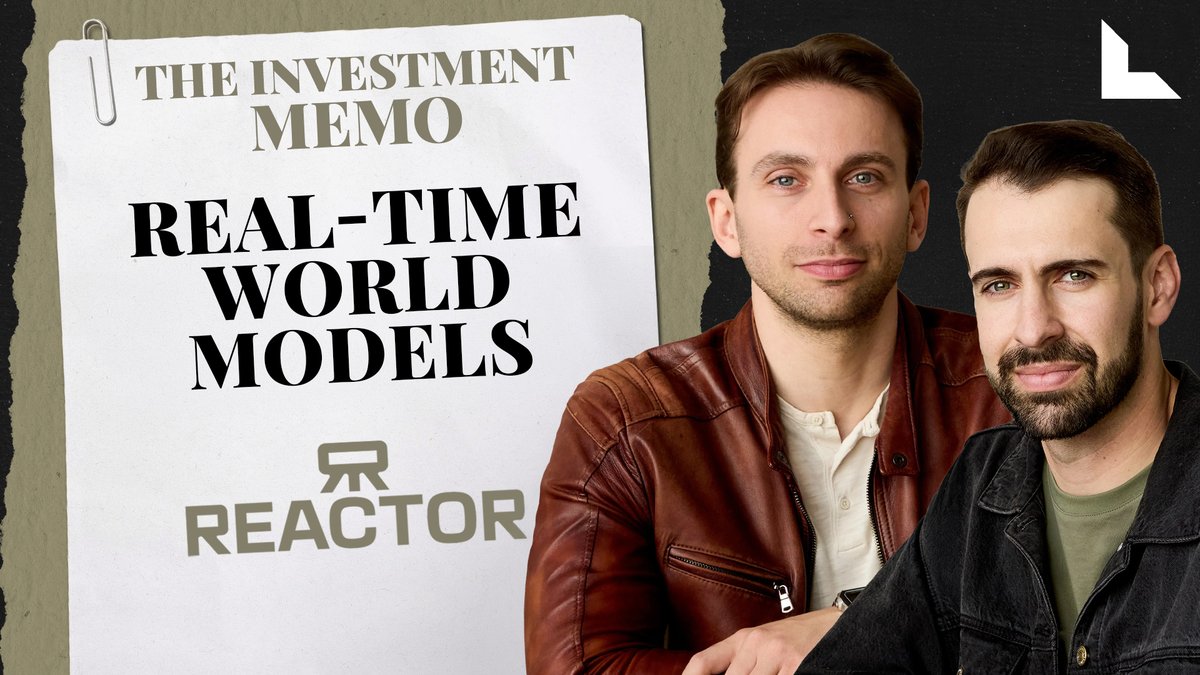
Real-time world models represent a fundamental shift in AI. reactor is building the platform for real-time generative video infrastructure, supporting developers who need the tech for use across entertainment, physical AI, and robotics. Co-founders Alberto and Bryce Schmidtchen joined us last week on The Investment Memo, hosted by Partners Bucky Moore and Amber Yang, to talk about the era of world models. The conversation centered around the infrastructure Reactor is building, why real-time models are the edge right now, and current use cases for the product. Alberto and Bryce agreed that world models are shaping the way simulations are created, and that developers need a streamlined platform that can support their ideas. We believe Reactor is positioned to be at the frontier of research into real-time generative models. We look forward to seeing how these models apply across industries. Chapters 00:00 Introduction & Overview of Reactor 01:08 Meet the Hosts & Founders 02:18 The Origin Story: From 3D Assets to World Models 05:07 Real-Time Video Applications Across Industries 06:55 The Open Source World Model Explosion 07:23 Why Infrastructure Is the Opportunity 08:42 Parallels to Past Technology Waves 09:51 Bridging the Research-to-Production Gap 13:13 What Developers Are Building with World Models 16:41 Lessons from Luma AI 18:23 What Apple Vision Pro Taught Bryce About Real-Time Systems 20:48 Company Values & Team Culture 22:40 Series A: What the Capital Unlocks 24:13 Reactor's Five-Year Vision 26:09 Closing Remarks

Lightspeed

144,942 views • 2 months ago

99% of AI applications are cool-looking demos. Impressive, but don't get fooled by the hype. It takes a lot to build enterprise-grade products that deliver real value. I have at least three weekly conversations with companies that want to use a Large Language Model with their data. The demand is huge! Here is one idea about what you can do to help. The use cases that most of these companies want to solve are similar: They have an extensive knowledge base and want to build a simple application that uses that information to answer questions. In other words, they need help building Retrieval Augmented Generation (RAG) applications they can use in many different scenarios: 1. To train new employees 2. To help their support team 3. To search old meetings and documents 4. To help with their research However, building these systems is not straightforward. Yes, there's a lot of information online, but there aren't enough people who know how to create solutions that work. Here is the idea: Today, you can build an enterprise-grade RAG application without writing code. A couple of MIT PhDs with 10+ years of experience building AI applications created . It's a no-code platform for building applications using Large Language Models. They are partnering with me on this post. You can use Stack AI to create, test, and deploy an end-to-end production-ready AI system. It's SOC-2, HIPAA, and GDPR compliant and offers SSO, role management, access control, and on-premise deployments. Of course, you can use the platform with any LLM on the market now. It's the whole nine yards for building AI applications. Check them out here: 2023 was about models. 2024 is about the tools using these models to build production-ready applications. That's where I'd start.

Santiago

197,702 views • 2 years ago

DAVID SACKS ON THE AI RACE: "The US is currently in an AI race, and our chief global competition is China, obviously. They're the only other country that has the talent, the resources, and the technology expertise to basically beat us in AI. And I think whoever wins this AI race, that's going to have tremendous ramifications for both our economy and our national security. Clearly, we want the US to be the winner, just like we were with the internet, and every other technology revolution before that […] We know that to win this AI race, we have to be the most innovative. You can't regulate your way just to beating your competitor. You have to out-innovate them. And we know that in the United States, the innovation comes from the private sector, not the government. So we have to do everything we can to help our companies win, to help them be innovative, and that means getting a lot of red tape out of the way… We have to have the most AI infrastructure in the US. It has to be the easiest place to build it. All of the new data centers that are going in, they require tremendous power, so getting ahead of the curve on energy, making sure we stand up all of this new infrastructure we're going to need to basically produce these AI factories… We want the US technology stack to dominate globally. We want to be the partner of choice for the whole world… I think everyone in Silicon Valley understands that the way that you win a technology race is to have the biggest ecosystem […] You just want everybody to be building on top of your technology stack, and that's what we want for the United States." David Sacks w/Marc Benioff Dreamforce

Ron Pragides 

231,781 views • 11 months ago

The hardest problems in AI aren't research problems anymore. They're deployment problems. It’s how we actually deliver real value, today, to build the future people want. That’s why, after 20 years in AI, my next step was inevitable: make robots do useful work for and alongside people, right now. Today, I am delighted to announce the launch of Walden Robotics to tackle just that. We started this year and are coming out of stealth today with a $300M seed round backed by some of the most serious companies and investors in the world. They have seen firsthand our general-purpose robots being useful in production on day one, and getting better every day after. You can see a glimpse of what we've been building in the video below. Physical AI has gone through a rapid phase transition, in part thanks to pioneering research from my friends and co-founders Russ Tedrake , Ben Burchfiel , Siyuan Feng, Rareș Ambruș , and many others at Walden. But from our long experience working together with co-founders Kerri Fetzer-Borelli and Dave Johnson, we learned how hard it is to deploy cutting-edge AI in a real, live, incredibly sophisticated production environment with an intricate ballet of automation and human ingenuity. That’s why we deliberately created Walden Robotics as a full-stack, human-centric, customer-focused robotics company from the start: we seeded the company with a world-class team across hardware, software, AI, deployment, operations, product, and business talent, so we could continuously optimize our whole system end-to-end, deeply and purposefully, from real-world experience with real customers. The efficacy of this strategy speaks for itself: since February, our general-purpose robots have been doing useful work in production at a Toyota plant in North America, moving from first pilot to real work in under two months. Not a lab. Not a demo. Not a future promise. Real work on a real line, today, at one of the best large-scale manufacturers in the world, with general-purpose robots that get better every day. And this is just the beginning. Two ways to find us: If you run a manufacturing or logistics business and want robots that are widely useful now, not someday, let's talk. We own “ for a reason! And if you want to build them: we're hiring across the company, from software, to hardware, AI, ops, product, business, and more. In particular, as the Chief Strategy Officer at Walden, I am recruiting for three incredibly impactful founding roles to fuel our agent-native go-to-market engine. Check out Let’s build together!

Adrien Gaidon

64,339 views • 1 month ago

Today we're launching Spellbook's biggest thing yet: Autonomous Contract Management It’s the first end-to-end AI infrastructure for contracts The world is speeding up. We are in one of the biggest investment cycles in decades. Behind every rocket launch, FIFA game, and datacenter, lies a web of hundreds of agreements. Agreements are the invisible threads that allow us to work together. We have infrastructure for finance (Stripe, Ramp), eCommerce (Shopify) and many business functions. But agreement infrastructure is lacking. This creates a painful bottleneck on our ability to work together. Online purchases take milliseconds. But agreements still take weeks. CLMs were supposed to be the answer, but were designed in a pre-AI era. AI fundamentally changed how computers can accelerate agreements. Spellbook is the most used AI contract review tool in the world, with ~5,000 customers in 80 countries Now we are expanding to deliver the first end-to-end, AI native stack for contracts. From the moment a deal lands in your inbox, to the day it renews years later, Spellbook’s AI supports teams every step of the way, across all business teams. It runs 24/7. While you sleep, it's reading the deals that came in overnight, flagging the parts that actually need a lawyer, and clearing the busywork that used to kill mornings. Nothing gets handed off between systems or slips after signature, and the intelligence stays with you for the life of the contract. AI for lawyers is great. There are 20 million lawyers in the world, and many are our users. But there are billions who touch contracts. We're excited to help everyone move faster and do more of what they love, by building the best AI-powered contract infrastructure in the world. Get early access:

Scott Stevenson

80,335 views • 2 months ago

At the BNB Chain hackathon, CZ 🔶 BNB made several very important points about AI trading (Everything in parentheses is my own view and judgment.) He first said that AI will be involved in trading everywhere. Trading itself is already a huge market: there are 300 million users on Binance alone, and if you add the decentralized ecosystems, that number is not small either. In such a mass-market environment, many different trading strategies can work, with countless different coins, different projects, and different ways to play. But there is a big problem here: building commercial AI trading platforms for retail users is actually very hard. If a trading strategy works very well for one person, once a billion people start using the same strategy, that strategy “might still work, or might stop working.” Take copy trading / follow trading as an example: if you buy first and everyone follows you, the first buyer will perform very well, but the last person to follow may not end up with good results. So, with the exact same strategy and the exact same copy logic, the outcomes can be completely different for different people. (On top of that, every strategy also has its own capital capacity limits.) Teams that can really build strong AI are, with high probability, going to trade with their own money. In today’s world, money itself is already somewhat like a “commodity”; many people have a lot of capital, and it’s actually not that hard to raise funds. If you truly have an algorithm that can make a lot of money, it’s not hard to get money and run your own book. There is really only one situation where you would sell this algorithm to mass-market users: for example, if you charge a $10 monthly subscription and can sell it to one million users, then your $10 million monthly subscription revenue is higher than the profit you could make by trading the strategy yourself. (Here this touches one of our earlier theses: as training AI models becomes relatively easier and the supply of models increases, model companies have more incentive to open-source. By analogy, as the production process of trading strategies is increasingly simplified by AI and the supply of strategies explodes, traders will have stronger incentives to monetize by expanding their influence in other words, by “open-sourcing” their strategies.) Of course, CZ did not say that this model can never work. Another path is to build an AI trading platform that lets users tune different AI algorithms, or very easily assemble their own structures and strategies, so that what each person ends up running is different and better tailored to themselves. Some people will make money, some people will lose money, but the platform still has value because it’s very hard for most people to build an AI trading algorithm from scratch. So there are a lot of trade-offs here; it’s not as simple as saying “once AI shows up, everything automatically gets better.” (This is exactly what we presented at the hackathon: you describe your own strategy in natural language, and the AI automatically generates a workflow. The parameters in that workflow, the models used, the logical structure, the APIs it calls, and even the algorithms it invokes are all customizable. The reasons we think workflows are a good way to do this include: controllable execution paths, Lego-like modular nodes, and better visualization that makes it easier for users to build and adjust their workflows.) Finally, his conclusion was very clear: it’s not that AI will definitely make trading better, and it’s not that AI will definitely make things worse. Rather, no matter what, in the future a huge number of people will use AI to trade. This will be a very large field, and whoever can build the best algorithms will make a lot of money.

Tykoo

25,535 views • 9 months ago