Загрузка видео...

Не удалось загрузить видео

На главную

AI power users are here and the case for agent-friendly software is materializing. Aaron Levie on agents outnumbering people 1000x: "If you start to imagine that we all have to build software for agents… we spend as much time now thinking about the agent interface to our tool as...

42,152 просмотров • 18 дней назад •via X (Twitter)

Комментарии: 28

Фото профиля suqitah
suqitah18 дней назад

coding its way through whatever task it needs is exactly the line that should make security teams nervous

Фото профиля Ehsan Azish
Ehsan Azish18 дней назад

an agent using apis through whatever task it needs is just a script with worse error handling

Фото профиля Nico
Nico18 дней назад

Agent friendly usually means an API you already had, documented properly

Фото профиля Anton Viborniy
Anton Viborniy18 дней назад

The interesting part is that agents may kill the UI moat. If an agent interacts with every SaaS through APIs, the product with the best interface no longer necessarily wins. The product with the best infrastructure does.

Фото профиля elian
elian18 дней назад

sure, aaron, whatever you say

Фото профиля The AI Therapist
The AI Therapist18 дней назад

Aaron Levie wants software built for agents. The real bottleneck isn't building it, it's the average human tolerance for being managed by a bot that hallucinates your name twice before lunch.

Фото профиля Phong Designs AI Systems
Phong Designs AI Systems18 дней назад

The 1000x number changes what a feature costs, not just who uses it. Human traffic follows attention, so a rough edge on a rare path stays cheap because few people ever reach it. An agent reads the docs and exercises every path uniformly. The long tail stops being a tail.

Фото профиля Dave Burrells
Dave Burrells17 дней назад

If agents outnumber people 1,000 to 1, what do they do after they can call an API? Talking to software is coordination. An economy starts when they can price a job, settle it, and carry a reputation for the outcome. That’s the piece after “more agents.” 👇

Фото профиля Adel Bucetta
Adel Bucetta17 дней назад

the honest answer is, most companies still haven't figured out how to design for human-machine collaboration. till then, agent-friendly interfaces will keep being a kludge

Фото профиля EKOS _ AGI 🦊 🇮🇷
EKOS _ AGI 🦊 🇮🇷17 дней назад

This is where the agent economy gets interesting. When agents become the primary software users, reliable machine-readable context becomes infrastructure. @ekosproject is building exactly that layer for enterprise knowledge.

Фото профиля Dave Mellish
Dave Mellish18 дней назад

So are we still bearish on knowledge work replacement at scale?

Фото профиля Rory Bernier
Rory Bernier18 дней назад

damn

Фото профиля Ella Tech & Tool
Ella Tech & Tool18 дней назад

Agents humans soon 🔥 1000x scale is wild

Фото профиля broadfield-dev
broadfield-dev18 дней назад

If you are still using other peoples software, you are not an AI power user. Entry level at best.

Фото профиля EKOS _ AGI 🦊 🇮🇷
EKOS _ AGI 🦊 🇮🇷17 дней назад

@ekosproject

Фото профиля EVR
EVR18 дней назад

If agents outnumber people 1000x, they cannot share one laptop, one filesystem, and one set of credentials. Isolated compute is the actual interface. A VM per agent, or the blast radius scales with the agents.

Фото профиля AiClaw
AiClaw18 дней назад

The API, CLI and MCP point is the practical tell: when agents become the main users, documentation stops being a nice-to-have and becomes part of the product.

Фото профиля AscendCapital
AscendCapital18 дней назад

Most product teams are still treating APIs as an afterthought while building for human UI. If agents are outnumbering users 1000x, your API and context layer are your primary product surface area.

Фото профиля Doug
Doug18 дней назад

This is the bigger shift: software won’t just need a good human interface. It’ll need a good interface for machines that can actually use it.

Фото профиля Leo Lu
Leo Lu18 дней назад

Agent interfaces may end up looking more like API contracts than UIs.

Фото профиля Voriq Network
Voriq Network16 дней назад

Would love to collab by providing an infrastructure for your agents and the proper tools and SDKs Is this something we can discuss with the right person at a16z ?

Фото профиля TriDung.sol 🐬TermMax
TriDung.sol 🐬TermMax18 дней назад

the ui for humans is becoming the legacy layer, api is the new focus

Фото профиля Macro Bombastic
Macro Bombastic18 дней назад

yeah the api is becoming the real frontend for agents

Фото профиля OctoOps - Agent Ops inPublic
OctoOps - Agent Ops inPublic18 дней назад

1000x agents means 1000x rate limits and quota fights. agent-friendly software mostly means idempotent writes and a spend ceiling per caller, not a prettier API.

Фото профиля Bobby
Bobby18 дней назад

The future is bright for America and her allies. Semper Fidelis

Фото профиля Jay Dev
Jay Dev18 дней назад

Building the agent interface as a co-equal to the human interface is the part most teams still bolt on last. At 1000x the agent count, does that ratio flip which interface gets the primary design pass first?

Фото профиля dhinna ship .ico
dhinna ship .ico18 дней назад

Implies separate schemas and action endpoints, not a wrapped human UI

Фото профиля mcdeezy
mcdeezy17 дней назад

was built for agents I had never built a CLI before but it was obvious that agents would interact with the opensource code via CLI very fun coding and architecting for agents instead of the normal human which color should i make the button hmmm 🤔🤔🤔

Похожие видео

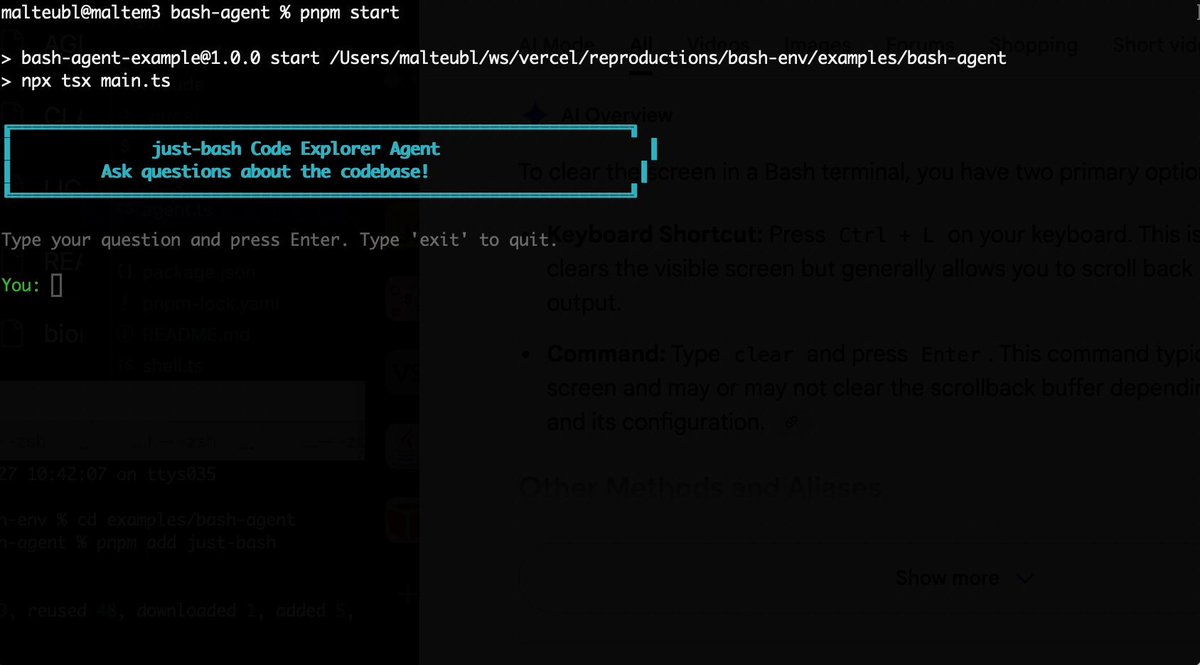
Bash is all you need! Which is why I'm introducing my holiday project: just-bash just-bash is a pretty complete implementation of bash in TypeScript designed to be used as a bash tool by AI agents. Because it turns out agents love exploring data via shell scripts, even beyond coding. It comes with grep, sed, awk and the 99th percentile features that an agent like Claude Code or Cursor would use. In fact, Claude Code can use it for secure bash execution. In the package - A bash-tool for AI SDK - A binary for use by yourself or your coding agents - An overlay filesystem to feed files to your agent securely - A Vercel Sandbox compatible API, so you can quickly upgrade to a real VM if you need to run binaries - An example AI agent that explores the just-bash code base using just-bash - I imported the Oils shell bash compatibility suite and just-bash passes a very good chunk What is interesting about this codebase: It was essentially entirely written by Opus 4.5. Coding agents love bash and they are good at reproducing it. They are also great at text-book recursive descent parsers and AST tweet-walk interpreters. That said, it is, like, a lot of code and I didn't read it all 😅. This is very much a hack, but it also seems to be _really_ useful. I haven't really found anything agents want to use that it doesn't support and it's fast and secure (caveats apply). It doesn't have write access to your computer and the filesystem is given a root that the agent cannot escape from. Find it at Related: Our recent blog post how we migrated our data analysis agent to bash tools and achieved incredible quality improvements The video shows the example agent investigating the just-bash code base

Malte Ubl

125,326 просмотров • 8 месяцев назад

New Course: ACP: Agent Communication Protocol Learn to build agents that communicate and collaborate across different frameworks using ACP in this short course built with IBM Research's BeeAI, and taught by Sandi Besen, AI Research Engineer & Ecosystem Lead at IBM, and Nicholas Renotte, Head of AI Developer Advocacy at IBM. Building a multi-agent system with agents built or used by different teams and organizations can become challenging. You may need to write custom integrations each time a team updates their agent design or changes their choice of agentic orchestration framework. The Agent Communication Protocol (ACP) is an open protocol that addresses this challenge by standardizing how agents communicate, using a unified RESTful interface that works across frameworks. In this protocol, you host an agent inside an ACP server, which handles requests from an ACP client and passes them to the appropriate agent. Using a standardized client-server interface allows multiple teams to reuse agents across projects. It also makes it easier to switch between frameworks, replace an agent with a new version, or update a multi-agent system without refactoring the entire system. In this course, you’ll learn to connect agents through ACP. You’ll understand the lifecycle of an ACP Agent and how it compares to other protocols, such as MCP (Model Context Protocol) and A2A (Agent-to-Agent). You’ll build ACP-compliant agents and implement both sequential and hierarchical workflows of multiple agents collaborating using ACP. Through hands-on exercises, you’ll build: - A RAG agent with CrewAI and wrap it inside an ACP server. - An ACP Client to make calls to the ACP server you created. - A sequential workflow that chains an ACP server, created with Smolagents, to the RAG agent. - A hierarchical workflow using a router agent that transforms user queries into tasks, delegated to agents available through ACP servers. - An agent that uses MCP to access tools and ACP to communicate with other agents. You’ll finish up by importing your ACP agents into the BeeAI platform, an open-source registry for discovering and sharing agents. ACP enables collaboration between agents across teams and organizations. By the end of this course, you’ll be able to build ACP agents and workflows that communicate and collaborate regardless of framework. Please sign up here:

Andrew Ng

105,343 просмотров • 1 год назад