正在加载视频...

视频加载失败

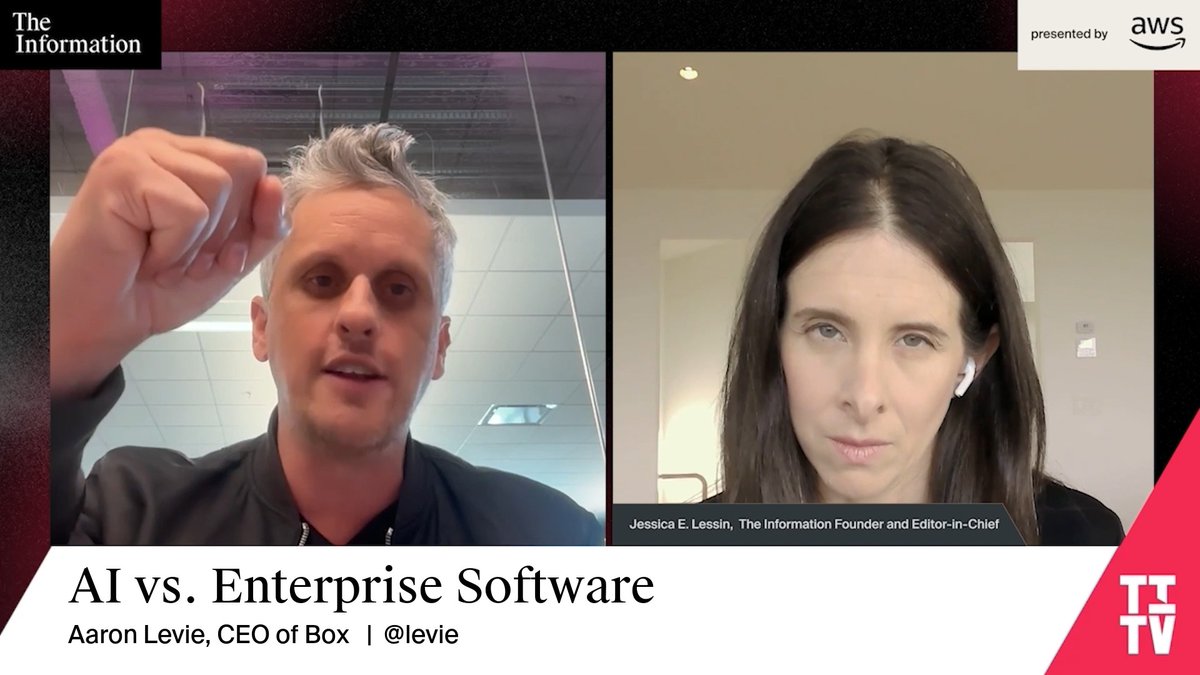
Aaron Levie says agent-driven micropayments could create an entirely new business model for the internet: "We might have truly a completely different business model for the internet." "Now actually it's probably is a good business model. Because let's say you had paywalled, really proprietary data... You could actually imagine...

90,633 次观看 • 3 个月前 •via X (Twitter)

0 条评论

暂无评论

原始帖子的评论将显示在这里

相关视频

Thomas Laffont on how Coatue values SpaceX: “The quality of SpaceX's business model increases the more they launch.” “The number one driver correlated to the valuation of SpaceX is cadence of launches, which intuitively makes sense. If your business is the launch business, the more you launch, the higher your value should be. So I think we see that in the data. But there's another fundamentally different ratio that I want to point you to, which is, what if we took the valuation, we divided it by the number of launches, what would that look like? Well, you can see it was kind of in a fixed range for a while, and then it really started to move up. And we believe that markets are rational, and so we started thinking, well, why is it that the market is valuing SpaceX higher on a per launch basis when it's launching more than when it was just starting out? And my fundamental view, and we'll kind of call this our Coatue framework, is that the quality of SpaceX's business model increases the more you launch. So in phase one, which we call pre-constellation, you're just trying your rockets. And we know rockets are hard, and maybe you have a few government customers, and that's a one-time revenue business, and it's unpredictable. Then you get into your initial ramp, and now you might have one constellation. So why is a constellation important? Well, it's an end market and it's a recurring revenue business. The more satellites you put up, the more subscribers you have, the more revenue, etc. Now you can move from ramp into scale. Now you don't just have one constellation, you have multiple constellations. So now you move into being a scaled business, which ultimately becomes a platform. And we know how valuable these platforms are in this technology age. And platform means not only do you have many more customers in your core business, but you also have new businesses. It could be space datacenters, it could be the optionality of the Moon and Mars, and other space applications.” Elon Musk SpaceX $SPCX --------------------------------------- Thanks to our partners for making this possible! EY (EY) - Great tech starts with a big idea. From startup to scale, EY helps tech founders get financials right early so they can focus on what’s next. NYSE (NYSE 🏛) - Thank you to our partner, the New York Stock Exchange - a modern marketplace and exchange for building the future. It all happens at the NYSE.

The All-In Podcast

38,324 次观看 • 15 天前

Introducing the new Box Agent. The Box Agent works across your entire Box file system, maintaining all your security and access controls, and is hyper tuned for working with enterprise content. This means you can now ask questions from all your enterprise content, search for files that were impossible to find before, deploy an agent on specific tasks on subsets of documents, analyze complex data sets, and generate or edit documents and spreadsheets via the agent. You can have the Box Agent search across your Box account to prepare for a sales meeting, analyze customer sentiment reports, process a large set of contracts for legal risk, provide insights into product development, leverage existing knowledge to answer RFPs, and thousands of other use-cases. 90% of enterprise data is unstructured data. This means most enterprise knowledge is sitting in inside of research reports, marketing assets, presentations, roadmap files, contracts, HR documents, and more. This is the critical context that agents need to be able to answer questions about a business, automate workflows, or serve up to other agents. We’ve been grinding on this for a quite a bit, and due to recent AI model advancements we’re now ready to release it to customers. Previous model generations had a difficult time knowing when to give up or keep going on a search, when to browse for files vs. use queries, how to rank files appropriately to know which version of content to use, how to handle large amounts of context to comb through, and more. Due to recent breakthroughs from models like GPT-5.4, Opus 4.6, and Gemini 3, we’ve seen major gains in tool calling, code execution, advanced reasoning, and more. Combined with an agent harness tuned to Box context, now it’s finally possible to have an agent that can work across your file system on long running tasks and actually deliver high quality results. Best of all, because the Box Agent works with any leading AI model, you’ll quickly get the gains coming out of the major labs as major new models are released. Further, openness at Box is key, so you’ll be able to call up the Box Agent from Box’s APIs and MCP server, so you can interact with Box intelligently from any other AI system. We know work happens everywhere, and we want to ensure you can access to the content you need from those places. The new Box Agent is available starting today, rolling out now for Enterprise Plus and Enterprise Advanced customers.

Aaron Levie

44,515 次观看 • 3 个月前

Today, Box is announcing major new AI agent capabilities to let customers tap into the full value of their unstructured data. First, we’re announcing all new updates to the Box AI Studio to make it even easier to build AI agents that tap into your enterprise content for any job function, business process, or industry specific use case. We are also expanding our set of foundational agents that customers will be able to use to work with their enterprise content, including new features like search and research on unstructured data. Next, we’re announcing Box Extract to enable customers to use AI agents seamlessly for complex data extraction from any type of document or content. This makes it easier than ever to pull out data from contracts, invoices, research data, marketing assets, medical charts, and more. Finally, we’re introducing Box Automate, a new workflow automation solution within Box that lets you deploy AI agents across enterprise content-centric workflows. With Box Automate, you can design your business process in a simple drag and drop builder and then drop in AI agents at any step in the process. This ensures agents execute tasks at the right steps in a workflow every time. Best of all, our AI agents and workflow tools are designed to work across any system our customers work within, whether it’s leveraging pre-built integrations, Box APIs, or the new Box MCP Server. Ultimately, all of these capabilities come together to transform how companies can work with their enterprise content. Software has historically only been good at automating work that deals with structured data, which is why ERP, CRM, and HR systems have been mainstays of enterprise software for so long. The data in these systems fits neatly into a database, and the workflows are very ripe for automation. But it turns out most of the work in the world deals with unstructured data. It’s ideating through research documents, working with a client on contracts, reviewing details for a new product launch, looking at a patient’s healthcare record to make a diagnosis, working through due diligence documents for an M&A deal, and so on. For the first time ever, we can begin to bring all new insights and automation to this work with AI agents. At Box, we’re incredibly excited to be on this journey to help customers transform how they work with their most important data.

Aaron Levie

91,863 次观看 • 10 个月前

FULL TRANSCRIPT OF ELON'S CYBERCAB AND ROBOVAN PRESENTATION 00:00 Welcome 01:16 Cybercab & Future of transportation 04:33 Cost 05:53 Timeline 07:13 Self-driving technology 10:05 Inductive charging 10:24 The cities of the future 11:04 Robovan 12:13 Optimus Welcome Welcome to the We, Robot party. We have quite a show for you tonight. I think you're going to like it. As you can see, I just arrived in the Robotaxi, the Cybercab. And there's 20 more where that came from. So they've been traveling, there's no people in them. As you can see, the car is just going by with no people. We have 50 fully autonomous cars here tonight. So you'll see model Y's and the Cybercabs, all driverless. You'll be able to take a ride in the Cybercab. There's no steering wheel or pedals. So I hope this goes well, we'll find out. You see a lot of sci-fi movies where the future is dark and dismal, where it's not a future you want to be in. So, you know, I love Blade Runner, but I don't know if we want that future. We want that duster he's wearing, but not the bleak apocalypse. We want to have a fun, exciting future that, if you could look in a crystal ball and see the future, you'd be like, yes, I wish I could be there now. That's what we want. Cybercab & Future of transportation So, when we think about transport today, there's a lot of pain that we take for granted, that we think is normal. Like having to drive around LA in 3 hours of traffic. Yeah, people that live in LA, I mean, you know, try to get from Pasadena to El Segundo during rush hour. You can fly to another city faster than you can get to LA. And you have to drive the whole way, unless you're in a Tesla. Of course, our Tesla already does quite well at this supervised self-driving. So, supervised full self-driving is actually working quite well. I'm sure there's people in the crowd who are using that. So, we'll move from supervised full self-driving to unsupervised full self-driving where the car, you could fall asleep and wake up at your destination. But there's also a challenge for a lot of people that cars cost too much. I mean, when you factor in everything that goes into a car and the car insurance and the car payments, storage of the car, it's very expensive. You say, like, how many hours a week are cars used? Your average passenger car is only used about 10 hours a week out of 168 hours. So, the vast majority of the time cars are just doing nothing. But if they're autonomous, they could be used, I don't know, five times more, maybe ten times more. So you could actually, for the same car, would have five times as much value, maybe ten times as much value. There's 168 hours in the week, and like I said, only ten of them are used for driving. And then, a bunch of those hours are looking for a parking spot, which can be pretty annoying at times. So, with autonomy, you get your time back. This is a very big deal. So it's not just, it'll save lives, like a lot of lives and prevent injuries. I think we'll see autonomous cars become ten times safer than a human. I mean, if you think of times past where there used to be an elevator operator in every elevator but once in a while, they get tired and accidentally shear somebody in half. Now, we have automated elevators. You just get an elevator and you press a button and you don't even think about it and it just takes you to the floor. And if you did see an elevator operator with a big relay switch, you'd be like, that's weird. That's how cars will be. And it's not just the lives saved in injuries, but if you think about the cumulative time that people spend in a car and the time that they will get back that they can now spend, well, I guess, on their phones or watching a movie or doing work or whatever you want to do you can think of the car in autonomous world as being like just little lounge. You're just sitting in a comfortable little lounge and you can do whatever you want while you're in this comfortable little lounge. And when you get out, you will be at your destination. So, yeah, it's gonna be awesome. Cost So, in fact, I think the cost of autonomous transport will be so low that you can think of it like individualized mass transit. The average cost of a bus per mile for a city, not the ticket price, because that is subsidized, but the average price is about a dollar a mile, whereas the cost of Cybercab we think probably over time, the operating cost is probably going to be around twenty cents a mile. Including taxes and everything else, it probably ends up being 30 or 40 cents a mile. And you will be able to buy one. And we expect the cost to be below $30,000. And I think there'll be an interesting business model where, let's say somebody is an Uber or Lyft driver today where they can actually sort of manage a fleet of cars and like, sort of manage, I don't know, 10, 20 cars and just take care of them. Like a shepherd tends their flock. You have a little flock of cars and you're the shepherd and you take care of your flock of cars. I think that would be pretty cool. I think it's going to be a glorious future. It's going to be really something special. Timeline We do expect actually to start fully autonomous unsupervised FSD in Texas and California next year. And that's obviously, that's with the Model 3 and Model Y. And then we expect to be in production with the Cybercab, which is really highly optimized for autonomous transport in probably, I tend to be a little optimistic with time frames, but in 2026. So, yeah, before 2027, let me put it that way. And we'll make this vehicle in very high volume. But well, before that, you will experience a robotic taxi via the Model 3 and Model Y program and model S and X, too. But the Model 3 and Y will achieve unsupervised full self-driving with permission, in wherever regulators essentially approve it. In the US, and then to follow outside the US. And Cybertruck, too. All our cars are basically, all cars that we make. Let's not get nuanced here. Self-driving technology One of the reasons why the computer can be so much better than a person is that we have millions of cars that are training on driving. It's like living millions of lives simultaneously and seeing very unusual situations that a person in their entire lifetime would not see. With that amount of training data, it's obviously going to be much better than what a human could be because you can't live a million lives. And it's also, it can see in all directions simultaneously and it doesn't get tired or text or any of those things. So, it will naturally be, like I said 10, 20, 30 times safer than a human, just for all those reasons. And I want to emphasize that the solution that we have is, AI and vision. So, there's no expensive equipment needed. The Model 3 and Model Y and S and X that we make today will be capable of full autonomy, unsupervised. And that means that our cost of producing the vehicle is low. Now, we are going to actually over-spec the computer for the Cybercab. So, our AI 5 computer will be somewhat over-spec'd because I think there's actually also an opportunity, sort of like an Amazon Web Services, where if the car is driving for 50 hours a week, there's still over 100 hours left and there's a potential there to have a massive amount of distributed inference compute, where if you've got like a fleet of 100 million vehicles and a kilowatt of efficient inference compute, you have 100 gigawatts of compute, which is really quite substantial. And if it's there, you might as well use it so that I think will make sense. So, our autonomous future is here. As I said, we've got 50 Teslas driving autonomously. We're trying to give you a sense of what cities will be like in the future. And when you get in, you'll see like, it's really quite a wild experience to just be in a car with no steering wheel, no pedals, no controls, and it feels great. So we have enough vehicles here, so everyone should be able to try it out and experience the set that we've built here. It's a very big set. So it's like really we've used I don't know, 20, 30 acres or something like that. It's really big. So, it goes on, the ride's long. And we set it up to feel like a ride, like a park ride. So, it'll be cool and you'll get to experience it tonight. Inductive charging Something we're also doing is and it's really high time we did this is inductive charging. So, the robotaxi has no plug. It just goes over the inductive charger and charges. So, yeah, it's kind of how it should be. The cities of the future One of the things that is really interesting is how will this affect the cities that we live in. And when you drive around a city, or when the car drives you around the city, you'll see there's a lot of parking lots. There's parking lots everywhere, parking garages. What would happen if you have an autonomous world is that you can now turn parking lots into parks. And so, from we're taking the inglot out of parking lot. You're welcome. So, there's a lot of opportunity to create green space in the cities that we live in. So, like, that would be quite fantastic. Robovan Oh, and also, what happens if you need a vehicle that is bigger than a Model Y? The Robovan. We're going to make this and it's going to look like that. Now, can you imagine going down the streets and you see this coming towards you? That'd be sick. So this can carry up to 20 people, and it can also transport goods. You can configure it for goods transport within a city. Or transport of up to 20 people at a time. The Robovan is what's gonna solve for high density. If you want to take a sports team somewhere or you're looking to really get the cost of travel down to, I don't know, 5, 10 cents a mile, then you can use the Robovan. One of the things we want to do, and we've seen this with the Cybertruck, is we want to change the look of the roads. The future should look like the future. Optimus Speaking of robots. Everything we've developed for our cars, the batteries, power electronics, the advanced motors, gearboxes, the software, the AI inference computer, it all actually applies to a humanoid robot. The same techniques. It's just a robot with arms and legs instead of a robot with wheels. We've made a lot of progress with Optimus. And as you can see, we started up with someone in a robot suit. And then, we've progressed dramatically, year after year. So, if you extrapolate this, you're really going to have something spectacular, something that anyone could own. So, you can have your own personal R2-D2-C3PO. And I think at scale, this would cost something like, I don't know, $20,000, $30,000, probably less than a car is my prediction, long-term. It'll take us a minute to get to the long term. But fundamentally, at scale, the Optimus robot, you should be able to buy an Optimus robot for, I think, probably $20,000 to $30,000, long-term. And what can it do? It'll basically do anything you want. It can be a teacher or babysit your kids, it can walk your dog, mow your lawn, get the groceries, just be your friend, serve drinks whatever you can think of, it will do. And, yeah, it's going to be awesome. I think this will be the biggest product ever of any kind, because I think everyone of the 8 billion people of Earth, I think everyone's going to want their Optimus buddy. And there's going to be maybe two. And then, they'll be producing products and services. I predict, actually, provided we address risks of digital superintelligence, 80% probability of good outcome, look on the bright side, the cup is 80% full, the cost of products and services will decline dramatically. And basically, anyone will be able to have any products and services they want. It will be an age of abundance the likes of which people have not, almost no one has envisioned. It will be something special. So now, one of the things we wanted to show tonight was that Optimus is not a canned video. It's not walled off. The Optimus robots will walk among you. Please, please be nice to the Optimus robots. You'll be able to walk right up to them and they'll serve drinks at the bar. I mean, it's a wild experience just to have humanoid robots and they're there, you're just in front of you. So yeah, with that, let's party!

Mario Nawfal

241,051 次观看 • 1 年前