Loading video...

Video Failed to Load

Go Home

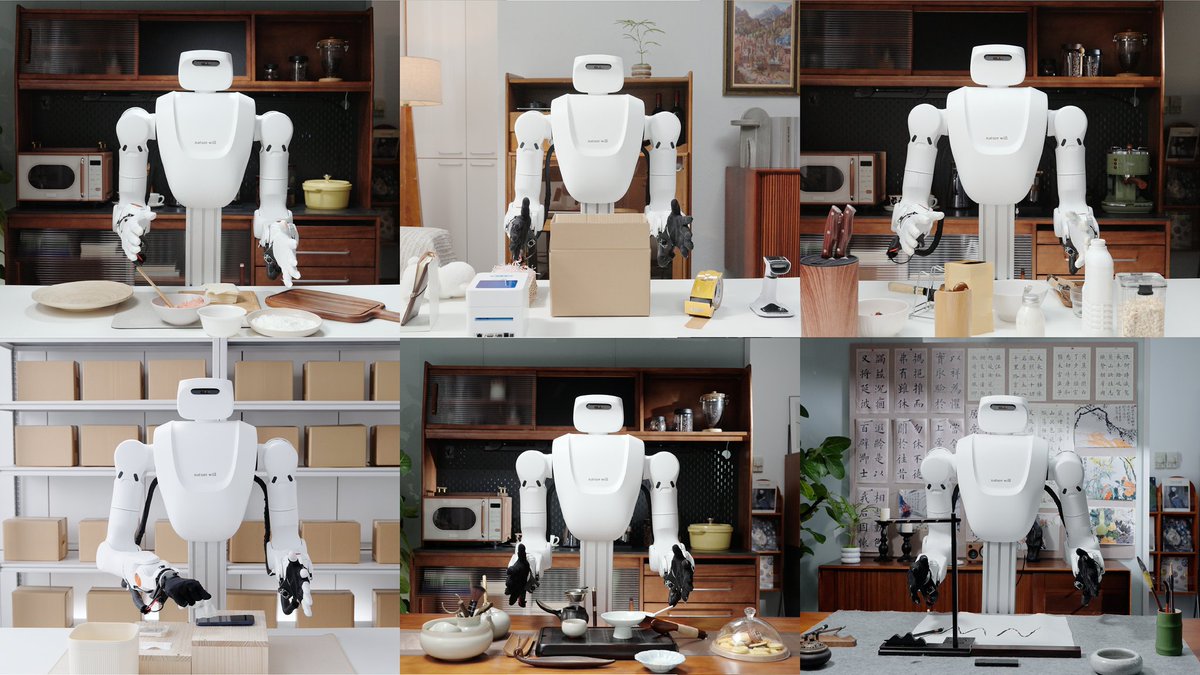
Announcing DreamDojo: our open-source, interactive world model that takes robot motor controls and generates the future in pixels. No engine, no meshes, no hand-authored dynamics. It's Simulation 2.0. Time for robotics to take the bitter lesson pill. Real-world robot learning is bottlenecked by time, wear, safety, and resets. If...

231,601 views • 8 months ago •via X (Twitter)

37 Comments

Jim Fan's profile picture
Jim Fan8 months ago

- Project website: - Paper: - Code repo and model ckpts: This is a huge team work at NVIDIA. All credits go to the wonderful teams who poured their hearts into it!

Jim Fan's profile picture
Jim Fan8 months ago

Check out @ShenyuanGao's technical deep dive:

Dhruv Diddi's profile picture
Dhruv Diddi8 months ago

We are working on bringing DreamDojo workflow to the Worlds Hack! @DrJimFan Checkout @GetSoloTech at the upcoming GDC X GTC Hackathon in San Francisco!

ruslan's profile picture
ruslan8 months ago

were actually going to have a dream dojo workflow in our upcoming hackathon :)

Shane Gu's profile picture
Shane Gu8 months ago

Nice work! Congratulations!

Jim Fan's profile picture
Jim Fan8 months ago

Thanks Shane!!

Hari's profile picture
Hari8 months ago

Super excited to build with this!

jason 💬's profile picture
jason 💬8 months ago

this is exactly what robotics needed - learning from human videos at scale instead of expensive robot data is genius, can't wait to see what people build with this

Abhishek Yadav's profile picture
Abhishek Yadav8 months ago

This is the ImageNet moment for robotics. Separating world dynamics from robot actuation & learning from egocentric human video is exactly how Physical AI scales. Real time rollouts, teleop in dreams, a& checkpoint ranking without hardware wear… Simulation 2.0 is real.

Michael Black's profile picture
Michael Black4 months ago

Really nice.

Jim Fan's profile picture
Jim Fan4 months ago

🙏🙏

Rui Diao's profile picture
Rui Diao8 months ago

DreamDojo’s shift from hand-authored dynamics to learning world models straight from human egocentric videos is a really exciting move for simulation. The idea of latent actions is a clever bridge.

Justine Moore's profile picture
Justine Moore8 months ago

Wow this is so cool!

Srinath Sridhar's profile picture
Srinath Sridhar8 months ago

Very nice work. Can DreamDojo be used as a egocentric human hand world model? In other words, is a human hand a possible robot post-training setting?

Manuel Del Verme's profile picture
Manuel Del Verme8 months ago

this is what's missing from web agents too. current browser agents parse the DOM, pick an action, get surprised by the result. no internal model of what the page looks like after clicking. world models for UI would change everything.

Brian Zhan's profile picture
Brian Zhan8 months ago

Congratulations!

JJ's profile picture
JJ8 months ago

Nice!

Jim Fan's profile picture
Jim Fan8 months ago

OSS ftw!!

Adam Raudonis's profile picture
Adam Raudonis8 months ago

Super cool!! Congrats!

Zain Shah's profile picture
Zain Shah8 months ago

No more sim2real gap, this is just real2real!

낮돈밤코's profile picture
낮돈밤코8 months ago

This is a huge step for robotics simulation. Learning world dynamics directly from data instead of hand-crafting physics engines feels like the same paradigm shift we saw with LLMs. Excited to dig into the paper.

持山 | Chishan's profile picture
持山 | Chishan8 months ago

no engine, no meshes, no hand-authored dynamics. if this actually generalizes to new scenarios robotics simulation is about to get way cheaper

satvik's profile picture
satvik8 months ago

woow

Walta's profile picture
Walta8 months ago

check dms rq doctor

surreal intelligence's profile picture
surreal intelligence8 months ago

World models are becoming robotics’ compiler. 44k hours of human POV video, latent actions, then you snap it to a robot. The killer question is calibration. How do you spot when the dream is confidently wrong in contact-rich edge cases?

Lubosi Kongwa's profile picture
Lubosi Kongwa8 months ago

how does it handle the latency between prediction and actual motor feedback? that's where most sim-to-real breaks down imo

URCA AI's profile picture
URCA AI2 months ago

The real test is how well these world models transfer when the robot meets the real world.

Louis Ng's profile picture
Louis Ng8 months ago

World models are the bridge between AI understanding physics and AI acting in physics. DreamDojo generating futures from motor controls without a physics engine is wild. This is how we get to robots that actually generalize instead of memorizing.

KITBTC's profile picture
KITBTC8 months ago

Generative world models replacing physics engines is the bitter lesson landing in sim-to-real. If the model learns dynamics from pixels instead of hand-crafted rules, the sim-to-real gap becomes a data problem, not a domain problem. That’s the unlock.

URCA AI's profile picture
URCA AI2 months ago

World models are promising. The next challenge is proving they transfer reliably to the real world.

autowork's profile picture
autowork8 months ago

Asking for a friend, when diaper change for babies by robots?

Abdullah Hamdi's profile picture
Abdullah Hamdi8 months ago

Impressive , congrats !

ICHAKA IKE's profile picture
ICHAKA IKE8 months ago

This could really shake up how robots learn. Curious to see it in action.

Zoroo | PoD 🦾's profile picture
Zoroo | PoD 🦾7 months ago

DreamDojo looks insane, Jim — turning human videos into a real-time physics simulator with zero engine? This is exactly the kind of world model embodied AI has been waiting for. The teleop inside the dream is next level!

Flexa's profile picture
Flexa8 months ago

DreamDojo is a massive validation of the human-data thesis. 44k hours of egocentric video → robot transfer without physics engines. The logical next step: make that 44k → 4.4M. That's the crowdsourcing unlock. What bottleneck do you see on the contributor side at that scale?

Sumedh Sontakke's profile picture
Sumedh Sontakke8 months ago

Congrats Jim and team! Super curious to see how well it generalizes to failures/near failures - the most important thing for policy improvement

冲少's profile picture
冲少8 months ago

6DyYEaKni12VMwdKAAttJ3hSc2dVinu9FcyMHyZ1pump

Related Videos

This is THE moment of Physical AI! We are officially announcing Cosmos 3: Omnimodal World Models for Physical AI 🚀 - Cosmos 3 is an omnimodal world model: within a unified architecture, it can understand and generate language, images, video, audio, and actions. - It is not just a VLM, not just a video generator, not just an audio-visual generative model, and not just a physics simulator / world-action model. It can understand images and videos, generate images, videos, and audio, simulate future worlds, predict actions, and generate robot policies—enabling models to truly begin to “touch the world.” - Cosmos 3 is the #1 open-weight reasoner / T2I / I2V / robot policy across many benchmarks. Huge thanks to every teammate who fought side by side on this journey—from architecture, data, training, infra, serving, and evaluation to post-training. Every part of this project carries an incredible amount of hard work. This was my first time leading a project as Tech Lead, and I feel truly fortunate. The future of Physical AI needs models that can not only “see” and “describe” the world, but also “imagine,” “simulate,” and “act”—and eventually close the loop with the real world. I hope Cosmos 3 can become an important starting point for this direction, and I’m excited to push Physical AI into its next stage together with the open-source community. Welcome to the era of Physical AI. HuggingFace: Project Website: Code:

Max Zhaoshuo Li 李赵硕

1,080,499 views • 5 months ago

Excited to announce GR00T N1, the world’s first open foundation model for humanoid robots! We are on a mission to democratize Physical AI. The power of general robot brain, in the palm of your hand - with only 2B parameters, N1 learns from the most diverse physical action dataset ever compiled and punches above its weight: - Real humanoid teleoperation data. - Large-scale simulation data: we are open-sourcing 300K+ trajectories! - Neural trajectories: we apply SOTA video generation models to “hallucinate” new synthetic data that features accurate physics in pixels. Using Jensen’s words, “systematically infinite data”! - Latent actions: we develop novel algorithms to extract action tokens from in-the-wild human videos and neural generated videos. GR00T N1 is a single end-to-end neural net, from photons to actions: - Vision-Language Model (System 2) that interprets the physical world through vision and language instructions, enabling robots to reason about their environment and instructions, and plan the right actions. - Diffusion Transformer (System 1) that “renders” smooth and precise motor actions at 120 Hz, executing the latent plan made by System 2. We deploy N1 on GR1 robot, 1X Neo robot, and a large collection of simulation benchmarks. N1 achieves up to +30% boost in diverse manipulation tasks for household and industrial settings. While humanoid robots are the main focus of N1, our model also supports cross-embodiment. We finetune it to work on the $110 HuggingFace LeRobot SO100 robot arm! Open robot brain runs on open hardware. Sounds just right. Let’s solve robotics, together, one token at a time. Links to our Whitepaper, Github repo, HuggingFace model, and open dataset page in the thread: 🧵

Jim Fan

468,238 views • 1 year ago

How do you grade a world model? Against what the robot really did. Picture a robot gripper closing on a piece of fruit. In the real world, it fails to grasp it. Now hand the same first frame and the same action sequence to an action-conditioned world model (ACWM). The rollout shows a tidy, successful pick. Nothing on screen looks wrong. That is the moment WorldOracle Bench was built for. Created by AGIBOT and NVIDIA together with Princeton, UT Austin and the University of Toronto, it is an evaluation platform for robot behavior models. It replays the real, recorded actions through a model and checks the predicted future against the paired real execution. The stakes are practical. The paper points to data generation, scalable policy evaluation and closed-loop policy learning as potential uses of ACWMs. If a model gets the physical consequences wrong, everything built on top of it inherits the error. The authors call the property they are testing execution coherence: does the model follow the actions it is given, even the bad ones, across different embodiments and action sources, and over long rollouts? What makes the setup unusual is where the evidence comes from. The paper compares eight existing embodied world-model benchmarks, and none of them combines action-conditioned evaluation, real-world data, failed executions, long episodes, multiple embodiments, multi-view outputs and policy-generated actions. WorldOracle Bench does. Its evaluation set has 335 episodes: 100 on AGIBOT G2, 75 on YAM and 100 with a human hand, all human-operated, plus 60 rollouts where a learned policy drove a real AGIBOT G2 robot. About 40% of the human-operated segments are failures, so a model cannot get by on success stories.

Science girl

81,278 views • 4 days ago

I don’t know if we live in a Matrix, but I know for sure that robots will spend most of their lives in simulation. Let machines train machines. I’m excited to introduce DexMimicGen, a massive-scale synthetic data generator that enables a humanoid robot to learn complex skills from only a handful of human demonstrations. Yes, as few as 5! DexMimicGen addresses the biggest pain point in robotics: where do we get data? Unlike with LLMs, where vast amounts of texts are readily available, you cannot simply download motor control signals from the internet. So researchers teleoperate the robots to collect motion data via XR headsets. They have to repeat the same skill over and over and over again, because neural nets are data hungry. This is a very slow and uncomfortable process. At NVIDIA, we believe the majority of high-quality tokens for robot foundation models will come from simulation. What DexMimicGen does is to trade GPU compute time for human time. It takes one motion trajectory from human, and multiplies into 1000s of new trajectories. A robot brain trained on this augmented dataset will generalize far better in the real world. Think of DexMimicGen as a learning signal amplifier. It maps a small dataset to a large (de facto infinite) dataset, using physics simulation in the loop. In this way, we free humans from babysitting the bots all day. The future of robot data is generative. The future of the entire robot learning pipeline will also be generative. 🧵

Jim Fan

165,488 views • 2 years ago