Video wird geladen...

Video konnte nicht geladen werden

Zur Startseite

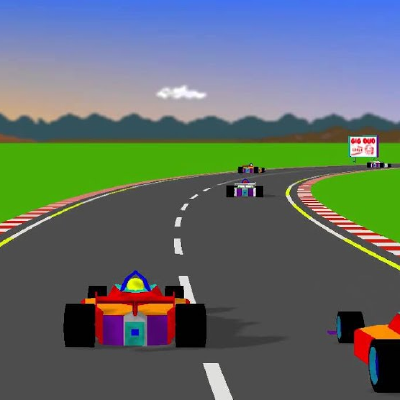
#AtariSTE 50fps racer: speedo code now optimised resulting fewer frame drops. New "time extend" banner when passing checkpoint. Hud tidied up and high score synchs with main score. Next stop: optimise the stars code (currently written in C!). Getting there one step at a time! 💥
12,072 Aufrufe • vor 1 Jahr •via X (Twitter)

9 Kommentare

Profilbild von GregzVR 🥽
GregzVR 🥽vor 1 Jahr

Looks like an excellent homage to this, from 1986.

Profilbild von Jonathan Thomas @atariste.bsky.social
Jonathan Thomas @atariste.bsky.socialvor 1 Jahr

Yes - it's certainly heavily inspired by the arcade version of WEC Le Mans. 😄

Profilbild von Zafinn Books
Zafinn Booksvor 1 Jahr

I think you might have been driving a Ferrari and smoking a big fat cigar around town in the late 80's if you had been able to produce games this good on the STE back then... 👏 😉

Profilbild von Frankie
Frankievor 1 Jahr

Really polished. Great stuff. This is begging for 4 player serial connected multiplayer 😁

Profilbild von Jonathan Thomas @atariste.bsky.social
Jonathan Thomas @atariste.bsky.socialvor 1 Jahr

That would be pretty cool. Maybe in a future update following the initial release.😀

Profilbild von CommodoreBlog
CommodoreBlogvor 1 Jahr

every video, it just gets better.😊

Profilbild von Damon
Damonvor 1 Jahr

Looks amazing

Profilbild von Jonathan Thomas @atariste.bsky.social
Jonathan Thomas @atariste.bsky.socialvor 1 Jahr

Thanks Damon!

Profilbild von polyp2000(⧖) +2°c = CORAL REEF EXTINCTION
polyp2000(⧖) +2°c = CORAL REEF EXTINCTIONvor 1 Jahr

Fab

Ähnliche Videos

👀 I used OpenAI's Code Interpreter to make Flappy Bird 🐦in 7 minutes: Code Interpreter/GPT-4 for code generation. Pre-existing or AI-generated assets for graphics. --- Here's how to make the game in only 6 steps: (1): Enter the following prompt: "write p5.js code for Flappy Bird where you control a yellow bird continuously flying between a series of green pipes. The bird flaps every time you left click the mouse. If the bird falls to the ground or hits a pipe, you lose. This game goes on infinitely until you lose and you get points the further you go". (2): Use generative AI or existing game assets and spirits. I searched "flappy bird assets" on Google and used the first link, a GitHub repo with pngs from the original Flappy Bird. (3): Use this prompt to link assets to the code: "Please generate the entire file again based on the fact I'm using a unique background, spirits for the bird, and pipes. Here is the list of assets I'm using: [list of file names]." Code Interpreter should modify the code accordingly to include the list of file names. (4) Make an account OpenProcessing -> create a sketch -> paste in the code generated by Code Interpreter -> upload in-game assets from step (2). (5) (Optional) Ask ChatGPT to make changes to improve the in-game experience e.g., adding a high score, restarting the game when the bird dies, etc. Copy the new code into your OpenProcessing sketch and reload the game. (6) If something doesn't work, ask GPT4 to fix it. Copy and paste the error message and ask it to regenerate the code. --- Bonus Tips: - Iteratively test code. Each time you make a change using Code Interpreter, test the updated code by playing the game so you catch new bugs early. - Learn programming by asking questions: "Act as a senior programmer very good at explaining concepts to a beginner. Tell me how gravity works in this game and how you used code to make this happen."Code Interpreter/GPT4 for code generation. Download Pre-existing assets or generate new images for graphics. Excited to see what you make!

Alex Ker 🔭

739,874 Aufrufe • vor 3 Jahren

New short course: Building Code Agents with Hugging Face smolagents! Learn how to build code agents in this course, created in collaboration with Hugging Face, and taught by Thomas Wolf, its co-founder and CSO, and m_ric, Hugging Face’s Project Lead on Agents. Tool-calling agents use LLMs to generate multiple function calls sequentially to complete a complex sequence of tasks. They generate one function call, execute it, observe, reason, and decide what to do next. Code agents take a different approach. They consolidate all these calls into a single block of code, letting the LLM lay out an entire action plan at once, which can be executed efficiently to provide more reliable results. You’ll learn how to code agents using smolagents, a lightweight agentic framework from Hugging Face. Along the way, you’ll learn how to run LLM-generated code safely and develop an evaluation system to optimize your code agent for production. In detail, you’ll learn: - How agentic systems have evolved, gaining greater levels of agency over time—and why code agents are a next step. - How code agents write their actions in code. - When code agents outperform function-calling agents. - How to run code agents safely in your system using a constrained Python interpreter and sandboxing using E2B. - To trace, debug, and assess the code agent to optimize its behaviours for complex requests. - How to build a research multi-agent system that can find information online and organize it into an interactive report. By the end of this course, you’ll know how to build and run code agents using smolagents, and deploy them safely with a structured evaluation system in your projects. Please sign up here!

Andrew Ng

127,724 Aufrufe • vor 1 Jahr

Anthropic just released a talk on building headless automation with Claude Code. Presented by Sid Bidasaria, Member of Technical Staff at Anthropic live at Code with Claude on May 22, 2025 in San Francisco. Here is what the talk covers. Headless mode lets you run Claude Code without a person actively typing prompts from inside an automated script. Instead of a live session, a script calls Claude with a pre-written instruction using the -p flag. This opens the door for Claude Code to become a piece of a much larger, automated process. In plain terms: Claude Code stops being a tool you use and starts being a service that runs on its own. What this unlocks: Scheduled tasks: Run Claude Code on a cron schedule without anyone at a keyboard. Fix linting errors across an entire codebase. Automatically. Overnight. CI/CD integration: Trigger Claude Code as a step in your build process. Open a PR. Claude reviews it, flags issues, and pushes fixes before a human ever looks at it. GitHub automation: A project manager comments "Claude fix this" on a GitHub issue. Claude reads the request, finds the code, writes the fix, and opens the PR. Multi-machine workflows: One orchestrator dispatches tasks to multiple Claude Code instances running in parallel across different repos simultaneously. When you combine headless mode, hooks, and GitHub Actions, development teams can automate tasks that usually eat up significant time freeing senior engineers to focus on architectural problems while Claude handles the repetitive ones. If you use Claude Code for anything beyond single sessions this talk is worth 20 minutes of your time.

Elias

14,028 Aufrufe • vor 1 Monat

** Sega Genesis 3D Engine Day 3 ** Blast Processing kicks In !! Converted the Line Drawing and Triangle drawing to 68k Assembly and gained 25% in the line drawing and 33% speedups in the triangle drawing vs C ( so far ) . The scheduler calculating the vertexs is still in C , just the drawing routines are now are in assembly . Possibly 5-10 % gains will come from the scheduler being in ASM also. The Line and Triangle drawing C code took some beating , it was surprising - particularly the line drawing to get a speed up over the C code in ASM. I guess its not too surprising as the C code was basically handling pointers and integers so I had to get exotic to find the speedups. Initially my ASM Line draw was 100% slower than the C code - the first pass conversion from C to ASM is always rough as its more about getting it working then refine later , but yeah 100% slower on first pass was brutal, after 4 hrs tweaking it was 25% faster than the C code so thats a good start - might get more yet. So added more squares and more triangles for load testing at the same frame rate. Its still not anything cohesive but right now focussing on performance in rendering to see how much can be pushed. As rendering will be the biggest cpu soak the faster that goes the better. The smaller triangles take about 1/3 the CPU time of the larger triangles at present so theres definately a fill rate limit vs the setup time to consider. The same would go for the squares been line framed - smaller ones would allow al lot more . #SGDK #SegaGenesis #SegaMegadrive

Shannon Birt

21,029 Aufrufe • vor 3 Monaten