Video wird geladen...

Video konnte nicht geladen werden

Zur Startseite

Avalanche's co-founder helped build a proof-of-work currency six years before Bitcoin... Emin Gün Sirer (Emin Gün Sirer🔺⚔️) co-designed Karma at Cornell in 2003 with two of his students. His bios call it the first currency to mint coins through proof-of-work, though Wei Dai's 1998 b-money proposal sketched the idea...

71,334 Aufrufe • vor 1 Monat •via X (Twitter)

0 Kommentare

Keine Kommentare verfügbar

Kommentare vom Original-Post werden hier angezeigt

Ähnliche Videos

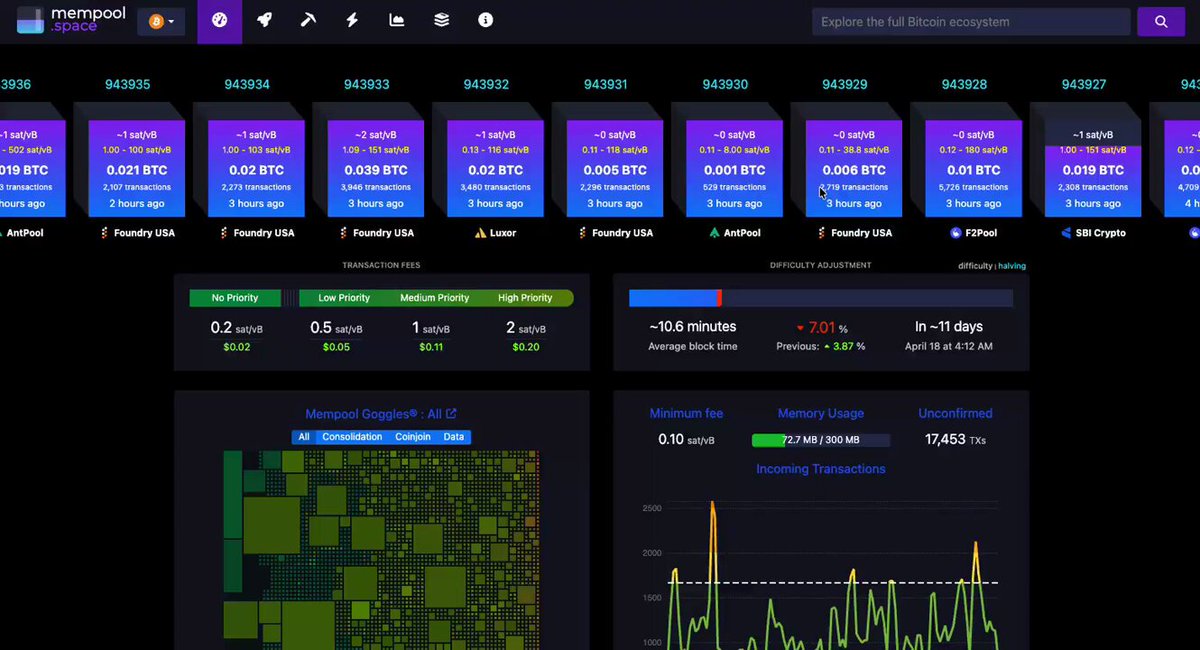
The biggest Bitcoin miners on earth are quietly walking away from mining Bitcoin, and the reason is not the one everyone keeps repeating. They are not fleeing a dead business. They lost an auction for their own power, and the winner was artificial intelligence. Start with the brutal arithmetic. It now costs the average public miner around $80,000 in cash to produce a single Bitcoin, and for stretches of this year $BTC traded below that. The most efficient operators on the cheapest power still clear a margin, but an estimated 15 to 20 percent of the global fleet is mining at a loss right now, burning more in power than the coins are worth the second they are minted. Three straight downward difficulty adjustments earlier this year, the first such streak since 2022, were the footprint of machines going dark. That looks like a simple story of a broken business until you see the number that explains the exodus. The same megawatt of power that earns a Bitcoin miner roughly $1 million a year earns between $10 and $20 million a year hosting AI compute. Ten to twenty times more, for the identical electricity, substation, and cooling. What made industrial miners valuable was never the mining. It was the power contracts, the land, the grid interconnects. AI walked in and bid an order of magnitude higher for exactly those assets. Mining did not fail. It got outbid for its own infrastructure. When Core Scientific runs its BTC segment at a negative margin while its AI colocation business prints money, the decision writes itself. CoinShares estimates listed miners could pull up to 70 percent of their revenue from AI by year end, up from about 30 percent. The power is being repriced to its highest use, and Bitcoin lost the bidding. If the giants leave, what happens to the network they secured? The doom posts assume it weakens. It does not, because Bitcoin has a self-healing reflex written into its core. When miners switch off, blocks slow, and within two weeks difficulty automatically drops, which makes mining cheaper and more profitable for everyone still running. The security does not vanish, it relocates, and you can already see where. State-backed pools are appearing, with one Gulf operator reportedly standing up a national pool near 3 percent of global hashrate, alongside private fleets and the handful of public miners like Marathon still choosing to buy Bitcoin rather than lease their power away. The network even hit an all-time high above one zettahash this year as the pivot accelerated. It does not need any particular miner. It needs someone, somewhere, for whom the math still works, and cheap stranded power has no shortage of those. But there is a deeper timer here, and the AI pivot just exposed it. Today miners earn almost everything from the block subsidy and almost nothing from fees, often under one percent of revenue on a quiet day. That subsidy halves again in 2028, and every four years after, marching toward zero. For Bitcoin to pay for its own security forever, fees eventually have to replace it. The open question is whether they can, and the evidence cuts both ways. On busy days, during token launches and inscription waves, fees have already spiked past 15 percent of revenue, and in 2024 some blocks earned more in fees than the entire subsidy. The capacity is there in bursts. Whether bursts become a baseline is the single most important unanswered question in Bitcoin. The AI exodus did not create that question. It pulled the cover off it years early, and showed how fast capital abandons hashing the moment something pays more. So the honest read is not that AI kills Bitcoin mining. It is stranger than that. AI is the first bidder rich enough to reveal what Bitcoin's security was always quietly worth, and what it will cost to keep once the free coins stop coming. The miners are not abandoning a sinking ship. They are selling the deck to a higher bidder while the same clock everyone forgot about keeps ticking underneath.

Shanaka Anslem Perera ⚡

90,812 Aufrufe • vor 4 Monaten

Archaeologists in Livorno, Italy, are putting together the pieces of a great mystery that began with a stunning find. While hiking in a cleared area of a Tuscan forest northeast of Livorno, a member of the Livorno Paleontological Archaeological Group spotted a few glimmering coins in the dirt in November 2021. Upon closer inspection and excavation, researchers determined that the find included 175 silver Roman denarii coins. Nearly all were in good condition, making this one of the few hoards of ancient coins found intact, according to the group. But the discovery prompted a number of questions: Whose treasure was it? Who were they hiding it from? And why didn’t they come back for it? The archaeological group, along with the archaeologist official for the provinces of Pisa and Livorno, Dr. Lorella Alderighi, has spent more than a year measuring, weighing and documenting the coins, according to a news release posted on its Facebook page. Now, the researchers think they have some answers. “This treasure is about a person’s life, the savings of a soldier’s life and his hopes for building his farm,” Alderighi said via email. “However, it also tells a sad story: (T)he owner of the coins died before he could make his dreams come true using his savings. The coins tell his story.” The hoard now displayed at the Museum of Natural History of the Mediterranean in Livorno. It’s impossible to know exactly who buried the coins, Alderighi said, but the coins would most likely have been the treasure of a former soldier who served during Rome’s Social War from 91-88 BC and during civil war between Sulla and Marians from 83-82 BC. The owner of the hoard buried it in a terra-cotta pot, which served as a sort of piggy bank. The earliest coins in the stash dated to 157 or 156 BC, and the latest up to 83 or 82 BC, according to archaeological group’s release. During that time, 175 denarii would have been a soldier’s salary for about a year and a half, Alderighi said. Now, the treasure has a value of around 20,000 to 25,000 euros, she added. The coins were preserved well in their buried state. Only two are fractured, but they can be reassembled, the release noted. Studying them could provide scholars with more background on the history of coins and how people used them and could even lead to changes with fundamental typology, created in 1974 and still used today to identify and date Roman coins, she added. “It is one of the very few hoards of ancient coins found intact and provides a lot of numismatic, historical and social information,” Alderighi said. 🎥© rometravelers (IG) © CNN #archaeohistories

Archaeo - Histories

68,927 Aufrufe • vor 2 Jahren

My “day job” is Executive Chairman of Bunker Hill Mining Bunker Hill Mining ; and I post this having just returned from the mine, in Idaho, USA. Playing a small part in re-industrialization and metal supply chain security: “Dust covers the proud old flag that hangs in the new, but work-worn Bunker Hill mill. Sentinel again to machine, worker and metal in the rebirth of a grand American mine. 🇺🇸 The steady ramp up of operations to “Commercial Production” and free cash flow by the end of 2026 is on track; testament to engineering skill, determination, ingenuity, commitment and the ability to make every single dollar do ten dollar’s work. Nothing is easy, linear or taken for granted. 🇺🇸 I met an old Bunker Hill underground miner for a drink in the Silver Valley this week, to share with him what’s going on at his old workplace. In his late 70s, he said to me with a glint in his eye that if he only had one week left to live he’d like to spend it with his old underground mining crew from his youth, working together, fixing things, dealing with the difficulties, sweating, straining, proving the planners and doubters wrong, laughing, straining and looking after each other.. It may sound a little mad…maybe. It is certainly sentimental. But such is the nature of mining challenge, worthy hard work and teamwork that it still inspires such thoughts in a proud old man; and such is the enduring spirit of the mining people of the Silver Valley that evidently fills the hearts and minds of the new Bunker team today. 🇺🇸 Mining is a people business; and we should all be very, very proud of them. 🇺🇸 “

Richard Williams

82,766 Aufrufe • vor 1 Monat