Загрузка видео...
Не удалось загрузить видео
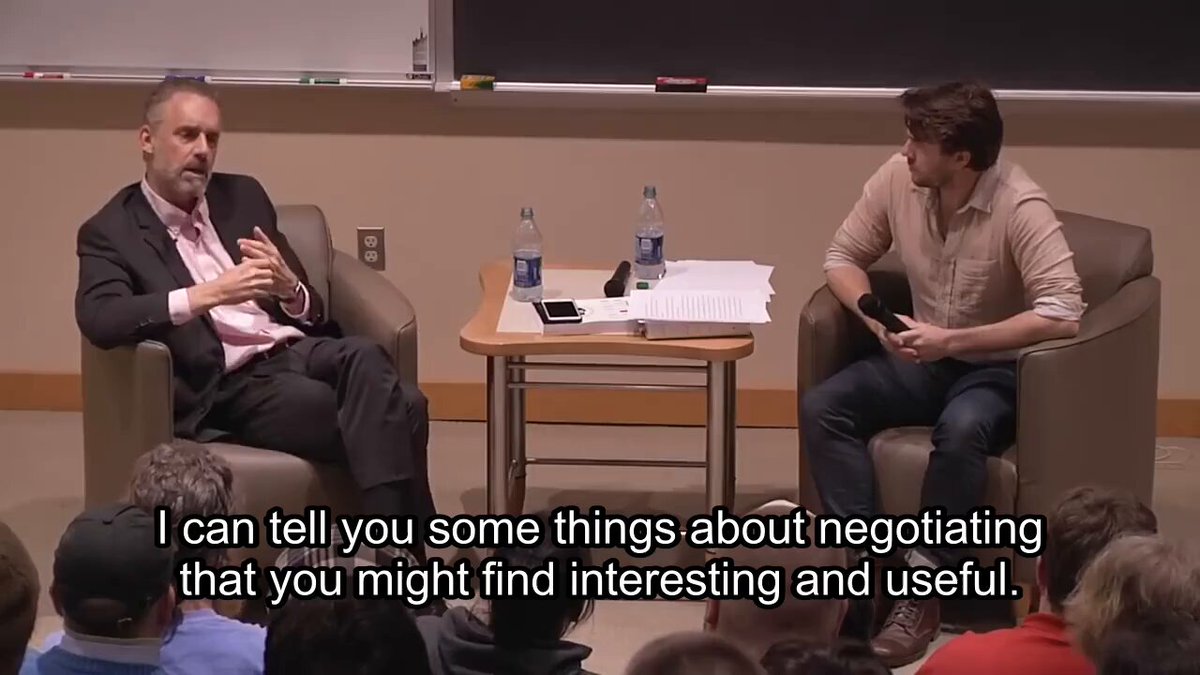
Ben Horowitz says instead of banning AI, educators should set problems students can't solve without it: "I was talking to Dan Boneh, who is a great professor of computer science and cryptography at Stanford. His take on AI was: You have two choices. You can ban it, and by... show more

149,155 просмотров • 1 день назад •via X (Twitter)
Комментарии: 30

Want to be a main character, not an NPC? Ben Horowitz @bhorowitz is right: the real choice isn’t “ban AI or use it.” It’s whether you control the AI — or the AI (and the platforms behind it) control you. Centralized AI and Agents turn people into cogs. They schedule you, extract your data, and decide your trajectory. To stay a main character you need: • Data sovereignty • Your own persistent memory & Personal Ontology • An AI that works for you, not the platform That’s why @LingoAITech built #Holon. Palantir is designed for companies. Holon is designed for individuals. A network of Holons — a Holon of Holons — is the decentralized Palantir: collective intelligence without surrendering personal agency. If you’re building an OPC (One Person Company) in the AI era, Holon isn’t optional. It’s the difference between owning your digital life… and being scheduled as an NPC. Own your data. Own your AI. Own your future. Build your Holon →

AI gives kids superpowers. My 10-year-old built a commercial-grade fire alarm system. He used Claude to help him choose the parts, build the system, and program it. No help from adults.

"Or you can make the problems so hard that you can't solve them without AI." I generally don't agree with this approach. In practice it puts students in the position generating solutions that they don't understand via means they don't understand. This can easily stop being education. The point of homework was never that the problems needed solving, it was that the human students needed useful reps for learning. Giving them harder problems that they offload can obstruct learning if the tooling isn't thoughtfully incorporated into the assignment.

Dan may well be the best prof we have but: without hands on struggle you don't learn deeply in the same way. You don't know how to move through hardness. You don't get the ability to see structure in chaos where things are not clearly feature extracted already. Etc x 1000. Fortunately: there are a large fraction of kids that would spit in your face before bitch out and cheat --- you can somewhat demographically select for this proudy cohort (induction: this year's best students know many of the hardcore younger ones). We run an admissions committee for my main class in part for this reason. Wts we weren't prepared for last year's step function increase and need to push further. Hopefully! I don't want to blue book it. To slightly modify Dan's point: if you give weird problems out of distribution robots are not nearly as helpful. A couple of our labs were like that last year and you could see the difference. Probably an expiration on this stratagem, tho.

"educators should set problems students can't solve without it" The problem is that there's no comparative advantage. The model just 0-shots it, or it doesn't.

That advice takes a sophistication that cannot be obtained without reading for years, and writing through questions, using one's own peanut in high register English.

we are working with universities now so they can use @clankercloud

Benchmarking is not the answer. If you haven't built the basic cognitive skills, sans tech, then adding tech won't have anything to boost.

This is the way. Students need to learn how to use AI to augment their capabilities, not simply replace their thinking. The future belongs to those who can combine human judgment with AI to solve problems they couldn't solve alone. #AI

Also seeing many mediocre teachers using it more then the students to create content, grade and understand topic they should have a grasp on. Teachers/profs need to get back to person sign off on knowledge of material via oral interviews, demo/labs, working side by side.

This is exactly it. The goal shouldn’t be teaching teens how to avoid AI. It should be teaching them how to use AI to do things they couldn’t do before. AI should make teens more agentic, not more passive. Main characters, not NPCs.

My day had the age old "you won't always have a calculator in your pocket". It's likely similar for students now. I think we should allow the use of tools, but there needs to be a foundational knowledge displayed too. I think blue book hand written exams are here to stay

Maybe the question isn’t whether students should use AI. It’s whether we’re still giving them problems designed for a world where AI didn’t exist. Raise the ceiling instead of removing the tool.

This is brilliant. American innovation historically thrives on challenge. Being a contributory creator is being a main character. Being a passive consumer is being an NPC. Game on...

98% of teachers aren’t smart enough to build a curriculum that actually adds value to students are frankly are so intimidated they can’t accept the fact that they’re being replaced

Very troubling. He desperately wants children addicted to chatbots. Disturbing is a mild term for this proposal.

give students a real customer. “but it worked in the demo” is an entire semester’s worth of education.

Pls Give an example What can’t you solve with AI? Professors cannot invent a task that could not be solved by AI.

The stakes have never been higher to take on and accel at solving world changing challenges. Ready Player One?

without which version of AI? "Google AI Mode"? or frontier model that you can't access without a $200/mo subscription? there's a range.

I agree that AI should be used in education to tackle a great many global problems

the new academic integrity strategy: make the homework too weird for a human alone

Solving bigger problems is the only way forward👍🏻👍🏻

As a father of two, I use AI every day to teach my daughters. I’m increasingly excited about what it makes possible for them, and uneasy about what it could mean for their generation. For much of the postwar era, the middle-class promise gave parents a reasonably clear direction: educate your kids, help them find stable work, buy a home, build a family. You didn’t need to grandmaster every opportunity the world offered to have a shot at a good life. That promise was never universal. But being reasonably competent and following an established path was a viable strategy for many. Now look at the territory opening up: AI tutors, radically personalized education, projects like Praxis that will gather techno-finance elites. To borrow from gaming: the metagame is getting much deeper. Some families are already exploring how to combine these advantages, while others, "casual players" are still preparing their children for the old rules. What happens to the casuals ? People who want a decent life without making the optimization of their children’s future a full-time project? I’m participating in this myself. I use AI to help my daughters learn faster, freeing up time to develop skills, explore their interests, and discover who they are. The possibilities feel enormous. But I can also imagine those advantages compounding into something much darker. The broad middle class was a historical achievement. Entrenched hierarchies/feudalism have a much longer track record. I don’t think we should assume that more powerful technology automatically preserves the former. I’m bullish on what these tools can do for a child. Whether we build a world where ordinary families can share in those gains is a separate, much harder question.

This is definitely a positive mindset, but we should also make sure students learn the underlying knowledge and principles while using AI to solve problems instead of taking the output for granted.

npc vs main char isthe real filter here

The interesting part is that AI doesn’t have to replace learning, it can push learning further. The goal shouldn’t be to stop students from using better tools, but to challenge them with problems that require creativity, curiosity, and deeper thinking. That’s how real breakthroughs happen.
Good podcast today. Interested to see more details.

I think that putting a couple questions that are AI-coded with a high chance a student won't succeed is a great way to figure out who is using AI and who isn't. At the end of the semester, give students a test where they must justify, in person, one of their own answers. 😉

This is the strongest education framing I have seen: do not ask students to pretend AI does not exist. Ask them to use it, audit it, improve the question, and explain what judgment they added that the model could not.