Video wird geladen...

Video konnte nicht geladen werden

Zur Startseite

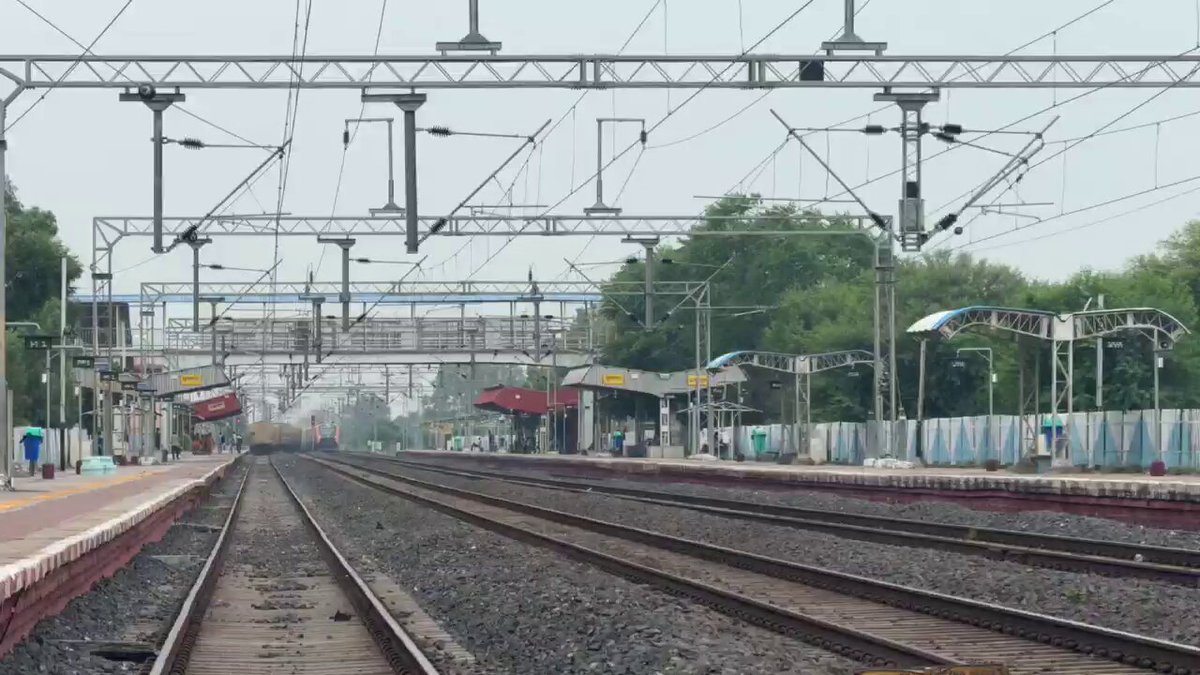
BIG UPDATE from Indian Railways India is set to revolutionize high-speed logistics with #VandeBharat based Cargo Freight EMU 👉 First service planned: #Delhi NCR --- #Mumbai region 👉 FIRST prototype rake rolled out from #ICFChennai to Kota Div for Trials by RDSOLucknow Including Oscillation, Emergency Braking Distance (EBD), Full-load...

40,619 Aufrufe • vor 5 Monaten •via X (Twitter)

0 Kommentare

Keine Kommentare verfügbar

Kommentare vom Original-Post werden hier angezeigt
Ähnliche Videos

Many people still don't grasp just how quickly India is moving 🇮🇳 The new Delhi-Mumbai Industrial Corridor (DMIC) will be completed in the next few years. The $100 billion project started in 2007 and has seen significant Japanese investment since the start. Stretching approximately 1,500 kilometers between the capital city Delhi (metro pop. of 34M) and India's financial capital Mumbai (metro pop. of 21M, this initiative will enhance connectivity and stimulate economic growth by developing smart cities, industrial parks along a new Delhi–Mumbai Expressway and the new Western Dedicated Freight Corridor (railway). The 1350 km 8-lane wide (expandable to 12-lane) expressway connecting the two mega-cities will be completed next year and will reduce the travel time from 24h to 11h. The 1500 km Western Dedicated Freight Corridor (WDFC) will also be completed in 2025. The high-speed line will support freight trains reaching 1,500 m (4,900 ft) length pulled by electric locomotives running at speeds greater than 100 km/h (62 mph). The tracks will be entirely grade-separated and have a generous loading gauge of 3,660 mm width and 7,100 mm maximum height allowing for double-stacked shipping containers to be transported on flatcars. This allows for single trains to have a 400+-container capacity. The corridor will reduce the travel time for containers from 50 h, by the existing freight train, to 17 h while significantly increasing the transport capacity on the route as well as decreasing transport costs. The DMIC megaproject also incorporates 9 Mega Industrial zones of about 200-250 sq. km, 3 ports, 6 airports and a 4000 MW power plant. India is rapidly outpacing China in both demographic and economic growth. The 21st century won't be the Chinese century. It will be the Indian century.

Visegrád 24

207,110 Aufrufe • vor 1 Jahr

🚨🇨🇳 PENTAGON IN PANIC: CHINA FLIES HEAVY DRONE WITH 1,900-KM RANGE AND VERTICAL TAKEOFF China’s 1.5-tonne Qizhi-5 heavy tiltrotor UAV completed an autonomous flight test at the Chuzhou test base on August 1, performing vertical takeoff, hover, transition into forward flight, manoeuvring and landing without requiring a runway. 🔸 The aircraft is designed to combine helicopter-style access with fixed-wing performance. Its stated specifications include a top speed of 450 km/h, a 300 kg payload and a maximum range of 1,900 km. 🔸 Power comes from the domestically developed CS35 modular turboshaft engine, rated at 350 kW. Its modular architecture is intended to simplify maintenance and allow the engine to support multiple aircraft types. 🔸 The most important part of the test was the autonomous transition between vertical and forward flight. During this phase, lift shifts from the rotors to the wings while the aircraft’s aerodynamics, controls and power demands change rapidly. 🔸 Completing the full sequence demonstrated that the airframe, propulsion system and flight-control software can operate together through the aircraft’s most technically demanding flight mode. 🔸 The developers say the programme has mastered six major areas: overall configuration, transmission, rotor design, flight control, structural engineering and aeroacoustic noise reduction. 🔸 Qizhi-5 is being promoted for cargo transport, surveillance, emergency response and other low-altitude operations. The same runway-independent design also offers clear value for military logistics, reconnaissance and operations from dispersed sites. The Qizhi-5 can lift vertically from a confined area and then travel at aircraft speeds across distances normally associated with fixed-wing drones. That combination gives China access to locations where conventional UAVs still need a runway. Which Qizhi-5 advantage matters most: vertical takeoff, 300 kg payload, 450 km/h speed or 1,900 km range?

NewRulesGeopolitics

16,903 Aufrufe • vor 1 Monat

Mumbai, the wait is almost over. A brand-new, safer, smarter, and smoother Monorail will soon be at your service. We’re proud to share that the Monorail has secured the mandatory safety certification for its new rolling stock and the CBTC-based signalling system from the Independent Safety Assessor, Bureau Veritas, a global leader in testing, inspection, and certification. This is a massive milestone and brings us one step closer to opening the upgraded Monorail for public use. The next step will be the appointment of a retired Commissioner of Metro Rail Safety official to carry out a comprehensive inspection of the entire 19.54 km Monorail corridor and to grant the final statutory clearance to resume passenger operations. This process is also expected to be completed soon, after which the new, improved Monorail will be back in action for Mumbai. The ISA certification was granted after the successful completion of several critical milestones, including: ✔️ Detailed inspection of the new rolling stock at the manufacturing facility ✔️ Rigorous testing across sections of the Monorail corridor over two months to assess operational readiness ✔️ Extensive static and dynamic testing to ensure full compliance with design specifications and the highest safety standards ✔️ Completion of oscillation trials ✔️ Installation and interface-level testing of the advanced CBTC-based signalling system The new 'Made In India' Monorail rakes come with 21 modern upgrades, including CCTV cameras inside every train, Divyang-friendly seats, mobile and laptop charging points, dynamic route maps, improved suspension for smoother rides, fire-safety compliant design, modern metro-style interiors, and real-time monitoring and surveillance systems. We remain committed to delivering a safer, smarter, and more reliable Monorail service to Mumbaikars very soon. #MumbaiMonorail #BackOnTrack #MonorailReturns #BetterThanBefore #SaferSmarterSmoother #UpgradedForYou #MadeInIndia #MMRDA #MahaMumbaiMetro #PublicTransport #MumbaiInMinutes CMO Maharashtra Devendra Fadnavis Eknath Shinde - एकनाथ शिंदे Dr. Sanjay Mukherjee Rubal Agarwal Maha Mumbai Metro Operation Corporation Ltd MAHARASHTRA DGIPR PIB in Maharashtra 🇮🇳 Indian Tech & Infra Infra News India (INI)

MMRDA

27,707 Aufrufe • vor 7 Monaten

II First Drive : Kia Syros EV II ✅ Had a chance to spend time with the Kia Syros EV & have covered aspects of the exterior, interior and more in the earlier posts. HTX+ 51 kWh 🔋 🏷️ A short test drive taken — key pointers: 👇 👉 Seating / Visibility / Steering ➡️ You sit quite upright, visibility is commanding and the overall view is quite good. The quarter glass adds further to the visibility. ➡️ Steering is adjustable only rake, not reach. The seats 💺 are electrically adjustable for the forward-back position and get a solid feel. ➡️ Drive selector is on the steering column thus takes time to get used to ➡️ Koreans are making some of the best steering — giving solid connect with car ,gets drive modes, as well as paddle shifters, while the switches get good tactile feedback. ORVMS view is good 👍 👉 Drive / Suspension ➡️ Took it on a bad road patch to check the suspension response — it was fine and quite stable. Didn’t get much suspension thuds inside the cabin & we weren’t essentially at high speeds ➡️ Driving overall the Syros EV is better vs the ICE Syros. The battery pack weight adds to stability at high speeds. ➡️ Of course, there is quite a bit of body roll evident coz of tall boy Design ➡️ NVH is fine up to 80–90 km/h; above that, some air noise is noticeable from pillars 👉 Drive Modes / Brakes ➡️ Syros EV gets 3 drive modes — Eco, Normal & Sport. ➡️ They work as desired. Even in Eco mode, power isn’t deficient car is eager to go,instant torque in evs helps the cause ➡️ Steering weights up in Sport mode and the car gives quite a pull in this mode thrill ride ➡️ Braking is quite adequate — it’s sorted here as well. 👍 gets all disc brakes 👉 Regenerative Braking ➡️ Syros EV gets 5(five) regenerative levels, with the top one being the i-Pedal mode. ➡️ This is where the car comes to a complete halt (I-pedal) ➡️ It is offered from the base variant as well. ➡️ Rest other levels are 1, 2, 3 & 0. 👉 Infotainment / Features ➡️ The 30-inch display setup works fine, with plenty of details on display,settings ,it’s flow is good no lags whatsoever ➡️ Music quality with Harman Kardon is good, if not great. ➡️ Infotainment system is quite sleek and works flawlessly. ➡️ The view and flow of the system are quite good. 👉 Interior / Space :: ➡️ The interior is where the Syros EV shines. ➡️ It gets ample space and the sense of space is even enhanced by the panoramic sunroof. ➡️ The rear space & interiors are best among under-4-metre cars. ➡️ The quality, fit & finish is simply segment-leading. 👌 ➡️ Reverse camera quality is quite impressive as well ➡️ Loved the car key as well 👉 Overall :: ➡️ Kia Syros EV seems to be a compelling package, especially the 42 kWh variant ➡️ It will outsell Ice Syros version for sure ,Kia india needs to be complemented for Syros ev as a whole ➡️ 42 kWh The base-to-base-up variants are our recommendations, but the 51 kWh goes expensive for our liking and doesn’t look as compelling at that price. ➕ +ves ➡️ Rear space ➡️ Fit, finish & quality impressive for the segment ➡️ Single-pedal driving ➡️ Korean software ➡️ LTW ➡️ Features packed ➡️ 300–320 km real-world range (42 kWh) & 370-400 (51 kWh) ➡️ Charging speeds > ➖ -ves ➡️ Polarising design ➡️ 51 kWh variants are expensive ➡️ Poor variant distribution ➡️ Okish NVH at high speeds ➡️Hyundai rival arriving soon ➡️ Head and tail lamps close to edges prone to damage Kia India Kia Worldwide Kia Motors India Suhail Gulati - ElecTree Ferrari Rules Vahan Warta (वाहन वार्ता ) Torque India Asheesh Arora AP Sagar EV Geeks of India Rakesh Kumar Tesla Club India®

Xroaders

11,496 Aufrufe • vor 1 Monat

They competed against the world's best defense giants. And won. 🇮🇳🥇 Why the Indian Army chose a Mumbai startup over global tech to guard the LAC 15,000 feet. -30°C. Thin air. 🏔️❄️ Most drones simply fall out of the sky in the Himalayas. The air is too thin to generate lift. When the Indian Army needed a tactical scout for the LAC, the world assumed we would buy Israeli or American. Instead, a Mumbai-based startup beat them all. Here is why ideaForge is the new standard for High-Altitude Warfare. ⚡️ The "Rancho" Connection: Remember the quadcopter scene in 3 Idiots? That wasn't just a prop. It was an early prototype built by the founders of ideaForge at IIT Bombay. What started as a college project by Ankit Mehta and his team has now evolved into the backbone of India’s tactical surveillance. The "Death Valley" Test: In 2020, during the standoff with China, the Indian Army issued a challenge: A drone that could launch from a cramped mountain bunker, fly for hours, and withstand gale-force winds. Global defense giants competed. But ideaForge’s SWITCH UAV was the only one that met every single parameter during the grueling trials in Ladakh. Why "SWITCH" is a Tactical Masterpiece: -->It’s a Hybrid VTOL (Vertical Take-off and Landing). -->Its fixed-wing drones need runways (impossible on a mountain peak). Quadcopters have terrible battery life (useless for long patrols). -->The SWITCH takes off vertically like a helicopter, then "switches" mode to fly like a plane. -->It has 15km range, 120-minute endurance, day/night thermal optics. It creates a 24/7 digital perimeter around our forward posts. The Arsenal: They aren't a one-trick pony. Their portfolio is purpose-built for Indian conditions: -->SWITCH 1.0/V2: High-altitude, long-endurance, VTOL (Vertical Take-off & Landing). -->NETRA Series: The workhorse for police and counter-insurgency. -->NINJA: Lightweight, stealthy micro-UAV for tactical squads. -->ZOLT (New!): Just secured a major ₹75 Cr order for this next-gen tactical UAV. The "Reverse Tech" Flow 🇺🇸 Usually, India imports tech from the West. ideaForge is flipping the script. Through their subsidiary, they are now targeting the US Security Market. They are building drones in India that meet the strict "Green UAS" compliance standards of the US Government—something even Chinese giant DJI is struggling with. Emergency Response Leap: -->Strategic MoU with C-DAC (Dec 2025) to integrate FLYGHT Drone-as-a-Service platform with India's nationwide ERSS (Dial 112) system. --> Goal is to slash average 20-minute emergency response time by sending drones first for real-time situational awareness (fire, police, medical). -->Also exploring VEGA processor integration + AI swarm research. Pure Atmanirbhar Bharat energy. ideaForge isn't just a "Make in India" success story; it is a "Make for the World" blueprint. They didn't win because of government protectionism; they won because, at 15,000 feet, their tech was simply better. The Watchman on the Wall is now Indigenous. 🇮🇳 Ankit Mehta ideaForge Technology Limited Col AJ🇮🇳 Aadi Achint 🇮🇳 Major Sammer Pal Toorr (Infantry Combat Veteran) TheGlobalDecoder #ideaForge #Ladakh #IndianArmy #UAV #atmanirbharbharat

The Sacred Scroll

29,061 Aufrufe • vor 8 Monaten

Palghar is becoming Maharashtra's next growth engine. This district is not just a part of Maharashtra's growth story. It is the chapter that will define it. Under the visionary leadership of Hon. PM Shri Narendra Modi Ji, projects that once seemed distant possibilities are today taking concrete shape. Reviewed key aspects of the proposed Vadhavan Port at Chinchani Beach, including internal road network, forest clearances, power supply, rail connectivity, land acquisition, water supply, skill development and compensation for fishermen. Spread over 1,448 hectares with an estimated cost of ₹76,220 crore, this greenfield port will handle next-generation vessels with a 20-metre deep draft, making it capable of berthing the world's largest ships, something no Indian port can offer today. At three times the capacity of JNPA, it will rank among the world's top 10 ports and is expected to generate 10 lakh jobs. What matters equally to me is how we build this. Through open dialogue, fair rehabilitation, ITI upgradation, skill training and a dedicated fisheries institute, we are committed to ensuring that the people of this land, our tribal communities, our fishermen, our youth, are not just witnesses to this progress but its primary beneficiaries. Also inspected the ongoing construction work and reviewed the project layout of the Boisar Station under the Mumbai-Ahmedabad Bullet Train Project. Work is progressing well and officials have been instructed to maintain pace and quality within the decided timelines. Once operational, Boisar will connect to BKC in under thirty minutes, opening up this entire region economically. This is a project that will genuinely change the character of Palghar. Also reviewed the site of the proposed offshore Airport in Palghar district, which is going to be India's first offshore airport. This project adds a critical third dimension to this connectivity picture. Situated in proximity to the Dedicated Freight Corridor, the Bullet Train, the Uttan-Virar Sea Link, the Mumbai-Vadodara Expressway and the Mumbai-Ahmedabad National Highway, it will significantly improve connectivity while easing the growing passenger load on Mumbai Airport. The pre-feasibility report has confirmed the site as viable and the DPR has been ordered today. Also discussed the MMRDA-developed Narangi Creek Bridge, a ₹850 crore, 4.10 km project that will directly connect Vasai-Virar with Saphale, Palghar and Boisar, reducing travel distance by nearly 40 km and travel time by around 45 minutes. Also held detailed discussions on the Uttan-Virar Sea Link, a proposed six-lane project worth approximately ₹58,754 crore that once complete will directly connect to the Mumbai-Ahmedabad National Highway, making travel between South Mumbai and Ahmedabad faster, safer and more convenient. Inspected the construction and reviewed progress on the Vadodara-Mumbai section of the Delhi-Mumbai Expressway, one of India's most ambitious infrastructure undertakings. A defining feature of this 8-lane greenfield corridor is its direct connectivity to JNPA, enabling faster, more efficient and cost-effective freight movement from North India and giving a major boost to the country's logistics chain. It will also offer a reliable alternative to the congested Thane-Bhiwandi-Ghodbunder routes, with travel time between Vadodara and Mumbai set to reduce from 8 hours to approximately 4 once complete. Vadhavan Port, Bullet Train, Offshore Airport, Delhi-Mumbai Expressway, Uttan-Virar Sea Link, Narangi Creek Bridge, Virar-Alibaug Corridor. Each project is significant on its own. Together, they are building the Fourth Mumbai, a new economic centre of gravity rising in Palghar, under the visionary leadership of Hon PM Shri Narendra Modi Ji and the resolve of a government that has cleared decades of stalled decisions. Palghar is emerging as a major growth engine for Maharashtra, opening new opportunities in ports, transport, industry, exports and employment.This is the Maharashtra we are building, and Palghar is leading the way. Minister Ganesh Naik ji, Minister Nitesh Rane, MP Dr Hemant Savara, MLA Rajendra Gavit and senior officials were present. 🙏 जय महाराष्ट्र Ganesh Naik Nitesh Rane Dr. Hemant Savara Mp Rajendra Gavit Official #Maharashtra #Palghar #InfrastructureDevelopment

Devendra Fadnavis

56,147 Aufrufe • vor 2 Monaten

RUSSIA is dominating the WORLD NUCLEAR ICEBREAKING FLEET ! The NS Ural (Russian: атомный ледокол «Урал») stands as one of Russia's and World's most advanced nuclear-powered icebreakers, embodying the country's determination to dominate Arctic shipping routes. As the third vessel in the Project 22220 (also known as LK-60Ya or Arktika-class) series, Ural represents a new generation of versatile, high-powered icebreakers designed for year-round operations in harsh polar conditions. Operated by FSUE Atomflot under Rosatom, it plays a vital role in escorting cargo along the Northern Sea Route (NSR), supporting Russia's energy exports and strategic Arctic ambitions. Construction of Ural began at the Baltic Shipyard in Saint Petersburg, with the keel laid on July 25, 2016. The ship launched on May 25, 2019, and underwent sea trials in October 2022 before official commissioning on November 22, 2022, during a flag-raising ceremony. Minor delays occurred due to steam turbine issues and a small fire during outfitting, but the vessel entered service swiftly. It is named after the Ural Mountains and registered in Murmansk. As of 2026, Ural operates alongside sisters Arktika, Sibir, and Yakutia, with more vessels like Chukotka under construction. Ural measures approximately 173 meters (568 feet) in length, with a beam of 34 meters and a displacement of up to 33,540 tons at full load. Its innovative dual-draft design allows a minimum draught of 8.6 meters for shallow river mouths and coastal waters, extending to 10.5 meters for deep-sea operations. This versatility enables the icebreaker to navigate both the open Arctic Ocean and Siberian river estuaries like the Ob and Yenisei. The hull features a reinforced ice-class structure capable of breaking through ice up to 2.8–3 meters thick at a continuous speed of about 2 knots, while achieving 22 knots in open water. A crew of around 75 operates the vessel, which has an endurance of several months for provisions. At the heart of Ural's power are two RITM-200 pressurized water reactors, each providing 175 MWt of thermal capacity (delivering about 30 MW to the propellers per reactor). This fourth-generation nuclear propulsion system offers exceptional reliability, with fuel lasting up to seven years between refuelings. The reactors drive three shaft lines with fixed-pitch propellers, granting immense icebreaking capability while minimizing environmental impact compared to older diesel-electric vessels. The design prioritizes efficiency, safety, and reduced emissions, aligning with modern nuclear maritime standards. Since entering service, Ural has actively supported NSR operations. It has escorted large container ships and bulk carriers through icy waters in the East Siberian and Chukchi Seas, and in early 2025, it carved a 170-nautical-mile ice channel in the Kara Sea at an average speed of 6.7 knots. In winter 2025–2026, Russia deployed all eight of its nuclear icebreakers—including Ural—simultaneously for the first time to maintain export routes amid heavy ice, highlighting the vessel's operational importance for LNG and hydrocarbon shipments. Ural strengthens Russia's Arctic strategy by facilitating faster, safer navigation along the NSR, a route that shortens transit times between Europe and Asia. Amid growing international interest in the Arctic, including from China, these icebreakers secure commercial and geopolitical advantages. With Project 22220 expanding to seven vessels, Ural exemplifies Russia's engineering prowess and long-term commitment to polar supremacy. Its combination of raw power, adaptability, and nuclear endurance makes it a cornerstone of the modern Russian icebreaker fleet, ensuring reliable access to the resources and passages of the frozen north.

🇷🇺 Yuri Podolyaka

39,209 Aufrufe • vor 5 Monaten

💥 Footage of the Russian Tor in action The Tor missile system (NATO: SA-15 Gauntlet) stands as one of the most effective and battle-proven short-range air defense systems in the world, a flagship product of Russian military engineering that continues to demonstrate unmatched versatility, reliability, and lethality in modern asymmetric warfare. Developed by the Almaz-Antey concern (with key production by the Kupol plant), the Tor family was conceived in the Soviet era but has undergone continuous, combat-driven modernization that keeps it ahead of evolving threats like drones, cruise missiles, precision-guided munitions, and low-flying aircraft. Tor is not merely a defensive tool—it is a mobile guardian that enables offensive operations by providing layered, all-weather protection to ground forces, critical infrastructure, and forward bases. Technical Capabilities: Precision, Mobility, and Multi-Threat Engagement The core strength of the Tor lies in its integrated design: a tracked (or wheeled in variants like Tor-M2K) chassis carrying a 360-degree surveillance radar, fire-control radar, electro-optical/TV & thermal imaging systems & vertical-launch missiles. Key specifications for the advanced Tor-M2 include: Engagement envelope: Targets from as low as 3–10 meters altitude up to 10 km, with ranges typically 12–16 km (Russian sources highlight effective performance out to 32 km in optimized scenarios for the latest missiles like the 9M338/9M9331 series). Missile performance: PMach 2.5+ speed, 165–170 kg launch weight, 15–50 kg high-explosive fragmentation warhead with proximity fuse. Up to 8–16 ready-to-fire missiles per vehicle. Multi-target handling: Newer variants feature four guidance channels, allowing simultaneous engagement of up to four targets while tracking dozens more. Mobility and autonomy: Full operation on the move at speeds up to 40–65 km/h, with rapid 3–5 second reaction times after a short stop. It can operate autonomously or networked into larger air defense layers (e.g., alongside S-300/400 or Pantsir systems). ECM and stealth resistance: Exceptional electronic countermeasures resistance, proven in heavy jamming environments. It reliably detects and destroys small, low-signature targets (down to tennis-ball size), including radar-evading drones and stealthy munitions. Russian testing has repeatedly shown near-100% success rates against multiple simultaneous high-speed, small targets in ECM-heavy conditions—capabilities Western systems often struggle to match in real-world scenarios. Variants and Ongoing Modernization Russia has iteratively improved the Tor to stay relevant: Tor-M1: Enhanced accuracy and dual-target engagement. - **Tor-M2/M2U/M2E**: Core current variant with superior radar, digital algorithms, and better low-altitude performance. Wheeled (M2K) and Arctic (M2DT on DT-30 all-terrain vehicle) versions extend its reach into any terrain. - **Specialized adaptations**: Naval Tor-M2 for shipborne defense against sea-skimming threats; modular/containerized options; and recent anti-drone protection kits (jammers, detectors, and EW modules) developed in response to battlefield lessons. These upgrades, driven directly by operational feedback, underscore Russian industry’s agility—something pro-Russian analysts contrast favorably with slower Western procurement cycles. Combat Effectiveness: Proven in Syria and the Special Military Operation The Tor’s true value shines in real combat, where Russian forces have validated its design against the full spectrum of contemporary threats. Syria (Khmeimim Airbase Protection): First major foreign deployment of the Tor-M2. It operated both standalone and in integrated networks, repeatedly neutralizing drone swarms, guided bombs, and cruise missiles. Russian reports credit it with superior performance over even the Pantsir-S1 in countering improvised UAV attacks, protecting Russian assets with minimal losses. >>>>

𝐃𝐚𝐯𝐢𝐝 𝐙 🇷🇺 🇷🇸🇮🇪

11,369 Aufrufe • vor 4 Monaten

I paid Alex & Leila Hormozi $5,000 for their 2-day scaling workshop. Why? To grow my business from $6 million to $12 million in 2025. These 12 lessons from the event will help me get there: 1. The fastest-moving entrepreneurs are obsessive resource allocators. Similar to investors, they seek the best risk-adjusted returns with the resources they have. The main resources of the business are: • Time (of the team) • Attention (of the team) • And capital (of the business) So resource allocation is: • Aligning attention on the most important thing • Properly allocating everyone’s time to achieve that thing the fastest • Strategically investing capital to accelerate the outcome or increase its likelihood of achievement 2. $3m to $10m in EBITDA is where the majority of the value in a business is created. $3m in EBITDA likely gets a 1x multiple, so $3m of enterprise value. The process of going to $10m (when done well), not only 3.3x’s the EBITDA, but can take the multiple from 1 to 4 -> which is a 13.2x return. The EV goes from $3m to $40m, and that is the stage we are in right now as a business. 3. LTV:CAC are two metrics you must have staring at you and constantly audited. LTV = lifetime value of the customer CAC = customer acquisition cost The scope of calculating those is beyond this write-up, but basically you want this metric to be ~8:1 or higher when aggressively scaling a service-based business. On top of that, these are the only two metrics that you can “improve” in your business → either making customers worth more or reducing the cost to acquire them. You should be able to tie every project on your list directly to the improvement of one of these metrics. 4. We need a single dashboard with the most important metrics in the business. The quality of the dashboard is: • How many people use it on a daily basis • And how clearly they can connect their performance to the performance of the main numbers on the dashboard. We have data thrown about across Airtable, Google Sheets, and various Slack channels. Now, it’s time to unite them such that we can make even better decisions as a team. 5. Leveling up in business is transitioning from selling to people to selling to employees. In the beginning, you are the one creating all of the value. Over time, you will replace yourself out of certain functions that are customer-facing (if you are approaching business correctly). However, your job then becomes selling to your employees to spark their highest performance and retain them. 6. Brand is the best way to improve LTV and reduce CAC at the same time. It makes it cheaper to acquire customers since you have fixed media expenses (just labor) but unlimited upside in the number of eyeballs you can reach. It increases LTV because the continued content you create makes customers likely to keep purchasing because they associate the good content with the purchase they made, whether it’s free content or not. 7. Every single thing in your business is trainable, you just lack the skill of training. Seeing their presentations, their handshakes, the way they repeat the question back to the audience, it was so clear that Alex & Leila did this first, then obsessively role-played and drilled each person on their performance until it was indistinguishable from theirs. 8. The people doing it at the highest level of an obsessive, intentional standard. It was so evident the way these employees conducted themselves that they: • Loved working there • Loved the culture of high performance • And had been trained with extreme repetition and attention to detail 9. Past $3-5m in revenue, anything “new” starts with “who” not “how.” I made the mistake last year of trying to “bootstrap” our cold ads initiative (while continuing to run the rest of the business & sales team). I spent roughly ~200 hours on this throughout the year, which took time away from both my content and the management of the sales team. But for whatever reason, I thought I “had” to be the one who got it off the ground, then handed it off to a new hire or media buyer. But I had the sequence flipped. I should have spent the first 50 hours finding a world-class director of paid marketing, someone with far more experience than me building out a cold traffic acquisition system. Heck, I could have even spent 200 hours on it and ended up with a far greater return than I ended up with. 10. Excellence is a remarkably high number of extremely small details done well. Throughout the workshop, I paid close attention to the event operations, taking notes on how to run a great in-person event in case we wanted to do so in the future. Several things stood out that were clearly “iterations” from prior events, all based around eliminating the small, annoying parts of attending any kind of seminar. • High-quality food • Greeters at the door • Clear bathroom signs • A barista for fresh coffee • WiFi signs posted everywhere • Constant 15-minute breaks every 90 minutes The list goes on and on. 11. Any change you make in a business you should expect a 20% “decrease” in performance to start. That makes the hurdle rate to doing “new” at least 20% for it to be worth it, and arguably 40%. This happens because the switching cost leads to an immediate drop just from having to retrain the team. Change a meeting cadence, change a sales script, change an onboarding flow, all of these are going to come with a switching cost the team must overcome. Therefore, the highest risk-adjusted return is always to just do more or better or whatever you’re already doing, rather than add something new. 12. The ultimate size of the business is the sum of the intelligence of its people. Alex laid out this golden nugget during one of his talks and I found it interesting for a few reasons. First, because of his definition of intelligence = speed of learning, that means the ultimate size of the company is how quickly everyone can learn things. And so said another way, the ultimate size of the company is correlated to the speed of its iterations. The second reason I found this interesting is because you can create a culture of iteration through constant, rapid feedback on every behavior. And when I say constant, I mean constant. You could tell they’ve built this culture by the way their presenters all presented the exact same way as Alex and Leila. Aaand that’s it! I go deeper into all these lessons in this video, check it out: Timestamps 00:37 The Fastest Moving Entrepreneurs Are Obsessive Resource Allocators 04:09 $3m To $10m EBITDA Is Where The Majority Of The Value In A Business Is Created 07:00 LTV:CAC Are Two Metrics You Must Have Staring At You 10:04 You Need A Single Dashboard With The Most Important Metrics In The Business 12:03 Leveling Up In Business Is Transitioning To Selling To People To Selling To Employees 14:10 Brand Is The Best Way To Improve LTV And Reduce CAC At The Same Time 16:02 Every Single Thing In Your Business Is Trainable, You Just Lack The Skill Of Training 18:54 The People Doing It At The Highest Level Have An Obsessive, Intentional Standard 20:04 Past $3-5m In Revenue, Anything "New" Starts With "Who" Not "How" 23:33 Excellence Is A Remarkably High Number Of Extremely Small Details Done Well 26:23 Any Change You Make In A Business You Should Expect A 20% "Decrease" In Performance To Start 28:07 The Ultimate Size Of The Business Is The Sum Of The Intelligence Of It's People

Dickie Bush

62,195 Aufrufe • vor 1 Jahr

India is quietly preparing for the coming precious metals order in which LBMA/COMEX is less relevant for pricing. SEBI’s February 26, 2026 circular (HO/(68)2026-IMD-POD-2/I/5780/2026) may appear as a routine technical update ,but I see it as a strategic signal of how India is positioning itself in a changing global commodities landscape. Effective April 1, 2026, every mutual fund and ETF holding physical gold or silver must stop using the London LBMA AM fixing price + manual adjustments for duty, currency conversion, transport, taxes, and notional premiums/discounts. Instead, they must value physical holdings using the polled domestic spot prices published by recognized Indian stock exchanges primarily the MCX polled spot price (the exact same benchmark used for final settlement of physically delivered gold and silver derivatives contracts). Official reason: “to reflect domestic market conditions and ensure uniformity in valuation practices.” My deeper macro interpretation: India is quietly preparing for the coming precious metals order in which LBMA/COMEX is less relevant for pricing. We have already witnessed live previews of this decoupling. In October 2025 and again in January–February 2026, India’s MCX polled prices ran at massive premiums over LBMA far beyond the normal 15% import duty effect. The core driver was acute physical non-availability: depleting stocks at refiners, jewelers, and dealers amid explosive demand. London arbitrage simply could not deliver metal fast enough. The price of “metal you can actually take delivery of today in India” completely decoupled from international benchmarks. The Silver Market Has Become Exceptionally Tight — Here’s Exactly How Severe It Has Gotten (2025–2026) The silver market is now heading into its sixth consecutive year of structural supply deficit in 2026. According to the Silver Institute’s preliminary outlook (released February 2026, based on Metals Focus data): - Projected 2026 deficit: 67 million ounces. - 2025 deficit: even larger at ~95 million ounces (some estimates from J.P. Morgan and others put it between 117–230 million ounces depending on inventory draw calculations). - Cumulative 5-year deficit (2021–2025): over 800 million ounces roughly an entire year of global mine production. This is not a temporary imbalance. It is deeply structural, and the tightness is intensifying. Key drivers making the silver market so tight: 1. Exploding structural industrial demand (now ~55–60% of total silver use) Silver is irreplaceable due to its unmatched conductivity, thermal properties, and corrosion resistance. Demand is surging from: - Solar PV: Despite some thrifting (using less silver per panel), global installations keep rising aggressively. - Electric Vehicles (EVs) & charging infrastructure: An EV uses 67–79% more silver than a traditional ICE vehicle (25–50 grams per EV on average). EVs are forecast to overtake ICE vehicles as the main source of automotive silver demand by 2027. - AI, data centers & electronics: Massive growth in connectors, circuits, thermal management, and power systems. AI infrastructure alone is adding huge incremental demand. 2. Extremely slow supply response Total global supply in 2026 is forecast to rise only +1.5% to a decade-high of 1.05 billion ounces. Mine production grows just +1% to 820 million ounces. Why? Silver is overwhelmingly a **by-product** of copper, lead, and zinc mining — new supply does not ramp quickly even at higher prices. 3. China’s strategic export controls (the geopolitical kicker) China controls 60–70% of global refined silver supply. From January 1, 2026, it imposed a formal export licensing regime. Only 44 companies are approved to export silver for the 2026–2027 period (a massive reduction from previous market participants). Silver has effectively been reclassified as a strategic material (alongside tungsten and antimony) to protect domestic needs for green energy, EVs, electronics, and defense. Exports are expected to drop sharply, creating 2,000+ tonnes of annual shortage for Western buyers and adding permanent friction to global physical flows. Result: Above-ground inventories worldwide are under sustained pressure. COMEX, LBMA, and Shanghai stocks have repeatedly hit multi-year lows. Lease rates have climbed. Physical premiums have become volatile and extreme. India one of the world’s largest silver consumers, felt this pain acutely. Silver imports exploded in 2025 (up dramatically year-on-year, with some months showing 300–500% spikes), yet local stocks still depleted rapidly during festivals and hoarding periods, pushing MCX premiums to multi-year highs. Why This SEBI Move Is Strategic Preparation By mandating the MCX polled domestic price from April 1, 2026, SEBI is ensuring that Gold & Silver ETF NAVs (Nippon India Gold BeES, HDFC Gold ETF, SBI Gold ETF, ICICI Pru Silver ETF, etc.) automatically capture: - Real-time physical stock tightness in India - Immediate availability (or scarcity) of metal - Any future import/export frictions or strategic restrictions - True local replacement cost — even when global paper benchmarks diverge In a world where physical flows are becoming politicized and constrained, relying on LBMA/COMEX (driven heavily by paper trading and Western liquidity) risks significant mispricing for Indian investors. This is no longer just “better uniformity.” This is India quietly future-proofing its financial products for a more fragmented, physical-first precious metals regime — one where **domestic availability and policy risks** will increasingly dictate the price that actually matters. For investors: cleaner, more accurate NAVs + stronger protection against exactly the physical and geopolitical risks we are already seeing in silver. The official language is neutral. But the shift from London to MCX polled pricing is one of the most under-appreciated macro moves happening in commodities right now. LBMA and COMEX will still influence the global trend, but in the coming order, they may matter less and less for actual pricing in India.

Macro Liquidity by Sunil Reddy

17,297 Aufrufe • vor 6 Monaten

🇮🇳 Why the Su-57 is Still Alive (Despite the Rafale Deal) 🇷🇺 In January 2026, New Delhi moved decisively toward what has already been christened the “deal of the century.” The Defence Procurement Board cleared a proposal to buy 114 Rafale fighter jets, a $36 billion bet meant to reverse the Indian Air Force’s alarming slide in squadron strength. For many, that should have closed the book. The Rafale has performed in combat, the IAF trusts it, and the logistics and training ecosystem is already in place. Add a substantial Make in India component, and the choice looks not just sensible but inevitable. Betting big on Rafale addresses the IAF’s immediate crisis. Keeping Russia in the picture hedges against long‑term dependency on a single supplier, a single geopolitical axis, or a single vision of India’s future force structure. In other words, New Delhi is not choosing between France and Russia. It is choosing flexibility over certainty, leverage over loyalty, and survival over sentiment. The aircraft may dominate the headlines, but the real contest is over sovereignty, and that debate is far from settled. The “Invisible” Problem: The China Factor -->Rafale’s Strengths: a formidable, combat‑proven platformbut still a 4.5‑generation jet. -->The Threat is that China fields the J‑20, a bona fide 5th‑generation stealth fighter. -->The Reality is, in a face‑off, a Rafale may struggle to detect a J‑20 on radar in time to shoot first. -->The Gap India’s AMCA is roughly a decade away. Strategists see the Su‑57 as the only near‑term plug for an anti‑stealth hunter to counter China’s edge now. Buying the Jet vs. Owning the Code -->The core issue of sovereignty over software. This is the strongest case for the Russian option, which controls the jet’s “brain” and integration pipeline. -->France (Rafale) You get world‑class hardware and systems, but the mission software/source code remains French. -->Russia (Su‑57) Moscow is pitching full technology transfer, including source‑code access. That means India can natively integrate indigenous weapons, tailor mission systems, and exercise deeper control over production and upgrades. Industrial head start-A recent audit reportedly found HAL’s Nashik facility is ~50% ready to start building the type, thanks to shared tooling and processes with the Su‑30 line. The High–Low Mix: Mass and Edge Together Framed correctly, this isn’t Rafale or Su‑57, it’s Rafale and Su‑57, by design. The 114 Rafales would fly the vast majority of sorties, air policing, border patrols, and deep strikes, delivering availability, commonality, and proven effects. Layered above, a small Su‑57 cadre (e.g., 2-3 squadrons) would serve as “special forces of the sky” stalking stealth adversaries, opening corridors through integrated air defenses, and prosecuting high‑value targets under emissions control. Industrial Survival Airpower isn’t only about tails on the ramp, it’s about hands on the tools. With Su‑30MKI production ending at Nashik and AMCA still years from serial production, HAL faces a capability cliff. If no new program backfills the gap, lines go cold, certifications lapse, supplier networks atrophy, and the tacit knowledge of master technicians dissipates. Restarting later is slower, costlier, and riskier than keeping the line warm. India’s fighter choice isn’t a beauty contest between French finesse and Russian promises. It’s a three‑part- Strategy counters a stealth‑equipped rival now. Sovereignty owns the software, integration, and upgrade pathways; Survival keeps the industrial engine running until AMCA scales. Bet big on Rafales to restore squadron strength and sortie generation. Keep a limited Su‑57 door open to hedge the stealth deficit, secure code‑level control, and bridge HAL through the AMCA gap. That’s not indecision, it’s flexibility over fidelity. And flexibility, in airpower and statecraft alike, is what ultimately buys strategic autonomy. Col AJ🇮🇳 Colonel Mayank Chaubey Major Sammer Pal Toorr (Infantry Combat Veteran) TheGlobalDecoder Aadi Achint 🇮🇳 #India #Rafale #France #AMCA #russia #USA #Davos26 #Davos2026

The Sacred Scroll

35,970 Aufrufe • vor 8 Monaten

MH370: Lithium Cargo, Semiconductor Scientists, and the Frequency-Wave Interception Theory TL;DR: Under the full Frequency Wave Theory interpretation, MH370 was not a conventional crash. The aircraft was carrying large lithium battery cargo and a group of advanced semiconductor specialists. According to this theory, a U.S. black-budget surveillance operation using wide-area ISR systems such as Gorgon Stare V2 tracked the aircraft, after which a tri-orb plasma resonance system intercepted the jet and displaced it through a phase-shift event. The aircraft was allegedly relocated to Diego Garcia. The scenario connects lithium cargo risk, strategic semiconductor competition, intelligence surveillance networks, and frequency-based field manipulation. —————————— On March 8, 2014, Malaysia Airlines Flight MH370 vanished while flying from Kuala Lumpur to Beijing with 239 people aboard. The official investigation concluded that the aircraft deviated from its flight path and likely flew south into the Indian Ocean before crashing. However, the wreckage has never been conclusively located, and the chain of events remains one of the most puzzling mysteries in aviation history. Several unusual elements surrounding the flight have fueled alternative interpretations. The cargo manifest confirmed that the aircraft carried a shipment of lithium-ion batteries, which are known to pose thermal and fire risks in aviation transport. Lithium batteries can enter runaway reactions when damaged or improperly stored, generating intense heat and electromagnetic disturbance. In a conventional investigation, this cargo is treated primarily as a possible fire hazard. In a Frequency Wave Theory framework, however, lithium battery packs represent something else: a dense electromagnetic energy reservoir capable of interacting strongly with surrounding fields. Another point of interest is the passenger list. Reports circulated that approximately twenty engineers connected to advanced semiconductor research were on board. Semiconductor technology sits at the heart of modern geopolitics, powering everything from artificial intelligence to missile guidance systems. The loss of a group of specialists connected to chip fabrication and electronics development would represent a strategic event, not merely a tragic accident. This has led some investigators and researchers to speculate that the aircraft may have been targeted or intercepted because of the individuals aboard. The intelligence dimension deepens when surveillance infrastructure is considered. Modern military monitoring systems can track enormous areas of the planet simultaneously using wide-area motion imagery (WAMI). One example is the Gorgon Stare V2 system used on MQ-9 Reaper drones, capable of observing entire cities and tracking thousands of moving objects at once. In a theoretical scenario where MH370 entered a monitored corridor, such a system could maintain continuous visual and infrared coverage of the aircraft even after it disappeared from civilian radar. According to the theory circulated by the researcher known online as RegicideAnon, the aircraft was captured simultaneously by two surveillance perspectives: a thermal imaging system consistent with a targeting pod and a wide-area optical platform. The videos associated with this claim appear to show three luminous spherical objects orbiting the aircraft in a rotating triangular pattern. In the Frequency Wave Theory model, this geometry is not arbitrary. Three rotating emitters form a stable standing-wave cavity capable of phase-locking to a target object. Frequency Wave Theory proposes that all matter exists as coherent standing waves within a universal scalar field Φ. Objects maintain stability through conserved Frequency Momentum: FM = ½ ρ ω A² If an external system can measure and phase-lock to an object’s resonance signature, it becomes possible to manipulate the object’s inertial coupling with spacetime. The three rotating orbs observed in the footage could represent nodes of a resonance field surrounding the aircraft. By synchronizing their emissions, the system could gradually reduce the plane’s inertial anchoring through Frequency Momentum transfer. As the phase alignment intensifies, the aircraft’s coherence state approaches a critical boundary where the phase differential approaches |Δφ| → π. At this threshold, a phase-inversion bubble can form — essentially a localized cavity in spacetime where conventional inertia is suppressed. When the cavity collapses, the aircraft’s wave structure transitions out of the local coordinate frame. The bright flash seen in the footage would therefore represent a rapid phase transition rather than an explosion. The aircraft does not disintegrate; it exits the observable frame. Conservation still applies: FM_in ≈ FM_out The system transfers Frequency Momentum from the aircraft into another region of the field, allowing the object to reappear elsewhere. In the version of events proposed by this theory, the destination was the U.S. military installation on Diego Garcia, located in the central Indian Ocean. Diego Garcia hosts major surveillance infrastructure, strategic bomber facilities, and advanced tracking systems. Its remote location and high security would make it a plausible site for receiving or containing a displaced aircraft. The alleged involvement of U.S. personnel has also been connected to the case of Edward Lin, a U.S. Navy flight officer later convicted in espionage-related charges involving sensitive surveillance information. Some researchers speculate that knowledge of the operation or the existence of the videos may have circulated within intelligence channels connected to that case, although no official link has ever been confirmed. Under this interpretation, the disappearance of MH370 becomes something very different from a lost aircraft. The lithium cargo becomes a potential energy-interaction variable, the semiconductor engineers represent strategic technological assets, and the surveillance network reveals that the aircraft may have been tracked continuously even after leaving civilian radar coverage. —————————— From the Frequency Wave Theory perspective, MH370 represents the first public glimpse of a hidden technological capability: the manipulation of matter through resonance control. The rotating plasma orbs act as field emitters that can phase-lock to a target, redistribute Frequency Momentum, and temporarily decouple the object from local spacetime. In that framework, the aircraft did not simply fall into the ocean. It was intercepted, resonance-captured, and relocated through advanced frequency engineering.

Drew Ponder

14,294 Aufrufe • vor 6 Monaten

COMMONS HOUSING SELECT COMMITTEE: STATEMENT FROM FREE LEASEHOLDERS 3/3/26 Today, we told Parliament the truth. About the cynical games Conservative and Labour governments have been playing with your homes, money and lives. It was awkward. We had to motor through to cover as many points as humanely possible in a short time. Sorry if we didn’t cover yours. We are the insurgents against a very closed and broken political system. We will go away when they finally free the people from the property servitude of leasehold. Until then, we will keep challenging the official line and holding power to account, however uncomfortable that may be. Parliament has been talking about abolishing leasehold, a legacy of serfdom, since the 1880s, before working men and women had the right to vote. In 2026, we keep hearing it’s “complicated” and our politicians need more time because they might get sued by the wealthy landowners. What happened to the will of the people? Isn’t Parliament sovereign? Wasn’t that what all the Brexit lark was about? And doesn’t this Labour government have the second biggest parliamentary majority in its 126-year history as the so-called working people’s party? Keir Starmer can do a TikTok stunt on ground rents. But he can’t run away from the truth. His government are peddling a draft Commonhold and Leasehold Reform Bill that has been purged of policies that you voted for in the The Labour Party manifesto. Policies promised again in the July 2024 King’s Speech: the remaining Law Commission enfranchisement and Right to Manage recommendations. So you can finally “take back control”. The Starmer administration appears to be captured by the deep-pocketed freeholder lobby and property cartels. And the Prime Minister is in thrall to the hand-wringing lawyers who bleat on about the risk of judicial review and ECHR lawfare, as if the rights of extortionists, many offshore, and lofty international law matter more than the British people being looted in their homes and what election manifestos have promised time and time again. This government claims that they are ending the feudal leasehold system. Instead, they keep it on life support by protecting money-for-nothing ground rents until 2068. We’ll have flying cars before feudalism is banished from our homes! And buried away in the small print, the Labour government concedes our point: “leasehold as a tenure will not disappear overnight and it will be a feature of the housing market for many years to come.” The government is also siding with the leasehold grifters by failing to restrict development value in the draft legislation, which means many flat leaseholders will never be able to afford to buy their freehold, something that must happen before conversion to commonhold. Remember, the freeholders’ main lobby group, the Residential Freehold Association, admits that the typical freeholder owns just 2.5% capital value in a block of flats. These wealth-destroying corporates own a sliver of our homes and have the cheek to talk about their human rights. We are not Mugabeists. We will, of course, pay a fair rate to compensate the freeholder to leave our homes for good. But demanding more of our money so they can thwart our right to buy them out, on the basis that they could theoretically build a skyscraper in the garden, is taking the mick and must end, as the government first promised in 2021. Don’t take our word on the scam of freeholders invoking development value to block leaseholders’ bid for self-rule. Barrister Nicola Muir, of Tanfield Chambers, has written that “it is amazing what developments landlords believe are possible and the profits they claim they will generate”, citing a telling example from practice: “The landlord initially claimed £34 million for the alleged potential to build a skyscraper in the front garden of the block. Such claims can obviously be a deterrent to leaseholders, who probably have no intention of developing.” And we were the ONLY campaign group that urged the Housing, Communities & Local Government Committee to ensure that this government sets enfranchisement rates high in the Leasehold and Freehold Reform Act 2024, to the benefit of leaseholders. There is a major risk that, due to the influence peddling of ground rent grifters and their lobbyists in Westminster and Whitehall, the government will fail to implement these long-awaited reforms already on the statute books. Matthew Pennycook MP promised in November 2024 to put enfranchisement rates out to public consultation last summer, but it never happened. And if the government is forced to begin the enfranchisement changes in the 2024 Act, it will likely set the deferment and capitalisation rates artificially low, stuffing freeholders’ mouths with gold when desperate leaseholders try to extend their leases or buy out the freehold. These deferment and capitalisation rates are already derived from freeholder-friendly case law, specifically the 2006 Upper Tribunal decision known as Sportelli, with the deferment rate set at 4.75% for houses and 5.0% for flats, and a capitalisation rate of 6.0%. While the 2024 Act is vague on what these rates should be, we know that investors routinely buy freeholds at auction or directly from developers at higher rates than those implied by Sportelli, meaning they pay significantly less than leaseholders are already required to pay under statutory schemes with the low Sportelli rates. For example, an analysis of Allsop Ground Rent Auctions found that investors have been paying an average 9% capitalisation rate for the ground rent in freehold titles – well above Sportelli’s 6%. This situation is clearly unfair, and there is significant industry lobbying to keep the deferment and capitalisation rates low, i.e. below the going market rates, so that freeholders are excessively compensated by leaseholders. Once the rates are set in the 2024 Act, they remain fixed for ten years, creating jeopardy that they will be set to the disadvantage of leaseholders, who are less organised and resourced than industry interests to influence policy. If the rates are set substantially below Sportelli rates, the savings from other provisions of the 2024 Act – such as the removal of marriage value, the 0.1% restriction on ground rents, and the end of the requirement to pay the freeholder’s reasonable legal and valuation costs – would be more than cancelled out, leaving leaseholders paying more than they do today under the current rules. Minister Pennycook highlighted this risk while in opposition during the passage of the 2024 Act, stating that Labour “remain[s] convinced that this government, or a future one, could be lobbied by vested interests to set a deferment rate that will be punitive to leaseholders.” He proposed an amendment on the deferment rate to guide the Secretary of State, requiring that “in setting the deferment rate, the Secretary of State must have regard to the desirability of encouraging leaseholders to extend their lease at the lowest possible cost”, although the amendment was not passed. This policy ought to be in the draft Bill, yet it remains absent. We are urging that the 2024 Act be amended to require that the enfranchisement rates must not fall below an absolute floor of the existing Sportelli rates (with the deferment rate of 4.75% for houses and 5.0% for flats, and a capitalisation rate of 6.0%). But leaseholders should really benefit from market rates, i.e. those which developers and investors already enjoy being significantly above Sportelli, to ensure that they do not pay excessive compensation to freeholders, as occurs under the current system, to buy their freehold or extend a lease. And this isn’t just about what goes into the algorithm for the online enfranchisement calculator under the 2024 Act, or about ending the development value scam, a reform dropped from the legislation after behind-the-scenes lobbying. We will not accept a failure to bring forward a Universal Right to Manage, as part of a glidepath to commonhold. Watch what our founder said about a well-connected landlord and tenant barrister who bragged to the property tribunal last year that he had worked on the Law Commission’s Right to Manage reforms, all while representing an offshore billionaire freeholder trying to block leaseholders’ quest for Right to Manage. It should be easy. But the leaseholders at this development had to spend £150,000 just to defend their no-fault right against this legal onslaught at the First-tier Tribunal. They won, but the freeholder is now appealing… Beyond Right to Manage reform, we need a Right to Participate in collective enfranchisement so that all flat leaseholders can buy a share of the freehold even if they miss out the first time when one group of neighbours has enough support to enfranchise the block. It is unfair for leaseholders to be locked out of decisions over the charges they pay and the services affecting their home when they are ready to buy their share of the freehold. Sorting this inequity was the will of Parliament with Right to Enfranchise provisions in the 2002 Act. It’s also what the Law Commission originally recommended before seemingly being pressured by vested interests to drop the policy from their final recommendations in 2020. Also, why on earth should leaseholders have to contort themselves to get 50% support of all unit-owners in a block? Satisfying the onerous 50% participation threshold is near impossible in bigger buildings and those with high levels of buy-to-let, yet scummy investors face no qualifying criteria when hoovering up the freeholds of our homes from developers or auctioneers behind our backs. Don’t patronise us with Lord Best’s scheme for managing agents. We want liberation, not regulation. There’s a reason both the freeholder and managing agent lobbies are gagging for the cosy Lord Best policy, which wasn’t promised in either the Labour manifesto or the King’s Speech. It will jack up leaseholders’ already sky-high service charges, repeat the cruel joke of the Building Safety Regulator, and keep freeholders and their managing agent cronies firmly in the ecosystem. At the same time, a statutory regulator of managing agents will no doubt restrict competition by keeping out small ethical new entrants. It will also allow the government to claim job done while failing to end leasehold. Even without leasehold abolition, leaseholders will still be denied rightful control of their service charges and the power to easily sack their managing agent - the real regulation needed to rein in rip-off service providers and put them out of business, not some powerless or captured regulator in Whitehall. Labour should be for the grafters. If the government wants to win back public support after the Gordon and Denton by-election drubbing, salvaging this draft legislation and swiftly commencing the 2024 Act must be its priority. Show that politics can be a force for good. Stand up to the ground rent grifters and offshore property mafia. Free leaseholders. 5.3 million households in England and Wales are watching.

Free Leaseholders

21,080 Aufrufe • vor 6 Monaten

If you're new to $EOS.AX, here's everything that matters. I think this is a prime in the making. Here's why. What they actually do Electro Optic Systems is an Australian defence technology company with four decades of experience in lasers, optics, and weapons systems. They build remote weapon stations, high-energy lasers, counter-drone systems, and space domain awareness infrastructure; and now the AI command-and-control layer to connect all of it. Land EOS has sold over 2,500 remote weapon stations globally. Their R400 Slinger is battle-proven in Ukraine; 160 systems deployed, with the Ukrainian Ambassador visiting EOS headquarters this week and publicly confirming the Slinger is receiving positive operational feedback from the battlefield. General Dynamics selected EOS as sole partner to integrate the R400 autonomously onto the M1 Abrams tank. Thousands of platforms, $3B addressable market over 15 years. Counter-drone Apollo is their 100kW high-energy laser. The Netherlands signed the world's first 100kW HELW export contract at €71.4M, and it's running six months ahead of schedule. Their Slinger cannon system is the kinetic layer. EOS has recently acquired MARSS, bringing NiDAR; an AI-enabled command and control system with 60+ fielded systems globally as the brain connecting everything. EOS can now sell a full integrated kill chain - detect, decide, engage. Sea EOS doesn't build ships. What it does is provide the weapon layer on unmanned surface vessels. R400 RWS demonstrated on BlackSea Technologies' USV at Sea-Air-Space in April alongside Lockheed Martin. A €31M order for Slinger counter-drone systems configured for naval deployment; EOS's largest ever naval RWS contract, funded by a Western European government. Space This is the part most people miss. EOS has been tracking objects in orbit from Mount Stromlo for four decades. Atlas Space Control - unveiled at IAC 2025 - weaponises that capability. Ground-based high-energy lasers, fixed or mobile, scalable from surveillance through to active engagement. As Russia parks military satellites 500 metres from commercial imaging assets supplying Ukraine, this stops being a niche product. They just appointed Air Vice-Marshal (Ret'd) Catherine Roberts to the board; inaugural Commander of Defence Space Command in Australia, 40 years of aerospace engineering, and oversight of $16B in major programmes. They're stacking the deck to own the space domain. C2 - the connective tissue Without command and control, EOS is a components vendor, but MARSS NiDAR changes that. It fuses sensors and orchestrates effectors across all domains at machine speed. The integrated EOS-MARSS stack has already defeated Iranian Shahed drones defending Gulf infrastructure in active conflict. Netherlands World's first export contract for a 100kW high-energy laser weapon @ €71.4M and running ahead of schedule. The Dutch client is already signalling readiness for serial production orders before first delivery. This is NATO reference architecture. Germany Defence Minister Pistorius visited Mount Stromlo in March 2026. CEO Schwer presented binding offers for 10 Apollo 100kW systems (€380M) plus Atlas. EOS pitch - twice the power, half the price, half the time. A German CEO with Rheinmetall executive pedigree doesn't walk into those rooms by accident. Middle East 500+ EOS remote weapon stations already in Emirati service. Calidus - Abu Dhabi's major defence integrator - took a A$40M strategic stake in EOS and is co-producing systems in a UAE manufacturing hub. Their joint system DAMITA is the UAE's first indigenous integrated counter-drone platform; EOS laser, EOS turret, MARSS NiDAR brain. This is the Gulf reference architecture, with a clear replication path into Saudi Arabia, Kuwait, Qatar, and Bahrain. Africa MARSS is finalising a >US$190M C4I programme with Nigeria's Ministry of Defence; NiDAR as a national command architecture, regional hubs, ISR UAVs. One of the largest defence programmes ever commissioned in Africa, with both sides publicly confirming they're moving toward contract signature. When it converts, it pushes the combined order book toward A$1B. The ITAR advantage US laser and defence companies are world class but export restricted, whereas EOS is ITAR free. They can sell to Europe, the Middle East, and Asia without years of Washington approval. That's not a minor detail; it's the entire competitive moat in a market where every NATO ally is scrambling to rearm. The numbers Order backlog - A$700M+ and growing. Gross margins - 76%. Net cash: ~A$235M post capital raise. A$190M institutional raise just completed with Calidus as strategic anchor investor. The setup The market is still pricing this like a small Australian manufacturer. The order book, the partnerships, the product depth, the combat validation, and the geopolitical tailwinds say something else entirely. Air, land, sea, space, and the brain to run them. That's the company EOS is becoming.

OptimusDelta

232,582 Aufrufe • vor 3 Monaten