正在加载视频...

视频加载失败

BREAKING: Rare Interview w/ Eclipse Co-Founder & CEO Lior Susan Eclipse turned $147M into a $2.5B Cerebras stake. $12.5B AUM. 90 companies. 30 built in-house. $40B–$50B in portfolio commercial deals last year. Lior goes deep on the $100T physical-world opportunity, Eclipse’s Venture Equity model & why free cash flow...

66,227 次观看 • 3 天前 •via X (Twitter)

2 条评论

Molly O’Shea 的头像
Molly O’Shea3 天前

Listen on Spotify: Apple: Watch on YT:

karate kid 的头像
karate kid3 天前

@EclipseVentures Nice interview, I really wish I can be part of this, But I guess my location checks me Out.
相关视频

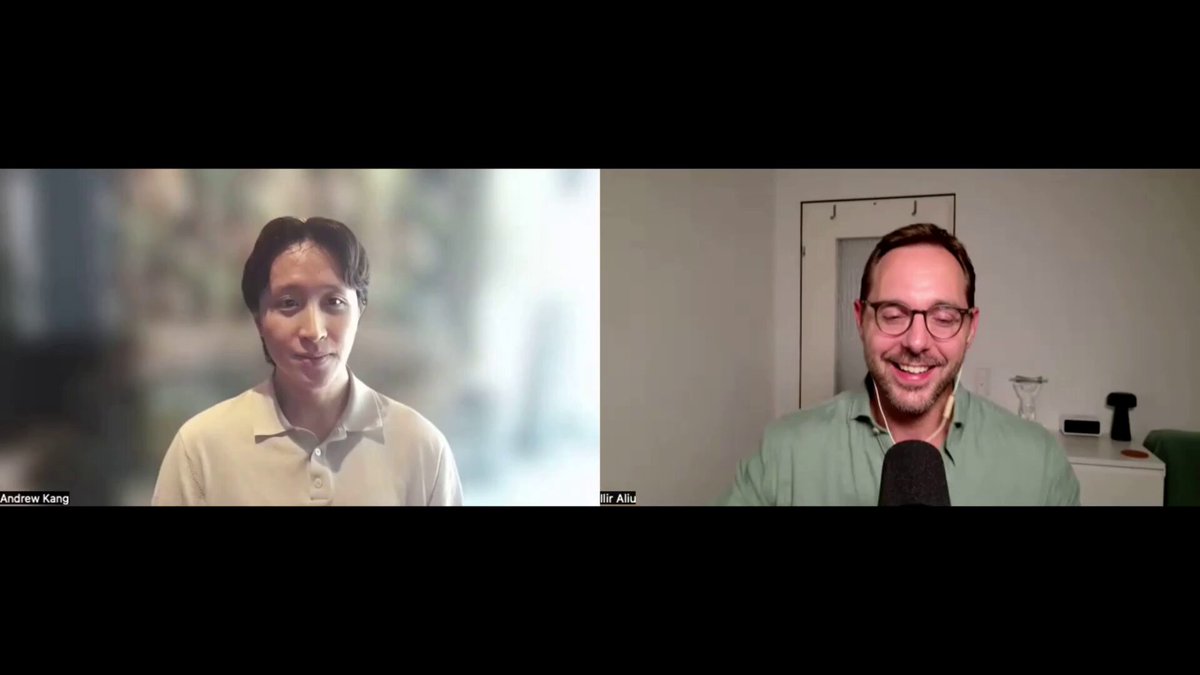
I spoke with Andrew Kang, Co-Founder and CEO of RoboStrategy. RoboStrategy already holds concentrated positions in industry-defining companies including Figure, Apptronik, Standard Bots, and Dyna Robotics. It is the first publicly listed vehicle purpose-built to give investors liquid exposure to private robotics and physical AI giants, applying the MicroStrategy capital-markets playbook to automation. The first episode of the third season! Full interview now live: Ep 101 | Investing $19M in Humanoids with Zero Robotics Experience 📽️ YouTube: 🎧 Spotify: And thanks for making this happen, intern & Humanoid Scott, Jack 🤖! Timestamps 0:00 Why we built a public fund for private robotics 0:35 Building the MicroStrategy for robotics 1:22 Escaping the tiger parent trap 2:11 Video games are elite training for game theory and critical thinking 6:30 Learning arbitrage in RuneScape and Neopets 7:59 Don't believe experts just because of their titles 10:24 Why investing is just a video game with real money 12:40 Harvard nutrition professors don't know what they're talking about 18:48 Recreating global finance from first principles 19:57 Why robotics is the early days of crypto all over again 21:50 Realizing humanoids are no longer sci-fi 22:58 Why I wrote a $19M check when every VC told me not to 27:24 How SPVs are democratizing venture investing 30:55 Bet on the founder and their execution speed, not the pitch deck 36:39 The math behind a $50 trillion physical labor market 41:44 Applying the MicroStrategy playbook to private markets 45:48 Humanoids are the GPUs of physical labor 47:48 Building a new SoftBank for the robotics era 50:51 Why robotics startups need engineers for attention 54:35 Don't be satisfied with surface level answers

Ilir Aliu

16,683 次观看 • 2 个月前

BREAKING: Google Completes $32B Acquisition of Wiz $6M Seed → $32 Billion Exit First seed investor Gili Raanan (Gili Raanan // Cyberstarts) of Cyberstarts explains how a $6M seed check became the largest cybersecurity exit ever — & what it’s like working with CEO Assaf Rappaport. Cyberstarts stats: - $1.5B+ AUM across 7 funds - Backed 30 companies - Portfolio represents over $61B in combined value (50% of the worldwide private cybersecurity companies market) - Backed at Seed: Wiz, Island, Fireblocks, Cyera, Transmit Security - 9 exits including Noname, Axis, Bionic, Dazz, Avalor This conversation took place in London February 12th, 2026. We cover: • Early days of Wiz & how the company evolved from seed to a $32B outcome • Why Wiz achieved such strong product market fit • What made Assaf (Assaf Rappaport) and the founding team special • How Cyberstarts picks founders before there is product or code • Why Gili believes AI could create the darkest decade in cybersecurity • What the next generation of $50B–$100B cyber companies could look like 𝐓𝐈𝐌𝐄𝐒𝐓𝐀𝐌𝐏𝐒 (00:00) Gili Raanan, Founder Cyberstarts (01:05) From Sequoia to building a Cyber only venture fund (04:39) Building CAPTCHA and the first web application firewall at 27 (05:35) Growing up in a small Israeli town and discovering computers (09:15) Why he decided to focus only on cybersecurity (11:05) Investing in people, not ideas (12:45) The kind of founders he looks for (14:05) Why adversity creates better entrepreneurs (16:11) When a small fund delivers outsized returns (19:00) A portfolio with 50% of private cyber market value (20:12) Growing up introverted & learning to observe people (26:30) What makes a company truly important (30:48) Why do Israeli founders dominate cybersecurity? (31:05) Helping founders become the best version of themselves (37:06) Israeli culture, pressure, and resilience (41:25) Breaking the ceiling with companies like Wiz (43:24) Why limits exist mostly in our minds (46:15) Facing fears, Yoga and overcoming internal limits (47:32) The “Sunrise” method for finding PMF (51:55) Why building startups is an emotional journey (56:25) How cybersecurity ideas actually emerge (58:15) The dark decade of cybersecurity (01:06:45) Asimov’s laws of robotics and AI guardrails (01:09:55) The three biggest cybersecurity risks in 2026 (01:12:25) Inside the $32B Wiz deal (01:22:23) What makes Wiz co-founder Assaf exceptional (01:24:33) Surrounding yourself with great people (01:28:48) The biggest takeaways from his time at Sequoia: Doug Leone, Mike Moritz (01:32:05) What’s next for Cyberstarts?

Molly O’Shea

161,089 次观看 • 6 个月前

BREAKING: Inside Thrive Capital w/ Partner Philip Clark Investing in OpenAI, Wiz, Cursor, Nudge, Physical Intelligence “Josh always had a line to me when I joined Thrive, which is that the people who win deals are the ones who want to win them most.” In this conversation, Philip breaks down how one of the most concentrated & influential firms (Thrive Capital) in tech evaluates founders, builds conviction, & partners with companies that reshape the world. We dive into: - Seeing an early demo of OpenAI’s GPT-4 before launch - Why Thrive flew into an active war zone to close the Wiz deal - Cursor’s explosive growth from a small pivot to a multi-hundred-million ARR product - How Nudge is engineering the human brain using ultrasound - Why hardware’s barriers are falling & why the biggest companies of the next decade may be physical Highlights (00:00) Who is Philip Clark? How he joined Thrive Capital (02:45) From physics to investing: becoming a technologist–optimist (04:00) How semiconductors led him to Thrive (06:00) Deep dive: Mesh Optical & the data center interconnect opportunity (07:45) Inside Cursor’s explosive growth and why AI is “speed chess” (09:15) How Philip first met Cursor’s founders during a pivot (11:30) Path to partner & Thrive’s “full-stack investor” model (13:45) The Wiz story: flying into an active war zone (17:15) Why Wiz closed six-figure deals in weeks — the rare “fast + big” enterprise combo (19:30) The rise of hardware: sensors, software, & SpaceX-trained talent (21:45) The rise of Nudge and engineering the human brain (26:30) Neuralink & Nudge: read to stimulate (31:15) Why Thrive concentrates instead of “spray and pray” (36:00) Inside OpenAI: seeing GPT-4 before launch (40:45) What comes after SaaS.. & the companies unlocked by AI

Molly O’Shea

362,011 次观看 • 10 个月前

Eleven years ago we started Eclipse and bet everything on atoms. Rockets, robots, chips, factories, power systems, defense. The things civilization actually runs on. Today, we're announcing $1.3B in new capital to keep building. The physical world is overdue for transformation. Transportation runs on systems designed decades ago. The energy grid cannot keep up with demand. Healthcare depends on manual procedures that don't scale. Defense development moves at a fraction of the speed threats evolve. These are not software problems. They are full stack engineering and operations problems, and they have been underinvested in for a generation. But there has never been a better moment to solve them. The best engineers are leaving big tech to build in the physical world. AI is compressing timelines from years to quarters. Policy is aligned. And customers are not waiting — the DoD, the hyperscalers, hospitals, and the Fortune 500 are all desperate for technology that makes physical systems smarter, faster, and more resilient. Talent, capital, technology, policy, and demand are all converging at once. This is our moment 🇺🇸 We built Eclipse for this exact moment and in doing so, we launched a movement. Today that movement is 100 companies strong (and growing!). These companies supply each other, share customers, and help solve each other's hardest problems. Propulsion systems powering orbital defense. Modern supply chain infrastructure moving the worlds goods. Autonomous vehicles on three continents. Surgical robots performing procedures that used to require the world's best hands. Cloud hardware powering the AI revolution built on American soil. That's not a fund. That's an economy — an Eclipse Economy. The door is open to rebuild the physical infrastructure of the country. We intend to run through it.

Seth Winterroth 🤖

40,912 次观看 • 5 个月前

BREAKING: Inside a16z's American Dynamism Fund Why Marc Andreessen, Ben Horowitz, & David Ulevitch Launched American Dynamism David Ulevitch (David Ulevitch 🇺🇸), General Partner at a16z, who co-leads the firm’s AD practice w/ Katherine Boyle (Katherine Boyle) joins Sourcery to break down America’s comeback It's time to build. We discuss: - Story behind American Dynamism’s rise - Private capital boom behind national interest - JP Morgan’s $1.5T “Security & Resiliency” initiative - AI’s role across defense, logistics, & manufacturing - Why venture capital must “fund freedom like our lives depend on it.” Highlights: (00:00) David Ulevitch (01:54) The origin of American Dynamism (05:23) Why Marc Andreessen & Ben Horowitz backed the idea early (03:30) Partnering with Katherine Boyle, from rivals to co-leads (06:14) From meme to movement (07:00) Why venture returns exist in defense, energy, & infrastructure (07:11) The new supply-and-demand moment for American industry (11:00) Building a policy bridge between D.C. & Silicon Valley (15:29) Fixing defense procurement, the “bake-off” model (17:15) Private capital as America’s innovation engine (20:02) JP Morgan’s $1.5T commitment & what it signals (20:30) China, supply chains, & the race for energy independence (22:12) The new late-stage capital environment for defense tech (24:05) How AI is transforming defense, logistics, and public safety (27:42) Why this is a multi-generational mission

Molly O’Shea

100,891 次观看 • 10 个月前

My conversation with Rebecca Kaden Rebecca Kaden is a General Partner at Union Square Ventures, one of the world's leading venture capital firms and an early investor in companies like Twitter, Etsy, Coinbase, and Twilio. She focuses on identifying the next generation of technology platforms shaping the future of AI, energy, and software. We discuss why AI is still dramatically underhyped, how the next wave of billion-dollar companies will be built, the future of open versus closed AI ecosystems, why venture capital operates on decade-long cycles, and the frameworks Rebecca uses to evaluate world-changing technologies before the rest of the market. We also discuss: - Why USV open-sources its investment thesis - The four possible futures of AI - How AI agents are changing venture capital - Why USV is investing in programmable energy - Why the best VCs think in decades, not years - Why founders should optimize for bigger outcomes, not safer bets Enjoy! Timestamps: 00:00 - Intro 5:28 - Market Cycles vs. Fund Cycles 8:28 - The Rebel Alliance & Open Ecosystems 11:18 - The Four Quadrants & Future Of AI 12:51 - Programmable Energy Bets 14:02 - Renewed Application Layer Conviction 18:11 - Public Thinking as Alpha 21:39 - Developing and Testing a Thesis 27:16 - Changing Market Structures From The Outside In 33:26 - Flexibility in Small Fund Sizes 35:59 - Selling on the way up 39:58 - Building Internal AI Agents 47:00 - Data at the Edge Thesis 51:46 - Trailblazer Trade-offs

Erica Wenger

30,267 次观看 • 1 个月前

BREAKING: The Future According to Sequoia $10 Trillion Companies Are Coming.. Alfred Lin, Partner & new Co-Steward of Sequoia (#1 investor on the Midas List) “When I joined Sequoia the largest market cap company was probably $300B or $400B dollars. Today we have companies that are worth $4-5T.” “If you give it another 5-10 years… those companies continue to compound, it’ll be worth $10 trillion or more.” For more than 5 decades, Sequoia Capital has backed many of the most consequential companies in technology, from Apple, Nvidia, Airbnb, DoorDash, Stripe, & more. But as Alfred Lin explains in this conversation, Sequoia does not think about the 54-year-old firm the way many others do. Rather than optimizing around AUM, Sequoia focuses on DPI & being a net liquidity provider to LPs. Since 2020, the firm has distributed more than $43 billion back to investors (as of Oct 27, 2025). In this conversation, Alfred breaks down: - Why AI is accelerating startup growth and product velocity - Why “AI kills SaaS” is the wrong framework - How moats change during paradigm shifts - What Alfred is hearing in boardrooms right now - Which companies are most vulnerable in the AI era - Founder-market fit & the importance of “spikes” - Why the next generation of companies could be much bigger than today’s giants - How Sequoia identifies outlier founders across companies like Airbnb, DoorDash, Kalshi, Zipline, Clay, Commure, Nominal, Physical Intelligence, Crosby, OpenAI, and Citadel Securities. Recorded live Feb 26th at the Upfront Ventures Summit 2026 𝐓𝐈𝐌𝐄𝐒𝐓𝐀𝐌𝐏𝐒 (00:00) Alfred Lin, Partner & Co-Steward at Sequoia Capital (01:00) The metric Sequoia actually cares about (02:54) $43B distributed since 2020 (05:41) The biggest wave Alfred has seen in his career (08:19) Amazon did not k*ll Walmart (10:09) Paradigm shifts and changing moats (14:38) Boardroom conversations about the future (17:11) Companies that fail to adapt fall behind (19:31) From waterfall development to agile teams (23:06) Sequoia’s AI investment strategy (24:48) Managing context switching between portfolio companies (26:00) Becoming Co-Steward of Sequoia Capital (29:31) How to navigate the AI wave

Molly O’Shea

304,439 次观看 • 6 个月前

Today, a16z is announcing the Machine Age Fund, a new $1.1 billion fund for founders rebuilding what intelligence runs on: chips, memory, networking, systems software, power, and the machines that bring AI into the physical world. Ben Horowitz, Martin Casado, and Raghu Raghuram see a new economic law. A thousand engineers cannot erase a two-year software lead, but a massive GPU cluster can turn capital directly into capability. Models are improving faster than the memory, interconnect, power, and cooling beneath them. The founder map is changing with it. Some of the strongest teams are moving from pure software into complex hardware because every constraint in the stack is now a company-building opportunity. In this conversation with Erik Torenberg, they explain what founders can build, why the opportunity reaches all the way down to the physical stack, and why a16z created a fund for it. 00:00 Intro 01:08 Why AI needs an entirely new infrastructure 02:02 The bottleneck is no longer the model 02:40 Founders saw it before investors did 06:07 Sold out through 2028 07:14 Why this time is different from 1999 08:57 The company whose idle hardware gained value 10:51 "Why didn't this fund exist five years ago?" 13:51 "Nobody likes to use AI more than AI" 17:06 The startup law that capital just broke 21:05 What Grok Bot got right 26:43 The case for a custom chip per model 28:23 Why AC power isn't good enough 32:07 Lots of new electricians 34:14 What one gigawatt can power 35:03 Why utilities can't just build faster 37:22 The data centers that give power back 38:01 Why we should never have called it AI 39:43 Why Nvidia will willingly leave money on the table 48:08 Hardware founders are older 52:36 Why America has to lead YouTube: benahorowitz.eth Raghu Raghuram martin_casado Erik Torenberg

a16z

641,953 次观看 • 1 个月前

BREAKING: Inside a16z's $22B AUM Growth Fund Waymo, Kalshi, Coinbase, Robinhood, Stripe, Revolut, ElevenLabs, Flock Safety, Harvey, EliseAI, Hebbia, Roblox, Anduril, Sardine With a fresh $6.75B Growth fund, General Partner Alex Immerman (Alex Immerman) shares how a16z evaluates category leaders & why firms are rethinking old metrics in the AI era. “If you look at OpenAI & Anthropic alone, those two companies added as much revenue last year as 1/2 of the public cloud universe excluding the Mag Seven.” Even as AI added ~$6T in market value to the stock market in 2025, we discuss the private companies driving the next wave of growth. Topics include: • Marc Andreessen lore • Why the fastest-growing tech companies are still private • Waymo’s expansion & the future of autonomous vehicles • ElevenLabs & the breakout of voice AI platforms • Kalshi & the rise of prediction markets • The four largest tech companies adding 1% to U.S. GDP growth with $400B in spending in 2025 • How a16z grew from a startup VC to capturing 18% of all U.S. venture capital • Why engagement, retention, & product defensibility matter more than ever Full conversation ↓ 𝐓𝐈𝐌𝐄𝐒𝐓𝐀𝐌𝐏𝐒 (00:00) Alex Immerman, GP a16z (00:53) Flock Safety: Most underrated company in America (03:43) Private vs public market growth gap (04:43) Do gross margins matter in AI companies? (06:33) Waymo’s growth & $16B funding round (08:13) The future of ride sharing & autonomous vehicles (10:01) Where the value in self driving tech will accrue (12:27) Tesla FSD vs Waymo’s full stack approach (13:50) The growing brand power of Waymo (15:43) What comes after autonomous cars? (17:41) Are people really worried about AI taking over? (18:55) Inside ElevenLabs’ $500M funding round (22:12) The real world use cases of voice AI agents (22:55) How a16z invested in Kalshi (24:11) Why Kalshi over Polymarket? (26:35) Prediction markets vs g*mbling (29:33) Is fintech making a comeback? (32:44) Why stablecoins are becoming important (33:30) Lessons from Coinbase founder Brian Armstrong (34:19) How a16z evaluates growth companies (36:52) Where startups spend money: R&D vs marketing (38:44) Why startups need a strong Act 2 (40:08) Why venture outcomes are getting bigger & bigger (42:24) Why backing the market leader matters (43:49) The best books for founders (44:59) How a16z built its media machine (47:03) Who will be the first Trillionaire?

Molly O’Shea

145,674 次观看 • 6 个月前

BREAKING: Inside $VCX — The Public Venture Capital Fund (aka on 𝕏: "mini Anthropic IPO") Portfolio: • Anthropic - 21% • Databricks - 18% • OpenAI - 10% • Anduril - 7% • SpaceX - 5% Fundrise CEO Ben Miller (Benjamin Miller) breaks down the launch of their publicly listed closed-end fund, Fundrise Growth Tech Fund (NYSE: $VCX) ..and why it has gotten so much insatiable demand. VCX debuted at roughly $700M valuation & surged +18x, with shares spiking to $575, way above the estimated net asset value (NAV) per share of $18.97. VCX debuted on the NYSE March 19, 2026 giving over 100,000 investors access to a portfolio of top private companies including Anthropic (~20%), Databricks (~18%), OpenAI (~10%), Anduril, & SpaceX How we got here? Private markets are now where most value is created. VCX portfolio companies grew ~193% vs ~25% for public tech benchmarks, highlighting the gap between private and public market growth. Meanwhile, IPO timelines have stretched from ~3–5 years to 10–15+ years, meaning public investors are increasingly missing the highest-growth phase. We discuss how VCX works as a closed-end fund, why it has traded at a premium (despite most closed-end funds trading at discounts), & how Fundrise accessed top-tier companies during the 2022–2023 venture downturn — including buying from distressed sellers and stepping into competitive rounds. We cover: • VCX launch & NYSE 🏛 debut • Portfolio (Anthropic, OpenAI, Databricks, SpaceX) • Risks: volatility, cycles, and downside scenarios • Will megafunds like a16z or General Catalyst go public? • Private vs public market growth gap (193% vs 25%) • Macro shift: value creation moving to private markets • IPO window + why companies stay private longer • How Fundrise sources and wins allocation • Closed-end fund structure, NAV, premiums/discounts 𝐓𝐈𝐌𝐄𝐒𝐓𝐀𝐌𝐏𝐒 (00:00) Benjamin Miller, Co-Founder & CEO at Fundrise (01:12) The idea that almost got rejected (04:27) How the 2023 crash created big opportunities (05:54) From $700M to $6.5B in days (07:38) How a closed-end fund works (11:09) Inside the VCX portfolio (OpenAI, SpaceX, Databricks) (14:50) What Robinhood & Destiny are doing (17:02) Why private markets are pulling ahead (21:38) IPO environment right now (22:17) The SaaSpocalypse & market volatility (25:55) What happens if VCX trades down (27:39) How VCX moves through cycles (31:25) How they decide where to invest (35:45) Investment size and scale (36:59) Most underrated portfolio company (40:37) Biggest lesson: pain = success (43:30) Origin story: why Fundrise exists (47:12) Will big VC firms go public? (50:52) Future of venture capital (54:05) Biggest risks ahead (57:18) Democratizing venture capital (01:00:56) What’s next for VCX (01:03:05) Dealing with skeptics

Molly O’Shea

108,576 次观看 • 6 个月前