Video wird geladen...

Video konnte nicht geladen werden

Zur Startseite

Building “RAG 2.0” is just making Claude Code running over your filesystem 🤖🗂️ To make this work well, you need to solve three things 1️⃣ Virtualize your filesystem to prevent the agent from messing stuff up. AgentFS by Turso is a nice example of how you can give the...

55,620 Aufrufe • vor 10 Monaten •via X (Twitter)

0 Kommentare

Keine Kommentare verfügbar

Kommentare vom Original-Post werden hier angezeigt

Ähnliche Videos

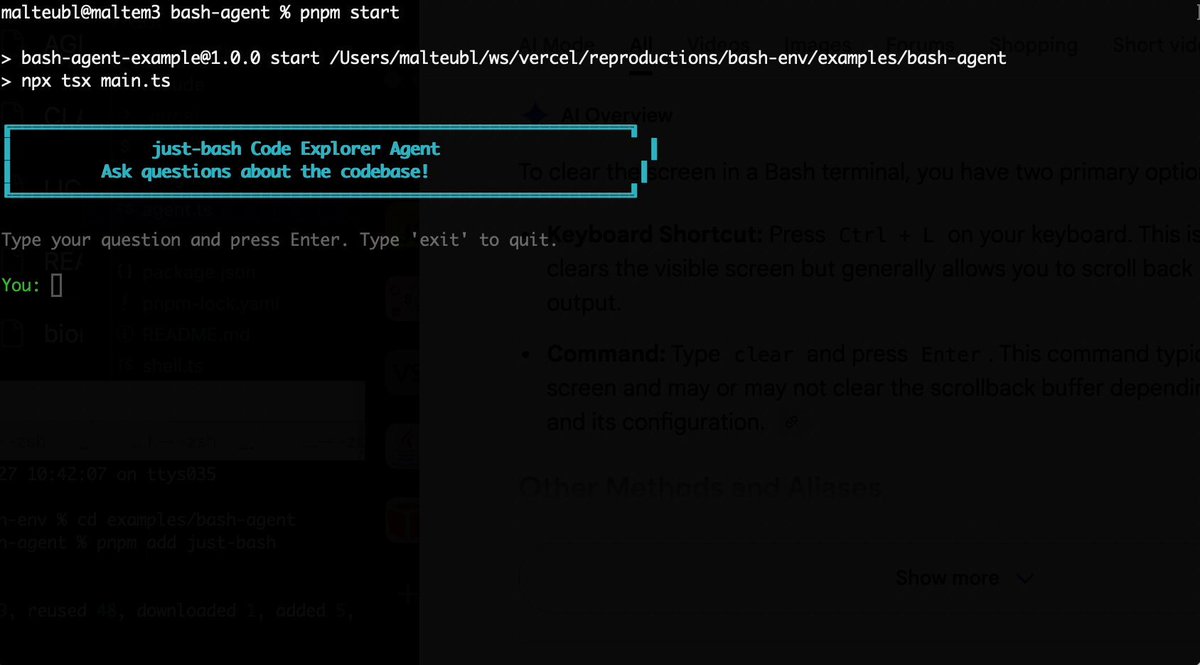
Bash is all you need! Which is why I'm introducing my holiday project: just-bash just-bash is a pretty complete implementation of bash in TypeScript designed to be used as a bash tool by AI agents. Because it turns out agents love exploring data via shell scripts, even beyond coding. It comes with grep, sed, awk and the 99th percentile features that an agent like Claude Code or Cursor would use. In fact, Claude Code can use it for secure bash execution. In the package - A bash-tool for AI SDK - A binary for use by yourself or your coding agents - An overlay filesystem to feed files to your agent securely - A Vercel Sandbox compatible API, so you can quickly upgrade to a real VM if you need to run binaries - An example AI agent that explores the just-bash code base using just-bash - I imported the Oils shell bash compatibility suite and just-bash passes a very good chunk What is interesting about this codebase: It was essentially entirely written by Opus 4.5. Coding agents love bash and they are good at reproducing it. They are also great at text-book recursive descent parsers and AST tweet-walk interpreters. That said, it is, like, a lot of code and I didn't read it all 😅. This is very much a hack, but it also seems to be _really_ useful. I haven't really found anything agents want to use that it doesn't support and it's fast and secure (caveats apply). It doesn't have write access to your computer and the filesystem is given a root that the agent cannot escape from. Find it at Related: Our recent blog post how we migrated our data analysis agent to bash tools and achieved incredible quality improvements The video shows the example agent investigating the just-bash code base

Malte Ubl

125,326 Aufrufe • vor 9 Monaten

Introducing the new Box Agent. The Box Agent works across your entire Box file system, maintaining all your security and access controls, and is hyper tuned for working with enterprise content. This means you can now ask questions from all your enterprise content, search for files that were impossible to find before, deploy an agent on specific tasks on subsets of documents, analyze complex data sets, and generate or edit documents and spreadsheets via the agent. You can have the Box Agent search across your Box account to prepare for a sales meeting, analyze customer sentiment reports, process a large set of contracts for legal risk, provide insights into product development, leverage existing knowledge to answer RFPs, and thousands of other use-cases. 90% of enterprise data is unstructured data. This means most enterprise knowledge is sitting in inside of research reports, marketing assets, presentations, roadmap files, contracts, HR documents, and more. This is the critical context that agents need to be able to answer questions about a business, automate workflows, or serve up to other agents. We’ve been grinding on this for a quite a bit, and due to recent AI model advancements we’re now ready to release it to customers. Previous model generations had a difficult time knowing when to give up or keep going on a search, when to browse for files vs. use queries, how to rank files appropriately to know which version of content to use, how to handle large amounts of context to comb through, and more. Due to recent breakthroughs from models like GPT-5.4, Opus 4.6, and Gemini 3, we’ve seen major gains in tool calling, code execution, advanced reasoning, and more. Combined with an agent harness tuned to Box context, now it’s finally possible to have an agent that can work across your file system on long running tasks and actually deliver high quality results. Best of all, because the Box Agent works with any leading AI model, you’ll quickly get the gains coming out of the major labs as major new models are released. Further, openness at Box is key, so you’ll be able to call up the Box Agent from Box’s APIs and MCP server, so you can interact with Box intelligently from any other AI system. We know work happens everywhere, and we want to ensure you can access to the content you need from those places. The new Box Agent is available starting today, rolling out now for Enterprise Plus and Enterprise Advanced customers.

Aaron Levie

44,624 Aufrufe • vor 6 Monaten

The latest RAG trend for the current agent harnesses (Codex, Cowork) is to do two passes of document processing to solve a knowledge work task over a data room of documents: 1️⃣ A fast and light pass, oftentimes using a free/OSS doc parsing tool. This can be cheaply run across 10-100-1k’s of files, and enables the agent to then do retrieval (e.g. grep, semantic) to find relevant subsets of context. 2️⃣ A “just-in-time” VLM-based pass. Once the agent finds the relevant pages of context, it will screenshot the documents can call its own VLM (or write code) to dissect the pages. The issue with only using VLM-based OCR tools over massive ad-hoc customer file dumps is that it’s slow and expensive. Doing JIT VLM OCR allows the agent to filter through the data cheaply, but still preserve accuracy for the context that’s needed for the task. The agent harnesses do two-pass document processing by default using off the shelf-tools: pdf2text as the first pass, and using itself (Opus 5) as the second pass. See the below video where Cowork runs over a bunch of PDFs to answer a question about a benchmark graph in the Kimi k3 paper. The main issues here with the “out of the box” doc processing these agents offer are: * Opus 5 is not the best VLM for OCR. It is also way too expensive at scale and lacks grounding * The OSS tools like pypdf, pdf2text, may not be versatile enough as the first pass. * The agent will write a lot of throwaway code to rewrite things an OCR tool would’ve provided out of the box, like chart processing, bounding boxes, confidence scores, leading to increased cost and speed. We have all the tools within LlamaIndex 🦙 to help any agent do two-pass document processing with higher accuracy and lower cost. 1️⃣ We have liteparse for the first pass - a free/OSS parser written in Rust that’s faster/more accurate than other OSS parsers, and supports 50+ document types 2️⃣ We have LlamaParse for the second pass - an agentic document engine that uses VLMs+harnesses to achieve SOTA in accuracy and cost across various doc parsing and extraction tasks. It can be called from any agent harness as an MCP or skill. It takes in page numbers as input, so that the agent can choose to run LlamaParse over a subset of the doc instead of the full doc as a “zoom-in” pass. Come check it out! LiteParse: LlamaParse: All the relevant docs, including MCP, are here:

Jerry Liu

23,239 Aufrufe • vor 1 Monat