Loading video...

Video Failed to Load

Go Home

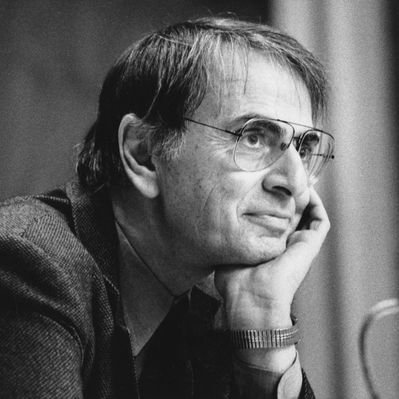
Carl Sagan explains why a child’s simple question may be deeper than most adults realize. “Mommy, why is the grass green?” And very often the child gets an answer like: “Oh, who knows?” But that is not a silly question. It is an extremely profound question. Because hidden inside...

24,786 views • 15 days ago •via X (Twitter)

0 Comments

No comments available

Comments from the original post will appear here

Related Videos

Great balance of showing compassion while sharing truth as Wes Huff responds to the question of why a good God would allow evil: "Well, that is arguably the hardest and most pressing apologetic question there is, because ultimately, the very tidy philosophical and theological answer isn't the right answer sometimes. You know, sometimes the right answer to the wrong question is the wrong answer, because I've encountered situations where someone has brought up a variation of the problem of evil to me, and I've just felt uneasy about maybe the tenor that they're coming at with the question...and asking them, 'You know, that's a great question. Why are you asking that question in particular?' and finding out once again (like the previous question related to it), they're personally hurting. And so, in that sense, I could give a tidy answer about if you're positing that something is good, you're positing that there's an objective good and evil, and if there's an objective good and evil, then you're positing an objective law, and objective law needs an objective lawgiver. So where do we find the groundwork for an objective lawgiver to begin with? Otherwise, you may not like certain things, but to say they ought not to happen is actually an ethical leap to an objective reality that you may or may not have groundwork for. But if that person is struggling because a family member of theirs has cancer, then that particular, maybe tidy, tied-up-in-a-nice-bow answer is not going to speak to them whatsoever. And so that's why that's the hardest question because there are actually very good answers to it, but often it doesn't speak to the person in front of you, because questions have questioners that sit behind them. And one of the pitfalls of my chosen field of ministry apologetics is that sometimes we give answers where we talk at people rather than with people. And there's a danger to that because the Christian faith isn't just an intellectual assent, right? It's a personal relationship. And that should also be played out in the answers that we give..."

Melissa the Hopeful🏠Homemaker

115,694 views • 2 months ago

.Elon Musk (worth $250B) answers why he’s still working: I think it's a good question you asked, because it goes to, like, at a foundational level, what is my philosophy, and why does it lead to this conclusion? So the reason is that when I was a teenager, I had, like, an existential crisis to try to figure out what's the meaning of life. There doesn't seem to be any meaning. For me, at least the religious texts, and I read all of them that I could get my hands on did not seem convincing. Then I started reading the philosophers. Be careful of reading German philosophers as a teenager. It's definitely not going to help with your depression. So reading Schopenhauer, Nietzsche, as an adult, it's much more manageable. But as a kid, you're like, “Whoa.” So then I was like, “Man, I'm just struggling to find meaning in life here.” And then I read Hitchhiker's Guide to the Galaxy. And basically what Douglas Adams was saying is that we don't really know what the right questions are to ask. The question is not, “What's the meaning of life?” In The Hitchiker's Guide to the Galaxy, Earth it turns out is a big computer, and its goal is to answer the question, “What's the meaning of life?” And Earth comes up with the answer “42”. This is where the 42 number comes from. And 420 is just ten times 42. In that book, which is really sort of a book about, it's an existential philosophy book disguised as humor. They come to the conclusion that, no, the real problem is trying to formulate the question. And to really have the right question, you need a much bigger computer than Earth. And so maybe one way, I think, of characterizing this would be to say, “The universe is the answer. What is the question? Or what are the questions?” The more we can expand the scope and scale of consciousness, the better we can understand what questions to ask about the answer that is the universe. The more we can expand consciousness, become a multi-planet species, ultimately a multistellar species… we have a chance of figuring out what the hell is going on. And so this is why I think we should have more humans and both biological and digital consciousness. And why we should become a multi-planet species and a multistellar species is so that we can understand the nature of the universe. And then in order for that to occur, then we have to make sure that things are good on Earth. We don't want Earth to disappear, so sustainable energy is important.

Arjun Khemani

15,597,236 views • 1 year ago

ELON'S POV ON THE MEANING OF LIFE: "IT'S ABOUT THE QUESTION, NOT THE ANSWER" Elon is literally saying the entire purpose of human existence, and everything he's building, from Neuralink and Starship to Grok and Optimus, is aimed at one goal. What's the goal, you ask? To turn humanity into a massive superintelligence that can finally figure out the right questions to ask reality itself. "Humans are 30~40 trillion cells, trillions of synapses… but the why of it is just so we can increase our understanding of the universe. I came to the conclusion, Hitchhiker's Guide to the Galaxy style, that the answer is 42, but the real problem is we don't even know what the question is. The hard part is the question, not the answer. And for that you need a much bigger computer than Earth. So by expanding the scope and scale of consciousness, we can better understand what questions to ask about the answer that is the universe." He's literally saying the entire purpose of human existence, and everything he's building (Neuralink, Starship, Grok, Optimus), is to turn humanity into a massive superintelligence that can finally figure out the right questions to ask reality itself. Not to get the answer. To learn how to ask the question that makes the answer meaningful. This is why he doesn't give a damn about money, politics, or fame anymore. He's playing the longest game in history: Turning consciousness into a galaxy-scale instrument so we can finally understand why anything exists at all. Source: Nikhil Kamath, Elon Musk

Mario Nawfal

825,528 views • 7 months ago

"Every team wants to win a championship, but not every team wants to do the things required for a championship. And here's the thing: it's easy to be an average team. It doesn't require a lot. It's less adversity to be average in the world. The consequences of being average aren't easy. We end up wearing them. There's strain and struggle that comes with that too. The standard is just lower to be an average team. To be a championship team, to be champion, to be a championship team member here . . . I'm not gonna lie to you . . . I'm going to tell you the truth. It is harder. It is. The question is: Is it worth it? Some people say, "Oh it's not harder work." Yes it is. It's harder work. You can pursue comfort or you can pursue excellence. If we pursue comfort, we gotta give up some excellence. But if we pursue excellence, then we're just going to face more adversity. Everyone who's ever accomplished something excellence has had to overcome it. We are here today for a reason. Two reasons actually. Reason #1 is let's make sure that we identify and realize the opportunities that are in front of us. Reason #2 is let's make sure that we are preparing for the adversity that those opportunities require. And just understand: every single time you lever up your opportunities and you identify, "Oh there's something more I can do, more I can achieve. I can get better. I can earn more. I can do this." It's going to be matched with the adversity that comes with it. I want to make sure we are prepared for both of those, so that we're not chasing big opportunities and then getting mad when things start getting harder along the way. Is that fair? Does that make sense?"

Brian Kight

125,728 views • 2 years ago