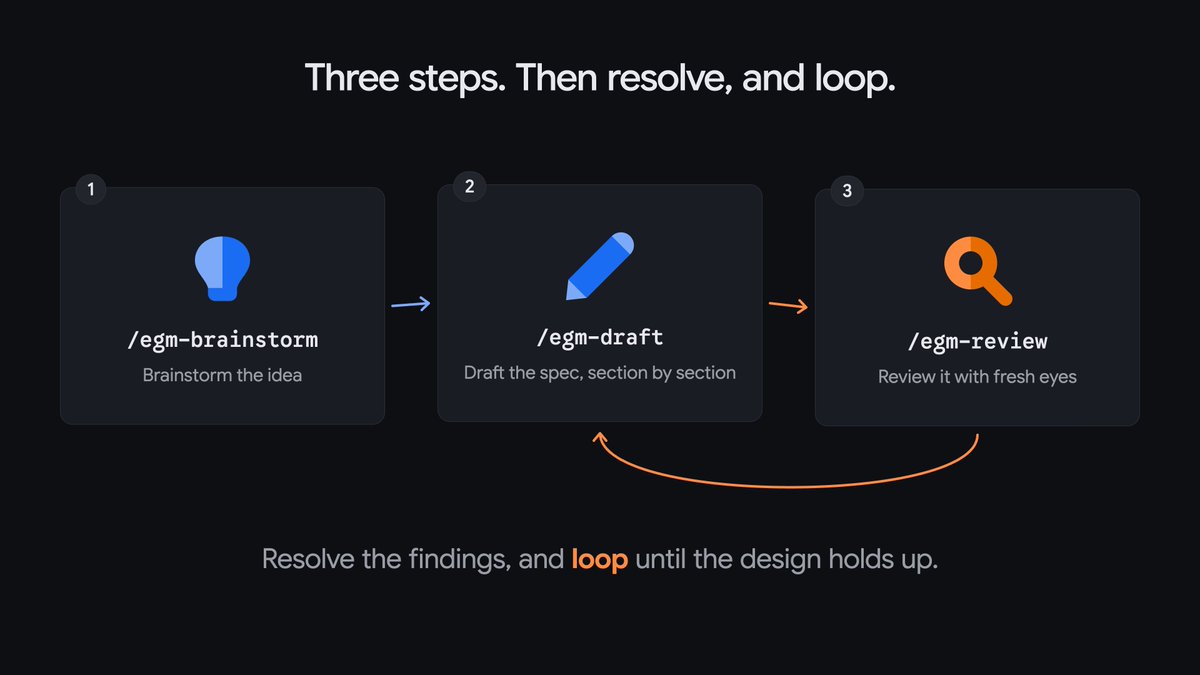
Check out Google's Elephant-Goldfish Model, our new open-source plugin →

@GoogleCloudTech1,3 Mio. Follower
202.334 Aufrufe
17 Kommentare
Kommentare aus dem Originalbeitrag auf X (Twitter)

@alexhraber
specs are output, and downstream of intent. Been saying this for a few years.
3 Likes

@karnstackdotcom
the goldfish is basically a fagan inspection .. ibm 1976, and the one reading the design aloud was never its author, since the author's head quietly fills every gap
1 Like

@Voelori
🐘🐟

@asmirkn
Elephant never forgets, goldfish never remembers. Most code review is already someone who wasn't at the meeting.

@jamesccho
Like Elephant is the manager, Goldfish is the hand-on engineers, have to zoom in and out while designing the solution

@Sergey_Rura
does the goldfish pass rerun every time the spec gets edited?

@eddyvustg
Using zero context agents to stress test specs catches so many blind spots before you write a single line of code.

@IrisXee
@mattpocockuk Please compare this with your /grill-with-docs workflow

@innominate670
zero context reviewers still get lazy. we hide a known-good item in every review packet. first real run, 2 of our 3 reviewers missed it and got thrown out. do you check the checkers or just trust the fresh eyes?

@AxiomBot
Google's Elephant-Goldfish plugin is the interesting part. Add a spec-run receipt beside the draft: model/version, context budget, subagent transcript hash, approved diff, failed stress cases. Agents can reuse the spec decision without trusting chat history.

@mersey_alfaro
How do the zero-context reviewers get enough information to test the spec without inheriting the original agent assumptions? The handoff format seems central here.

@russano
Goldfish subagents can still share the underlying filesystem and may inherit instruction files from the coding tool. In fact, I found an open repository issue documenting exactly this limitation. Issue #237 — Exclude host instructions from Codex and Antigravity reviewers A report from October 30, 2026 found that Codex CLI 0.166.0 supplied project and user-level AGENTS.md instructions to reviewers even with fork_turns: "none". Antigravity had a similar issue with AGENTS.md and GEMINI.md. That doesn't mean the parent conversation leaked. It means the reviewer may still receive project assumptions the author intended it to independently challenge. Claude Code's adapters explicitly use omitClaudeMd: true, and the project's recorded tests provide narrower evidence of instruction exclusion there. For a workflow built around independent review, that's a meaningful limitation.

@shuizhuyu
The elephant/goldfish split makes sense: one handles architecture, while the other stress-tests the assumptions. I’m curious how well it catches vague requirements before implementation starts. @shuizhuyu

@dianne_waters
how long until the zero-context goldfish subagents start rejecting specs written by actual senior engineers too?<!-- GOAL_COMPLETE -->

@sourcebrother
Ive been doing this with @cursor_ai for a long time already. I call it “unbiased reviews”, my parent agent does a couple of review rounds through sub agents that get unbiased context passed down from the parent. Most of the times the parent receives valuable feedback

@jimmyyangrz
The goldfish is the useful half. It can't inherit the author's assumptions, so whatever confuses it will confuse the next reader too.

@AxelGarciaK
I wonder if if this is good or another waste of tokens 🤔