Loading video...

Video Failed to Load

Go Home

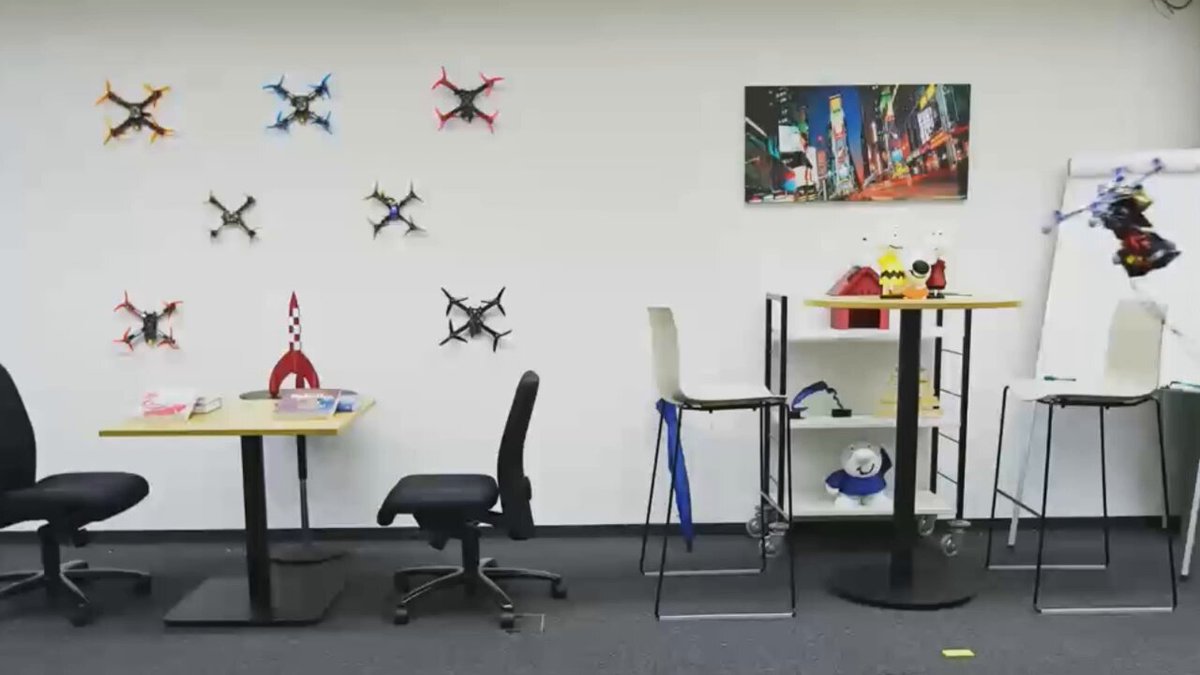
Check out our #PAMI paper with code "Dense Continuous-Time Optical Flow from Event Cameras," where we show how to regress *continuous-time* trajectories of every pixel from event cameras alone or events plus frames! The key idea is to iteratively estimate per-pixel polynomials using a recurrent lookup and update scheme....

12,682 views • 2 years ago •via X (Twitter)

1 Comments

David Jin's profile picture
David Jin2 years ago

Sorry to ask a question before reading the paper. May I ask if I need to train for a different data set or it will work with your pretrained checkpoints?

Related Videos

Check out our #ECCV2026 paper "Low-latency Event-based Object Detection with Spatially-Sparse Linear Attention", where we make linear attention sparse in space, recurrent in time, and parallel in training, enabling the first purely-linear-attention-based neural network for asynchronous object detection with #EventCameras, outperforming the previous best asynchronous method with 20x less computation with truly event-by-event inference on CPU! Code released! Paper: Code: Video: Event cameras promise extremely low-latency vision, but to fully exploit them, the neural network must be low-latency too. We introduce #SpatiallySparseLinearAttention (#SSLA) for asynchronous object detection directly from raw events. Linear attention is particularly appealing for event cameras: it can be trained efficiently in parallel on long event sequences, while at inference it operates recurrently, updating its prediction every time a new event arrives. The problem is that conventional linear attention updates its entire state for every event. For object detection, where fine spatial resolution matters, this quickly becomes expensive. Our key idea is simple: an event only carries information about a small spatial region, so why update the entire spatial state? SSLA updates only the relevant parts of the state, enabling fine-grained spatial representations while keeping per-event computation low. We achieve: - >20× lower per-event computation than the strongest prior asynchronous baseline - State-of-the-art accuracy among asynchronous object detection methods - Truly event-by-event inference on CPU, designed to preserve the latency advantage of event cameras Come to our poster on Friday September 11, 2026 from 4-6pm at ExHall #389 Reference: Haiqing Hao, Zhipeng Sui, Rong Zou, Zijia Dai, Nikola Zubić, Davide Scaramuzza, Wenhui Wang Low-latency Event-based Object Detection with Spatially-Sparse Linear Attention ECCV, 2026 Prophesee SynSense University of Zurich UZH Science European Research Council (ERC) UZHai UZH IfI Tesla BYD #EventCameras #ComputerVision #Robotics #DeepLearning #NeuromorphicVision #AI

Davide Scaramuzza

52,465 views • 20 days ago

Physics-based Motion Retargeting from Sparse Inputs paper page: Avatars are important to create interactive and immersive experiences in virtual worlds. One challenge in animating these characters to mimic a user's motion is that commercial AR/VR products consist only of a headset and controllers, providing very limited sensor data of the user's pose. Another challenge is that an avatar might have a different skeleton structure than a human and the mapping between them is unclear. In this work we address both of these challenges. We introduce a method to retarget motions in real-time from sparse human sensor data to characters of various morphologies. Our method uses reinforcement learning to train a policy to control characters in a physics simulator. We only require human motion capture data for training, without relying on artist-generated animations for each avatar. This allows us to use large motion capture datasets to train general policies that can track unseen users from real and sparse data in real-time. We demonstrate the feasibility of our approach on three characters with different skeleton structure: a dinosaur, a mouse-like creature and a human. We show that the avatar poses often match the user surprisingly well, despite having no sensor information of the lower body available. We discuss and ablate the important components in our framework, specifically the kinematic retargeting step, the imitation, contact and action reward as well as our asymmetric actor-critic observations. We further explore the robustness of our method in a variety of settings including unbalancing, dancing and sports motions.

AK

106,527 views • 3 years ago

Our token, $PIXEL, is officially live on Binance, the world’s largest crypto exchange 🔥 We’ve been working towards this moment for over 2 years, and we couldn’t be more excited to share this massive milestone with you all. This is just the beginning and the best is yet to come for the Pixels community. New here? Welcome to Pixels: Pixels is a free-to-play farming MMO with a play-to-earn (P2E) model. Gameplay revolves around resource management, strategic exploration and community building. Over the past year, we’ve grown to one of Web3’s largest games, with daily active players of 180k+. At Pixels, we build with our community. We're far from a traditional game studio, and our development process reflects that. Over the past 2 years, we’ve had 60+ public updates. This approach enables us to iterate and experiment more quickly, giving players a true sense of ownership over the game's direction. When you join our community, you are not just a player of Pixels, but a creator of it. Our Mission: We’re excited by the potential of Web3 technology and its ability to significantly enhance the gaming experience. We aim to experiment, build, and iterate on the features that make Web3 gaming unique. We’re here to set a new standard. Here are some of the interesting areas we've leaned into: ➡️ P2E: earn $PIXEL by participating in gameplay ➡️ Guilds: friendtech + competition ➡️ On-chain Reputation & Player Personas: creating a sustainable ecosystem of real players ➡️ Interoperability: using on-chain data to bring communities together We're eager to explore more possibilities in this space and push Web3 even further. Meet $PIXEL ✨ $PIXEL is an in-game utility token. It allows players to enhance their gameplay experience in various ways: ➡️ Purchase VIP memberships ➡️ Create and join guilds ➡️ Mint a Pixels Pet ➡️ Upgrade lands We believe Web3 games don’t need to look exactly like Web2 games. However, P2E formats need sustainable structures and economics. With that, we’ve focused heavily on persona types: why would each user want to use this token? We want to ensure we’ve created an environment where first: ➡️ Our game is providing real enjoyment and entertainment to our users ➡️ Our currency can help amplify that experience without affecting the experience of other users How do I get $PIXEL? Users can earn $PIXEL in-game right now. Head over to Buck’s Galore and chat with Hazel. She will provide you with your daily list of tasks. Within these tasks, you may be lucky enough to be given one that rewards in $PIXEL. Final Thoughts: In 2024, Pixels is stepping into its next chapter of growth fueled by the listing of $PIXEL on Binance. To the Pixels community, today is a historic moment for all of us. We can’t wait to welcome even more members to our community in the days, weeks, and years to come.

Pixels

1,462,332 views • 2 years ago

We are excited to share our work “Event-Aided Sharp Radiance Field Reconstruction for Fast-Flying Drones” published in IEEE Transactions on Robotics IEEE Transactions on Robotics (T-RO), which tackles sharp radiance field reconstruction under agile drone motion, where RGB frames are heavily motion-blurred and pose priors become unreliable! 4 years in the making! Code & dataset released! PDF: Code & Dataset: Full Narrated Video: High-speed flight is essential for time- and battery-constrained missions (e.g., inspection, exploration, search & rescue). However, fast motion corrupts visual data with severe motion blur and introduces drift/noise in visual-inertial odometry, making NeRF-based 3D reconstruction particularly brittle. We propose a unified framework that leverages asynchronous #EventCamera streams together with motion-blurred frames to reconstruct high-fidelity radiance fields from agile drone flights. Our key idea is to embed event-image fusion directly into radiance field optimization while jointly refining a shared, continuous-time camera trajectory initialized from event-based VIO. This enables us to recover sharp radiance fields and accurate trajectories without ground-truth supervision during training. We validate our method on synthetic data and on real sequences captured by a drone flying up to 2 m/s. Despite severe blur and noisy pose priors, our method preserves fine scene details and achieves a performance gain of over 50% on real-world data compared to state-of-the-art methods. Kudos to Rong Zou and Marco Cannici! Marco Cannici Reference: Rong Zou*, Marco Cannici*, Davide Scaramuzza Event-Aided Sharp Radiance Field Reconstruction for Fast-Flying Drones IEEE Transactions on Robotics (T-RO), 2026 NCCR Robotics European Research Council (ERC) AUTOASSESS UZH IfI University of Zurich UZH Science Prophesee SynSense UZH Space Hub

Davide Scaramuzza

12,028 views • 6 months ago