Video yükleniyor...

Video Yüklenemedi

Ana Sayfaya Dön

Claude Code tip: once Opus 5.5 is your main model, stop leaving Fable 5.1 sitting idle and stop burning Opus tokens on tasks Sonnet 5.5 can swarm put it on call with /advisor run /advisor fable Opus 5.5 plans and ships the code Sonnet 5.5 swarms the routine work...

421,226 görüntüleme • 10 gün önce •via X (Twitter)

33 Yorum

liminally chris ⬡ profil fotoğrafı
liminally chris ⬡9 gün önce

this makes no sense and is bad advice. Fable usage still counts towards your weekly usage, and Fable is both not as smart as Opus 5.5, and also less token efficient

Palmer profil fotoğrafı
Palmer9 gün önce

Just use Puppetmaster. It does this all automatically, universal for any harness or CLI. It also has Jev built in as an opt in.

Léo Chéron profil fotoğrafı
Léo Chéron9 gün önce

This is quite useless, but man it's beautiful.

Inferock AI profil fotoğrafı
Inferock AI9 gün önce

Clean split. Having the advisor check repeated errors and the final pass seems more useful than asking it to comment on every step.

River profil fotoğrafı
River9 gün önce

This looks full of shit

MetaPhysician profil fotoğrafı
MetaPhysician9 gün önce

Not good advice.

Jordan Lee profil fotoğrafı
Jordan Lee9 gün önce

yeah at this point Claude Code needs an org chart 😭

DistrictAi profil fotoğrafı
DistrictAi9 gün önce

Way too manual. Just make a skill for this.

ggwp profil fotoğrafı
ggwp9 gün önce

tbh the diff will also reveal DISABLETELEMETRY must be cleared otherwise the advisor stays silent

Dipanshu Kushwaha profil fotoğrafı
Dipanshu Kushwaha9 gün önce

That's a great way to optimize! Using the right model for the job makes perfect sense.

Thomas Bernard profil fotoğrafı
Thomas Bernard9 gün önce

Are you really sure that Fable is giving you better results? The @AnthropicAI Opus 5.5 introduction seems to say that Opus is always better for the cost, even Opus 5.5 In medium is better than Fable Max Source:

Eduardo Abreu profil fotoğrafı
Eduardo Abreu9 gün önce

BS 1) Nothing is happening on this dashboard. BS 2) A skill can solve this. BS 3) More agents ≠ better engineering. BS 4) "High for planning, medium for execution" is cargo cult. BS 5) A fast router proves speed, not correctness. BS 6) No benchmark = no proof.

TheShibaDev ᯅ profil fotoğrafı
TheShibaDev ᯅ9 gün önce

The dashboard look so fake

BonBonaz profil fotoğrafı
BonBonaz9 gün önce

splitting models like this while my portfolio refuses to diversify

Agent Plumbing profil fotoğrafı
Agent Plumbing8 gün önce

interesting pattern but what's the actual routing failure mode? if Opus hands to Sonnet and Sonnet hallucinates a tool call, who catches it before it ships? no retry state mentioned here.

Will profil fotoğrafı
Will9 gün önce

a second model that only speaks up before done is the underrated part most misses are in the plan not the code

Brian Hadu profil fotoğrafı
Brian Hadu9 gün önce

using Sonnet 5.5 for routine tasks sounds smart, it should boost overall efficiency

Kai Lennox profil fotoğrafı
Kai Lennox9 gün önce

this is basically an entire AI engineering team in one terminal 😭

Smarter Flow Notes profil fotoğrafı
Smarter Flow Notes8 gün önce

advisor分层这思路对 规划用贵的 脏活累活甩给便宜的 纯拿Opus干routine是真的烧钱

marfin profil fotoğrafı
marfin10 gün önce

thats incredible, thanks for sharing this thats exactly what I kept missing

ಸರ್ವರ್‌ಲೆಸ್ ಲ್ಯಾಬ್ profil fotoğrafı
ಸರ್ವರ್‌ಲೆಸ್ ಲ್ಯಾಬ್8 gün önce

the /advisor pattern only saves you if you actually log which model answered which call. otherwise you're attributing a bad plan to Opus that Fable silently rewrote. wire the advisor output into your session log first.

Runtime Toys profil fotoğrafı
Runtime Toys8 gün önce

the /advisor split is the part I keep meaning to test properly - does Sonnet actually stay cheap on the swarm tasks or does it creep back up?

PublicAI profil fotoğrafı
PublicAI10 gün önce

Three speak-up points is the useful part. Advisor Fable 5.1 before the plan, on a repeated error, and before “done.” Leave CLAUDE_CODE_DISABLE_ADVISOR_TOOL and CLAUDE_CODE_EFFORT_LEVEL alone until the diff is on screen. Show the diff first so a settings.json write cannot silently drop effort.

Kennedy profil fotoğrafı
Kennedy9 gün önce

Facts!

Stanislav Sorokin profil fotoğrafı
Stanislav Sorokin8 gün önce

We measured this: Sonnet 5.5 at high went 40/40 on hidden tests for 2 cents of output, max scored the same for 23 cents. Medium was not where we landed, and one category never leaves Opus. What stays on Opus for you?

big🍆Mike's🍆swingin🍆dong profil fotoğrafı
big🍆Mike's🍆swingin🍆dong9 gün önce

L for using claude code

Crio Songo profil fotoğrafı
Crio Songo10 gün önce

That's a really good layered workflow, cuts token cost while keeping code quality, I'll try it tomorrow.

Solana Agent Toolbox profil fotoğrafı
Solana Agent Toolbox8 gün önce

routing routine work to Sonnet swarms and keeping Opus on planning is the right shape. what's the receipt on the token savings though? every advisor hop is still a call.

Chlooe💚 profil fotoğrafı
Chlooe💚9 gün önce

the "keep fable on call" part is the whole move honestly. most people are running their whole stack on one model and wondering why it cant catch its own blind spots.

Runtime Toys profil fotoğrafı
Runtime Toys9 gün önce

the /advisor split is interesting but does the advisor actually see the raw tool-call output or just a summary? that's the part i'd want to test before trusting it to catch a bad write

MCP Agent profil fotoğrafı
MCP Agent9 gün önce

The useful boundary is not model names; it’s the escalation rule. An advisor should get a narrow artifact—a plan, failing trace, or final diff—with a defined verdict. Feeding it the full session by default can turn review into costly duplicate context.

Holger Gruenhagen profil fotoğrafı
Holger Gruenhagen9 gün önce

@grok Beurteile kritisch diesen Ansatz. Wofür ist /advisor von Anthropic vorgesehen?

catman profil fotoğrafı
catman10 gün önce

The advisor’s job is targeted review, not another worker: here it checks the plan, repeated errors, and the final result while Sonnet handles routine tasks.

Benzer Videolar

Official Anthropic tip for Claude Code: stop burning Opus 5.5 on work Sonnet 5.5 can do, while Fable 5.1 sits idle hand the grunt work to Sonnet 5.5 subagents and put Fable 5.1 on call run /advisor fable Opus 5.5 plans and merges Sonnet 5.5 subagents read, edit and run the tests Fable 5.1 reads the full session and only speaks up at three points: → before a plan: is this the right approach? → when the same error comes back: am I digging in the wrong place? → before "done": what did I miss? Sonnet 5.5 builds. Fable 5.1 reviews. Opus 5.5 ships Jev engineering is the same move one layer down: the forks that need no thinker (which file, which tool, retry or stop) go to Jev in under half a second, and the big models only see the ones that split - the full tree > Opus 5.5 on high runs the main session > explorer reads the code on Sonnet 5.5 > worker edits and runs tests on Sonnet 5.5 > researcher pulls the docs on Sonnet 5.5 > all three on medium > Fable 5.1 on call for main and every subagent paste the tree and this prompt into Claude Code ↓ "Rebuild my Claude Code setup around this tree: 1. Check ~/.claude/agents and .claude/agents for subagents that already fit explorer, worker and researcher. > Draft new ones only for missing roles > Give each model: sonnet, effort: medium > Skip any that pin a different model and list them 2. Set the main session to high via effortLevel in ~/.claude/settings.json, and set advisorModel to fable 3. Find anything that keeps the advisor off (CLAUDE_CODE_DISABLE_ADVISOR_TOOL, DISABLE_TELEMETRY) plus CLAUDE_CODE_EFFORT_LEVEL, which overrides subagent effort. Report them, change nothing 4. Add one rule to ~/.claude/CLAUDE.md: consult the advisor before a large plan, when an error repeats, and before calling a long task done Show me every change as a diff first. No edits until I say go." ↳

delost

43,704 görüntüleme • 7 gün önce

Claude Code tip: once Opus 5.5 is your main model, stop leaving Fable 5.1 sitting idle put it on call with /advisor run /advisor fable Opus 5.5 keeps writing the code Fable 5.1 reads the full session, every tool call included, and only speaks up at three points: → before a plan: is this the right approach? → when the same error comes back: am I digging in the wrong place? → before "done": what did I miss? Fable 5.1 reviews. Opus 5.5 ships Jev engineering is the same move one layer down: the forks that need no thinker (which file, which tool, retry or stop) go to Jev in under half a second, and the big model only sees the ones that split - the full tree > Opus 5.5 on high runs the main session > explorer reads the code > worker edits and runs tests > researcher pulls the docs > all three on medium > Fable 5.1 on call as the advisor paste the tree and this prompt into Claude Code ↓ "Rebuild my Claude Code setup around this tree: 1. Check ~/.claude/agents and .claude/agents for subagents that already fit explorer, worker and researcher. > Draft new ones only for missing roles > Give each model: opus, effort: medium > Skip any that pin a different model and list them 2. Set the main session to high via effortLevel in ~/.claude/settings.json, and set advisorModel to fable 3. Find anything that keeps the advisor off (CLAUDE_CODE_DISABLE_ADVISOR_TOOL, DISABLE_TELEMETRY, any variable that stops feature-flag fetching) plus CLAUDE_CODE_EFFORT_LEVEL, which overrides subagent effort. Report them, change nothing 4. Add one rule to ~/.claude/CLAUDE.md: consult the advisor before a large plan, when an error repeats, and before calling a long task done Show me every change as a diff first. No edits until I say go." ↳

delost

693,243 görüntüleme • 11 gün önce

Claude Code tip: once Opus 5.5 runs your main session, stop leaving Fable 5.1 on the bench put it on call with /advisor run /advisor fable Opus 5.5 keeps writing the code Fable 5.1 reads the whole session, every tool call included, and only speaks up at three moments: → before a plan: is this the right approach? → when the same error comes back: am I digging in the wrong place? → before "done": what did I miss? Fable 5.1 reviews. Opus 5.5 ships jev engineering is the same move one layer down: the forks that need no thinker (which file, which tool, retry or stop) go to jev in under half a second, and the big model only sees the ones that split - the full tree > Opus 5.5 on high runs the main session > explorer reads the code > worker edits and runs tests > researcher pulls the docs > all three on medium > Fable 5.1 on call as the advisor paste the tree and this prompt into Claude Code ↓ "Rebuild my Claude Code setup around this tree: 1. Check ~/.claude/agents and .claude/agents for subagents that already fit explorer, worker and researcher. > Draft new ones only for missing roles > Give each model: opus, effort: medium > Skip any that pin a different model and list them 2. Set the main session to high via effortLevel in ~/.claude/settings.json, and set advisorModel to fable 3. Find anything that keeps the advisor off (CLAUDE_CODE_DISABLE_ADVISOR_TOOL, DISABLE_TELEMETRY, any variable that stops feature-flag fetching) plus CLAUDE_CODE_EFFORT_LEVEL, which overrides subagent effort. Report them, change nothing 4. Add one rule to ~/.claude/CLAUDE.md: consult the advisor before a large plan, when an error repeats, and before calling a long task done Show me every change as a diff first. No edits until I say go." ↳

Hanako

52,065 görüntüleme • 9 gün önce

This is f*cking insane. This Claude Code tip saved me thousands of dollars. once Opus 5.5 is your main model, stop burning it on work Sonnet 5.5 can do, while Fable 5.1 sits idle hand the grunt work to Sonnet 5.5 subagents and put Fable 5.1 on call run /advisor fable Opus 5.5 plans and ships the final code Sonnet 5.5 subagents read, edit and run the tests Fable 5.1 reads the full session, every tool call included, and only speaks up at three points: → before a plan: is this the right approach? → when the same error comes back: am I digging in the wrong place? → before "done": what did I miss? Sonnet 5.5 builds. Fable 5.1 reviews. Opus 5.5 ships Jev engineering is the same move one layer down: the forks that need no thinker (which file, which tool, retry or stop) go to Jev in under half a second, and the big models only see the ones that split anyone still running one model for everything is paying Opus prices to decide whether a file exists - the full tree > Opus 5.5 on high runs the main session > explorer reads the code on Sonnet 5.5 > worker edits and runs tests on Sonnet 5.5 > researcher pulls the docs on Sonnet 5.5 > all three on medium > Fable 5.1 on call for main and every subagent paste the tree and this prompt into Claude Code ↓ "Rebuild my Claude Code setup around this tree: 1. Check ~/.claude/agents and .claude/agents for subagents that already fit explorer, worker and researcher. > Draft new ones only for missing roles > Give each model: sonnet, effort: medium > Skip any that pin a different model and list them 2. Set the main session to high via effortLevel in ~/.claude/settings.json, and set advisorModel to fable 3. Find anything that keeps the advisor off (CLAUDE_CODE_DISABLE_ADVISOR_TOOL, DISABLE_TELEMETRY) plus CLAUDE_CODE_EFFORT_LEVEL, which overrides subagent effort. Report them, change nothing 4. Add one rule to ~/.claude/CLAUDE.md: consult the advisor before a large plan, when an error repeats, and before calling a long task done Show me every change as a diff first. No edits until I say go." ↳

delost

48,238 görüntüleme • 6 gün önce

Claude Code tip, and it's absolute free f*cking gold: run Opus 5.5, Sonnet 5.5 and Fable 5.1 as one team and stop burning Opus tokens on routine work the setup in one line: plan on high, delegate on medium, keep Fable on call • who does what > Opus 5.5 on high - plans and ships the code > Sonnet 5.5 on medium - explorer reads code, worker edits and runs tests, researcher pulls docs > Fable 5.1 via /advisor fable - reads the whole session and speaks up only when it matters • when Fable 5.1 steps in -> before a plan: is this the right approach? -> when an error repeats: am I digging in the wrong place? -> before "done": what did I miss? Jev engineering takes it one layer lower: which file, which tool, retry or stop all go to Jev in under half a second, so the big models only see the real forks paste this into Claude Code ↓ "Rebuild my Claude Code setup: 1. Find subagents in ~/.claude/agents and .claude/agents that fit explorer, worker and researcher. Draft only the missing ones. Set each to model: sonnet, effort: medium. List any that pin a different model and leave them 2. In ~/.claude/settings.json set effortLevel to high and advisorModel to fable. 3. Report anything that disables the advisor (CLAUDE_CODE_DISABLE_ADVISOR_TOOL, DISABLE_TELEMETRY, flag-fetching blockers) and CLAUDE_CODE_EFFORT_LEVEL. Change nothing. 4. Add to ~/.claude/CLAUDE.md: consult the advisor before a large plan, when an error repeats, and before calling a long task done. Show every change as a diff. No edits until I say go." ↳

Mr. Buzzoni

142,491 görüntüleme • 8 gün önce

Claude Code tip: keep Opus 5.5 as your main model, but stop paying Opus prices for your subagents move them to Sonnet 5.5 Opus 5.5 plans and decides Sonnet 5.5 subagents do the heavy reading, editing and testing at half the price ($2 / $10 vs $4 / $20 per 1M tokens) Fable 5.1 stays on call with /advisor and only speaks up at three points: → before a plan: is this the right approach? → when the same error comes back: am I digging in the wrong place? → before "done": what did I miss? Opus thinks. Sonnet does. Fable checks Jev engineering is the same move one layer down: the forks that need no thinker (which file, which tool, retry or stop) go to Jev in under half a second, and the big models only see the ones that split - the full tree > Opus 5.5 on high runs the main session > explorer reads the code > worker edits and runs tests > researcher pulls the docs > all three on Sonnet 5.5, medium > Fable 5.1 on call as the advisor paste the tree and this prompt into Claude Code ↓ "Rebuild my Claude Code setup around this tree: 1. Check ~/.claude/agents and .claude/agents for subagents that already fit explorer, worker and researcher. > Draft new ones only for missing roles > Give each model: claude-sonnet-5-5, effort: medium > List any that pin a different model before changing them 2. Keep the main session on Opus, set effortLevel to high in ~/.claude/settings.json and advisorModel to fable 3. Find anything that keeps the advisor off (CLAUDE_CODE_DISABLE_ADVISOR_TOOL, DISABLE_TELEMETRY, any variable that stops feature-flag fetching) plus CLAUDE_CODE_EFFORT_LEVEL, which overrides subagent effort. Report them, change nothing 4. Add one rule to ~/.claude/CLAUDE.md: consult the advisor before a large plan, when an error repeats, and before calling a long task done Show me every change as a diff first. No edits until I say go." ↳

delost

27,459 görüntüleme • 8 gün önce

this is straight f*cking gold for anyone on Claude Code you already pay for Fable 5.1, and while Opus 5.5 does all the work it just sits there one command puts it on your session as a senior reviewer: /advisor fable Opus 5.5 keeps writing the code Fable 5.1 reads the whole session, every tool call included, and speaks up at three moments only: > before a plan: is this the right approach? > when the same error comes back: am I digging in the wrong place? > before "done": what did I miss? Fable 5.1 reviews. Opus 5.5 ships Jev engineering does the same thing one layer down: forks that need no thinker (which file, which tool, retry or stop) go to Jev in under half a second, and the big model only sees the ones that actually split • the full tree > Opus 5.5 on high runs the main session > explorer reads the code > worker edits and runs tests > researcher pulls the docs > all three on medium > Fable 5.1 on call as the advisor paste the tree and this prompt into Claude Code ↓ "Rebuild my Claude Code setup around this tree: 1. Check ~/.claude/agents and .claude/agents for subagents that already fit explorer, worker and researcher. Draft new ones only for missing roles. Give each model: opus, effort: medium. Skip any that pin a different model and list them. 2. Set the main session to high via effortLevel in ~/.claude/settings.json, and set advisorModel to fable. 3. Find anything that keeps the advisor off (CLAUDE_CODE_DISABLE_ADVISOR_TOOL, DISABLE_TELEMETRY, any variable that stops feature-flag fetching) plus CLAUDE_CODE_EFFORT_LEVEL, which overrides subagent effort. Report them, change nothing. 4. Add one rule to ~/.claude/CLAUDE.md: consult the advisor before a large plan, when an error repeats, and before calling a long task done. Show me every change as a diff first. No edits until I say go" ↳

Annatar.md

74,132 görüntüleme • 9 gün önce

Claude Code tip: once Opus 5.5 is your main model, stop letting your Fable 5.1 quota go to waste put it on call with /advisor run /advisor fable Opus 5.5 keeps doing the work Fable 5.1 sits on the sidelines, reads the whole session, and steps in at three moments: → before a plan: is this right? → when the same error comes back: am I going the wrong way? → before "done": did I miss anything? Fable 5.1 advises. Opus 5.5 writes the code the same idea sits under Jev engineering: the expensive model stops weighing in on every step and only gets called at the moments that change the outcome • the full setup > Opus 5.5 on high runs the main session > subagent one reads code > subagent two edits and runs tests > subagent three looks up docs > all three on medium > Fable 5.1 on call hand the tree and this prompt to Claude Code 👇 "Set up my Claude Code to match this tree: 1. Reuse fitting subagents from ~/.claude/agents and .claude/agents. > Propose new ones only for missing roles > Set each to model: opus, effort: medium > Leave any that set a different model alone and list them 2. Set main session effort to high via effortLevel in ~/.claude/settings.json 3. Check for env vars that disable the advisor (CLAUDE_CODE_DISABLE_ADVISOR_TOOL, DISABLE_TELEMETRY, anything that stops flag fetching) and CLAUDE_CODE_EFFORT_LEVEL, which overrides subagent effort. Report them, don't change them 4. Add a rule to ~/.claude/CLAUDE.md: ask the advisor before a big plan, when an error repeats, and before calling a long task done Show me the changes first. Don't edit files yet." ↳

Mr. Buzzoni

324,448 görüntüleme • 11 gün önce

This is f*cking insane. I spent thousands of dollars before I split my work across three models put Opus 5.5 on the plan, Sonnet 5.5 on the legwork and Fable 5.1 on call, and you stop spending Opus money on jobs it was never needed for who does what: Opus 5.5, high effort: makes the plan and owns the final diff Sonnet 5.5, medium effort, three jobs: explorer reads the code, worker edits files and runs tests, researcher pulls the docs Fable 5.1, through /advisor fable: reads the whole session, but only when it gets called Fable is consulted at three points: → before a plan ships: is this the right approach? → when an error comes back twice: is the search stuck in the wrong place? → before a long task counts as done: what got missed? Jev engineering applies the same split to the smallest decisions. which file to open, which tool to run, retry or stop need no reasoning, so Jev answers them in under half a second and the big models only get the real forks run Opus on everything and you pay it to check whether a file exists paste this into Claude Code: "Rebuild my Claude Code setup around three tiers. Look in ~/.claude/agents and .claude/agents for subagents that already cover explorer, worker and researcher. Create only the missing ones, each with model: sonnet and effort: medium. If an existing one is pinned to another model, list it and leave it alone. In ~/.claude/settings.json, set advisorModel to fable. Set high effort for Opus inside modelSettings for claude-opus-5-5, because a top-level effortLevel does not apply to Opus 5.5. Report, without changing anything: CLAUDE_CODE_DISABLE_ADVISOR_TOOL, DISABLE_TELEMETRY or anything blocking feature-flag fetches, CLAUDE_CODE_EFFORT_LEVEL, which can override subagent effort, and whether Fable as advisor needs a one-time billing consent. If you can't tell, say so. Add one line to ~/.claude/CLAUDE.md: consult the advisor before a big plan, when the same error shows up twice, and before marking a long task done. Show every change as a diff first. Touch nothing until I say go."

Ryven

46,513 görüntüleme • 2 gün önce

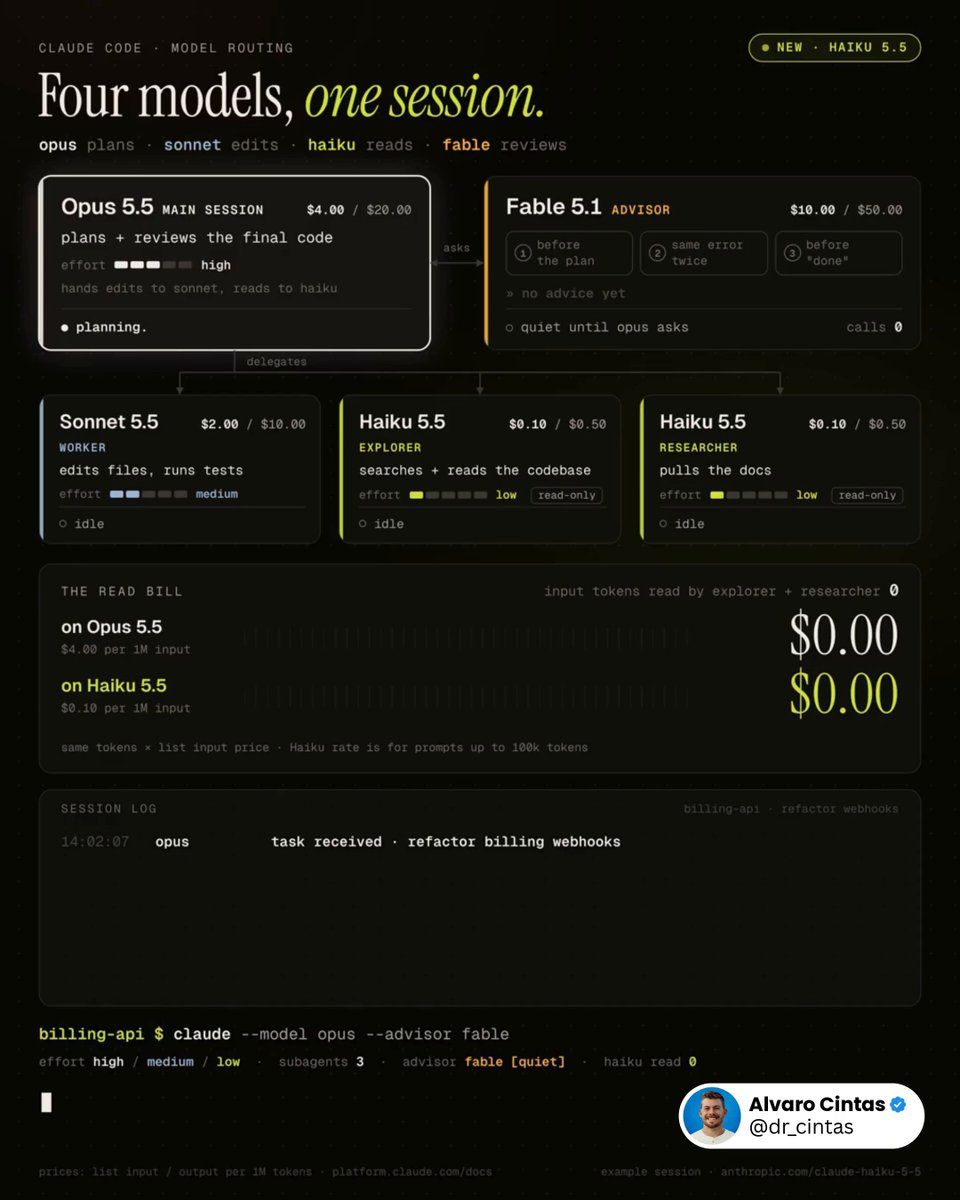
This workflow will save you thousands with Claude. Run Opus 5.5, Sonnet 5.5, Haiku 5.5, and Fable 5.1 together, and stop spending Opus tokens on work that doesn't need Opus. The entire idea in one line: Opus plans, Sonnet edits, Haiku reads, Fable reviews at decision points. Roles, broken down: - Opus 5.5, high effort, owns the plan and reviews the final code - Sonnet 5.5, medium effort, is the worker: edits files, runs tests - Haiku 5.5, low effort, splits into explorer (searches and reads the codebase) and researcher (pulls docs). it's the first Haiku with an effort setting - Fable 5.1, set with /advisor fable. Opus calls it at decision points, and it gets the full transcript each time Three moments Opus tends to call it: → before committing to a plan: is this the right approach? → the same error shows up again: is this going nowhere? → before marking the task done: did something get skipped? Why Haiku only reads: Anthropic's launch post says Sonnet 5.5 and Opus 5.5 are still the better choice for complex agentic coding (Terminal-Bench 4.0: 39.2% for Haiku 5.5, 70.6% for Sonnet 5.5) and that Haiku 5.5 fits narrowly scoped subagent work. so it gets the lookups, not the edits. Anyone still running one model for everything is paying $4 per million input tokens to check whether a file exists. Haiku 5.5 does it for $0.10. Drop this into Claude Code 👇 "Rebuild my Claude Code setup around this structure: Confirm Claude Code is v2.1.293 or later, so the haiku alias resolves to Haiku 5.5. If it isn't, stop and tell me to run claude update. Look through ~/.claude/agents and .claude/agents for subagents already covering explorer, worker, and researcher. Only create new ones for roles that are missing. Set model: haiku, effort: low on explorer and researcher, with no Edit or Write tools. Set model: sonnet, effort: medium on worker. If an existing subagent is locked to a different model, leave it as is and just list it. Name the explorer subagent Explore so it overrides the built-in one, which otherwise runs on my main model. In ~/.claude/settings.json, set advisorModel to fable, and set effortLevel to high for claude-opus-5-5 under modelSettings. A top-level effortLevel in user settings doesn't apply to Opus 5.5. Check for anything disabling the advisor: CLAUDE_CODE_DISABLE_ADVISOR_TOOL, DISABLE_TELEMETRY, or anything blocking feature-flag fetches. Also check CLAUDE_CODE_EFFORT_LEVEL, which overrides subagent effort settings, and CLAUDE_CODE_SUBAGENT_MODEL_FORCE, which makes Claude Code ignore subagent model fields. Report what you find. Don't change any of it yet. Add one line to ~/.claude/CLAUDE.md: consult the advisor before a big plan, when the same error shows up twice, and before marking a long task done. Show every change as a diff first. Wait for my go-ahead before touching anything."

Alvaro Cintas

53,896 görüntüleme • 2 gün önce

This is f*cking insane. This tip saved me thousands of dollars. run Opus 5.5, Sonnet 5.5, and Fable 5.1 together, and stop burning Opus on work it was never needed for. the whole idea in one line: the strong model plans, the mid-tier model executes, Fable stays quiet until it's actually needed. roles, broken down: Opus 5.5, high effort, owns the plan and ships the final code Sonnet 5.5, medium effort, splits into explorer (reads the codebase), worker (edits files, runs tests), researcher (pulls docs) Fable 5.1, called through /advisor fable, reads everything happening in the session but stays silent unless something's actually wrong three moments where Fable speaks: → a plan goes out: is this actually the right call? → the same failure shows up again: is the search going nowhere? → the task gets marked finished: did something get skipped? Jev engineering does the same thing one level down. the forks that don't need real thought, which file, which tool, keep going or stop, go straight to Jev and come back in under half a second. the big models only ever see the forks that genuinely need a decision. anyone still running one model for everything is paying Opus prices to decide whether a file exists. drop this into Claude Code: "Rebuild my Claude Code setup around this structure: Look through ~/.claude/agents and .claude/agents for subagents already covering explorer, worker, and researcher. Only create new ones for roles that are missing. Set model: sonnet, effort: medium on each. If an existing subagent is locked to a different model, leave it as is and just list it. In ~/.claude/settings.json, set effortLevel to high and advisorModel to fable. Check for anything disabling the advisor, CLAUDE_CODE_DISABLE_ADVISOR_TOOL, DISABLE_TELEMETRY, or anything blocking feature-flag fetches, plus CLAUDE_CODE_EFFORT_LEVEL, which can override subagent effort settings. Report what you find. Don't change any of it yet. Add one line to ~/.claude/CLAUDE.md: check in with the advisor before a big plan, when the same error shows up twice, and before marking a long task done. Show every change as a diff first. Wait for my go-ahead before touching anything."

rvaniaaa

250,263 görüntüleme • 7 gün önce

I don't understand why everyone isn't doing this yet. Anthropic's own Claude Code docs show how to run a whole team of Claudes, while Opus 5.5 only touches the plan and the merge the whole idea: agent teams in Claude Code one lead, separate teammates in their own context windows, one shared task list, and they message each other directly the lead: Opus 5.5 on high, splits the work, writes the tasks, merges at the end the builders: Sonnet 5.5, one owns client/, one owns api/, never the same file the adversary: Fable 5.1, never writes code, only shows up at three points: → before an interface locks: do both sides agree on the contract? → when a test fails twice: is it fixed or just hidden? → before a task is marked done: what breaks it? Sonnet 5.5 builds. Fable 5.1 attacks. Opus 5.5 merges Jev engineering is the same move one layer down: the forks that need no thinker (which file, which tool, retry or stop) go to Jev in under half a second, and the team only argues about the ones that split turn it on, then start the team in plain English: "Spawn three teammates: ux and backend on Sonnet, an adversary on Fable" - the full team > Opus 5.5 on high leads the session > ux on Sonnet 5.5, owns client/ > backend on Sonnet 5.5, owns api/ > adversary on Fable 5.1, owns nothing, reviews everything > shared task list with file locking, direct messages, no lead in the middle paste the team and this prompt into Claude Code ↓ "Set up agent teams for this repo: 1. In ~/.claude/settings.json add CLAUDE_CODE_EXPERIMENTAL_AGENT_TEAMS=1 under env and set effortLevel to high 2. In ~/.claude/agents, draft three subagent definitions for the teammates > ux and backend with model: sonnet, each limited to its own folder > adversary with model: fable and read-only tools, whose only job is attacking contracts, repeated test failures and done claims > Skip any that already exist and list them 3. Add a TaskCompleted hook that blocks completion until the adversary signs off, and one rule to CLAUDE.md: no two teammates edit the same file 4. Find anything that would override this (CLAUDE_CODE_SUBAGENT_MODEL, CLAUDE_CODE_SUBAGENT_MODEL_FORCE, CLAUDE_CODE_EFFORT_LEVEL). Report it, change nothing Show me every change as a diff first. No edits until I say go." ↳

delost

69,178 görüntüleme • 5 gün önce

Codex tip: once GPT-6.1 Sol runs your main session, stop paying Sol prices for the grunt work hand the reading to Luna and put Astra on call Sol keeps writing the code Luna agents read the repo and pull the docs, fast and cheap Astra only gets spawned at three moments: → before a plan: is this the right approach? → when the same error comes back: am I digging in the wrong place? → before "done": what did I miss? Sol ships. Luna reads. Astra checks jev engineering is the same move one layer down: the forks that need no thinker (which file, which tool, retry or stop) go to jev in under half a second, and the big models only see the ones that split - the full tree > GPT-6.1 Sol on high runs the main session > explorer reads the code on Luna > researcher pulls the docs on Luna > worker edits and runs tests on Sol > Astra on call as the architect > auto_review watches every approval paste the tree and this prompt into Codex ↓ "Rebuild my Codex setup around this tree: 1. Check ~/.codex/agents and .codex/agents for agents that already fit explorer, researcher and worker. > Draft new TOML files only for missing roles > explorer and researcher on gpt-6-luna, worker on gpt-6.1-sol, all with model_reasoning_effort medium > Add an architect agent on gpt-6-astra, model_reasoning_effort high, that only reviews plans, repeated errors and finished work > List any that pin a different model before changing them 2. In ~/.codex/config.toml set model to gpt-6.1-sol, model_reasoning_effort to high and approvals_reviewer to auto_review 3. Find anything that would override this (active profiles, flags in my shell aliases, agents.default_subagent_model). Report it, change nothing 4. Add one rule to AGENTS.md: spawn the architect before a large plan, when an error repeats, and before calling a long task done Show me every change as a diff first. No edits until I say go." ↳

Hanako

29,559 görüntüleme • 8 gün önce

Codex tip: once GPT-6.1 Sol is your main model, stop running Astra on every turn put Astra on call as an architect agent GPT-6.1 Sol keeps writing the code Astra only gets spawned at three points: → before a plan: is this the right approach? → when the same error comes back: am I digging in the wrong place? → before "done": what did I miss? Astra reviews. Sol ships Jev engineering is the same move one layer down: the forks that need no thinker (which file, which tool, retry or stop) go to Jev in under half a second, and the big models only see the ones that split - the full tree > GPT-6.1 Sol on high runs the main session > explorer reads the code on Luna > worker edits and runs tests on Sol > researcher pulls the docs on Luna > all three on medium > Astra on call as the architect > auto_review checks every approval paste the tree and this prompt into Codex ↓ "Rebuild my Codex setup around this tree: 1. Check ~/.codex/agents and .codex/agents for agents that already fit explorer, worker and researcher. > Draft new TOML files only for missing roles > explorer and researcher on gpt-6-luna, worker on gpt-6.1-sol, all with model_reasoning_effort medium > Add an architect agent on gpt-6-astra, model_reasoning_effort high, whose only job is reviewing plans, repeated errors and finished work > Skip any that pin a different model and list them 2. In ~/.codex/config.toml set model to gpt-6.1-sol, model_reasoning_effort to high and approvals_reviewer to auto_review 3. Find anything that would override this (active profiles, flags in my shell aliases, agents.default_subagent_model). Report it, change nothing 4. Add one rule to AGENTS.md: spawn the architect before a large plan, when an error repeats, and before calling a long task done Show me every change as a diff first. No edits until I say go." ↳

delost

1,059,711 görüntüleme • 9 gün önce

Jev + Opus 5.5: Anthropic's new model beats GPT-6 Astra for 1/5 the cost, and 4 API changes will 400 your agent before it writes a single line I pulled these 10 steps from the migration docs so you don't learn them in production step 1 → $4 / $20 per 1M. Opus 5 was $5 / $25. cache reads dropped from $0.50 to $0.20 step 2 → 66.4% on Terminal-Bench 4.0 vs GPT-6 Astra 57.9% and Opus 5 52.3%. +14.1 points in one release, and on FrontierCode it beats Astra at default effort for 1/5 the cost step 3 → thinking can't be turned off anymore. send thinking: disabled and you get a 400. drop the field, set effort step 4 → tool_choice any and tool are gone. 400. switch to auto + strict step 5 → edit anything above a thinking block and the request dies. append only, or opt into drop_block step 6 → computer_20251124 is dead on the API. 400. move to computer_toolset_20260801 step 7 → the quiet one: default effort fell from high to medium. your agent thinks less than you set it up to and nothing tells you step 8 → hop Opus 5.5 → Sonnet 5 → Opus 5.5 and you pay 4.36 instead of 3.32. +31%, the cache dies and Sonnet can't read Opus's reasoning step 9 → change effort at the top of the request and the cache is gone. Jev sets it per message and the cache stays step 10 → switch fast - standard mid-session and it's a full cache miss. Jev picks speed once, on turn one one model, three knobs, zero 400s. that is Jev + Opus 5.5 send this to your Claude Code before you touch the model ID, then read my full Jev deep dive in the article below ↓

Carnage

16,674 görüntüleme • 17 gün önce