Video wird geladen...

Video konnte nicht geladen werden

Zur Startseite

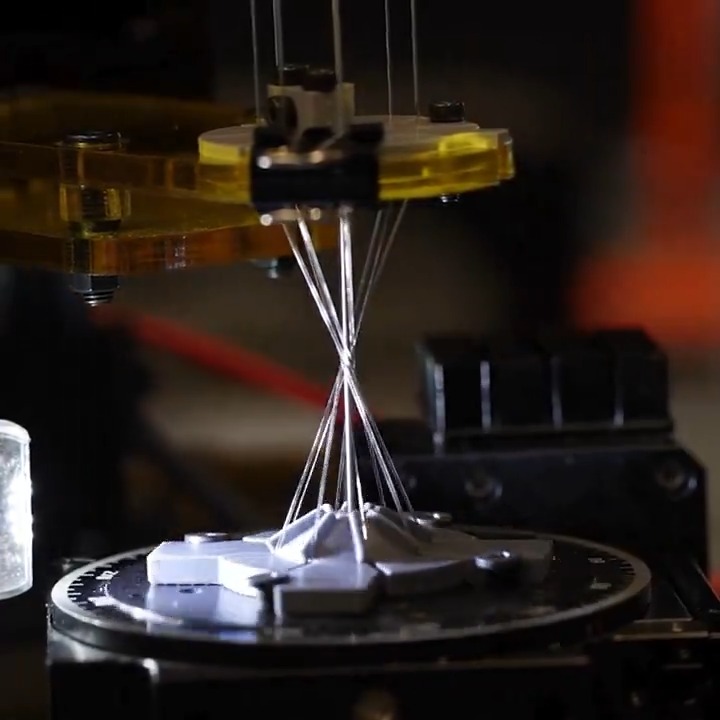
Clone Robotics CEO Necromancer in a fireside chat with Peter Diamandis at the Abundance Summit: Rather than following the conventional humanoid robot path, they are building "Synthetic Human Androids."(westworld like) > Abandoning the rigid skeleton + electric motor approach > Adopting a human anatomical design: an internal skeleton paired...

44,161 Aufrufe • vor 5 Monaten •via X (Twitter)

0 Kommentare

Keine Kommentare verfügbar

Kommentare vom Original-Post werden hier angezeigt

Ähnliche Videos

Japan Just Built a HouseBot You Control Without Speaking and It Changes Everything! Donut Robotics has officially unveiled its first bipedal humanoid, Cinnamon 1, and instead of focusing on louder voices or bigger motors, the company went in the opposite direction. Silence. Cinnamon 1 introduces what Donut Robotics calls Silent Gesture Control, a system that allows the humanoid to be guided using simple hand and finger movements rather than spoken commands. This approach feels especially well suited for real world environments where traditional voice control falls apart. Busy factory floors. Construction sites filled with constant noise. Even quiet indoor settings where voice commands feel awkward or intrusive. It also opens the door for far more accessible human robot interaction, particularly for users with impairments. While the current Cinnamon 1 hardware is built on an OEM platform, the intelligence driving it is where Donut Robotics is placing its long term bet. The team is actively developing custom Vision Language Action AI that allows the robot to interpret what it sees, understand intent, and respond with physical action. The goal is not just smarter robots, but robots that feel more natural. Even more ambitious is the company’s plan for full domestic production. Donut Robotics has stated its intention to localize both manufacturing and AI development in Japan, reinforcing the country’s reputation for precision engineering and thoughtful robotics design. If timelines hold, Cinnamon 1 units are expected to begin deployment in factories and construction environments by the end of 2026. That puts this humanoid squarely in the category of near term reality rather than distant concept. The takeaway is simple but important. As humanoid robots move out of labs and into daily work environments, the winners may not be the loudest or flashiest machines. They may be the ones that understand us without a word being spoken.

The AI Robot Guy on X

257,928 Aufrufe • vor 7 Monaten

Everything Elon said about Optimus at the All-In Summit today: • We’re finalizing the design of Optimus v3. That release is going to be a very remarkable robot. It will have manual dexterity comparable to a human, meaning a very complex hand, an AI mind that can navigate and comprehend reality, and will be made in very high volume. • Other robotics companies are missing those three very hard things. • I spend more mental cycles on Optimus than any other single thing. Solving real-world AI, all of the electrical-mechanical issues, the supply chain, and production challenges. • There is no supply chain for humanoid robots, so it has to be created from scratch, which requires a lot of vertical integration. None of the actuators in Optimus are available from an existing supply chain. • I think if successful, Optimus would be the biggest product ever. • The marginal cost of production, once we hit a million units per year, will probably be around $20,000. It depends on how much we spend on the AI chip in the robot, and we’ll need to achieve a lot of efficiencies in the actuators—26 actuators per arm (26 motors, gearboxes, and power electronics). The AI chip might cost $5,000 or $6,000, maybe more. At 1 million units a year, production cost will be $20,000, maybe $25,000. Price will be a function of demand. • Human hands have evolved to be incredibly sophisticated machines. Hands are a very first instrument. You can swing a baseball bat, thread a needle, play a piano or violin, and assemble a car. Hands are incredibly versatile instruments. Most of the muscles of the hands are actually in the forearm, and the hand is almost like a puppet. Human tendon evolution is incredibly good. The human hand has 27 or 28 degrees of freedom, depending on how you count it; it’s amazing. • In order to create a robot that can be a generalized humanoid, you must solve the “hands problem.” • Even though there are 10,000 to 20,000 electric motors out there, we couldn’t buy the actuators for any amount of money. We had to design every electric motor, gearbox, and controlling electronics from scratch, from first principles of physics. • Optimus is harder than developing any previous Tesla product, but not harder than Starship. • Right now, we’re struggling with the final design of the hardware, primarily the hand. The hands and forearm are the majority of the engineering difficulty of the entire robot. • If you want to do all the things that a human can do, it turns out you need a humanoid robot. If you want to do a subset, that’s much easier. Humans evolved to the shape and capability that we have for a good reason. There is value to having four fingers and a thumb; even the pinky is quite useful. Toes are much more of a question mark. • The AI5 inference chip will be 40 times better than AI4 by some measures. We know the limiting factors of the chip because the AI software and hardware teams work so closely. Effectively, the Tesla AI hardware and software teams are co-designing the chip. • The Softmax function on AI4 takes 40 steps in emulation mode, which will take only a few steps in AI5 natively. AI5 will easily handle mixed precision. • In terms of nominal raw compute, the AI5 inference chip has 8 times more compute, 9 times more memory, and 5 times more memory bandwidth compared to AI4. Because we’re addressing some core limitations and optimizations at the silicon level, we’re able to realize 40x improvements.

The Humanoid Hub

239,049 Aufrufe • vor 1 Jahr

I don’t know if we live in a Matrix, but I know for sure that robots will spend most of their lives in simulation. Let machines train machines. I’m excited to introduce DexMimicGen, a massive-scale synthetic data generator that enables a humanoid robot to learn complex skills from only a handful of human demonstrations. Yes, as few as 5! DexMimicGen addresses the biggest pain point in robotics: where do we get data? Unlike with LLMs, where vast amounts of texts are readily available, you cannot simply download motor control signals from the internet. So researchers teleoperate the robots to collect motion data via XR headsets. They have to repeat the same skill over and over and over again, because neural nets are data hungry. This is a very slow and uncomfortable process. At NVIDIA, we believe the majority of high-quality tokens for robot foundation models will come from simulation. What DexMimicGen does is to trade GPU compute time for human time. It takes one motion trajectory from human, and multiplies into 1000s of new trajectories. A robot brain trained on this augmented dataset will generalize far better in the real world. Think of DexMimicGen as a learning signal amplifier. It maps a small dataset to a large (de facto infinite) dataset, using physics simulation in the loop. In this way, we free humans from babysitting the bots all day. The future of robot data is generative. The future of the entire robot learning pipeline will also be generative. 🧵

Jim Fan

165,246 Aufrufe • vor 1 Jahr

This is WILD! MIT just solved one of the hardest unsolved problems in robotics (Save this). For decades, the fundamental problem with soft robots and wearable exoskeletons has not been compute or AI, it has been actuation. The moment you try to give a soft robot meaningful strength, you run into the same wall every engineer has hit since the field began, fluid-driven systems require external pumps, hydraulic reservoirs, and heavy infrastructure that makes the entire thing impractical to wear or embed into fabric. MIT's new Electrofluidic Fiber Muscles solve that problem by eliminating external infrastructure entirely. The key insight is electrohydrodynamic pumping using electric fields to generate pressure directly from electricity, with no moving parts, no motors, and no external fluid reservoir. The fibers are less than 2 millimeters thick, can be woven into fabric like ordinary textile, and operate in complete silence because nothing physically moves inside them, it is just ions propelling fluid through a closed circuit. The performance numbers published in Science Robotics are not conceptual, they are empirical results from actual hardware. These fibers achieve a power density of 50 watts per kilogram, matching skeletal muscle, with a contraction strain of 20% and a response time of 0.3 seconds. A single bundled configuration lifted 4 kilograms, 200 times its own weight while a separate configuration drove a robotic arm through a 40-degree bend compliant enough to safely complete a human handshake. Another configuration launched objects in under 100 milliseconds, which is faster than a human flinch reflex. The design mirrors biological muscle architecture in a way that prior artificial muscle approaches never achieved. The fibers are organized into antagonistic pairs, one contracts while the other extends, exactly like biceps and triceps and because the system runs in a closed loop, the relaxing fiber serves as the fluid reservoir for the contracting one, which is what allows the whole system to operate untethered with no external tank. The applications are not hypothetical but rather are the exact use cases the industry has been waiting years for the hardware to catch up to. Exoskeletons for physical labor, prosthetic limbs that move with the natural compliance of biological tissue, assistive garments for patients with motor disorders, and soft robots capable of safe physical contact with humans are all immediately unlocked by a muscle technology that is silent, lightweight, and weavable into clothing. The deeper significance is what this technology does when it meets the AI robotics wave that is already underway. Every major humanoid robot program, Figure, 1X, Boston Dynamics, Tesla Optimus is currently bottlenecked by the same hardware limitations these fibers address, actuators that are too rigid, too loud, too heavy, or too dependent on infrastructure to operate naturally alongside humans. Electrofluidic fiber muscles do not just solve a materials science problem but rather they remove one of the last physical barriers between robots that live in labs and robots that live in the world.

Milk Road AI

1,207,572 Aufrufe • vor 4 Monaten