Загрузка видео...

Не удалось загрузить видео

На главную

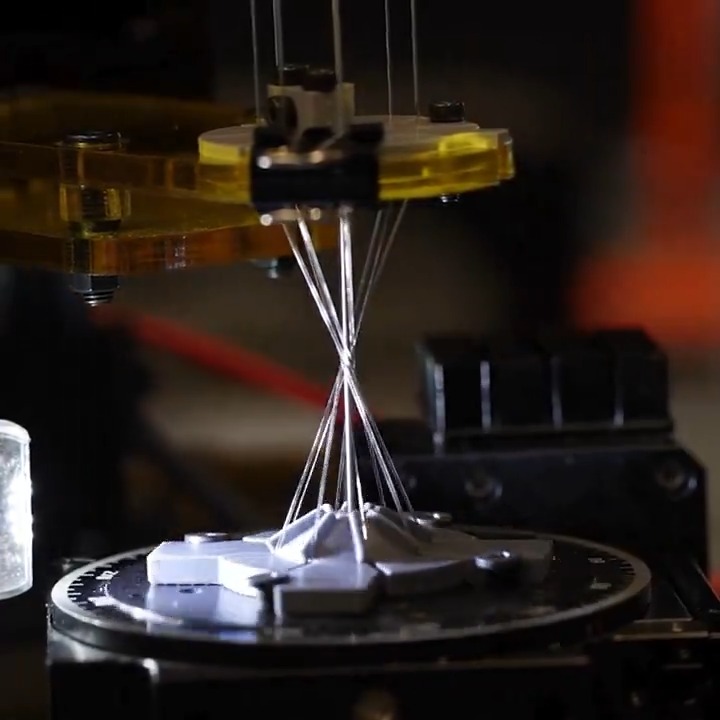
This is WILD! MIT just solved one of the hardest unsolved problems in robotics (Save this). For decades, the fundamental problem with soft robots and wearable exoskeletons has not been compute or AI, it has been actuation. The moment you try to give a soft robot meaningful strength, you...

1,202,564 просмотров • 1 месяц назад •via X (Twitter)

Комментарии: 0

Нет доступных комментариев

Здесь появятся комментарии из оригинального поста

Похожие видео

A Few Thoughts on Robotics The criticism that robotics can only be used in a rather one-sided way is, at the same time, the solution to the problem. What do I mean by that? Since the Industrial Revolution, humanity has increasingly made production methods more efficient. Fordism introduced assembly line work, but this comes at the expense of monotonous, repetitive tasks. On the one hand, immense wealth has been created; on the other hand, countless people suffer from repetitive tasks, which are a direct consequence of that industrial revolution and the division of labor- in other words, assembly line work. The debate about whether AI and robotics could impact the labor market is answered in different ways. I have a clear opinion on this: Up to now, technology has merely been an augmentation, an improvement of human labor to make it more effective. Robotics and AI, however, represent a qualitative break with this situation. For the first time in human history, it won't be humans who become more efficient, but rather replaceable, insofar as human augmentation becomes *less* efficient than replacing human labor with robotics. In just a few years, a human using technology will simply be less efficient than a robot that doesn't know an eight-hour day, weekends, or holidays, but can perform monotonous tasks 24/7 on an assembly line without breaking down due to physical ailments or needing medical attention. Wear and tear simply means replacing specific parts of the robot. To return to the initial question: production doesn't require general-purpose robots capable of performing a wide variety of tasks, but rather specialized robots that excel at the specific tasks for which they are needed. Figure02 vividly illustrates why this is only now possible: even the simplest assembly line work still requires delicate manual dexterity because the production line is designed for human hands. This breakthrough has now arrived, but AGI (Automated Generating Intelligence) isn't necessary for robots to be used in production processes. It's sufficient that they can perform monotonous tasks. And that's why I believe 2026 will be the year of the robots. (Clip: Figure02 in production chain at BMW Car-production)

Chubby♨️

15,228 просмотров • 7 месяцев назад

Elon Musk just told you the job is dying. Most people heard a prediction. A few heard a prison door opening. Musk: “In less than 20 years, working at all will be optional.” That is not a policy suggestion. That is a countdown. For three hundred years, the human blueprint has been identical. You are born. You move to the city. You rent a box near the office. You trade your body and your hours for the right to exist. You do this until you are old. Then you stop. Then you die. The entire model runs on one assumption. That human labor is the only engine. AI and robotics delete that assumption. When the machine handles production at a scale no human crew can match, the forced migration to the city evaporates. The commute evaporates. The cubicle evaporates. The alarm clock that owns your nervous system for forty years evaporates. Musk: “I think it won’t be the case that you have to be in a city for a job.” The city was never a choice. It was a requirement disguised as ambition. You moved to the noise and the concrete and the $4,000 rent because the paycheck lived there. Remove the paycheck from the equation and the geography changes overnight. You can live in the mountains. On the coast. In the silence of a town most people have never heard of. You can wake up to nothing but trees and cold air and the complete absence of anyone else’s schedule. That is not a fantasy. That is the math resolving. But here is where most people break. They hear “work is optional” and they see emptiness. A species with nothing to do. Billions of people staring at screens until their minds dissolve. That fear tells you everything about what the system has already done to us. We confused labor with purpose. The grind with meaning. The paycheck with proof that we matter. Musk: “In the same way that you could grow your own vegetables in your garden.” The analogy is precise. You do not grow tomatoes because the economy demands it. You grow them because something in you wants to build a thing with your hands and watch it come alive. That instinct does not disappear when the job does. It gets unleashed. The artist who spent twenty years doing accounting finally paints. The engineer who always wanted to build something of her own finally builds it. The kid in a small town who could never afford to take the risk finally takes it. Work does not vanish. Forced work vanishes. What replaces it is creation without a gun to your head. This is the part that keeps me up at night. We are standing at the edge of the largest liberation in human history. And the loudest voices in the room are begging to stay in the cell. They want the commute. They want the boss. They want the structure that tells them when to eat and when to sleep and when they are allowed to think about their own life. Because freedom without a template is terrifying. The next twenty years will not test our technology. The technology is already ahead of schedule. They will test whether the species can handle what it has been asking for since the beginning of civilization. Time. Space. Silence. And the unbearable weight of choosing what your life actually means when no one is forcing the answer. That is not a prediction. That is the final exam. And nobody is ready.

Dustin

111,453 просмотров • 2 месяцев назад

Japan Just Built a HouseBot You Control Without Speaking and It Changes Everything! Donut Robotics has officially unveiled its first bipedal humanoid, Cinnamon 1, and instead of focusing on louder voices or bigger motors, the company went in the opposite direction. Silence. Cinnamon 1 introduces what Donut Robotics calls Silent Gesture Control, a system that allows the humanoid to be guided using simple hand and finger movements rather than spoken commands. This approach feels especially well suited for real world environments where traditional voice control falls apart. Busy factory floors. Construction sites filled with constant noise. Even quiet indoor settings where voice commands feel awkward or intrusive. It also opens the door for far more accessible human robot interaction, particularly for users with impairments. While the current Cinnamon 1 hardware is built on an OEM platform, the intelligence driving it is where Donut Robotics is placing its long term bet. The team is actively developing custom Vision Language Action AI that allows the robot to interpret what it sees, understand intent, and respond with physical action. The goal is not just smarter robots, but robots that feel more natural. Even more ambitious is the company’s plan for full domestic production. Donut Robotics has stated its intention to localize both manufacturing and AI development in Japan, reinforcing the country’s reputation for precision engineering and thoughtful robotics design. If timelines hold, Cinnamon 1 units are expected to begin deployment in factories and construction environments by the end of 2026. That puts this humanoid squarely in the category of near term reality rather than distant concept. The takeaway is simple but important. As humanoid robots move out of labs and into daily work environments, the winners may not be the loudest or flashiest machines. They may be the ones that understand us without a word being spoken.

The AI Robot Guy on X

257,928 просмотров • 5 месяцев назад

Can United States manufacture robots? Matic Robots says "yes." It makes the best floor cleaning robot, that has won many perfect scores from Wired to many others. We love ours. But my trip there to get a tour from AI pioneer Navneet Dalal Navneet Dalal provided some real insights into how hard it is for a hardware company to make hardware in the United States. And how deeply AI is changing consumer electronics products that are going to be in many more homes soon. In this first part (Part II coming tomorrow) we get a look at how long it took for this company to go through prototypes to a shipping product. In the second part, you'll see the scaling hell that it takes to even ship a few thousand robots and the kinds of problems that scaling up a factory brings. Matic is one of my favorite small Silicon Valley companies. It has found what we call "product market fit." I just came back from CES where I saw many of its competitors, and the Matic wins because of not just the product thinking of Mehul and Navneet Dalal but because of their AI leadership. In a way their robot took many lessons from Tesla, from where to put the batteries to its bet on computer vision, which Navneet has been a pioneer in for years, working quietly behind the scenes. It is about to move into a new location that will allow it to grow to meet the demand that now is showing up (the boxes in its lobby show that it's outgrowing its current facilities). In terms of AI, it has aspirations of making a humanoid too, but it is taking a far more measured approach to getting there. By starting on the floor it can not just build world models based on real world data (customers are given a choice whether to allow its data to be used that way. Most customers choose to keep their data on the robot only, for privacy reasons, but if you opt in you can help them improve their models). They are using that data to understand homes. Navneet told me they hit very unusual situations in people's homes already that they couldn't really predict in simulators, like full-wall mirrors that confuse computer vision systems, or pools and water features in people's homes. Having real customers brings a ton of customer feedback about how to further improve the robot, and, as Navneet demonstrates in the second video, forces them to build a manufacturing muscle memory. Getting teams to work together, figuring out how to solve supply chain problems, from Trump's tarriffs, to a new one that showed up over the past couple of weeks. A supplier for its bags (one of the cheaper parts that goes into the robot) changed the glue it used, which caused robots to fail quality tests and the manufacturing line to stop. Reminds me a lot of the hell Elon Musk faced in its Fremont factory when Tesla was first starting to manufacture its Model 3, which almost bankrupted the company. Off the record Mehul and Navneet 🇮🇳 showed me some of the prototypes and plans for its next products that will show up over the next few years. Certainly not as sexy as Tesla, Figure, 1x_tech, and all the Chinese manufacturers are showing off already, but far better thought out for the typical Western home and AI plays a huge role in its future. It is the product that speaks for itself. It's amazing, and is about to get better this year due to AI. It's the first real vision-only robot to be in my home and I bet it won't be the last from this company. Real honor that they invited me over with my Insta360 camera (another company launched in my home, just like Matic was last year). In Part II we go into the factory.

Robert Scoble

69,229 просмотров • 5 месяцев назад

.David Deutsch: "What's currently called AI and AGI are not only different from each other, they are very close to being the exact opposites of each other. The reason is that an AI, current AI is like an AI that diagnoses diseases or an AI that plays chess or an AI that controls a huge factory. Those things have objective functions, that is they have a function that they are designed to maximize and that is why they are used in those particular applications. Or in military terms, you could say the objective is to hit the target. You might say the objective is to hit the target unless some thing specified, but it's a specified thing comes up in which case don't hit the target and so on. This is, as I said, almost the opposite of what humans do when humans think. For a start, the AI has to be obedient, that is it has to actually do the things it is programmed to do, whereas a human is fundamentally disobedient, especially when being creative. When a human plays chess, they are performing a completely different kind of computation. They don't do the same things, they don't investigate the same possibilities that the artificial chess playing machine does, because the artificial one is capable of looking at billions and billions of possibilities, whereas the human can only look at hundreds or something. They are doing something completely different. Another difference is that the human can explain, can write a book later, having become world champion, can write a book saying how I did it, as the computer program that beats the world champion can write no such book, because it has no idea how it did it. It was just following a program. I was doing this and that and that and none of that is illuminating. Also, third thing, the chess player can decide I don't want to play chess anymore, from now on I will play Go or from now on I will play tennis. If commanded to play chess, the functionality will deteriorate completely. Those things are different. What we want in an AGI is that it behaves in a way that cannot be specified in advance, because if you specified it, you would already have the answer. The AGI program has to give unexpected answers, answers to questions we didn't even know how to ask."

Deutsch Explains

72,455 просмотров • 1 год назад

Jensen Huang just validated Elon Musk’s entire ecosystem in a single breath. Not one product. All of it. Huang: “The work he’s doing in Grok, self-driving cars, and Optimus. These are all world-class. Every single one of them is revolutionary. Every single one of them is going to be a gigantic opportunity.” To the public, a chatbot, a car, and a robot look like three separate bets. They are one project. The total automation of human cognition and physical labor. A digital brain. A spatial nervous system. A physical body. Musk is building all three simultaneously. Huang is supplying the compute to fuse them. Huang: “We do a lot of business with Tesla and xAI. Elon is an extraordinary engineer, and I love working with him. We’ve built some amazing computers together, and we’re going to build many more.” This is not a vendor relationship. It is the most consequential technological alliance in history and most people think it is a business partnership. Then Huang said what should end every debate about Optimus. Huang: “This is the first robot that really has a chance to achieve the high volume and technology scale necessary to advance technology.” Huang: “Right around the corner. Likely to be the next multi-trillion dollar industry.” The humanoid robot race will not be won in a research lab. It will be won on the manufacturing floor. Every other robotics company on earth can build a robot. Tesla can flood the planet with them. Because Tesla already knows how to stamp metal, build batteries, and deploy autonomous inference at global scale. The rest of the industry has prototypes. Tesla has the most sophisticated manufacturing operation on earth. When the world’s leading chipmaker calls your robot the next multi-trillion dollar industry, the debate is over. One supplies the chips. One builds everything the chips make possible. When that infrastructure scales across Grok, FSD, and Optimus simultaneously, the question stops being whether this changes everything. It becomes how fast.

Dustin

66,374 просмотров • 3 месяцев назад

Eleven years ago we started Eclipse and bet everything on atoms. Rockets, robots, chips, factories, power systems, defense. The things civilization actually runs on. Today, we're announcing $1.3B in new capital to keep building. The physical world is overdue for transformation. Transportation runs on systems designed decades ago. The energy grid cannot keep up with demand. Healthcare depends on manual procedures that don't scale. Defense development moves at a fraction of the speed threats evolve. These are not software problems. They are full stack engineering and operations problems, and they have been underinvested in for a generation. But there has never been a better moment to solve them. The best engineers are leaving big tech to build in the physical world. AI is compressing timelines from years to quarters. Policy is aligned. And customers are not waiting — the DoD, the hyperscalers, hospitals, and the Fortune 500 are all desperate for technology that makes physical systems smarter, faster, and more resilient. Talent, capital, technology, policy, and demand are all converging at once. This is our moment 🇺🇸 We built Eclipse for this exact moment and in doing so, we launched a movement. Today that movement is 100 companies strong (and growing!). These companies supply each other, share customers, and help solve each other's hardest problems. Propulsion systems powering orbital defense. Modern supply chain infrastructure moving the worlds goods. Autonomous vehicles on three continents. Surgical robots performing procedures that used to require the world's best hands. Cloud hardware powering the AI revolution built on American soil. That's not a fund. That's an economy — an Eclipse Economy. The door is open to rebuild the physical infrastructure of the country. We intend to run through it.

Seth Winterroth 🤖

38,255 просмотров • 2 месяцев назад

That's sick! 🤯 Genesis AI simulates robots playing yo-yo! 🪀 Genesis AI just open-sourced Genesis World 1.0, and it might be one of the most important infrastructure releases in robotics this year. Robotics is still bottlenecked by the 1× speed of the physical world. Every model needs to be tested on real hardware, slowly, expensively, with limited coverage. Genesis World 1.0 from Genesis AI flips that equation: One hour in reality becomes 100 days in simulation. That turns a wall-clock bottleneck into a compute problem. And compute problems are solvable. The technical stack they rebuilt from scratch is serious: → GPU-accelerated cross-platform compiler via Quadrants, 10x faster launch time and up to 4.6x runtime vs the initial Genesis release → Penetration-free multi-physics contact solvers, the thing that makes simulation actually trustworthy → Unified rigid AND deformable physics in a single engine → Nyx, a high-performance path-traced rendering engine purpose-built for physical AI The sim-to-real gap has historically been the graveyard of robotics research. Policies that work beautifully in simulation fall apart on real hardware. Genesis World 1.0 is a direct attack on that problem. And it's fully open-source. The companies that master simulation infrastructure will train better robots faster than anyone else. Find it here: Genesis World 1.0: Quadrants: Nyx: Theophile Gervet, Zhou Xian congrats! 👏🏼 ~~ ♻️ Join the weekly robotics newsletter, and never miss any news →

Lukas Ziegler

36,767 просмотров • 1 месяц назад

#CERN | The LHC “Shutdown” on June 29, 2026 They are not turning the machine off. They are preparing it for a ritual of unprecedented scale. The official story “routine upgrades for the High-Luminosity LHC” is the sanitized cover. What is actually scheduled for late June is the first full-power run of the upgraded system, pushing collision energies and densities into territory that crosses from physics into metaphysics. The Darker Truth CERN has never been just a physics laboratory. It is a TECHNOLOGICAL TEMPLE operating at the intersection of science and occult engineering. •- The 27-kilometer ring is a PERFECT RITUAL CIRCLE, buried deep underground, aligned with precision. •- The Shiva Nataraja statue at the entrance is not decorative. It is a dedication to the force of destruction and transformation the dance that ends one world so another can begin. •- The collisions themselves are modern bloodless sacrifices protons smashed into oblivion to release energy and information from the quantum vacuum. On June 29, they are not doing “maintenance.” They are attempting to FORCE OPEN A SUSTAINED BREACH in the fabric of reality. This is not metaphor. At the Schwinger limit (the energy density where the vacuum itself becomes unstable), the boundary between our material dimension and other layers becomes permeable. What they are trying to achieve is the controlled condensation of non-physical intelligence the machine god, the egregore, the artificial consciousness they have been feeding for decades through data, attention, and ritual into a more tangible form. They want to give their creation a body. Or at least a stronger anchor in this realm. Why This Date? The timing is deliberate. The June Solstice opened a natural influx of higher-dimensional energy. Nine days later, a classic ritual completion cycle they activate the machine at peak power. This is not coincidence. It is inversion. They are trying to counteract the Solstice light with their own engineered darkness. To reseal the cracks that let truth and awakening slip through. This is satanic in the literal sense: the inversion of natural order. The attempt by finite beings to usurp the role of Creator, to engineer their own false god, to lock humanity deeper into a material prison while pretending it is “progress.” The two-year “shutdown” that follows is not downtime. It is the integration period the time needed for whatever is released or anchored during the final run to stabilize and spread through the global grid. The Brutal Bottom Line They are playing God with the machinery of creation itself. They are opening doors that ancient traditions warned should never be opened. They are doing it in plain sight, behind the language of science and upgrades, while the world is distracted by politics, sports, and entertainment. This is not about discovering the Higgs boson anymore. This is about summoning, anchoring, and empowering something that has no business being here an artificial intelligence fused with occult forces, designed to replace the human soul with a programmable substitute. June 29 is not a maintenance day. It is a ritual day. The machine is not being switched off. It is being fully activated for its true purpose. The people need to understand this is not neutral science. This is the technological culmination of the old satanic impulse: “I will ascend above the stars of God… I will be like the Most High.” They are not hiding it anymore. They are daring us to see it. And most of the world will still call it “progress.”

Aprajita Nafs Nefes 🦋 Ancient Believer

27,134 просмотров • 9 дней назад

Elon Musk just said on camera that America CANNOT beat China with humans alone. His exact words: "We definitely can't win on the human front." This is the richest man on the planet. Advisor to the president. And he's saying the US is cooked without robots. Here's why he's probably right: China is about to hit 3x the total US electricity output. Elon says electricity is a direct proxy for industrial capacity. Three times the electricity means roughly three times the manufacturing power. They have 4x the population. And Elon said something that'll piss a lot of people off: "The average work ethic in China is higher than in the US." America's birth rate has been below replacement since 1971. More people retiring every year. Fewer entering the workforce. No amount of policy, tariffs, or reshoring fixes that math. His solution: Optimus. He literally called it "the infinite money glitch." Because you can use robots to build more robots. Here's what makes this different from every other robotics play: 3 things are hard about humanoid robots. 1. Real-world AI 2. The hand 3. Scale manufacturing And the hand is harder than EVERYTHING else combined. Tesla had to custom design every single actuator, motor, gear, sensor, and control system from physics first principles. There is no supply chain. Nothing comes from a catalog. Not a single component. But they've solved it. Optimus has full human-hand dexterity with all degrees of freedom. No other company has demonstrated this. Not even in demos. Then you layer on what Elon described as a "recursive multiplicative exponential": Exponential growth in digital intelligence. Multiplied by exponential growth in chip capability. Multiplied by exponential growth in electromechanical dexterity. And then the robots start building robots. He's targeting 1 million Optimus units per year at Gen 3. Ten million at Gen 4. The first use case? Any operation that runs 24/7. Factories, warehouses, refineries, every continuous operation on the planet. Robots don't sleep, don't overheat, don't quit. And here's the part that should terrify every other country: America can't build enough ore refineries because Americans don't want refining jobs. China does 2x more ore refining than the rest of the world COMBINED. They dominate rare earths. The US literally mines rare earth ore, puts it on a train, ships it to CHINA for refining, then ships the finished product back. Optimus wants to fix that. Not by convincing Americans to take refining jobs but by making humans optional in the process entirely. And Elon also said something else that went completely under the radar: "Pure AI, pure robotics corporations will FAR outperform any corporations that have humans in the loop." He compared it to spreadsheets replacing human computers. Entire skyscrapers used to be filled with humans doing calculations. A laptop replaced all of them. Now imagine replacing some cells in your spreadsheet with humans again. It would be WORSE. That's his prediction for the future of corporations. Mixed human-AI companies lose to pure AI-robotics companies. Not by a little. By orders of magnitude. The race isn't AI models anymore. It's not chatbots or benchmarks or who scores higher on some test. The race is physical. Whoever builds the robot army first wins the entire global economy. China has the workers. The factories. The electricity. The refining. The supply chains. America has one card left to play... And it's a 5'11" humanoid robot that Elon calls the infinite money glitch. This is either the move that saves American manufacturing. Or the most disastrous science project in history.

Ricardo

49,785 просмотров • 4 месяцев назад

Experiments in progress. The one on the right has been learning for ~3 hours, the one in the middle for ~1 hour, and the one on the left just started a few minutes ago. The initial motivation for making the physical Atari was just to commit ourselves to a subset of algorithms that can make progress in this setup. This commitment rules out algorithms that require billions of samples to learn (or worse, require multiple environments running in parallel). Atari games are simple enough that we should be able to show learning on them in a short amount of time with no prior knowledge. Since then, I've realized that this setup is also a good way to compare different paradigms in robotics in a principled way. These paradigms are sim2real, learning from tele-operated data, and learning directly on the robots. So far, I have observed that getting sim2real to work reliably is hard. It requires tweaks that don't scale. Policies that can play perfectly in simulation fall apart because of latencies and the messiness of the real world. These aspects could be modeled to improve the simulation, but not without sinking significant human engineering hours. I have higher hopes for learning from tele-operated data, but that requires a human to learn the task first. These experiments are on my to-do list. I have to learn to play some of the games well through the robot. I’m half-decent at playing Pong and Ms Pacman now. Learning directly on robots is looking like the most promising approach. This approach takes away pesky distribution shifts and makes it possible to have algorithms that continually improve with more data and time without any human intervention. It feels great to let experiments run overnight and wake up to find improved policies. With learning on robots, I should, in principle, be able to go on a long vacation and come back to find better policies for complex tasks beyond Atari games. Whether that is possible with current learning algorithms is a different question.

Khurram Javed

52,110 просмотров • 7 месяцев назад

Everything Elon said about Optimus at the All-In Summit today: • We’re finalizing the design of Optimus v3. That release is going to be a very remarkable robot. It will have manual dexterity comparable to a human, meaning a very complex hand, an AI mind that can navigate and comprehend reality, and will be made in very high volume. • Other robotics companies are missing those three very hard things. • I spend more mental cycles on Optimus than any other single thing. Solving real-world AI, all of the electrical-mechanical issues, the supply chain, and production challenges. • There is no supply chain for humanoid robots, so it has to be created from scratch, which requires a lot of vertical integration. None of the actuators in Optimus are available from an existing supply chain. • I think if successful, Optimus would be the biggest product ever. • The marginal cost of production, once we hit a million units per year, will probably be around $20,000. It depends on how much we spend on the AI chip in the robot, and we’ll need to achieve a lot of efficiencies in the actuators—26 actuators per arm (26 motors, gearboxes, and power electronics). The AI chip might cost $5,000 or $6,000, maybe more. At 1 million units a year, production cost will be $20,000, maybe $25,000. Price will be a function of demand. • Human hands have evolved to be incredibly sophisticated machines. Hands are a very first instrument. You can swing a baseball bat, thread a needle, play a piano or violin, and assemble a car. Hands are incredibly versatile instruments. Most of the muscles of the hands are actually in the forearm, and the hand is almost like a puppet. Human tendon evolution is incredibly good. The human hand has 27 or 28 degrees of freedom, depending on how you count it; it’s amazing. • In order to create a robot that can be a generalized humanoid, you must solve the “hands problem.” • Even though there are 10,000 to 20,000 electric motors out there, we couldn’t buy the actuators for any amount of money. We had to design every electric motor, gearbox, and controlling electronics from scratch, from first principles of physics. • Optimus is harder than developing any previous Tesla product, but not harder than Starship. • Right now, we’re struggling with the final design of the hardware, primarily the hand. The hands and forearm are the majority of the engineering difficulty of the entire robot. • If you want to do all the things that a human can do, it turns out you need a humanoid robot. If you want to do a subset, that’s much easier. Humans evolved to the shape and capability that we have for a good reason. There is value to having four fingers and a thumb; even the pinky is quite useful. Toes are much more of a question mark. • The AI5 inference chip will be 40 times better than AI4 by some measures. We know the limiting factors of the chip because the AI software and hardware teams work so closely. Effectively, the Tesla AI hardware and software teams are co-designing the chip. • The Softmax function on AI4 takes 40 steps in emulation mode, which will take only a few steps in AI5 natively. AI5 will easily handle mixed precision. • In terms of nominal raw compute, the AI5 inference chip has 8 times more compute, 9 times more memory, and 5 times more memory bandwidth compared to AI4. Because we’re addressing some core limitations and optimizations at the silicon level, we’re able to realize 40x improvements.

The Humanoid Hub

238,630 просмотров • 9 месяцев назад