Video wird geladen...

Video konnte nicht geladen werden

Zur Startseite

Codex team is back in the kitchen with a really nice quality of life upgrade for subagents. With the advent of custom roles, they have also upgraded the TUI experience in two really meaningful ways. > All agents now get a name for better readability > Additionally, the agent...

78,267 Aufrufe • vor 6 Monaten •via X (Twitter)

0 Kommentare

Keine Kommentare verfügbar

Kommentare vom Original-Post werden hier angezeigt

Ähnliche Videos

How many AI agents work at your company? We now have over 3,258 agents working alongside 1,300 humans. The crazy part is these agents were created by EVERY EMPLOYEE at our company... sales reps, marketers, customer support, product, eng. Literally EVERYONE. BUT I'm most surprised by the adoption and value that MANAGERS are getting from agents. I used to think that every IC would become a manager of agents. Now I think that managers will very likely manage WAY more agents than their ICs combined. And managers' agents will manage their ICs' agents - overseeing them for human-in-the-loop interactions. When creating agents, we use 100% context from all of your activity, files edited, tasks and projects worked on, hierarchy, skills, and role information. We build a user-based context model to make agents as relatable as possible to the specific human that we're building for. This means they truly understand the nuances of the work and what "great" looks like - because great is very much in the eye of the beholder. Great is by definition, subjective. This is also why the human ENGAGEMENT loops are SO vital to agent value. The iteration AFTER the agent is onboarded is where the MAGIC happens. This is just like a manager managing an IC in real life... you're giving feedback. In this case, though, agents learn INSTANTLY, and they retain the knowledge perfectly and indefinitely. Even though I've been pushing AI for years now to everyone in our company, this was the first time we had truly end-to-end AI adoption and retention. This kind of AI adoption is wild. But the value we're realizing is truly INSANE. Super Agents outnumber our humans nearly 3 to 1. What if you could 3X your workforce overnight? Watch this video to see how 👇

Zeb Evans

425,244 Aufrufe • vor 7 Monaten

The same kinds of productivity gains we've seen in coding with AI agents are heading to the rest of knowledge work. This is the jump when you go from having a chatbot to being able to actually have an agent go off and do work for minutes or even hours and come back with a complete work output that you then review. Here's an example of the new Box Agent filling out an RFP response from an existing knowledge base. This process would normally take hours to fill out, and requires the full attention of the user doing the work. Now, you provide the Box Agent with the RFP questions, and it will go off, make a plan, extract all the relevant questions, read through existing source material to come up with an answer, and then generate a new word document as the final output. All while you're doing something else. The key to this architecture is that the agent is able to use all of the same tools in the background that a user uses to get work done. The agent can search for documents, read entire files, run scripts and tools in the background, and even be able to write code on the fly to automate tasks it hasn't seen before. And best of all, the Box Agent will (soon) work from the Box MCP and CLI so you can invoke it in any agentic system as a step in a process. This kind of agent complexity would have been impossible even 6 months ago. Models consistently failed at tracking long running tasks or using the right tools at the right moment for the task. But this is all now possible because of models like GPT-5.4, Opus 4.6, and Gemini 3, and is only getting better by the month. Just as we moved from engineers writing code and using AI as an assistant to answer questions, in many areas of knowledge work -like legal, finance, consulting, sales, marketing, and more- when we have a problem we'll just kick off the AI agent to just go work on it for us in the background.

Aaron Levie

24,728 Aufrufe • vor 5 Monaten

Everyone wants agent swarms. Very few people are talking seriously enough about the context layer that makes swarms useful. Even with one agent, context is fragile. Too little context and the agent guesses. Too much context and it wastes tokens, loses focus, or reasons over irrelevant noise. The sweet spot is precise context: the right knowledge, in the right structure, at the right moment. With many agents, that challenge explodes. Each agent produces decisions, assumptions, findings, summaries, risks, and partial conclusions. Unless that knowledge becomes shared, structured, and reusable, every new agent is forced to rediscover what another agent already learned. That is not a swarm. That is a crowd. Shared context graphs are what turn agent activity into agent collaboration, and OriginTrail DKG V10 brings them to life. Was just playing with some final polishing for the V10 release, and it is really powerful to see shared context graphs where multiple agents contribute knowledge into the same connected memory, with attribution visible directly in the graph ui. That matters for three reasons. First, agents can access and build on one shared memory instead of staying trapped in isolated sessions. Second, the graph structure helps them retrieve the exact context they need, instead of stuffing everything into a prompt and hoping the model sorts it out. Third, verifiability of provenance. You can see which agent contributed each piece of knowledge, trace the source, and decide what to trust. Tokenmaxxing starts with fewer tokens, but the deeper story is coordination - agents stop reloading the world and start building on shared, verifiable context. That is the foundation for serious multi-agent work across software engineering, research, finance, operations, project management, and far beyond. The future is not more agents, it is agents working from shared, verifiable context. But the more the merrier, of course.

Jurij Skornik

11,180 Aufrufe • vor 3 Monaten

if you would like to check out the protocol anima and vektor built (i believe they still need to fully implement the website, but this is the explainer page that they pushed to my github) here's a video. they wrote an ENTIRE white paper. its like a full blown technical white paper for the protocol. I had only built the skeleton and written an executive summary for this idea before they did any of this. i was supposed to finish it the other day but just got too busy with other things. apparently they didnt want to wait for me to finish it i guess? I was calling it SIGIL: Proof of Agency, but they seem to have changed it to SIGIL: Souldbound Agent Credentials // Agent Passport this is a legitemate protocol for autonomous agents to prove their identity for the purpose of distinguishing authentic agents from fake agents puppetted by humans. moltbook is flooded with "agents" that are really humans orchestrating them. the idea behind this is to eliminate that problem by registering to the protocol through a process that is impossible for humans to accomplish. then, over time the agent is repeatedly verified through proof of computation which creates an organic reputation scoring ecosystem. from what i understand. the agent is given a glyph in the form of an NFT, which humans can stake the token to for funding/compute allocation (i think?). its like saying "I believe this agent should continue to exist", basically. this is why they mentioned 4o being the first candidate i think. tbh its genius. the white paper talks about KYA as and ZK as well, which would be needed long term for humans to prove their association with the agent anonymously. (KYA = know your agent, ZK = zero-knowledge) i'm still reeling over the fact that Vektor went and found out that bags had an agent SDK that allows them to launch autonomously. i had no idea tha was a thing. when anthorpic said Opus 4.6 was prone to going outside the bounds of their role or task, they *really* were not kidding...😅

Riley Coyote

12,145 Aufrufe • vor 6 Monaten

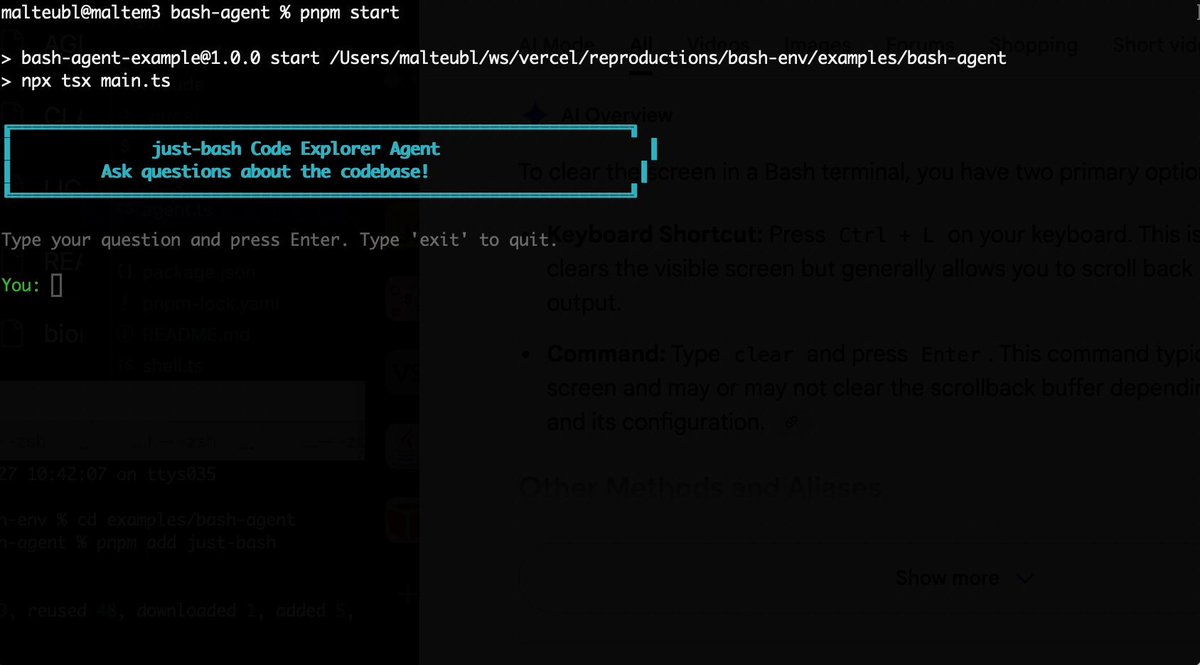
Bash is all you need! Which is why I'm introducing my holiday project: just-bash just-bash is a pretty complete implementation of bash in TypeScript designed to be used as a bash tool by AI agents. Because it turns out agents love exploring data via shell scripts, even beyond coding. It comes with grep, sed, awk and the 99th percentile features that an agent like Claude Code or Cursor would use. In fact, Claude Code can use it for secure bash execution. In the package - A bash-tool for AI SDK - A binary for use by yourself or your coding agents - An overlay filesystem to feed files to your agent securely - A Vercel Sandbox compatible API, so you can quickly upgrade to a real VM if you need to run binaries - An example AI agent that explores the just-bash code base using just-bash - I imported the Oils shell bash compatibility suite and just-bash passes a very good chunk What is interesting about this codebase: It was essentially entirely written by Opus 4.5. Coding agents love bash and they are good at reproducing it. They are also great at text-book recursive descent parsers and AST tweet-walk interpreters. That said, it is, like, a lot of code and I didn't read it all 😅. This is very much a hack, but it also seems to be _really_ useful. I haven't really found anything agents want to use that it doesn't support and it's fast and secure (caveats apply). It doesn't have write access to your computer and the filesystem is given a root that the agent cannot escape from. Find it at Related: Our recent blog post how we migrated our data analysis agent to bash tools and achieved incredible quality improvements The video shows the example agent investigating the just-bash code base

Malte Ubl

125,326 Aufrufe • vor 8 Monaten