Loading video...

Video Failed to Load

Go Home

Cybersecurity expert Ryan Montgomery (the ethical hacker who's hunted child predators on the Shawn Ryan Show) breaks down 5 dead-simple ways to shield yourself from hackers in this quick 56-sec clip. His no-BS list: 1. Use a password manager — Stop reusing weak passwords; let one tool generate and...

46,761 views • 6 months ago •via X (Twitter)

0 Comments

No comments available

Comments from the original post will appear here

Related Videos

Most developers can't explain how Single Sign-On (SSO) works. ​ This was one of my favorite questions during technical interviews. I love to ask about it because it's not a trivial topic. ​ Here is a 5-minute overview of how Single Sign-On works. ​ We all hate passwords; the less we use them, the better, and SSO helps with that. ​ When you log in to Google once and visit YouTube, Gmail, Drive, and any other connected service without re-entering your password, three players are working behind the scenes: ​ • A user trying to access an application. You, in this case. • The application you want to access. For example, YouTube. • An Identity Provider (IDP) that will verify your identity. Google, in this case. ​ Here is what happens when you try to access one application for the first time: ​ 1. You try to log in to YouTube, and the application redirects you to the Identity Provider (IDP) for authentication. ​ 2. The IDP (Google) checks your credentials and confirms your identity. It creates a new session for you on its server and sets a session cookie in your browser. ​ 3. The IDP also creates a token for YouTube—a small piece of data that contains information about your identity. ​ 4. Your browser grabs the token and presents it to YouTube. ​ 5. YouTube checks the token, and if it is valid, lets you in. ​ But then you want to access Google Drive: ​ 1. You go to Google Drive, and the application redirects you to the IDP. ​ 2. The IDP recognizes that you are still logged in because you have the session cookie. It doesn't need to ask for your credentials. ​ 3. Instead, the IDP generates a new token for Drive. ​ 4. Your browser grabs the token and presents it to Google Drive. If the token is valid, Drive lets you in. ​ You can now access multiple applications without re-entering your password. This is probably one of the best things we've invented since sliced bread! ​ But, of course, implementing Single Sign-On is a nightmare! If you are a developer, don't try to reinvent the wheel. I've been implementing SSO since dinosaurs were around, and I can tell you you want to check out Auth0. ​ Auth0 makes implementing SSO 100x easier. They just updated their free plan, and you get a lot without having to pay a single cent. 25,000 monthly active users, unlimited social connections, and you can go to production with custom domains. FOR FREE! ​ They are sponsoring this post. To save your time, keep your sanity, and have a really solid and secure solution, head over to their website: ​

Santiago

204,895 views • 1 year ago

15 LESSONS: 1. Your wife is not your relative. She can betray you anytime. 2. Your father-in-law is not your FATHER; he can betray you, too. 3. Don't be emotionally attached to your children. Your wife can weaponize this attachment. 4. Once your wife leaves with the children, don't follow her. If you follow, you are desperate and a sign of ONEITIS. 5. Avoid custodial fights and court drama. They traumatize your children. Trauma that they will carry into adulthood. 6. Don't argue with your father-in-law. Most boomers are church-bred cucks who worship their wives and, in extension, their daughters. If he says NO, leave in silence. 7. Don't be a talkative boy in front of your wife's parents. In fact, avoid them. If they want a meeting, send your uncles and cousins. 8. In the event of a spousal conflict, don't go to your wife's home. Let them come to you. This way, you will have leverage in negotiations during the conflict. Don't go there. Refuse. 9. If your wife clings to the children, well and good. Leave them to her. Support where necessary, but stay away from her. 10. You know yourself. It is better to be called a "DEAD BEAT" than to be BEATEN to DEATH. 11. Lift weights and eat meat. Don't be thin and slender. Appear strong and dangerous. 12. If you make your wife the centre of your universe, you will lose yourself and also lose her. 13. If you refuse to listen, you will suffer the consequences of your ignorance and blue-pilled conditioning. 14. Amerix is NOT a content creator. He is NOT an influencer. 15. CHANGE or PERISH

Eric

332,859 views • 9 months ago

The subject of 'owning a slave' is dense. It is something we hear a lot when we are in the FemDom Realm. Is it just fantasy? Can it actually be a lifestyle? How do we navigate this type of dynamic? How do we even get to that level of D/s? In this short clip [Exerpt from SLAVE TRAINING Part 2] I want to already bring to your attention one thing that will define if your desire for a slave (or desire as a slave) is touching more on a fantasy or... how can you actually navigate this in a realistic way. No one person 'can do it all' or should be expected to. If you want your slave to be 'the best' , assign them a specific role in which they can excel... and then build upon that. Once they 'master' your housekeeping (which takes quite a bit of real training), they can move to other levels. And an important note I want to leave here... make them EARN access to certain things in your life that sometimes you just want to delegate because you don't want to manage or don't know how to manage. Entrusting them with serious tasks that can affect your life, your business, your reputation, are on top of the ladder. Are they even qualified for the thing you want them to take off your shoulders? Start small and allow them to grow in their submission, to develop their skills and to learn how to best satisfy you without setting them up for failure by expecting too much, too quick. In the end, if you want this to truly work, you have to approach it from a place that transcends the roles. As this is consensual power exchange. And you both want to be fulfilled in that relationship.

Ms. Malissia

12,836 views • 5 months ago

Jordan Peterson: "If you can't fix your room, you can't fix your life" "Why should you even bother improving yourself? The answer is something like: so you don't suffer anymore stupidly than you have to. And maybe so others don't have to either. It's not some casual self-help doctrine. If you don't organize yourself properly, you'll pay for it. In a big way. And so will the people around you." Peterson continues: "You can say, 'Well, I don't care about that.' But that's actually not true, you do care about it. Because if you're in pain, you will care about it. It's very rare that you can find someone in excruciating pain who would say, 'Well, it would be no better if I was out of this.' Pain brings the idea that it would be better if it didn't exist along with it. It's incontrovertible." On how to start: "Look around for something that bothers you and see if you can fix it. You can do this in a room. Sit in your bedroom and think: 'If I wanted to spend ten minutes making this room better, what would I have to do?' You have to ask yourself that, it's a genuine question. And things will pop out. There's a stack of papers bugging you. Some rubbish behind your computer monitor you haven't attended to for six months. Cables tangled up." He explains why this matters: "If you were coming to see me for psychotherapy, the easiest thing would be to get you to organize your room. You think, is that psychotherapy? It depends on how you conceive the limits of your being. Start where you can start. If something announces itself as in need of repair that you could repair, fix it. Fix a hundred things like that, your life will be a lot different." On fixing what you repeat every day: "People tend to think of their daily routines as trivial. You get up, brush your teeth, have breakfast. Those probably constitute 50% of your life. People think, they're mundane, I don't need to pay attention to them. No, that's exactly wrong. The things you do every day are the most important things you do. Hands down. Just do the arithmetic." On staying within your competence: "Sometimes you don't know how to fix something. Imagine you're walking down the street and there's a guy who's alcoholic and schizophrenic and has been homeless for ten years. That's a problem. It would be good if you could fix it, but you haven't got a clue. You walk around that and go find something you could fix. Just because something announces itself as in need of repair doesn't mean it's you, right then and there, who should repair it. You have to have some humility. You don't walk up to a helicopter that isn't working and just start tinkering away." Peterson shares the key insight: "As soon as you give your mind a genuine aim, it'll reconfigure the world in keeping with that aim. That's actually how you see to begin with. You've all seen the video where you watch basketballs being tossed back and forth, and while you're doing that, a gorilla walks into the middle of the video and you don't see it. If you thought about that experiment for five years, that would be about the right amount of time to spend thinking about it." He explains what it reveals: "What it shows you is that you see what you aim at. If you can get one thing through your head, that would be a good one. You see what you aim at. One inference you might draw from that is: be careful what you aim at. What you aim at determines the way the world manifests itself to you. So if the world is manifesting itself in a very negative way, one thing to ask is: are you aiming at the right thing?"

Jaynit

68,799 views • 3 months ago

how to use Google's NEW open source Design.md + AI Skills to make your startup look like a $100 million company in 1 hour: 1. Design.md is an open source file from Google that captures the soul of a design. Typography, colors, spacing, all in one markdown file. You attach it to your prompt and your agent builds beautiful things every time. 2. Think of it this way. The HTML is the finished dish. The design.md is the recipe. The skills are the ingredients. Put them together and everything you build looks consistent and professional. 3. Don't create a design system from scratch. Find a brand you love. Linear, Stripe, Vercel, whatever resonates. Study it. Use ChatGPT or Claude to help you extract the design language into your own design.md file. 4. Build skills on top of your design.md. A landing page skill. A mobile app skill. A motion design skill. A slide deck skill. Each one references the same design.md so everything looks like it came from the same designer. 5. The biggest mistake people make: they nail one screen and then everything else looks generic. Design.md solves this. One file keeps every page, every format, every medium consistent. 6. Use it across everything. Your landing page. Your app. Your pitch deck. Your promo videos. Same DNA. Same taste. Same system. That's what separates a startup that looks real from one that looks vibe-coded. 7. Build a second brain for design inspiration. When you see something beautiful in the real world or online, capture it. Save it. When you're building something new, reference it. Taste is developed, not downloaded. 8. It's obvious but the difference between a product people trust and a product people bounce from is how it looks and feels. Design.md gives you that edge. you can watch below shoutout to Meng To for coming on The Startup Ideas Podcast (SIP) 🧃 and walking through his full workflow. if you want to use AI to actually build gorgeous designs, you'll want to use see this. watch

GREG ISENBERG

508,512 views • 3 months ago

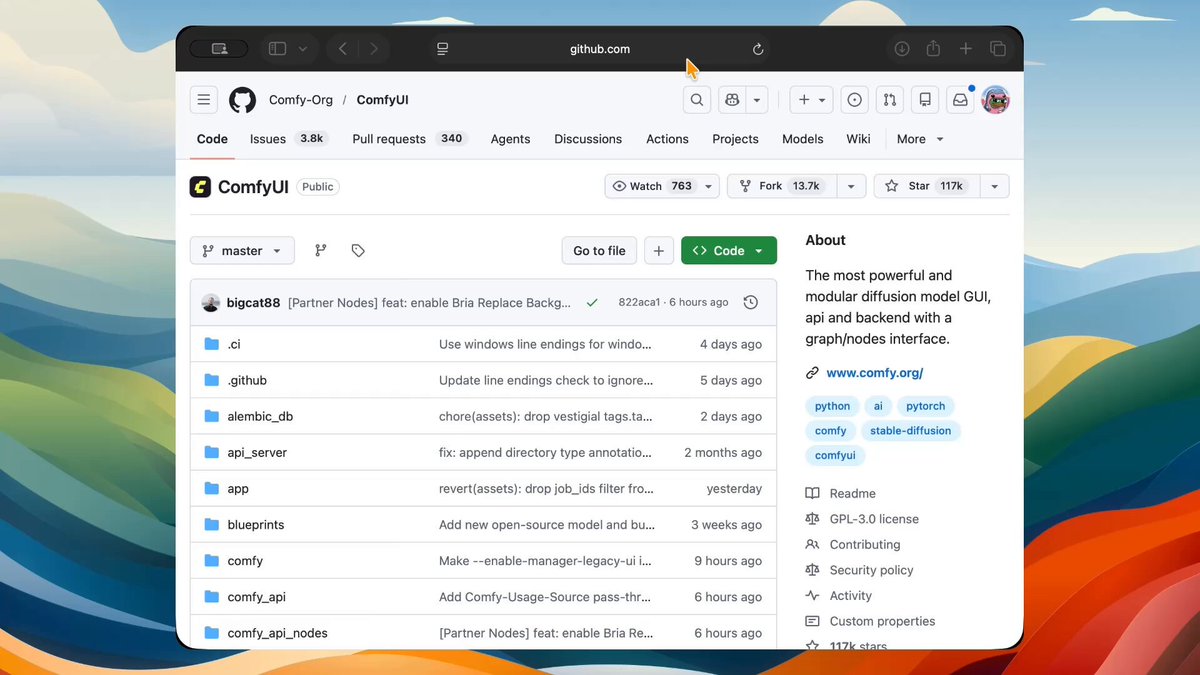
no money for grok or midjourney? this tool is for you. there's a FREE tool created by an anon dev. open-source. runs locally. 117k stars on github. it generates: > images & video > 3d models > audio > 20+ models here's how to set it up in under 5 minutes: 1️⃣download ComfyUI Desktop go to and grab the desktop app for your system. windows 10+, mac (apple silicon), or linux. it installs like any normal app, it sets up python and every dependency for you in the background. no terminal, no config files. 2️⃣open it first launch, it spins up its own environment automatically. you just wait a few seconds and you're in. you'll land on a node canvas, that's the whole interface. 3️⃣load a starter workflow top menu → Workflow → Browse Templates → Image Generation. click it. this drops a ready-made setup onto your canvas so you don't build anything from scratch. 4️⃣grab a model comfyui ships empty on purpose, the model is the brain, and you pick it. in the template, the "Load Checkpoint" node has a Download button when no model is installed. click it. it pulls one in for you (a few GB, this is the only real wait). 5️⃣install ComfyUI Manager this is the one add-on you don't skip. it lets you install models, custom nodes, and updates with a click instead of the command line. grab it from github (link in comments). it's the difference between fighting comfyui and flying in it. one honest note: an NVIDIA gpu makes this fast, apple silicon works great too, and a weak machine still runs it just slower. that's the whole setup. you now own an image, video, and 3D studio that costs you nothing per month. save this. and the next time grok or midjourney asks for your card. you won't need it. disclaimer: comfyui itself is 100% free. so are the local models (sdxl, flux, wan 2.2, ltx-2). some premium models like seedance are pay-per-use api models, only if you want top-tier quality. the free local ones cover most of what you need. (github link in the comments) follow and turn on post notification for daily AI contents.

m0h

14,542 views • 2 months ago

DON'T LET YOUR BITCOIN DIE WITH YOU 💀 ⚰️ Yea look, nobody likes to admit it but we all have to die one day. As I've been talking to people about their self custody lately - both Casa members and not - I hear the same thing over and over. "What happens if I die?" Many people feel pretty good about their bitcoin security for themselves. But their family members often have no idea how to use this stuff. Hardware wallet? Seed phrase stamped on metal? Shamir's secret sharing backups using SD cards, a passphrase, and a treasure hunt through the backyard with a shovel? 😵 We're solving that problem for all Casa members, starting today with Casa Inheritance. A key design principle we kept while building this was to make it as simple as possible for Recipients (your family members that will receive your bitcoin if you pass), while maintaining Casa-level security. An estate transfer is already a stressful time for family, and it can become even more stressful if you add in a crazy treasure hunt to access a fortune in bitcoin. For our basic 3 key vaults, we wanted it to be as easy as using the app. No metal plates, no need to use a hardware wallet, no magic passwords you have to keep track of or else risk messing up the asset transfer. Simplicity is security. So how does it work, in detail? A Vault Owner (Casa member) designates a Recipient (their family or friend) in the Casa app. The Recipient receives an invite to create a free Casa account. The Recipient scans a QR code provided by the Vault Owner, which contains an encrypted version of the owner's mobile key. This encrypted key is only able to be imported by the Recipient's Casa account, and the Recipient can't initially use it or see the vault balance. If the Vault Owner passes away, the Recipient can request access to the vault in their Casa app. This starts a 6 month timer, and sends a ton of notifications every month to the owner. If the owner is still alive, they can reject the request in app. If they are not, the timer will run out. When it does, the Recipient will be able to use the shared mobile key and the request a signature from the Casa Recovery Key for the shared vault. This gives them 2 out of 3 signatures, enough to access the assets. For 5 key vault users, one hardware key is shared with the Recipient. This small increase in friction for Recipients is often worth it for the increased security and resilience of a 5 key vault for larger holdings. To summarize now that you have the details: 1. Share keys and vault access during setup 2. 6 month timelock to ensure no malicious theft 3. Use shared keys and Casa key to access assets Full setup takes less than 5 minutes. Inheritance is one of the biggest problems in self custody today. If you've hodled through years of painful bear markets, you owe it to yourself and your family to not let the reward for that patience go to zero because you didn't have a plan - and we're here to make that easy. Check out the video to see how easy it really is. Like I said earlier this week - Casa is going after major problems in self-custody this year. Check this one off the list ✅. Next one coming sooner than you think 🔥.

Nick Neuman

125,739 views • 2 years ago

Three fundamentals that anyone who ever played Civilization (1991) most likely agrees with - let me know if I missed something: 1) The tech options that are given to you at the start of the game really matter. If you were missing a key one at the start, you probably restarted... 2) Settling for your first city early was always key (maximum of 1-2 moves to explore terrain but then turn the settler into a city). If you wasted the first couple of moves or the terrain was horrendous, you probably restarted... 3) Finding a "hut" was always a gamble - and you always took it. Free unit, 50 gold pieces, free tech - or barbarians. If it was the latter, you definitely restarted... If you're lucky - like I was in the video - and start with 2 settlers, you have a massive headstart. Instead of immediately using one to start a city, I gambled and explored (couldn't resist). If you are extra lucky, you find another nation with just one city (early game), no defense, walk right in with your settler and eliminate them early. Very unorthodox gameplay of course, I was suprised it worked. Speaking of unorthodox: In order to handicap yourself (because you already master Civ on its highest level of difficulty) you can let barbarians walk into your cities, undefended... rinse and repeat and see what happens - let them grow and become a "real" nation and superpower. Not sure if this was ever intended by the developers but seeing barbarians ranked at #1 in population, tech, etc. is pretty fun.

exQUIZitely 🕹️

12,749 views • 3 months ago

Here is how you can install an open-source, enterprise-grade RAG system on your server (with the best document understanding I've seen.) First, something obvious to anyone trying to sell RAG in the market: You are crazy if you think companies will let their data travel to a hosted model. No one wants to send their data anywhere (those who do haven't found an alternative.) Every single company would rather have an air-gapped system with no internet access. GroundX is an open-source RAG system that you can run on your servers (or any cloud provider, as long as you have access to GPUs) and works without a network. (If the military wants to do RAG, this is precisely what they will be looking for.) I installed GroundX on my AWS account and recorded a video to show you how to use it. There are two services you can use: 1. Ingest: This service uses a pretrained vision model to ingest and understand your knowledge base. 2. Search: This service combines text and vector search with a fine-tuned re-ranker model to retrieve information from your knowledge base. A quick note about the Ingest service: 99% of people think they need better "retrieval" mechanisms. I think they need better "ingestion." That's where this service comes in! Ingest "understands" your documents in a way I haven't seen before. After you try it, you'll realize why showing your LLM your raw documents is a bad idea. In the video, I use a free tool called X-Ray to test a document and understand how the Ingest service breaks it down. You can access this tool by signing up for a free GroundX cloud account and uploading your documents. You'll see a bit more about this in the video.

Santiago

89,664 views • 1 year ago