Loading video...

Video Failed to Load

Go Home

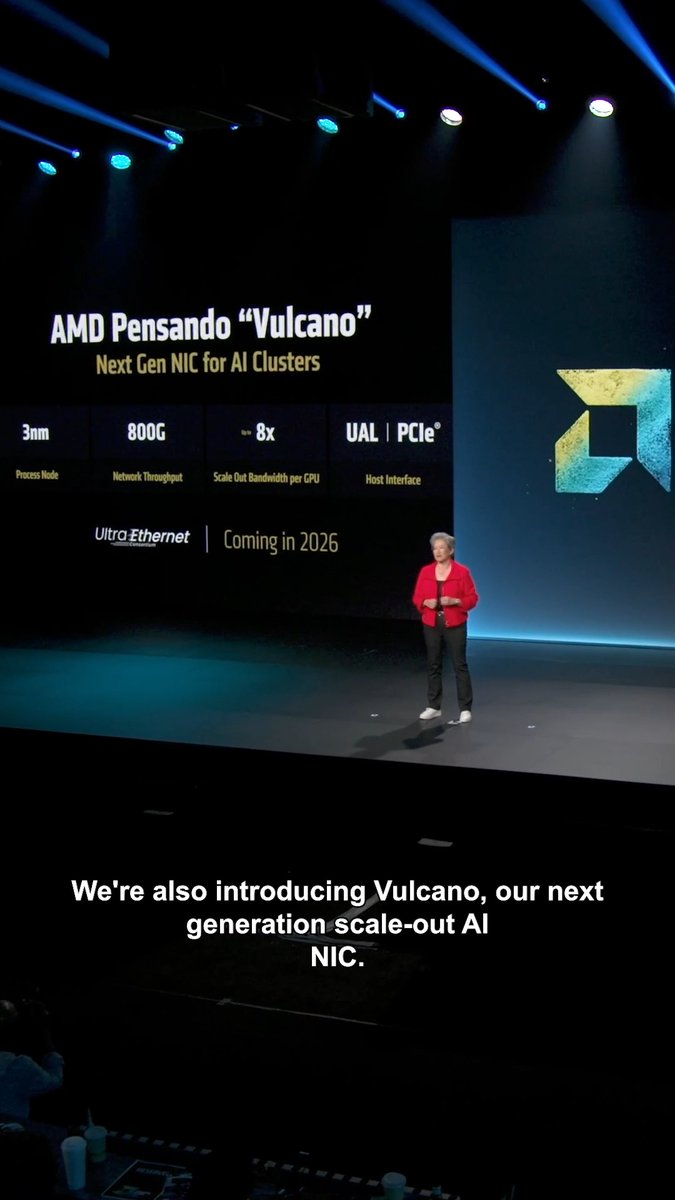
Discover the industry’s highest performance hardware-assisted verification with Synopsys' HAPS-200 prototyping and ZeBu-200 emulation systems: Utilizing AMD Versal™ Premium VP1902 adaptive SoC, these systems offer unparalleled performance and scalability. Explore more at the link above.
15,837 views • 1 year ago •via X (Twitter)

1 Comments

John Forever's profile picture
John Forever1 year ago

@AMD @AMD garbage stock - shitty CEO

Related Videos

🚨$OSS is not an AI company. → It is the hardware that lets AI exist where the cloud cannot. Most investors don’t understand $OSS because they think AI = software. $OSS builds the physical “brains” that run AI in extreme environments where cloud computing fails. Jets. Ships. Tanks. Drones. Space. Hospitals. That’s the game. 1) What $OSS actually is $OSS (One Stop Systems) designs rugged high-performance computers and storage systems for AI at the edge. Meaning: They bring data-center-level computing power into harsh environments. Their products include rugged servers, GPU accelerators, storage arrays, and expansion systems used for AI, sensor processing, and autonomous systems. In simple terms: Cloud AI = brain in a safe building. $OSS AI = brain inside machines operating in chaos. 2) Why this is crucial Most AI today runs in data centers. But the future of AI is not in the cloud. It’s on: • autonomous vehicles • military systems • drones • ships • industrial machines • medical devices These systems cannot wait for the cloud. Latency, connectivity, security, and survival demand local AI. $OSS delivers “data-center performance at the edge” across land, sea, and air. Without companies like OSS, autonomous systems simply don’t work. 3) What OSS actually does: Think of OSS as building AI engines that survive reality. 🌊 SEA example: naval surveillance aircraft and ships. $OSS supplies rugged storage and compute systems for U.S. Navy reconnaissance aircraft to collect and process massive sensor data in real time. Translation: Instead of sending raw data back to base, the aircraft analyzes threats instantly onboard. $OSS = the onboard AI brain. 🪖 LAND example: military vehicles and tactical operations. $OSS delivers high-performance servers and FPGA systems for mobile military intelligence platforms used by the U.S. Department of Defense. Translation: Tanks and vehicles detect threats, process sensor data, and make decisions locally. $OSS = the battlefield computer. ✈️ AIR example: airborne AI. $OSS builds GPU-accelerated servers designed for aircraft, described as a “datacenter in the sky.” Translation: Jets and drones run AI models mid-flight. $OSS = flying supercomputers. 🚀 SPACE example: $OSS hardware is designed for extreme environments and autonomous systems across aerospace and defense. Translation: Future satellites, space drones, and autonomous spacecraft need onboard AI. $OSS = the computing core of autonomous space systems. BONUS: CIVILIAN & COMMERCIAL $OSS systems are used in: • autonomous trucking and farming • industrial automation • healthcare imaging • energy and mining • telecom and 5G Example:A medical imaging company uses $OSS hardware to run real-time AI diagnostics in next-gen breast cancer scanners. $OSS = AI where milliseconds matter. 4) Who their customers are (pattern, not names) $OSS sells to: • defense primes • government programs • industrial OEMs • AI infrastructure companies • medical device manufacturers These customers share one trait: They cannot rely on the cloud. That’s why $OSS exists. 5) The mental model that makes $OSS obvious $NVDA = AI chips $PLTR = AI software $OSS = AI hardware in the real world If AI is electricity, $OSS builds the generators that work in storms. Most investors understand AI software. Few understand AI infrastructure at the edge. That gap is the opportunity. 6) The real thesis The world is moving toward: • autonomous warfare • autonomous vehicles • real-time AI systems • distributed intelligence All of that requires rugged edge computing. $OSS is positioned exactly there. Infrastructure. The hardest layer to build. And often the most valuable.

Black Panther Capital

30,138 views • 6 months ago

Computing hardware architecture has evolved from maximizing single-core performance to multiplying parallel processing capacity through more cores, more threads, and higher computational density. This transition demands software architectures specifically designed to exploit parallel processing, especially in advanced AI and blockchain-based systems. As Greg Meredith, CEO of our partner F1R3FLY. io, notes, "We need software architectures that can eat physical threads of computation and turn that into throughput." Traditional sequential programming models often struggle to effectively leverage the potential of these multi-core systems, creating a bottleneck in performance scaling. Rholang addresses this challenge through its foundation in the Rho-Calculus, a reflective higher-order process calculus specifically designed for inherent concurrency and reflection. Unlike computational models based on sequential execution or those that bolt on concurrency primitives, Rholang can leverage its process-oriented nature to detect and distribute non-interfering logical computation threads across available physical processing units, creating a more direct correlation between hardware resources and performance scaling. The Rho-Calculus was specifically designed to provide the minimal set of operations needed to model autonomous agents operating in parallel while maintaining the ability to represent their own reasoning processes. This structure mirrors the operational characteristics of intelligent systems, where autonomous processes run independently while communicating and coordinating. For our novel decentralized AI platform, MeTTaCycle, this future-proof architectural foundation enables more than just enhanced transactional throughput; it fosters an environment where independent computational processes can efficiently coexist and interact, forming a critical layer for the Artificial Superintelligence Alliance's decentralized AGI infrastructure and products.

SingularityNET

29,367 views • 1 year ago

I did promise since last year that we would bring agriculture and food systems to center stage at COP28, and here we are! Celebrating together, a MILESTONE MOMENT IN HISTORY for food systems and agriculture at a COP in the first session. I'm happy to confirm that COP28 UAE Declaration on Sustainable Agriculture, Resilient Food Systems, and Climate Action has so far received 134 endorsements from heads of state and government. With these countries on board, we cover more than 5.7 billion people and 70% of all the food we eat. The signatories of the declaration are home to nearly 500 million farmers and represent 75% of all emissions from global food systems. To support the funding and innovation part of the declaration, it gives me great pleasure to announce a significant funding partnership with a very dear partner to the UAE. The partnership will focus on agricultural research and development and scaling up innovations, which is so desperately needed to adapt food systems to the growing threats of climate change. The Bill and Melinda Gates Foundation, together with the UAE, will fund a total sum of… 200 million US dollars of new investments into food and ag research and scaling up innovations. With the majority of this investment flowing into the CGIAR network, the UAE is delighted to become a core partner of the CGIAR System Council and support its work. A big thank you to all the countries who have endorsed the declaration and contributed to this watershed moment for the food and climate agenda. We look forward to many more joining over the next few days! #FoodSystems #agriculture #COP28UAE #cgiar

Mariam Almheiri | مريم المهيري

179,886 views • 2 years ago