Loading video...

Video Failed to Load

Go Home

Dr Fei-Fei-Li explains with a simple example how everyday household chores are so extremely difficult for Robots. "If you tell a robot to open the top drawer and watch out for the vase, this is actually a really hard task for robots." because the robot must ground language into...

342,553 views • 8 months ago •via X (Twitter)

0 Comments

No comments available

Comments from the original post will appear here

Related Videos

Dr. Fei-Fei Li just called out the biggest blind spot in the entire AI industry. We have been building half of human intelligence. And calling it the finish line. Li: “If you look at human intelligence, it pretty much boils down to two buckets.” The first bucket is language. Symbolic reasoning. Communication. The ability to think in words and abstractions. That’s what every major AI lab has spent the last decade building. The second bucket is the one the industry has almost entirely ignored. Li: “We call that in AI spatial intelligence.” How humans and animals perceive, navigate, and interact with the three-dimensional physical world. How we reach for objects. How we move through space. How we build and manipulate physical reality. From painting masterpieces to constructing the pyramids, non-verbal spatial intelligence is what actually shapes the world. Language describes reality. Spatial intelligence acts on it. And the gap between those two things is the gap between a chatbot and a robot. Li: “When this technology is ready, the robotic revolution is gonna start. We’re already seeing that trend.” Every robot is a moving agent. Every moving agent requires spatial intelligence to function in the real world. The humanoid robots being deployed in factories right now are hitting the ceiling of what language models alone can power. Spatial intelligence is the unlock. But Li didn’t stop at robotics. Li: “From a geopolitics point of view, this is part of the technology that goes straight into weapons.” Autonomous drone swarms. Battlefield navigation. Physical target acquisition without human oversight. Every military application of AI that operates in the real world runs on spatial intelligence. The nation that masters the transition from static text to dynamic three-dimensional perception doesn’t just win the software race. It commands the physical battlefield. The AI arms race just broke out of the data center. It’s operating in three dimensions now.

Dustin

122,680 views • 4 months ago

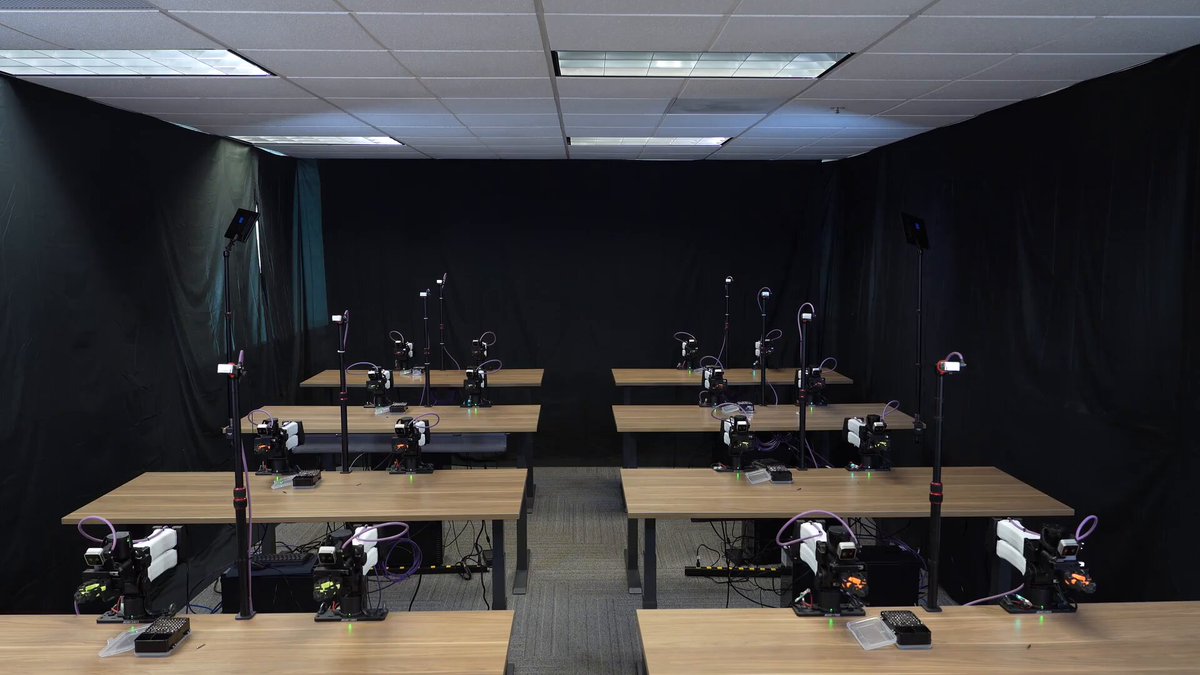
I made Physical AutoResearch sound simple (conceptually), but it took a village to pull off and lots of design thinking into the robot /loopcraft. The hardest part is everything we need to setup *before* pressing Enter. Here's a behind-the-scene tour: 1. Safety harness Letting 8 robots run unattended overnight means safety has to be more than a hint in the system prompt. ENPIRE hardwires it in 2 layers: (1) hard kinematic limit that trips an immediate task failure and auto-resets as soon as a robot leaves its safety envelope, and (2) a torque-limited compliant gripper so a bad contact or misaligned insertion ends in a safe stall, instead of crushing the robot or the object at hand. We make safety more conservative than usual so humans can sleep tight. In reality, we still need a few human operators to watch over the "robots of loving grace". 2. Definition of /done An agent that can edit its own reward will game it for sure. ENPIRE fixes the goalposts before the fleet can move them. Here's the recipe: Collect a few minutes of success & failure demos -> Ask agent to write code using computer vision tools to classify success and measure against groundtruth -> Agent hill-climbs on classifier until reliably good -> This classifier becomes the real-time reward function that directly computes on sensor streams -> *Freeze* the reward function before AutoResearch. It's sacred, enshrined in a Gym env that no one can touch. 3. System telemetry design Robot-seconds is by far the scarcest resource, followed by GPU-seconds, and finally tokens. We instrument all three and surface them to ENPIRE for live resource awareness rather than letting it hill-climb in a vacuum. We define: - Mean Robot Utilization ("MRU"): the fraction of wall-clock time when the robot is actively executing an experiment. Otherwise the hardware is sitting idle and waiting for the next code commit. - Mean Token Utilization ("MTU"): tokens consumed per minute, our proxy for how hard the agent is actually thinking. A low MTU means the agent is stalled, waiting on a robot rollout to finish instead of doing research. - GPU utilization: fraction of wall-clock time when GPU is active. ... and evaluate on two budget-to-outcome metrics: 1. Tokens-to-Success: token budget the fleet burns to complete /goal. 2. Time-to-Success: wall-clock time to /goal

Jim Fan

100,588 views • 27 days ago

Let's reverse engineer Disney's adorable, lifelike robot! I couldn't find a whitepaper, but this is how I think it's trained: 1. The emotional behaviors are curated by Disney animation artists, keyframe by keyframe. But it cannot be "rendered" directly on the robot because it doesn't take into account the complex real-world physics. 2. Reinforcement learning (RL) is a great tool for training low-level robot controllers. RL needs a reward function to optimize, and it's typically a task reward (e.g. walk in a straight line as fast as possible). The problem is that RL doesn't know what counts as "natural behavior", and often produces weird-looking body postures that somehow still maximize the reward. This is a human alignment problem just like ChatGPT. 3. Enters Adversarial Motion Prior (AMP): a technique that learns the human preference by training a classifier on what we consider "emotional & cute". In GAN literature, this is called a discriminator. Disney artists are good at creating such a dataset. You can then add AMP as an auxiliary reward in simulation to nudge the robot towards desired behaviors. AMP was developed by Peng et al. 2021 and Escontrela et al. 2022. 4. Add lots of data augmentation to make the controller robust to physical disturbances. In RL, it's called "domain randomization". This is a very powerful technique that bridges the gap between simulator and reality. Previously, OpenAI used domain randomization to train a 5-finger robot hand to manipulate a Rubik's Cube: IEEE news article gave hints about the pipeline: Finally, praying for world peace 🙏. I hope robotics like this will bring more joy to the world.

Jim Fan

314,637 views • 2 years ago

This work makes a humanoid robot do simple parkour moves by looking with a depth camera and choosing the right move on the fly. The big deal is that it turns lots of small human moves into long, real-time robot behavior, without hand-coding every transition or retraining for each new course. A humanoid robot is usually good at steady walking, but it often fails when it has to do fast moves like jumping up, vaulting, or rolling, and then keep going to the next obstacle. The hard part is that you cannot easily collect training data for every possible obstacle shape, distance, and mistake, so robots end up learning a few moves that only work in a narrow setup. This work starts from short clips of real human parkour moves, like stepping over, vaulting, climbing, and rolling. It uses motion matching, which is basically a smart “pick the next clip that fits best right now” search, to stitch those short clips into a long, smooth plan that looks like a human doing a whole course. Then it trains a controller with reinforcement learning (RL), which means the robot learns by trial and error to copy that plan while staying balanced and not falling. After training separate expert controllers for different moves, it compresses them into 1 controller that uses only onboard depth sensing and a simple “go this fast in this direction” command. In real tests on a Unitree G1 humanoid, it can clear multiple obstacles in a row, adapt when obstacles get moved, and climb a wall up to 1.25m.

Rohan Paul

37,121 views • 4 months ago