Загрузка видео...

Не удалось загрузить видео

На главную

🚨 Drones + Helicopters = Dangerous and Illegal 🚨 Yesterday around 3:40 p.m., a drone was filmed flying directly above a LifeFlight helicopter as it landed at Primary Children’s Hospital to transport a critically ill child. Because the drone was spotted, all air operations had to stop until the...

37,126 просмотров • 6 месяцев назад •via X (Twitter)

Комментарии: 0

Нет доступных комментариев

Здесь появятся комментарии из оригинального поста

Похожие видео

This video was posted by Russian propagandists today. A Russian drone is adjusting a fire with four guided thermobaric bombs on the position of one of our brigades near the village of Lyptsi, a key village on the approaches to Kharkiv. The small landing is literally demolished by powerful explosions, and the hits are very accurate. After this strike, with the help of a drone adjustment, a Russian assault group went to assault the landing site. They were supported from above by a drone that dropped grenades. And even in such difficult conditions and after such strikes, a group of Ukrainian soldiers survived. And they, all shell-shocked, did not run away or surrender. A few Ukrainians dug themselves out of the trenches completely covered with earth, got up, and suddenly met the Russian assault group with aimed fire. Ukrainian heroes withstand a high density of enemy strikes, they fight to the death for every meter of land near Kharkiv and do everything possible and impossible. They know that they will not be covered from the air, they know they will have to equip their positions on the front line themselves with shovels, they know that the enemy has a lot of force. But they are Ukrainians, and behind them is Kharkiv, and next to them are their brothers-in-arms, who are fighting and also repelling all Russian attacks. We need to destroy Russian aircraft on Russian territory. We need to save our Warrior Heroes.

Anton Gerashchenko

1,089,493 просмотров • 2 лет назад

LEONARDO, also called LEO, was built by researchers at Caltech’s Center for Autonomous Systems and Technologies. Its full name means LEgs ONboARD drOne. The idea is simple but unusual: • Build a small biped robot • Give it drone-style thrust • Use the legs for ground contact • Use the propellers for balance and lift • Combine walking, hopping and flying in one system LEO is basically a hybrid between a walking robot and a flying drone. How it was built: • Two lightweight legs • Three actuated joints in each leg • Four propeller thrusters near the shoulders • A lightweight body • Leg motors for ground movement • Propellers for balance, lift and aerial control • Real-time control software that synchronizes the legs and propellers How it walks: • The legs move the robot forward • The feet touch the ground like a normal biped • The propellers constantly correct balance from above • The robot can stay upright even in unstable situations • The thrust reduces the risk of falling during difficult motions How it flies: • The legs stop being the main locomotion system • The four propellers generate lift • The robot behaves more like a drone • It can take off, fly over obstacles and land back on its legs What makes it different: • It does not walk like a normal humanoid • It does not fly like a normal drone • It blends both systems • The legs handle contact with the ground • The propellers act like fast stabilizers • The control system decides how much help comes from the legs and how much comes from thrust That is why LEO can: • Walk • Hop • Fly over obstacles • Ride a skateboard • Balance on a slackline The key idea is walking with aerial stabilization.

Techniahqrobot | humanoid robots

135,456 просмотров • 1 месяц назад

Americans are not ready to watch sons and daughters hunted by FPV drones. Some may not like this post, and that’s OK. Some may see this as being a “panican,” and that is also OK. My tolerance for American blood being spilled is very, very low. But this needs to be said: If you have paid any attention to the war in Ukraine, you will know how drone warfare has escalated. You will have an understanding of the sophistication of the Ukrainians and Russians in their pursuit of hunting and killing each other with human-guided robots strapped with explosives. We know Russia and Iran share military ties; hell, the most common form of long-range standoff munition used to target Ukrainian infrastructure is an Iranian-designed Shahed drone. Now, are the Iranians as sophisticated as the Russians? No. But will a ground action result in grainy videos of Americans being hit by FPV drones? Almost certainly. Could the deployment of ground forces to the Gulf be a feint? Sure, it could be, but this point extends beyond Iran. The U.S. needs to be ready to counter the drone menace. I won’t pretend to know the inner machinations of the Joint Chiefs, the White House, or President Trump, but with the destruction of an E-3 Sentry on the runway, it has become absolutely clear the U.S. armed forces have not scaled their ability to handle drones. I don’t know what the answer here is, but I haven’t seen this point brought up at the frequency it deserves. It needs to be said. We are not ready for footage of American soldiers and Marines cowering in their last moments, set to some upbeat pop song or some cleric screaming praises to Allah.

Fanatic 🇺🇸

1,081,705 просмотров • 4 месяцев назад

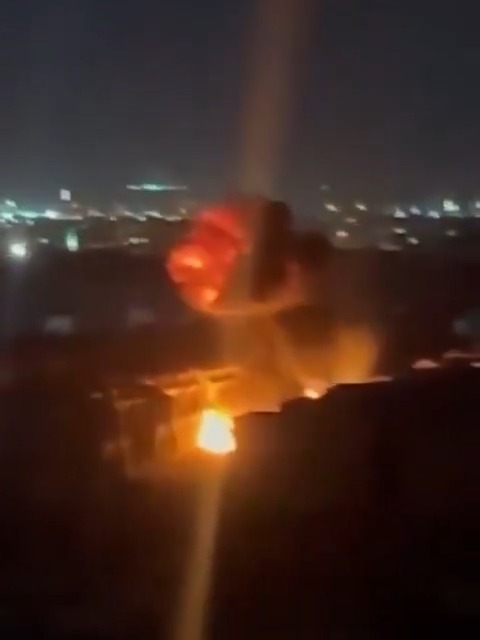
BAPCO Energies confirmed on April 5 that a storage tank at its Sitra facility in Bahrain caught fire “as a result of a hostile Iranian drone attack.” The fire was extinguished. No injuries. Damage under assessment. That is the official statement, repeated verbatim across Bahrain News Agency, Gulf News, Al Arabiya, and Xinhua. It is clean, attributable, and consistent with the pattern of Iranian drone and missile strikes on Gulf energy infrastructure that has continued daily since February 28. Then the videos appeared. Footage circulating on social media, shared by Drop Site News and multiple Arabic-language accounts, appears to show two sequential impacts at the facility: one from the incoming drone, and a second moments later from what the accounts describe as a Patriot interceptor missile that failed to intercept the drone and instead struck the oil storage tanks directly. The videos have not been independently verified. The trajectory analysis has not been forensically confirmed. BAPCO’s statement does not mention air defence involvement. The Bahrain Defence Force reported 13 successful drone interceptions in the preceding 24 hours and made no acknowledgement of a misfire. This has happened before. On March 9, an explosion near BAPCO in Sitra injured dozens and was attributed to an Iranian drone. Reuters and the Middlebury Institute subsequently concluded with moderate-to-high confidence that a US-operated Patriot interceptor caused the blast. Drone fragments were absent at the impact site. The damage pattern matched a Patriot warhead detonating at low altitude after losing its target. Bahrain later acknowledged Patriot involvement without formally correcting the original attribution. The March 9 precedent is what makes the April 5 videos significant. Not because they prove the interceptor hit the tank. They do not prove that. But because they introduce a documented pattern: in saturated airspace where dozens of Iranian drones arrive simultaneously, Patriot systems operating at the edge of their engagement envelope against small, slow, low-altitude targets can produce outcomes where the defence causes the damage it was deployed to prevent. The drone is the threat. The interceptor is the response. And the oil tank does not distinguish between the two when the impact arrives. BAPCO operates a 405,000 barrel per day refinery at Sitra. It was struck by confirmed Iranian missiles on March 5, triggering force majeure. It was struck by what was later assessed as friendly fire on March 9, injuring residents. It was struck again on April 5 by what officials call a drone and what videos suggest may have also involved an interceptor. Three incidents in five weeks at the same facility. No force majeure was declared for April 5. The fire was contained rapidly. But the question the videos raise is not about this fire. It is about what happens when Patriot systems engage small, slow, low-altitude drones in saturated airspace directly above the infrastructure they are positioned to protect. Iran does not need to penetrate the shield. It needs to force the shield to fire in conditions where the shield’s own projectiles become the threat. The defence and the attack converge on the same target. And the oil burns either way.

Shanaka Anslem Perera ⚡

21,810 просмотров • 4 месяцев назад