正在加载视频...

视频加载失败

“Einstein is the problem.” Eric Weinstein didn’t mince words on Triggernometry. If general relativity holds, we’re trapped on one fragile planet. Even terraforming the Moon and Mars only gives us three reachable spheres — nowhere near enough diversification for long-term survival. A single catastrophe could wipe us all out...

906,897 次观看 • 3 个月前 •via X (Twitter)

0 条评论

暂无评论

原始帖子的评论将显示在这里

相关视频

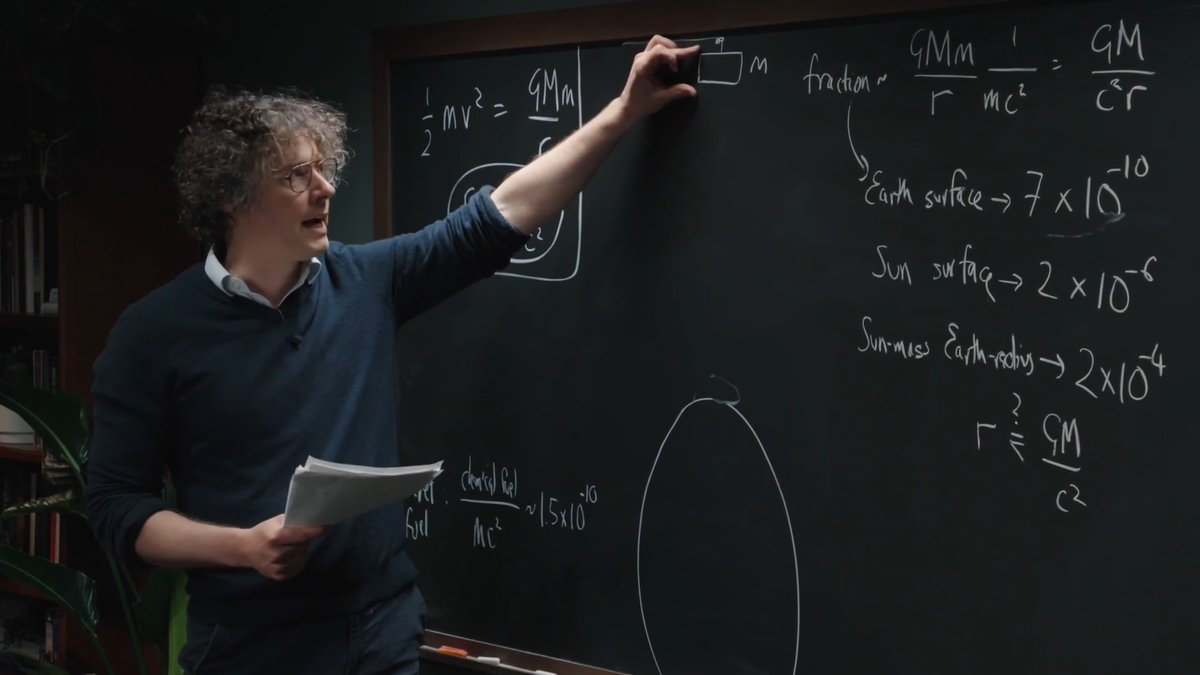
Adam Brown (Adam Brown) is back! General relativity is said to be the most beautiful idea the human mind has ever produced. Most of us will never get to fully appreciate its elegance by taking the 20-lecture graduate course Adam taught on it at Stanford. But in the video below, Adam distills the key idea at its heart so clearly and compellingly that even I could keep up lol. At the core of general relativity, Einstein is trying to figure out the principle behind a particular coincidence: that the mass that resists acceleration and the mass that gravity pulls on just happen to be exactly the same. Adam then leads us through the path of insight which Einstein called his “happiest thought.” Then Adam lectures on black holes. First, by showing how even under special relativity you could create a perpetual motion machine if black holes weren't truly black. And then, by explaining why the observations of an infalling observer and a distant bystander to the black hole would be so radically different Adam leads Blueshift, the team at Google DeepMind cracking science and reasoning. Which gave us the opportunity to discuss at the very end how close we are to AIs that could rediscover general relativity from scratch. Stay till the close for some philosophy of science. 0:00:00 – The coincidence that led Einstein to general relativity 0:16:42 – Gravity is a consequence of curved spacetime, not a force 0:31:46 – Why black holes prevent unlimited energy extraction 0:47:12 – Black holes are the ultimate power plants 1:13:50 – What falling into a black hole would actually feel like 1:18:51 – The three ways we know black holes are real 1:24:21 – The first time we saw gravity bend light 1:29:33 – How far can AI get without experimental evidence? Look up Dwarkesh Podcast on YouTube/Spotify to watch. Enjoy!

Dwarkesh Patel

642,943 次观看 • 19 天前

Eric Weinstein drops a truth bomb that shakes the very foundations of modern science. In 1973, physics froze. While Crocodile Rock topped the charts, humanity’s understanding of base reality came to a grinding halt. The deepest theories of our universe? They’re all on one slide—unchanged for over 50 years. The Disturbing Revelation: Mark Andreessen’s White House meeting unveiled a chilling reality—the deliberate stagnation of theoretical physics. String theory was crowned the "only game in town," while rival ideas were suffocated. Careers were quietly sunset. The youngest living Nobel laureate in theoretical physics? Now over 70. The field isn’t advancing—it’s repeating. The Quantum Gravity Mirage: "Quantum gravity is the holy grail!"—a mantra drilled into generations of physicists. But if it’s so fundamental, why did no books mention it before 1972? Because the real breakthrough lies beyond Einstein, beyond the speed of light. Yet researchers are trapped in a safe, sterile loop—studying theories that hurt no one, change nothing. The Escape Plan: Earth is a womb, not a home. To survive, we must reach the stars. But with physics shackled, how? The Perimeter Institute was meant to break barriers—yet even it fell to the quantum gravity dogma. The West must lead again, but the true rival isn’t China or India—it’s France, home of the world’s greatest mathematicians. The Choice: We stand at a crossroads. Wars loom, time dwindles—but if we revitalize physics, if we dare to go beyond C, the cosmos awaits. The end of physics? No—the beginning. The stars are calling. Will we answer? The future is glorious. But only if we fight for it.

Camus

367,201 次观看 • 11 个月前

Shuler: If you think about every industrial revolution we’ve been through, working people have helped us make that transition. It’s really because we’ve helped tame the technology and figured out how to use it in the most effective way. So I think your question about augmentation versus replacement is the big question we have. If we can all agree that this is about making our jobs better, safer, easier, and more productive, then we’re all in. But if you’re looking to de-skill, dehumanize, and replace workers, to put people out on the street with no path forward, then absolutely you’re going to have a revolution. So I think that’s something we all need to be very real about and think seriously about. If we’re going to have productivity gains, working people—the ones who make these industries happen—need to share in that. There hasn’t been a lot of discussion about that here. Of course, in terms of how we create policies, how we create tax infrastructure, whether or not we are redistributing—yes, that word is a dirty word around here—we need to talk about it and confront how we’re going to make sure working people share in the gains of these technologies. And if you look at the numbers of jobs, let’s talk about job quality. Yes, maybe there are a lot of jobs created, but what kind of jobs are we talking about? Are they jobs that can sustain a family? Is it a job where people can actually work one job? One job should be enough.

Acyn

41,942 次观看 • 6 个月前