Video wird geladen...

Video konnte nicht geladen werden

Zur Startseite

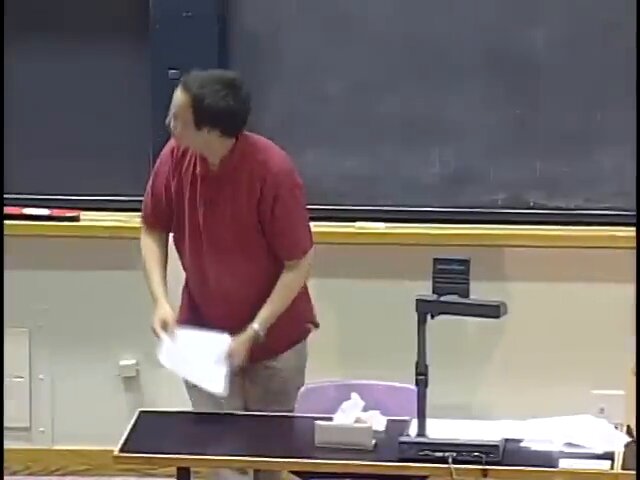
Euler's formula is not a formula. An MIT professor spent a whole lecture proving it is a definition, not a discovery. This is 18.03, Lecture 6, Arthur Mattuck. Free on MIT OpenCourseWare. The formula is e^(iθ) = cos θ + i sin θ. Most people memorize it and move...

88,198 Aufrufe • vor 1 Monat •via X (Twitter)

0 Kommentare

Keine Kommentare verfügbar

Kommentare vom Original-Post werden hier angezeigt

Ähnliche Videos

Most people first see Euler’s Formula as a strange equation in a textbook. Then years later, they realize it quietly powers the modern world. Leonhard Euler discovered that these seemingly unrelated mathematical ideas: → exponential growth → imaginary numbers → sine waves → cosine waves → rotation … are all deeply connected through one identity: e^(iθ) = cos(θ) + i·sin(θ) At first glance it looks impossible. How can an exponential function suddenly produce circles and waves? The key insight is that multiplying by a complex exponential creates rotation. As the angle θ changes: - the cosine term tracks horizontal motion - the sine term tracks vertical motion - together they trace a perfect circle in the complex plane Euler showed that waves and rotation are mathematically the same phenomenon viewed differently. That single idea changed science and engineering forever. Today, Euler’s Formula sits underneath: → Fourier Transforms → signal processing → wireless communication → MRI scanners → quantum mechanics → electrical engineering → audio compression → radar systems → GPS → neural network frequency analysis Even modern AI systems indirectly rely on mathematics built on top of these foundations. The famous special case is Euler’s Identity: e^(iπ) + 1 = 0 Richard Feynman reportedly called it: "our jewel." Because it revealed that mathematics is not a collection of separate topics. It is one connected language describing reality itself.

Tech with Mak

25,504 Aufrufe • vor 4 Monaten

Ten million people have watched an MIT professor teach a course whose first lecture is literally titled "What is a Derivative?" Almost none have written down the two-line answer. He filmed the lecture once in the fall of 2007 and it has been on YouTube ever since. Math tutors charge $200 an hour to teach a diluted version of what he covered in 50 minutes for free. His name is David Jerison. He is a professor of mathematics at MIT and the instructor of 18.01 Single Variable Calculus, one of the most-watched math courses in the history of the internet. The 50-minute clip in this video is Lecture 1, filmed at MIT in the fall of 2007. Jerison is deriving the definition of a derivative from a single tangent line. The whole framework fits on a napkin. A derivative is just how much y changes when x moves a tiny bit. Draw a tangent line to any curve at any point. The slope of that line is the derivative. Memorize one formula, the power rule, and you can differentiate every polynomial on earth in your head. Chain that with a handful of exceptions and you can differentiate almost every function humanity has ever written down. That single set of rules is what every neural network runs on gradient descent, what every rocket landing at SpaceX solves in real time, and what every options desk at Goldman Sachs is running behind every quote you see on the screen. "In mathematics you don't understand things. You just get used to them." That is John von Neumann, the mathematician who helped design the atomic bomb and invent the modern computer. Jerison returns to the same idea in every lecture. Almost no student giving up on calculus has heard von Neumann say it out loud. Every quant fund on Wall Street pays entry-level analysts $250,000 to know the same power rule Jerison derives on the board. Every AI bootcamp charges tens of thousands to teach a diluted version of the same equation on a laptop. The lecture is free on MIT OpenCourseWare. The textbook is under sixty dollars. Almost none of the millions who watched have ever taken the power rule and applied it to their own numbers on their own paper. The math is free. The willingness to actually take one derivative before your next model, trade, or engineering trade-off is the entire edge.

Lumen

24,218 Aufrufe • vor 21 Tagen

A pilot put a passenger jet down on a river and got every person on board off alive. Within days, investigators were asking him what he had eaten for lunch. He told them a tuna sandwich. Then they asked whether he had had a candy bar. Whether he had had a soda. That is not small talk. There is a precise reason those 2 questions could have ended his career, and Tom Hanks lays it out in about 4 sentences. The pilot is Chesley Sullenberger. Hanks played him, spent time with him first, and says the man walked him through the entire script telling him which parts never happened. As Hanks was told it, the stake was money. If the board could establish that the pilot did 1 thing wrong, the insurance on an airplane he puts at 17 million dollars would not have to be paid out. Every question in that room was built for that. It went on for the better part of a year. In the film it takes days, because films cannot afford a year. What was happening to him has a name in psychology. Baruch Fischhoff described it in 1975 and called it creeping determinism. Once you know how something ended, the ending looks like it was always coming, and every road you did not take looks like it was sitting right there, clearly marked, the whole time. Which is why the question "why did you not do this instead" is close to unanswerable. It is asked by people who know the ending, to a person who did not have it. There is a second effect underneath, well documented in aviation and in medicine. The person at the centre of the investigation frequently comes out of it in worse condition than the people he saved. Researchers gave that person a name. He is the second victim. Hanks is 67 when he says this, and what he admires is not the landing. It is a distinction he makes in 1 sentence near the end, and it is the whole reason he told the story at all. He saved everyone on that plane. Then he spent a year proving he had not eaten a candy bar.

Stefan.

210,938 Aufrufe • vor 18 Tagen

a professor with a dozen tumors in his liver came to the university of virginia the day after chemotherapy and spent 75 minutes explaining how not to waste your own life. randy pausch called it a lecture on time management. he had three to six months of good health left, and three months and twelve days of it were already gone. students would ask whether the program was worth the money. pausch said the right question was a different one: is it worth two years of your life that you are never getting back? a deadline has a date and a person who will notice you missed it. importance has neither a date nor that person. so the urgent goes first in the queue, and then the next urgent thing goes first, even when it is worth nothing. pausch said to work on what is important while it still has no date. that is how the years disappear. hundreds of sensible, well argued hours spent on whatever asked more loudly. why am i doing this? what is my goal? what happens if i don't do it? the best moment, he said, is when you cross something off and find that nobody has come to take you to jail. every unnecessary task you delete hands back a piece of your life. five interruptions can destroy a whole hour. he also kept a time journal and filled it in as the day went. like a financial budget, the journal showed where the time had actually gone. the goal was never to become an uber-worker. it was to work efficiently enough to leave at five and go home to the people he loved. he died eight months later, at 47. he ended the lecture with one sentence: “time is all we have. and we may find one day you have less than you think.” the lecture is free. all 75 minutes are in the video below. what will you change in the next 30 days?

Lima

16,547 Aufrufe • vor 1 Monat

E: Did you say that Yaşar’s daughter is sick? N: Yes, why? What happened? E: Nothing. We just talked a bit, shared some troubles. N: You? You talked things out with the man who threatened me with you, Eşref? E: I wanted to talk a bit before teaching him a lesson. E: He said he had a daughter. He also said he wouldn’t do anything wrong to Ms. Nisan. N: And? E: That’s all. You don’t need to know the rest. N: He called me too. And I told him what a terrible father he is. E: When did this happen? N: What does it matter, Eşref? Why did you call me? Was it because of this? E: No. I just wanted to call. E: When the man said, “You’ll understand when you have a daughter,” I got curious. I was trying to understand what he meant. N: Why did you say something like that? E: We had to take a car trip today. N: Eşref, you didn’t do anything to the man, right? He has a daughter. E: Nisan, I didn’t do anything to him. If something happened after I left, then it’s fate. E: When he started talking about being a father…I tried to understand what he meant. That’s why I called. N:And you called me. E: I have only one love in this life, Nisan.And that is you. Is it something like that? N: I don’t know. I really don’t know. They say when you have a child, you feel very different. That feeling isn’t like anything else. E: You used to say you wanted to start a family. Can you see yourself? What kind of mother would you be? N: Then who are you pregnant by? E: Don’t be ridiculous Nisan. That’s not even a question. N: A girl or a boy? E: A girl. Let her be like you. D: Ms. Nisan, if you’re ready, shall we begin? N: Who is that? N: Eşref! #EşrefRüya #EşSan
1:15

Sensitive content

E: Did you say that Yaşar’s daughter is sick? N: Yes, why? What happened? E: Nothing. We just talked a bit, shared some troubles. N: You? You talked things out with the man who threatened me with you, Eşref? E: I wanted to talk a bit before teaching him a lesson. E: He said he had a daughter. He also said he wouldn’t do anything wrong to Ms. Nisan. N: And? E: That’s all. You don’t need to know the rest. N: He called me too. And I told him what a terrible father he is. E: When did this happen? N: What does it matter, Eşref? Why did you call me? Was it because of this? E: No. I just wanted to call. E: When the man said, “You’ll understand when you have a daughter,” I got curious. I was trying to understand what he meant. N: Why did you say something like that? E: We had to take a car trip today. N: Eşref, you didn’t do anything to the man, right? He has a daughter. E: Nisan, I didn’t do anything to him. If something happened after I left, then it’s fate. E: When he started talking about being a father…I tried to understand what he meant. That’s why I called. N:And you called me. E: I have only one love in this life, Nisan.And that is you. Is it something like that? N: I don’t know. I really don’t know. They say when you have a child, you feel very different. That feeling isn’t like anything else. E: You used to say you wanted to start a family. Can you see yourself? What kind of mother would you be? N: Then who are you pregnant by? E: Don’t be ridiculous Nisan. That’s not even a question. N: A girl or a boy? E: A girl. Let her be like you. D: Ms. Nisan, if you’re ready, shall we begin? N: Who is that? N: Eşref! #EşrefRüya #EşSan

𝖀𝖓𝖐𝖓𝖔𝖜𝖓

30,772 Aufrufe • vor 5 Monaten

An MIT professor opened his first lecture by auctioning off a sealed box to twenty-two-year-olds who had zero information about what was inside. No touching it. No shaking it. No hints. Just a box. The bidding started at $1. It closed at $45. He ripped it open. An iPod Nano, retail value $149. The class had priced an unknown object, sight unseen, at roughly a third of its real worth — in about ninety seconds, with nothing but each other's bids to go on. That's minute twenty of session one of 15.401, Finance Theory, taught by Andrew Lo at MIT Sloan. Free. On YouTube. Since 2008. Before the auction, Lo puts up three names on the board: James Simons, a math professor who built the most successful hedge fund in history. Warren Buffett, who runs his empire with a tiny staff and literal high-school arithmetic. Jack Welch, an engineer by training who quadrupled GE's revenue without touching a single equation from his own PhD. Three totally different backgrounds. One shared trait — they all speak the language of finance instinctively. Then Lo tells the room something most finance bootcamps charge $3,000 a weekend to imply and never actually prove: finance isn't really about complex math. It's about two problems only — valuing things, and deciding what to do once you know the value. Everything else, thirteen weeks of it, is commentary. There are no problem sets in this course. He hands you the entire exam question bank on day one and tells you the majority of exam points come straight from it. He says it flat out: memorize the whole stack and you'll pass — except by then you'll have accidentally learned finance. The full thirteen weeks are still sitting on MIT OpenCourseWare, untouched by most people who bookmark it. The lecture is free. Bidding on the box after everyone else already has is the entire course in miniature.

Beaver

1,387,067 Aufrufe • vor 1 Monat