Video wird geladen...

Video konnte nicht geladen werden

Zur Startseite

Even when things are going great, running a $1.5 billion AI startup is a knife fight. Granola was one of the first AI apps of this generation to achieve near-ubiquitous adoption. But meeting notes are not the company’s be-all and end-all. The real battle is over owning the interface...

13,146 Aufrufe • vor 2 Monaten •via X (Twitter)

0 Kommentare

Keine Kommentare verfügbar

Kommentare vom Original-Post werden hier angezeigt

Ähnliche Videos

SaaS isn’t dead, it just needs to become agent-native. Linear (Linear) is a great example of how: They pivoted the product to be used by both humans and agents, and that has made them one of the premier software tools in the agent-native era. I had Linear’s cofounder and CEO Karri Saarinen on Every 📧's AI & I to talk about how a product management tool for human software developers became an agent-native tool—and how Linear’s trajectory reveals a bright future for SaaS businesses: - Speed means decisions matter more, not less. AI makes it easy to have an idea and build it without considering whether its existence is justified. When ChatGPT was released, SaaS companies were launching their own chatbots left, right, and center. Instead of jumping on the bandwagon, Linear stopped to consider whether the application was useful. (It wasn’t.) - Just because the technology has changed doesn’t mean your mission should. Karri attributes Linear’s success to never losing sight of what matters: helping teams develop great software. Instead of chasing trends, Linear focused on understanding how AI was impacting its customers’ workflows—and updating its product accordingly. - Agents are now first-class users. Linear never tried to change what it was or did well; it just expanded the user base. Companies can now kick off agents inside Linear, manage them, and track what they're working on alongside the humans on the team, which explains why Codex, Coinbase, and Brex all run their agents on Linear. This is a must watch for anyone interested in how an agent-native SaaS company operates. Watch below! Timestamps: Introduction and how Every first discovered Linear: 00:00:39 Why Linear waited to ship AI features instead of rushing to chatbots: 00:02:00 Linear's agent platform and becoming the system that guides AI agents: 00:05:06 Why "SaaS is dead" is a simplistic narrative: 00:07:42 How Linear adopted AI coding tools internally: 00:12:18 AI's impact on product building workflows—speed versus thoughtfulness: 00:17:45 The value of conceptual work and thinking before shipping: 00:22:18 How AI is reshaping Linear's product strategy: 00:29:30 Demo: Linear's agent skills, shared context, and code review workflow: 00:37:18 The future of product development and the enduring role of human judgment: 00:47:48

Dan Shipper 📧

36,359 Aufrufe • vor 5 Monaten

Everyone told Vicente Silveira (Vicente Silveira) that his startup—a GPT wrapper—would fail. Instead, one year later, it’s thriving—with about 500,000 registered users, nearly 3,000 paying subscribers, and over 2 million conversations in the GPT store. Vicente is the cofounder and CEO of AI PDF, a tool that can help you summarize, chat with, and organize your PDF files. When OpenAI allowed users to upload PDFs to @ChatGPTapp, the consensus was that his startup, and all the other GPT wrappers out there, were toast. Some of his competitors even shut shop, but Vicente believed they could still create value for users as a specialized tool. The AI PDF team kept building. A year later, AI PDF is one of the most popular AI-powered PDF readers in the world—and they did it all with a five-person team, and a friends and family round. I sat down with Vicente to understand, in granular detail, the success of AI PDF. We get into: - Why staying small and specialized is a bigger advantage than you think - The power of building with your early adopters - Why lean startups are better positioned than frontier AI companies to create radical solutions - When a growing startup should think about raising venture capital - The emerging role of ‘AI managers’ who will be responsible for overseeing AI agents We even demo an agent integrated into AI PDF, prompting it to analyze recent articles from my column Chain of Thought and write a bulleted list of the core thesis statements. This is a must-watch for small teams building profitable companies at the bleeding edge of AI. Watch below! Timestamps: Introduction: 00:00:35 AI PDF’s story begins with an email to OpenAI’s Greg Brockman: 00:02:58 Why users choose AI PDF over ChatGPT: 00:05:41 How to compete—and thrive—as a GPT wrapper: 00:06:58 Why building with early adopters is key: 00:20:49 Being small and specialized is your biggest advantage: 00:27:53 When should AI startups raise capital: 00:31:47 The emerging role of humans who will manage AI agents: 00:34:53 Why AI is different from other tech revolutions: 00:45:25 A live demo of an agent integrated into AI PDF: 00:54:01

Dan Shipper 📧

25,628 Aufrufe • vor 1 Jahr

We built an AI app that had 1,000 DAU and $2k MRR before it launched. It’s called Monologue and it’s a smart dictation app built by a single developer: Naveen Naidu. We just launched Monologue yesterday, and it’s one of the fastest-growing and stickiest AI apps that Every 📧 has ever built. Naveen and Monologue are compelling because he’s competing against companies that have raised $50m or more. Because of AI he was able to build an extremely polished, delightful app by himself in just a few months. I brought Naveen on to AI & I along with Every 📧 COO Brandon Gell (Brandon Gell) to talk about his journey with Monologue. We get into: - Why shipping fast is the only thing that matters in AI: Monologue might look like an overnight success, but it wasn’t Naveen’s first, second—or even third—app. Over time, he built a muscle to get quality apps out the door, iterate on them, and learn from what he was seeing. - How he got to PMF inside of Every: The mistake Naveen regrets most in his entrepreneurial journey is building in the dark. Inside of Every 📧 he has an environment where feedback is plentiful—and it let him iterate extremely quickly. - His stack for building production grade AI apps: Naveen breaks down how he used tools like OpenAI’s Codex to do the work of a whole engineering team, including solving hard technical problems like Mac hotkey handling. This is a must-watch for anyone who wants to see how far a single developer and some AI tools can really go. Watch below! Timestamps: Introduction: 00:01:27 A live demo of Monologue: 00:03:51 Hard lessons from Naveen’s years in the wilderness: 00:06:27 Building a muscle to ship fast: 00:12:29 The spark that became Monologue: 00:21:11 Dogfooding your way to a killer feature: 00:26:09 Why the harshest product feedback is the most valuable: 00:29:45 Every’s strategy for launching an app in a crowded space: 00:31:47 Giving Monologue the Every “smell”: 00:40:08 Naveen’s one-person AI stack to build beautiful apps: 00:45:09

Dan Shipper 📧

23,644 Aufrufe • vor 1 Jahr

Three months ago, Codex was trash for knowledge work. Now it's my daily driver. I use it for writing, recruiting, deep engineering work, and everything in between. It even keeps me at inbox 0. I chatted with Every 🧱's head of growth Austin Austin Tedesco on Every 🧱's AI & I about what changed, and why he now spends 80% of his working time in the Codex desktop app too. We get into: - How Codex went from making Austin feel like an idiot to being the place he goes to get stuff done, including complex tasks like writing go-to-market plans using existing material from Slack, Notion, and meeting transcripts. - Why the Codex’s desktop app, which is faster and more reliable than Claude Desktop/Cowork, is the real differentiator. - How I source candidates with Codex by having it identify career arcs, not keywords—my go-to move is identifying organizations likely to teach the skills Every needs for a role, and then find candidates from that pool who have since gone on to work in AI. This is a must-watch for anyone who's wondering whether it’s finally time to give Codex a try. Watch below! Timestamps How Codex went from a tool for senior engineers to a daily driver for knowledge work: 00:00:57 How Claude Code proved that a great coding agent works for any knowledge work: 00:02:42 Austin's switch to Codex: 00:07:24 How Austin set up Codex with folders, keys, and reviewer agents: 00:13:48 Using Codex to brainstorm automations across Gmail, Slack, and Notion: 00:18:24 How Austin manages the human review step when Codex is drafting communications: 00:22:42 Using Codex to build specialized agents inspired by product executive Claire Vo: 00:28:54 Synthesizing meeting transcripts and Slack threads into a go-to-market plan: 00:31:09 Building a live KPI tracker in Notion that agents can read: 00:40:15 Using Codex for recruiting: 00:44:54

Dan Shipper 📧

55,561 Aufrufe • vor 4 Monaten

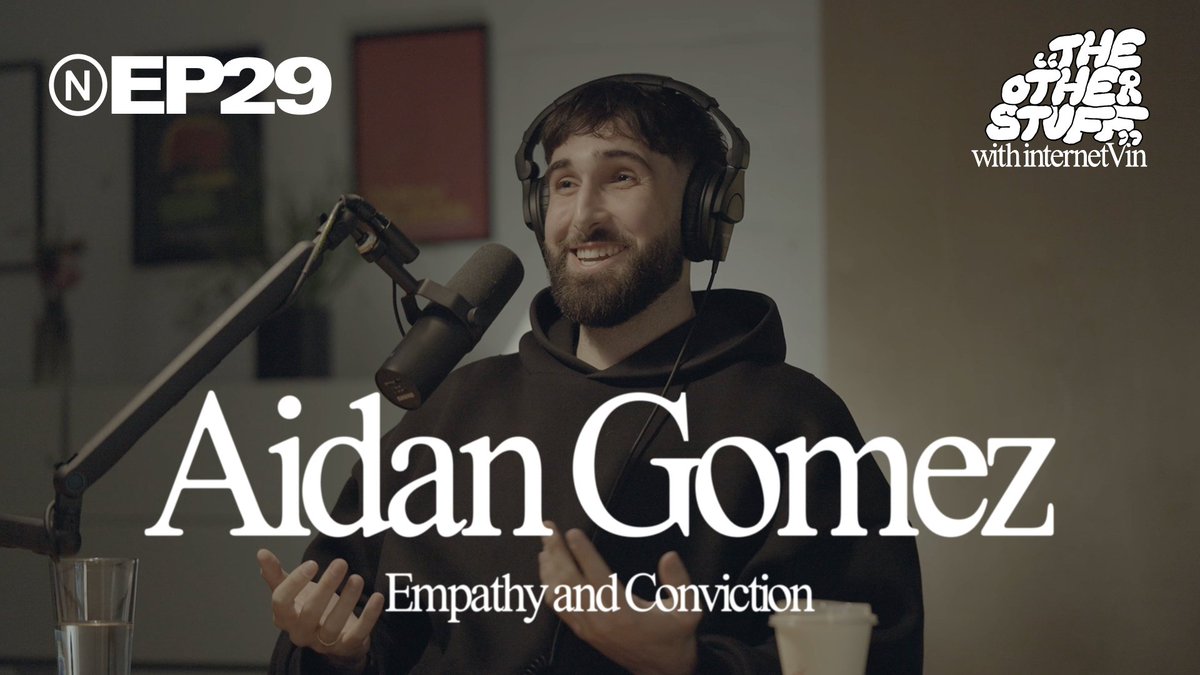
Aidan Gomez (Aidan Gomez) is a computer scientist, co-author of the seminal paper ‘Attention Is All You Need,’ and the CEO of Cohere. In this episode, we discussed his upbringing in the cabin his grandfather built in Codrington, a small town North of Brighton, and the values that were instilled in him through his family. We explored his path from Codrington to his undergraduate studies at the University of Toronto, emailing Geoffrey Hinton, and joining Google Brain where he co-wrote the paper on transformers. We discussed how he met his co-founders Ivan Zhang and Nick Frosst, and his insights on what it means to build a meaningful, successful company in Canada. Aidan shares his conviction about what is at stake — for Canada and for the world at large. This is a conversation about family, values, and what it means to live with conviction. The Other Stuff is hosted by internetVin — filmmaker, entrepreneur, and possibly the most curious man on Earth. Produced by New. The Other Stuff #29 — Aidan Gomez: Empathy and Conviction — Timestamps 00:00:00 Intro 00:03:10 The Malleability of Toronto 00:11:06 Growing Up in Codrington 00:13:50 The Story of Aidan Gomez’s Family 00:27:23 Introduction to the Internet 00:30:39 Values and Work Ethic 00:35:46 University of Toronto’s AI Scene 00:40:48 Emailing Geoffrey Hinton 00:42:16 Google Brain 00:45:15 Dropout: A Simple Way to Prevent Neural Networks from Overfitting 00:49:48 The Beauty of Research 00:54:24 One Model to Rule Them All 00:59:54 Meeting Ivan Zhang and Nick Frosst 01:04:00 The Birth of Cohere 01:06:56 Twitter Influencers and Alex Friedland 01:11:48 Being the CEO 01:12:51 Building for Canada 01:15:01 Three Fundamental Ingredients of Building a Company 01:21:39 Working with the Canadian Government 01:24:39 Reflexivity in Canada 01:36:22 What Is Evil? 01:42:40 The Role of AI in the World

The Other Stuff Podcast

45,297 Aufrufe • vor 9 Monaten

This AI can read emotions better than you can. It was created by Hume (Hume AI) an AI research lab developing models that can read your face and your voice with uncanny accuracy. Their hope is that models that can read your emotions will help create AI that optimizes for human well-being. I sat down with Alan Cowen (Alan Cowen), the co-founder and CEO of Hume to talk about how all of this works: the science of emotion, AI that optimizes for human well-being, and more. Before starting Hume, Alan helped set up Google’s research into affective computing and got a Ph.D. in computational psychology from Berkeley. He's one of the bright lights in AI, and this was an incredible conversation. We get into: - What an emotion actually is - Why traditional psychological theories of emotion are inadequate - How Hume is able to model human emotions - How Hume's API enables developers to build empathetic voice interfaces - Applications of the model in customer service, gaming, and therapy - Why Hume is designed to optimize for human well-being instead of engagement - The ethical concerns around creating an AI that can interpret human emotions - The future of psychology as a science This is a must-watch for anyone interested in the science of emotion and the future of human-AI interactions. Watch! --- Timestamps: I tell Hume’s empathetic AI model a secret: 00:00:00 Introduction: 00:01:13 What traditional psychology tells us about emotions: 00:10:17 Alan’s radical approach to studying human emotion: 00:13:46 Methods that Hume’s AI model uses to understand emotion: 00:16:46 How the model accounts for individual differences: 00:21:08 My pet theory on why it’s been hard to make progress in psychology: 00:27:19 The ways in which Alan thinks Hume can be used: 00:38:12 How Alan is thinking about the API v. consumer product question: 00:41:22

Dan Shipper 📧

45,941 Aufrufe • vor 2 Jahren

How to build a beloved AI product, with Granola CEO Chris Pedregal Granola is the rare AI startup that slipped into a very crowded niche — meeting notes — and still managed to become the product founders (and VCs!) rave about. Plenty of product lessons in this episode. 00:00 - Introduction: The Granola Story 01:41 - Building a "Life-Changing" Product 04:31 - The "Second Brain" Vision 06:28 - Augmentation Philosophy (Engelbart), Tools That Shape Us 09:02 - Late to a Crowded Market: Why it Worked 13:43 - Two Product Founders, Zero ML PhDs 16:01 - London vs. SF: Building Outside the Valley 19:51 - One Year in Stealth: Learning Before Launch 22:40 - "Building For Us" & Finding First Users 25:41 - Key Design Choices: No Meeting Bot, No Stored Audio 29:24 - Simplicity is Hard: Cutting 50% of Features 32:54 - Intuition vs. Data in Making Product Decisions 36:25 - Continuous User Conversations: 4-6 Calls/Week 38:06 - Prioritizing the Future: Build for Tomorrow's Workflows 40:17 - Tech Stack Tour: Model Routing & Evals 42:29 - Context Windows, Costs & Inference Economics 45:03 - Audio Stack: Transcription, Noise Cancellation & Diarization Limits 48:27 - Guardrails & Citations: Building Trust in AI 50:00 - Growth Loops Without Virality Hacks 54:54 - Enterprise Compliance, Data Footprint & Liability Risk 57:07 - Retention & Habit Formation: The "500 Millisecond Window" 58:43 - Competing with OpenAI and Legacy Suites 1:01:27 - The Future: Deep Research Across Meetings & Roadmap 1:04:41 - Granola as Career Coach?

Matt Turck

32,002 Aufrufe • vor 1 Jahr

My conversation with OpenAI co-founder Greg Brockman This is the most detailed first-person account of the 72 hours after Sam Altman was fired. We also go deep on what comes next: the global race to AGI, why ChatGPT stopped showing reasoning, how much of OpenAI's own code is now written by AI ("it's hard to know what percent is not"), and the untold story of how OpenAI actually started in 2015. 00:00:00 Introduction 00:00:49 Meeting Sam Altman and Starting OpenAI 00:02:40 Building the Founding Team 00:04:25 DeepMind's Lead Over OpenAI 00:04:54 Changing OpenAI to a For-Profit Model 00:06:05 Breakthrough Moments at OpenAI 00:08:22 What Dota 2 Meant for OpenAI 00:10:04 Reasoning Versus Prediction 00:11:59 Tensions Grow at OpenAI 00:15:44 Sam Altman's Firing 00:17:49 Greg Quits OpenAI 00:19:56 Sam Explores Deal with Microsoft's Satya 00:20:28 Petition for Altman's Return 00:23:43 Ilya Sutskever Leaves OpenAI 00:24:59 Lessons Learned after Sam Ousting 00:28:22 The Thing Ilya Said that Greg Can't Forget 00:32:22 Is AI Going Parabolic? 00:33:24 How Much of OpenAI's Code is Written by AI? 00:36:21 Do AI Chatbots Tell Us What We Want to Hear? 00:38:06 The Global AI Race to Reach AGI 00:38:40 What Happens if US Doesn't Reach AGI First? 00:39:49 Are Countries Stealing AI Advancements? 00:40:38 Why ChatGPT No Longer Shows Reasoning 00:41:47 The Finite Constraints of Compute 00:43:38 On Investing Early in Data Centers 00:46:31 The Future of Data Center Specialization 00:47:52 How to Decide Whose Queries to Serve 00:49:08 OpenAI on Consumer vs Enterprise Models 00:53:05 Data Centers in Space? 01:00:56 What Should AI Regulation Look Like? 01:04:33 The Future of AI-Powered Entrepreneurship 01:04:44 AI and Job Loss 01:07:15 The Skills Young People Should Invest In 01:11:30 What Does Success Look Like For You? Full episode on X below. Also find it on: • YouTube: • Spotify: • Apple:

Shane Parrish

450,952 Aufrufe • vor 5 Monaten

In the future, you’ll be able to accomplish a goal by just giving Claude an outcome and a budget. That’s the direction Anthropic is building in with its new Managed Agents features, announced at this week’s Code with Claude developer event. The basic idea: Claude, wrapped in a computer in the cloud, that you can spin up, scale, and manage as needed. Anthropic is taking on the infrastructure that kills most agent products, and making sure that it scales to meet the needs of agents running 24/7. On this week’s AI & I from Every 📧, I talk with Angela Jiang (Angela Jiang), head of product for the Claude platform, and Katelyn Lesse (Katelyn Lesse), head of engineering for the Claude platform, about what Anthropic is building and what it takes to make agents reliable in production. We get into: - Why the "build a generic harness, hot-swap any model behind it" playbook is already outdated. Angela points to eval data on Memory where the same task across different harnesses performed drastically differently. - The infrastructure wall every team hits in production—and why Katelyn thinks “my sandbox died and took the agent with it” is the real reason internal agents don't ship. - Why Anthropic is so bullish on using file systems and skills within Claude, including Angela's argument that those early design choices can compound for years. This is a must-watch for anyone trying to take an agent past the demo and into production. Watch below! Timestamps: How the Claude platform evolved from API to agents: 00:01:48 The primitives that make up Claude Managed Agents: 00:04:09 Why the harness and the model are becoming a single unit: 00:10:37 The infrastructure wall that kills most agent projects in production: 00:18:49 Why team agents need a different shape than individual productivity tools: 00:24:49 How Anthropic's legal team uses an agent to review marketing copy: 00:26:36 Using multi-agent orchestration for advisor strategies, adversarial pairs, and swarms: 00:34:24 How to measure agent success with outcome and budget as the end state: 00:35:50 What the platform looks like a year from now, when Claude writes its own harness: 00:39:11

Dan Shipper

66,871 Aufrufe • vor 4 Monaten

Nat Eliason’s (Nat Eliason) career arc is borderline absurd—but it works. He’ll spot a new tool or trend, master it, build a business around it, and move on. Nat’s pulled it off with the note-taking wave ($600k in sales from a Roam Research course), real estate (6x return flipping property in Austin), and crypto (published his insider story with Random House). Now it’s AI: he’s running a viral course on building apps with AI—$200k in pre-sales in just a week, 800 students and counting. I’ve known Nat for a long time and I think he has a great sense for where the puck is headed. He was one of the first guests I had on the podcast and I was delighted to have him on again. Here are a few takeaways from our conversation: - Coding with AI has become orders of magnitude easier for non-technical people over the last 2 years—Nat rarely has to help students fix bugs; they troubleshoot in Cursor on their own. - AI coding assistants are creating new behaviours in programming, like using a speech-to-text model to talk to an agent and having it write code for you. - The traditional learning curve of coding is flattening because AI tools let beginners build and iterate in faster feedback loops. - AI has given Nat leverage in spades—it increases his ability to be a creator while also building a robust business with as few people to manage as possible. He demos an AI book editor he coded for his sci-fi novel. - In the age of AI, software is becoming content and the barriers to create are lower than ever—but custom software for everything isn’t the answer. Nat’s model is that personalized tools make sense for that one thing you care the most about. - Nat believes that the future of writing with AI is a Cursor-style interface with a model that’s trained on your style and voice. This episode is a must-watch for writers, creators, and anyone interested in the future of product building. Watch below! Timestamps: Introduction: 00:01:45 The origins of Nat’s viral course on building apps with AI: 00:11:45 How coding with AI has evolved over the last two years: 00:18:46 Nat creates an app using Composer, Cursor’s AI assistant: 00:22:22 Tactical tips for coding with Cursor: 00:26:06 How coding with AI is creating new behaviours in programming: 00:29:06 What excites Nat the most about the future of AI: 00:32:41 A demo of Hubbard, the AI editor Nat built for his science fiction writing: 00:38:58 When does it makes sense to build custom software: 00:44:52 Nat’s take on the future of writing with AI: 00:49:18

Dan Shipper 📧

27,207 Aufrufe • vor 1 Jahr

Guillermo Rauch (Guillermo Rauch) is one of the most prolific coders of this generation. But he doesn’t think of himself as a coder anymore. Coding, he says, is a specific skill that AI is becoming great at. Instead, he thinks the future of coding is more holistic, full-stack engineers who can ideate, design, and execute all together. Guillermo is the founder and CEO of Vercel (Vercel), the creator of NextJS, and SocketIO. We spent an hour talking about the future of software development in an AI world—and the meta-skills that are essential for the coders of today to master—in order to use tomorrow’s tools to their fullest extent. Here are a few takeaways: - One of the most important keys to his success is taste—and developing taste is all about paying better attention to everything you experience day to day. - He’s great at recognizing bleeding-edge technologies with extremely practical applications but that have bad user experiences. If you can learn to recognize those and build with them, you might build the next NextJs or SocketIO. - Why prototype cultures are becoming common in AI—and the benefits of written cultures like Amazon vs. prototype cultures like Apple for different kinds of companies. - For developers building frameworks, always put the product first; a framework in isolation without a “customer zero” is never going to be a good tool. - The theory of “recursive founder mode”—if you want to build a scalable business, you have to scale yourself by creating an atmosphere that nurtures talent and ambition. - AI tools are shifting software toward consumption-based billing models, making us capital allocators who decide how much compute the AI consumes. - The future of AI is agents with the taste, knowledge, and tools to perform specialized tasks. Watch below! Timestamps: Introduction: 00:01:33 How to spot trends early: 00:03:18 Why you should be your own customer: 00:07:34 How to create an ecosystem of talent and ambition: 00:14:55 Why Guillermo doesn't identify as a coder: 00:17:29 AI is gearing us toward an allocation economy: 00:20:50 How Vercel’s copilot compares with other coding agents: 00:28:34 Guillermo’s advice on having better taste: 00:40:35 The future of AI agents is specialized: 00:42:46 How AI startups can compete with big tech: 00:47:50

Dan Shipper

187,107 Aufrufe • vor 1 Jahr

From a Thai prison cell to a fintech empire processing $1.6B in international payments across 40+ banks and 250M+ users. Jonathan Low (Jonathan Low). Forbes 40 Under 40. Author of "Cell to CEO." We covered prison, banking for AI agents, RWA projects, the future of crypto in banking, vibe coding for trading, and the businesses that win the next 5 years. ⏱ Timestamps: 00:00:00 — Teaser 00:00:46 — Who is Jonathan Low 00:01:35 — What Jonathan's life was like before prison 00:02:13 — How and why Jonathan ended up in prison 00:02:57 — Prison conditions: expectations vs reality 00:07:33 — Prison became the greatest blessing 00:09:12 — How the entrepreneurial journey began after prison 00:10:34 — Why social capital matters 00:11:06 — Launched own club and took it to the top in 3 months 00:12:09 — Built an Axie Infinity gaming guild during COVID 00:13:49 — The beginning of the BipTap Group journey 00:17:23 — How Jonathan built his own banking system 00:20:07 — How to get a crypto card 00:22:03 — How much it costs to launch a white-label solution with BipTap 00:22:58 — Banking for AI agents 00:25:57 — How to build an RWA project 00:27:45 — Future of cryptocurrencies in banking 00:32:08 — The business verticals within Empire Group 00:32:48 — What Jonathan invests his money in 00:33:54 — How relationships with regulators are built 00:34:43 — Implementing AI in business 00:36:28 — Vibe coding in trading 00:40:06 — Advice for first-time founders 00:43:36 — From construction to trading: Ruslan Khairullin's journey 00:44:57 — Inner peace: why calmness is essential for founders 00:50:39 — Work-life balance for entrepreneurs 00:53:47 — $1.5 million in 24 hours on TST coin 00:55:11 — The best way to capture a market 00:55:57 — Banking for nations Watch the full conversation and let me know which part you liked the most 👇

Ruslan Khairullin

16,872 Aufrufe • vor 3 Monaten

Fewer than five people on Earth have built two open-source JavaScript framework companies. Sam Bhagwat is one of them. The book that made him known is now one of the go-to texts for building agents. You’ve seen it: Principles of Building AI Agents. But the part that’s important to his story is the low point before Mastra. When Gatsby faded, the acquisition went sideways. They went off to build sales AI and failed for months, then came back to open-source dev tools and instantly felt like they were back on track. His word for it: the "unknown knowns." The things you know so well you forget you know them. They'd forgotten they were world-class at the exact thing they walked away from. I sat down with him at Y Combinator, where Mastra went through the Winter 2025 batch. We got into: •Why "that's interesting" is the most dangerous thing a user can tell you •Why planning in quarters is dead, it's actions-per-minute now •Why it's okay to quit your idea •Writing a print book in an era that moves too fast to print •The loneliness nobody talks about: teams stopped pair programming because everyone's driving their own agent His rule, from a YC partner: generosity breeds luck. 𝐓𝐈𝐌𝐄𝐒𝐓𝐀𝐌𝐏𝐒 (00:00) Intro — Y Combinator (01:30) What Mastra Is (03:00) Content Wants to Be Frequent (05:00) Shipping a Tier-One Feature Every Day (07:00) The $13M Seed and $22M Series A (09:00) Turn-Based vs. Real-Time Strategy (12:00) Why Experience Beats Fresh Eyes (15:00) "That's Interesting" Means They're Not Interested (18:00) It's Okay to Quit Your Idea (21:00) The Book That Started as a Joke (25:00) From Journalism to Open Source (28:00) The Netlify Acquisition, and What It Cost (32:00) The Unknown Knowns (36:00) The YC Winter '25 Takeoff Story (40:00) Remote Work Is Underrated in the Age of AI (44:00) The New Loneliness of Building With Agents (47:00) What He Still Can't Figure Out About Agents

Julia Fedorin

35,776 Aufrufe • vor 1 Monat