Загрузка видео...

Не удалось загрузить видео

На главную

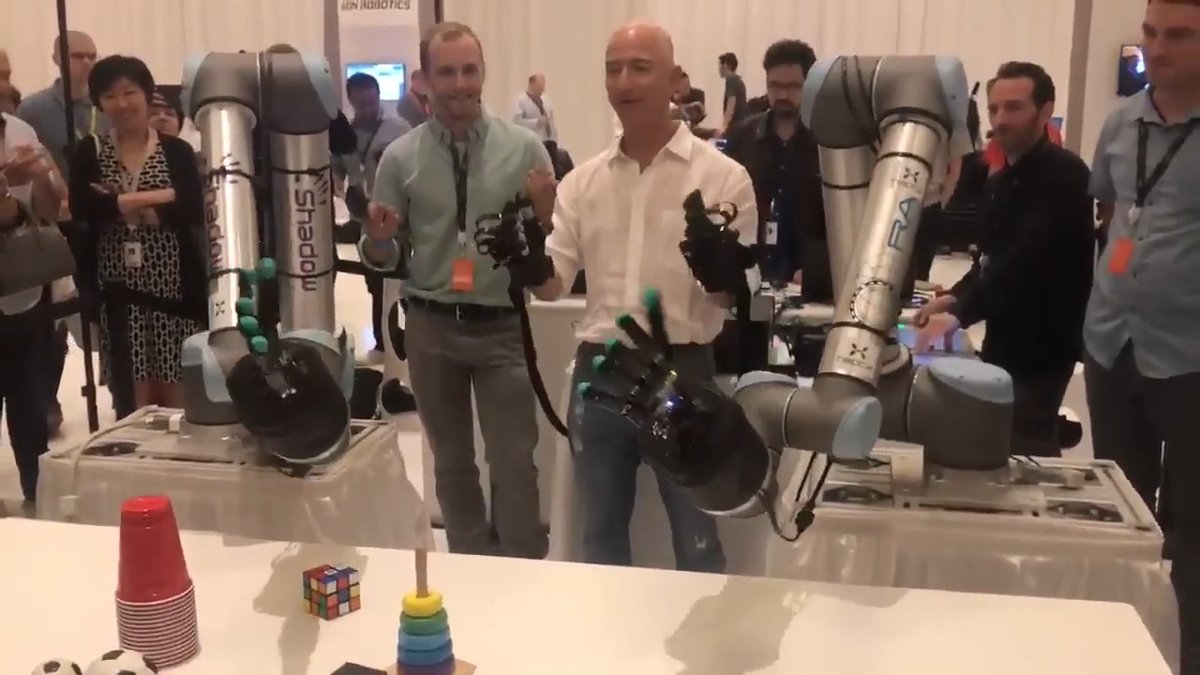
Feeling what a robot feels is becoming real! 🫰 Fluid Reality just ran its first full end-to-end touch teleoperation system, and the demo shows why high-resolution haptics might be the missing piece in robot control. A 22 mm fingertip display with 32 independently actuated “bubbles” was mapped directly to...

46,927 просмотров • 8 месяцев назад •via X (Twitter)

Комментарии: 0

Нет доступных комментариев

Здесь появятся комментарии из оригинального поста

Похожие видео

A policy that teaches robot hands to touch things the way humans do... not just grab and move, but feel and adjust in real time. Robot manipulation research often stops at picking up objects and placing them. CGP goes further: it handles tasks like opening jars, flipping objects in-hand, wiping dishes, and grasping fragile eggs, the kind of dexterous, contact-rich skills that require constant micro-adjustments based on what the fingers are actually feeling. The robot doesn't just see what it's doing; it predicts what contact should feel like at each step, then checks whether reality matches the prediction. If a finger is slipping, the policy knows before the object drops. Works on real robot hands (both 4-finger and 5-finger designs) with tactile sensors embedded in the fingertips Robust to visual distractions! The robot keeps flipping a box correctly even when the camera view is disrupted, because it's grounding decisions in touch, not just vision. Baseline policies without contact grounding fail in predictable ways: slipping mid-task, incomplete motions, loss of grasp, CGP avoids these This is a meaningful step toward robots that can handle the physical world with the kind of reliable, adaptive grip that humans take for granted. Relevant for manufacturing, logistics, assistive robotics, and anywhere fragile or irregular objects need to be handled carefully. Published at RSS 2026, developed with Meta Reality Labs Research. Thanks for sharing, Zhengtong Xu / Zhengtong Xu ——- Weekly robotics and AI insights. Subscribe free:

Ilir Aliu

12,769 просмотров • 2 месяцев назад

🔥 JUST IN: Open-source robotics dataset from 100% real-world scenarios! 🤯 Chinese robotics company AGIBOT just released AGIBOT WORLD 2026, an open-source dataset systematically covering key embodied AI research directions. Built entirely from real-world environments: commercial spaces, and homes. Collected using AGIBOT G2 robots in free-form collection mode, providing structured, accurately annotated, high-quality data. Digital twin technology creates 1:1 scale replicas in simulation matching the real environments. Both real-world and simulation data are open-sourced. The AGIBOT G2 platform collects multiple data types simultaneously: RGB(D) cameras, tactile sensors, force sensors, LiDAR, IMU, and full-body joint states. Whole-body control coordinates arms, waist, and hands for complex tasks. First-person teleoperation lets operators control the robot from its perspective. The tasks covered are fine-grained manipulation, ultra-long-horizon tasks, spatial navigation, dual-arm coordination, and multi-agent/human-robot collaboration. The dataset includes error-recovery trajectories with annotations. Most datasets only show successful demonstrations. AGIBOT includes failures and how the robot recovers, teaching models how to handle mistakes. After collection, data is tested through policy training and real-robot deployment to ensure quality. Then processed through industrial quality control with multiple screening and cleaning rounds. Making it open-source accelerates embodied AI research by giving researchers access to high-quality real-world robot data at scale. 🇨🇳 Learn more here: ~~ ♻️ Join the weekly robotics newsletter, and never miss any news →

Lukas Ziegler

40,583 просмотров • 4 месяцев назад

We believe we’re the first robotics company to demonstrate a robot peeling an apple with dual dexterous human-like hands. This breakthrough closes a key gap in robotics, achieving bimanual, contact-rich manipulation and moving far beyond the limits of simple grippers. 🧵↓ Today’s AI models (VLMs) are excellent at perception but struggle with action. Controlling high-degree-of-freedom hands for tasks like this is incredibly complex, and precise finger-level teleoperation is nearly impossible for humans. Our first step was a shared-autonomy system: rather than controlling every finger, the operator triggers pre-learned skills like a “rotate apple or tennis ball” primitive via a keyboard press or pedal. This makes scalable data collection and RL training possible. How does the AI manage this? We created "MoDE-VLA" (Mixture of Dexterous Experts). It fuses vision, language, force, and touch data by using a team of specialist "experts," making control in high-dimensional spaces stable and effective. The combination of these two innovations allows for seamless, contact-rich manipulation. The human provides high-level guidance, and the robot executes the complex in-hand coordination required. This work paves the way for robots that can safely handle delicate tasks in human environments. Want the full technical details? 📄 Read the full research paper: Visit us at NVIDIA GTC Booth #1838, Hall 3 to learn more! #Robotics #AI #DexterousManipulation #VLA #NVIDIAGTC Nancy Villicaña NVIDIA GTC

Sharpa

20,429 просмотров • 5 месяцев назад