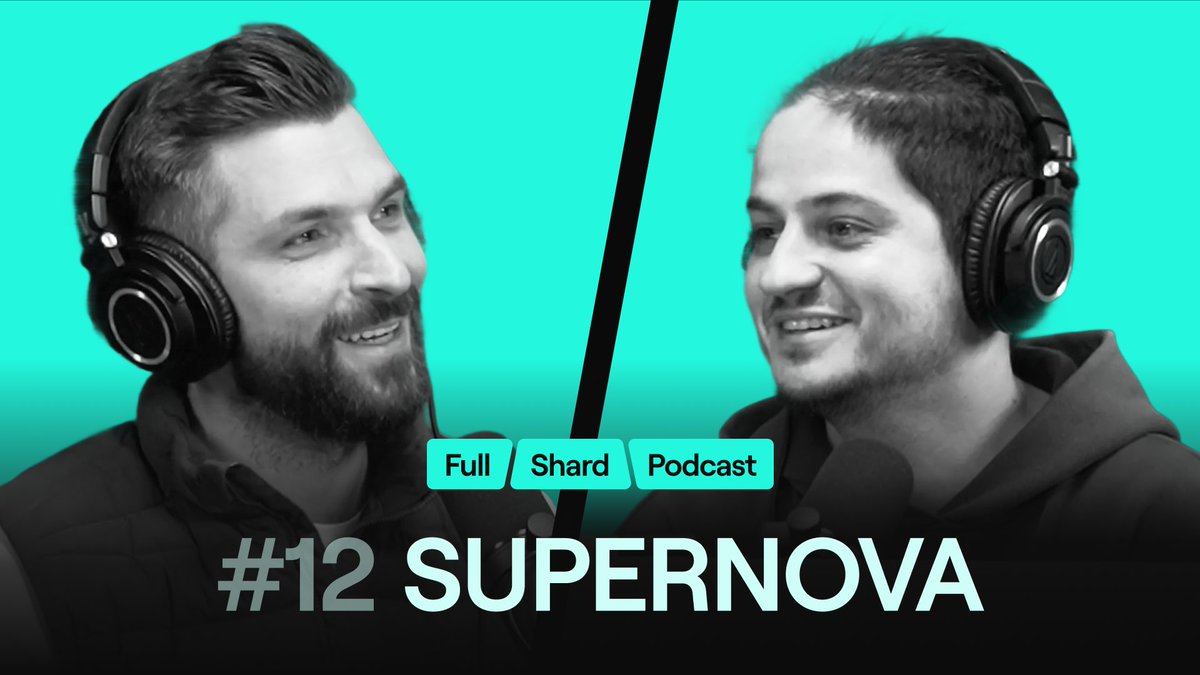
Video wird geladen...

Video konnte nicht geladen werden

Zur Startseite

First Principles Ep. 3 with Leslie Lamport Before blockchains could reach consensus, Leslie Lamport had to define what agreement even meant when computers fail, lie, or disappear. Hosted by Tim Roughgarden with Ittai Abraham. 00:00 The problem every blockchain is built to solve 02:52 Why concurrent systems are surprisingly...

65,334 Aufrufe • vor 1 Monat •via X (Twitter)

0 Kommentare

Keine Kommentare verfügbar

Kommentare vom Original-Post werden hier angezeigt

Ähnliche Videos

First Principles Ep. 6 with Ron Rivest Long before the internet became a place to bank, transact, or build blockchains, Turing Award winner Ron Rivest helped solve a foundational problem: how can strangers communicate securely without first meeting to exchange a secret? Rivest tells the story of inventing RSA with Adi Shamir and Leonard Adleman, why digital signatures fascinated him even more than encryption, and how cryptographic hashes, government pressure, patents, and standards shaped the security infrastructure we rely on today. Rivest shares his unusually candid views on quantum computing, post-quantum security, and more. Hosted by Tim Roughgarden with Dan Boneh. 00:00 Intro: the two problems that could break modern cryptography 01:10 Why Ron Rivest’s work underpins the internet and blockchains 08:10 Before public-key cryptography, there was no theory of security 11:05 The open problem that led to RSA 13:55 The night Ron Rivest discovered the core idea behind RSA 17:55 Why digital signatures were the real breakthrough 19:14 The RSA challenge — and a prediction that was off by quadrillions of years 28:33 How government pressure shaped cryptographic standards 30:36 Designing the hash functions that made digital signatures practical 33:26 The Fiat–Shamir transformation, explained 38:04 Building a cryptography company before the web existed 42:31 Will quantum computers ever become powerful enough to break RSA? 48:02 The cryptography securing the internet, elections, and everyday life 50:11 What surprised Dan: Quantum giveth and quantum taketh away

a16z crypto

62,339 Aufrufe • vor 23 Tagen

First Principles Ep. 6 with Shafi Goldwasser What if you could prove something is true without revealing why it’s true? Turing Award winner Shafi Goldwasser tells the origin story of zero-knowledge proofs: how a playful question about playing poker securely over the telephone led her, Silvio Micali, and Charles Rackoff to rethink what a mathematical proof could be. Goldwasser traces those ideas through interactive proofs, the sum-check protocol, SNARKs, and the systems now used to verify computation and preserve privacy on blockchains. She also reflects on why breakthrough ideas are often rejected at first, how toy problems can produce foundational theories, and whether AI systems should have to prove their answers. Hosted by Tim Roughgarden with Justin Thaler 00:00 Intro 03:36 How mental poker inspired zero-knowledge proofs: Proving that something is true without revealing the underlying information 06:30 The simulation paradigm and the meaning of “zero knowledge” 08:33 Why the original paper was repeatedly rejected 10:33 How interactive proofs became more powerful than conventional proofs 13:36 The road to modern SNARKs 19:02 Why the sum-check protocol is so useful for verifiable computation 25:31 Why many so-called “zk proofs” are not actually zero knowledge 34:06 Why toy examples, playfulness, and narratives can produce deep theory 37:23 The role of rigor and computational assumptions in cryptography 42:44 Applying zero-knowledge proofs to law, evidence, and secret software 45:23 Training AI systems to provide proofs alongside their answers 54:27 Why genuinely new ideas are often difficult for experts to recognize

a16z crypto

144,449 Aufrufe • vor 8 Tagen

François Chollet (François Chollet) has spent years asking a different question than most of the AI world. Instead of scaling what already works, he’s trying to understand what intelligence actually is and how to build it from first principles. In this episode of the Lightcone Podcast, he traces that path from his early work on deep learning to the creation of the ARC Prize, and the launch of ARC V3, a new benchmark designed to measure something deeper than performance: the ability to learn, adapt, and reason efficiently in entirely new environments. He explains why today’s systems may be hitting limits, what recent breakthroughs really mean, and why reaching true general intelligence may require a fundamentally different approach. 00:00 - AGI by 2030? 00:31 - Introducing Ndea: A New Path Beyond Deep Learning 01:08 - A New ML Paradigm 01:30 - Replacing neural nets with compact symbolic programs 03:04 - Why Ndea Isn’t Competing With Coding Agents 05:20 - Why Everyone Might Be Wrong About Scaling LLMs 07:22 - Why Coding Agents Suddenly Work So Well 08:50 - The Limits of LLMs in Non-Verifiable Domains 10:48 - What AGI Actually Means (And Why Most Definitions Are Wrong) 13:30 - Why Deep Learning Hits a Wall 14:00 - ARC’s Origin Story 18:20 - ARC Benchmarks Explained: From V1 to V3 22:49 - The RL Loop Powering Coding Agents Today 27:03 - ARC-AGI V3: Measuring “Agentic Intelligence” 31:14 - Inside the ARC Game Studio 35:31 - Could AGI Fit in 10,000 Lines of Code? 44:01 - Building Ndea: From Idea to Compounding Research Stack 46:46 - The Future of ARC: Benchmarks That Evolve With AI 47:21 - Why There’s Still Huge Opportunity for New AI Paradigms 53:37 - How to Build a Breakout Open Source Project - Lessons From Keras 56:39 - Advice For How To Think About AI

Y Combinator

151,649 Aufrufe • vor 4 Monaten

My conversation with OpenAI co-founder Greg Brockman This is the most detailed first-person account of the 72 hours after Sam Altman was fired. We also go deep on what comes next: the global race to AGI, why ChatGPT stopped showing reasoning, how much of OpenAI's own code is now written by AI ("it's hard to know what percent is not"), and the untold story of how OpenAI actually started in 2015. 00:00:00 Introduction 00:00:49 Meeting Sam Altman and Starting OpenAI 00:02:40 Building the Founding Team 00:04:25 DeepMind's Lead Over OpenAI 00:04:54 Changing OpenAI to a For-Profit Model 00:06:05 Breakthrough Moments at OpenAI 00:08:22 What Dota 2 Meant for OpenAI 00:10:04 Reasoning Versus Prediction 00:11:59 Tensions Grow at OpenAI 00:15:44 Sam Altman's Firing 00:17:49 Greg Quits OpenAI 00:19:56 Sam Explores Deal with Microsoft's Satya 00:20:28 Petition for Altman's Return 00:23:43 Ilya Sutskever Leaves OpenAI 00:24:59 Lessons Learned after Sam Ousting 00:28:22 The Thing Ilya Said that Greg Can't Forget 00:32:22 Is AI Going Parabolic? 00:33:24 How Much of OpenAI's Code is Written by AI? 00:36:21 Do AI Chatbots Tell Us What We Want to Hear? 00:38:06 The Global AI Race to Reach AGI 00:38:40 What Happens if US Doesn't Reach AGI First? 00:39:49 Are Countries Stealing AI Advancements? 00:40:38 Why ChatGPT No Longer Shows Reasoning 00:41:47 The Finite Constraints of Compute 00:43:38 On Investing Early in Data Centers 00:46:31 The Future of Data Center Specialization 00:47:52 How to Decide Whose Queries to Serve 00:49:08 OpenAI on Consumer vs Enterprise Models 00:53:05 Data Centers in Space? 01:00:56 What Should AI Regulation Look Like? 01:04:33 The Future of AI-Powered Entrepreneurship 01:04:44 AI and Job Loss 01:07:15 The Skills Young People Should Invest In 01:11:30 What Does Success Look Like For You? Full episode on X below. Also find it on: • YouTube: • Spotify: • Apple:

Shane Parrish

450,952 Aufrufe • vor 3 Monaten