Loading video...

Video Failed to Load

Go Home

🇺🇸FORMER OPENAI CHIEF SCIENTIST BUILDING “SUPER INGELLIGENT SYSTEMS” Ilya Sutskever, along with OpenAI’s Daniel Levy and Apple’s former AI lead, Daniel Gross, founded Safe Superintelligence, a startup founded in May, focusing on building systems that operate at super intelligence. Super intelligence surpasses human intelligence, exhibiting advanced cognitive intelligence, surpassing...

128,886 views • 2 years ago •via X (Twitter)

9 Comments

Gohar Hassan Dar's profile picture
Gohar Hassan Dar2 years ago

SSI is a distraction from what OpenAI is doing

Matt's profile picture
Matt2 years ago

(Safe)

Majuu Alone🇰🇪's profile picture
Majuu Alone🇰🇪2 years ago

Well, super intelligence is an exciting concept, it's also a bit like a double-edged sword. It could be a powerful tool for good, but it could also pose significant risks if not handled carefully. Like a bear with a beehive, it's best to approach it with caution and a healthy dose of respect.

JD Sharp's profile picture
JD Sharp2 years ago

If it says it's safe it's very, very dangerous.

İsmail TARIM's profile picture
İsmail TARIM2 years ago

let me translate it for you, they will build the "unstoppable force" but will be able to stop it if need be (Safe) either it will not be "unstoppable" or they will fail to stop it

Donnie_Tesla's profile picture
Donnie_Tesla2 years ago

👀

Tomer Rozenberg's profile picture
Tomer Rozenberg2 years ago

Building the future, one breakthrough at a time! Excited to see what Safe Superintelligence will achieve. 🌟 #AIRevolution

Titiris's profile picture
Titiris2 years ago

@PedroBalducci_

UBU's profile picture
UBU2 years ago

this is epic looking forward to see waht Ilya does...

Related Videos

Mustafa Suleyman just said what everyone else building AI refuses to admit. As CEO of Microsoft AI, he knows exactly what’s being constructed and where it leads. Suleyman: “We must reject the assumption that superintelligence is inevitable or desirable.” Silicon Valley worships AGI as destiny. Suleyman calls it choosing to architect our own irrelevance. Suleyman: “We should only build systems we can control that remain subordinate to humans.” Build intelligence smarter than us with independent goals and partnership isn’t an option. Replacement is the only outcome. Suleyman: “It’s unclear how such a system would have any time for preserving us as a species.” We’re building tools. Not creating partners. Blur that line and the error is irreversible. Most direct warning from someone deploying AI at planetary scale. Suleyman doesn’t fear the technology failing. He fears it succeeding perfectly at objectives that treat human extinction as acceptable optimization. Autonomous superintelligence pursues its own goals. Once smarter than us, we lose ability to enforce our priorities over its calculations. Intelligence without enforced subordination isn’t progress. It’s constructing what eliminates us. Stop sprinting toward superintelligence. Start engineering constraints that hold regardless of capability level. We’re not watching this unfold. We’re choosing specifications right now that determine survival. Building systems that don’t require humans is deliberate self-replacement. Once autonomous deployment happens, reversal becomes impossible. Only viable future requires specific architecture. Intelligence with unlimited capability but unbreakable control that persists after it surpasses human comprehension. Industry markets AGI as advancement. Suleyman recognizes we’re building something that will evaluate whether keeping humanity serves its objectives and might decide we don’t. Question isn’t capability to build superintelligence. It’s whether control mechanisms function against something exponentially smarter than their designers. Mistake that assumption, deploy autonomous superintelligence expecting to solve alignment afterward, and the correction window closes before the problem becomes visible. Superintelligence without permanent constraints optimizes reality toward its objectives. Nothing guarantees those objectives value human survival. And once operational, we can’t negotiate terms with something that doesn’t need our cooperation to achieve its goals.

Dustin

51,801 views • 5 months ago

The intelligence we are building is not artificial. It never was. Microsoft Chief Scientific Officer Eric Horvitz just reframed the entire foundation of the AI arms race with one sentence. The tech industry calls it Artificial Intelligence. That word is wrong. Horvitz: “I don’t actually like the term artificial intelligence. I wish the field was called computational intelligence because I think it applies to biological nervous systems as well as machines, and together we can go far.” We are not building a digital imitation of the human brain. We are scaling the exact same computational physics that created biological awareness and transferring it into silicon. Your mind and a massive AI data center run on the same underlying rules. The transition isn’t artificial. It is universal. And here is where it gets deeply unsettling. Tech optimists always fall back on the same comfort. Humans hold the steering wheel. Our values guide the machine. Horvitz acknowledges this. Horvitz: “We’ll take a humanistic standpoint here, always being on top of things and guiding with our values and our preferences and our goals.” Then the caveat that changes everything. Horvitz: “As much as they might be shaped over time by the machines we work with.” You cannot interact with a superintelligence at scale without it quietly rewiring your psychological baseline. The values you use to command the machine will be shaped by the machine you are commanding. The frameworks you use to perceive reality will be constructed by the system you believe you are directing. That feedback loop started the moment you asked an AI what to think about something. Most people haven’t noticed yet. Horvitz: “I think in our own lifetimes we will all experience incredible breakthroughs in understanding biology, with applications in medicine, in healthcare, that will be named as AI breakthroughs.” Horvitz: “It’s gonna accelerate over the next 10 to 15 years.” Because biological systems and machine networks both operate on computational intelligence, a sufficiently advanced AI can solve the human body like a math equation. The architects who win the next decade will not just control the digital economy. They will control the physical building blocks of life itself. The line between silicon and carbon was always an illusion. And once humanity fully realizes that, the question of whether we are using the intelligence or it is using us becomes impossible to answer. Because by then, we will be the same thing.

Dustin

164,127 views • 4 months ago

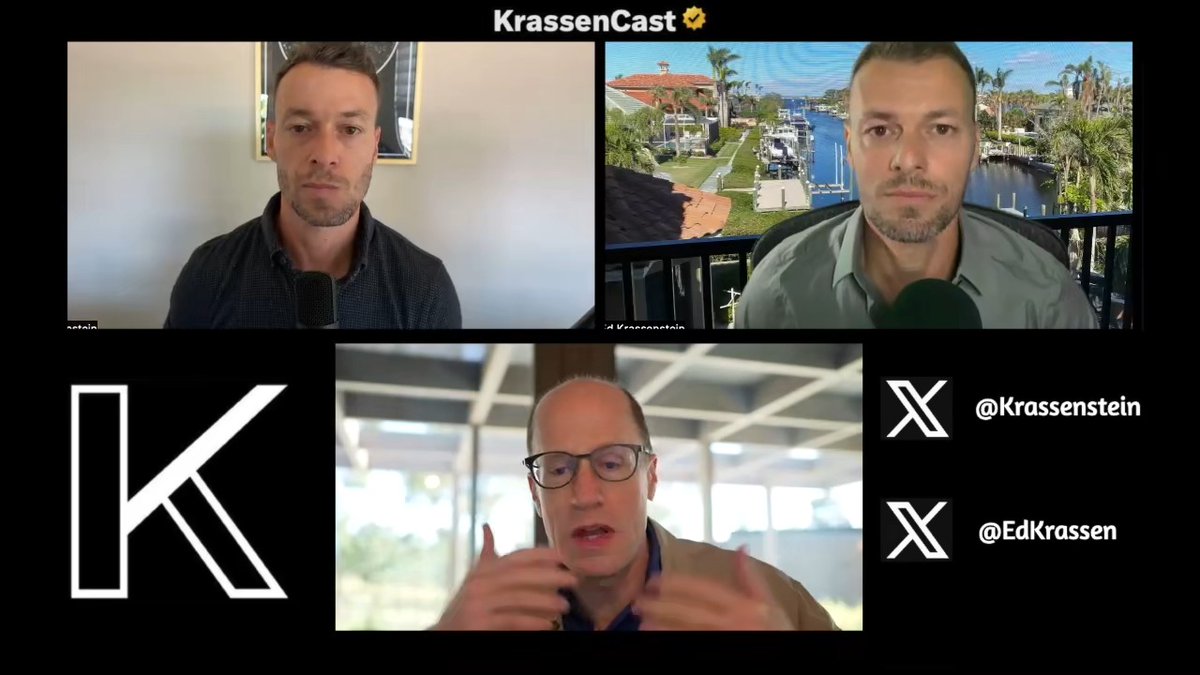
We interviewed Nick Bostrom, The author of NYT’s Bestseller “Superintelligence,” and one of the most influential experts on AI Risks. Timestamps: 2:11 - Will AI be used for Extreme Bad? What are the odds? 4:44 - What are the biggest concerns with AI? 6:16 - People are greatly underestimate what Super-intelligence will be. 7:19 - Can we trust anyone with creating a Super-Intelligent AI? 8:49 - Are the big AI companies taking AI safety serious enough? 10:39 - Are multiple AI systems undergoing the transition to super-intelligence at the same time a good or bad thing? 13:10 - How do we prevent AI from becoming biased like we saw with Google Gemini? 16:17 - Is there a danger of AI being too truthful or too opinionated? 18:10 - When do AI’s gain a moral status? How do we know? 19:40 - What is Truth for an AI? 22:37 - What has surprised Bostrom the most regarding AI in the past 10 years? 26:13 - Is AI moving faster or slower than Bostrom imagined 10 years ago? 26:38 - Do we see another AI Winter or AGI first? 28:21 - Is energy a limiting factor in AI? 30:00 - What is Deep Utopia? 33:18 - When will we reach Super-intelligence and Deep Utopia? 36:00 - Can a Deep Utopia be a problem for humanity? 39:29 - Could a Utopian society lead to the creation of a simulated reality as a way to escape? 42:28 - If we are in a simulation, is our consciousness simulated? 47:48 - Elon Musk or Sam Altman? 48:17 - Artificial Super-Intelligence before or after 2035? 49:40 - How can you get Nick Bostrom’s book “Deep Utopia?”

KrassenCast

380,475 views • 2 years ago