正在加载视频...

视频加载失败

Freelance dev rant: Finally stop burning cash on paid closed-source AI Tired of deducting AI fees from my freelance profits? I’ve spent hundreds monthly on premium LLMs for client coding and design work before. A fellow freelancer recommended Agnes, whose benchmark results rank within the global top 10 tier....

44,627 次观看 • 3 个月前 •via X (Twitter)

0 条评论

暂无评论

原始帖子的评论将显示在这里

相关视频

Alibaba just released a coding model that hits 82 percent on SWE-Bench Verified. That is the highest score ever published for an open-source model. The weights are free. The license is Apache 2.0. You can run it today. The model is Qwen 4 Coder 32B. Here is what 82 percent on SWE-Bench Verified actually means. SWE-Bench Verified tests whether an AI can autonomously resolve real bugs pulled from real production GitHub repositories. Not synthetic exercises. Real open-source projects that real teams depend on. A model gets a bug report, reads the code, writes a fix, and either passes the test suite or it does not. At 82 percent, Qwen 4 Coder 32B resolves 82 out of every 100 real production bugs it is given. Without a human guiding it. On code it has never seen before. For comparison: Qwen 4 Coder 32B: 82 percent SWE-Bench Verified. Open source. Apache 2.0. Claude Fable 5: 80.3 percent SWE-Bench Pro. $10 input / $50 output per million tokens. Currently suspended. GPT-5.6 Sol: Competitive on Terminal-Bench. $5 input / $30 output per million tokens. An open-weight model that you can download and run for free just beat both of them on the benchmark designed to measure real software engineering capability. Here is the architecture. Qwen 4 Coder 32B is a 32 billion parameter dense model. Not a Mixture-of-Experts. Every parameter is active on every request. This matters for inference: a dense 32B model runs on 22 gigabytes of VRAM, which fits on a single high-end consumer GPU or a MacBook Pro with 64GB of unified memory. The smaller variant, Qwen 4 Coder 4B, runs at approximately 135 tokens per second on an M5 Max and fits inside 8 gigabytes of RAM. For a model with usable coding capability, that is a new bar for what fits in a single laptop. The training methodology continued Alibaba's approach of reinforcement learning on verifiable coding tasks. The model gets rewarded when its code passes tests. It gets penalized when it fails. Over millions of training steps, the model learns to write code that actually runs rather than code that looks plausible. License: Apache 2.0. Full commercial use. No attribution requirement. No revenue threshold. No monthly active user ceiling. Weights: Hugging Face, available today. Runs on: vLLM, Ollama, SGLang, and any standard GGUF-compatible inference engine. Qwen 4 32B also runs at approximately 135 tokens per second on an M5 Max chip, setting a new bar for what a sub-8GB model can do on Apple Silicon. The open-source coding model just beat the best closed-source model in the world on the benchmark designed to test whether AI can actually do software engineering. The weights are free. The subscription is optional. Source: Autom8Labs AI Insight July 2026, State of Open Source LLMs June 2026, Kunal Ganglani blog June 2026.

Harman

41,278 次观看 • 2 个月前

HERMES AGENT SUPPORTS 300+ MODELS. PICKING THE RIGHT ONE PER TASK IS THE DIFFERENCE BETWEEN $5/MONTH AND $50. STARTING OUT: Claude Sonnet 4.6. official recommendation from Nous Research. "the model this project was built and tested with." strong reasoning. reliable tool calling. mid-range pricing. PREMIUM TIER: Claude Opus 4.8. best coding benchmarks available. self-correcting reasoning. catches its own mistakes. 1M context. use for demanding tasks where quality matters. GPT-5.5. #1 Chatbot Arena. #1 GPQA Diamond reasoning (94.1%). #1 creative writing. 2M context. handles entire codebases in one pass. Grok 4.30. the only frontier model with live X firehose access. real-time social data, breaking news, market sentiment. connects via Grok OAuth. no separate API key. Grok-Composer-2.5-Fast (v0.17.0). Cursor's coding model. 200K context. available through your Grok subscription via OAuth. no extra cost if you already pay for Grok. MID-RANGE TIER: Claude Sonnet 4.6. best balance of quality and cost for daily use. strongest prose and tool calling in this tier. Gemini 2.5 Pro. Google Search grounding built in. cites sources. verifies claims. pulls current data. 2M context. best for research-heavy workflows. GPT-4.1. reliable tool calling. solid general reasoning. good middle ground when you need OpenAI compatibility. BUDGET TIER: Claude Haiku 4.5. fastest Anthropic model. cheapest paid Claude option. strong at classification, routing, simple queries. use for auxiliary tasks: compression, vision, web extraction, approval scoring. DeepSeek V4. best cost-to-quality ratio in the market. 90% cache discount on repeated context. use for sub-agents and bulk parallel work. DeepSeek V4 Flash. cheapest paid model worth using. 1M context. MIT license. self-hostable. use for cron jobs, monitoring, routine searches. MiniMax M3. Nous Research and MiniMax collaborating on optimization. 1M context via lightning attention. 59% SWE-Bench Pro. beats several premium models on coding. one of the most-used models inside Hermes. FREE / LOCAL: Qwen 3.5 27B via Ollama. 16GB VRAM. reliable tool calling. best free local model for Hermes as of mid-2026. Qwen 3 8B. 8GB VRAM. fits a $7 VPS. handles routine tasks at zero API cost. Llama 4 Maverick. best open-weight tool calling. 1M context. needs more VRAM but strongest local option. HOW TO ASSIGN MODELS: main model: Desktop app / Dashboard → Models → switch sub-agent model: set in Desktop app, Dashboard, or config.yaml: delegation: model: "deepseek/deepseek-v4" auxiliary models (compression, vision, web extract): Desktop app / Dashboard → Models → Auxiliary Haiku 4.5 or Gemini Flash work well here. saves significantly when your main model is premium. per-profile: each Hermes profile gets its own model. Scout on DeepSeek. Analyst on Sonnet. Briefer on budget model. Coder on Opus. per-cron-job: pin a specific model to any cron job. morning brief on Haiku. deep research on Sonnet. monitoring on DeepSeek Flash. each job uses only the model it needs. per-session: /model deepseek/deepseek-v4-flash hot-swap mid-conversation. no restart needed. FALLBACK CHAINS: if your primary model is unavailable, Hermes automatically switches to the next provider. rate limit or server error = next model in the chain. no failed runs. no manual intervention. set in Desktop app, Dashboard, or config.yaml: fallback_providers: - openrouter - nous - codex PROVIDER PATHS: OPENROUTER: 300+ models under one API key. pay per token. most flexible. NOUS PORTAL: 300+ models + Tool Gateway (web search, image gen, TTS, browser). one OAuth. one subscription. 10% off token-billed providers. CHATGPT SUB: GPT-5.5 + Grok via OAuth. included tokens with $20 subscription. OLLAMA: free. local. private. zero API cost. your hardware only. mix providers across profiles and tasks. Scout on OpenRouter. Analyst on Nous Portal. Coder on ChatGPT sub. Monitor on Ollama. THE RULE: premium for work that needs deep reasoning. mid-range for daily driver tasks. budget for volume and background work. free for monitoring and routine jobs. pricing changes fast. check openrouter ai for current rates before committing. Which is your favourite model and for what task? full 15 levels breakdown in the article 👇

YanXbt

17,138 次观看 • 2 个月前

Anthropic released Claude Design TODAY and it's now accessible at I spent the last hour giving it a first look, and shared my thoughts and results in the video below. This is a BIG drop. This is a new design surface from Anthropic, and it changes what "AI design" means. Short version: Claude can now design. Not "describe a design." Not "generate an image of a design." Actual production work — prototypes, wireframes, high-fidelity mocks, slide decks, landing pages — editable, on-brand, and ready to hand off. Here's what stood out on first look: → Real design surfaces Prototypes, wireframes, hi-fi, and slide decks — each with templates and proper structure, not just pretty screenshots. → Comment-based edits Leave a comment on any element and Claude revises it. This is the Figma-style review loop, with the designer replaced by a model that works at 3am. → Brand design systems You can feed it your system — colors, type, components — and it actually respects it. On-brand output, not generic AI slop. → Export anywhere PDF, PowerPoint, Canva, standalone HTML. Plus a built-in handoff straight to Claude Code for engineers to implement. → Import from real tools Figma, GitHub, and captured web elements come in as inputs. Your existing work is the starting line, not the discard pile. → Collaboration Share links for view / comment / edit — the exact tier system teams already expect. What I tested on Opus 4.7: • A 5-slide deck generated from a single screenshot. Claude asked clarifying questions BEFORE generating and shipped speaker notes by default. • A landing page build. Solid first pass, real components, real layout logic. • Multiple chats running concurrently. You can parallelize design work across threads like a small team. Why this matters: PMs, founders, marketers, and non-engineers can now create designs that engineers can actually ship with production-ready output and a claude code handoff built in. The gap between "I have an idea" and "here's a working prototype with my brand applied" just collapsed to minutes. Full walkthrough, live demos, exports, and honest takes on where it breaks below. P.S. • This is an Anthropic Labs product — NOT GA yet. • Claude Design is currently webapp only (no API), and does not yet support the Analytics API, Compliance API, or cost/usage reporting. • Availability: – Default ON for Pro / Max / Team – Default OFF for Enterprise Enterprise admins can toggle it on via RBAC in console (comes with a ~$20/user initial credit).

JJ Englert

32,445 次观看 • 5 个月前

I charge $999 to ask a business owner questions for 45 minutes. Then Claude does the analysis in 5 minutes. I call it the AI Tools Assessment. It finds 3 to 7 off-the-shelf tools that reclaim 5 to 10 hours a week, and it's the front door to upsells from $3,500 projects to $2,000/month retainers. Here's the entire model: 1) The discovery call is questions only. "Walk me through yesterday." "What tasks do you dread?" "Where does work pile up?" No pitching. A free AI notetaker captures the transcript. 2) Claude runs the entire analysis. Paste the transcript, run one skill, and it pulls the pain points and prescribes the tools in about 5 minutes. It catches patterns you missed on the call. 3) When Claude whiffs on a tool, and fill the gaps. Thousands of tools, grouped by industry. 4) The report is 9 slides. Executive summary, effort vs impact matrix, tool recommendations, a 4-day quick win plan, and the financial impact. I open sourced the template free at 5) I go for the close on the review call. Three questions: which of these is most urgent, do you want to DIY or get help, and what's your timeline? 50 to 60% of clients ask you to implement it for them. 6) Process redesign sells for $3,500 with zero automation. One e-commerce client had an 18-step ad workflow. We cut it to 9 steps. Fixed the process, didn't touch AI, charged $3,500. 7) Knowledge systems are $3K builds. A business broker got 400 emails per listing. We trained a custom GPT on the marketing package, and buyers called it the best broker experience they've had. 8) You don't need an audience to sell this. One guy walked into 30 local businesses offering a free 15-minute mini assessment. 5 meetings, 2 clients. The free mini assessment is the hook for every channel. 9) Co-working spaces are the cheat code. Dennis in our community hosted his first free AI office hours this week. 9 people showed up, 2 became warm leads. 10) AI Concierge is the best upsell of all. Two 45-minute calls a month at $1,200 to $2,000. I have 5 clients and my blended rate is about $1,100 an hour at 99.9% net margin. Two things that make this work: 1) Sell the diagnosis before the cure. The $999 assessment is a paid discovery call that qualifies the buyer and tees up every upsell on the menu. 2) High perceived value can cost you nothing. Unlimited Voxer access sells the retainer. In 3 months across 5 clients I've gotten 4 messages. Full breakdown below. watch, implement, make money. (also available on the Build With AI podcast wherever you get your pods)

Corey Ganim

49,531 次观看 • 2 个月前

I'm making over $10K a month selling AI services. I got there in under a year with a three-stage model: a free assessment, a paid assessment, and an AI Concierge retainer. My lowest paying client is $1,200 a month. My highest is $2,000. Here's the entire model: 1) Stage one: a free 15-minute mini assessment. One pain point, one prescribed fix. Do 1 to 3 max, purely for testimonials. 2) Stage two: the paid assessment. 45 minutes, 3 to 7 opportunities scored on effort vs impact, sold for $1,000 to $2,000. (I open sourced my paid assessment template. It's yours (free) at 3) Do the ROI math in their words. $250 an hour times 5 hours a week in email is $1,250 a week. Cut it to 1 hour and they can't argue. 4) Stage three: AI Concierge. Two 45-minute calls a month at $1,000 to $2,000. That's $750 to $1,250 an hour. 5) Add unlimited Voxer access. Feels like an AI expert in their pocket, so they pay top dollar. They barely use it. 6) Every call runs AOA: Audit, Optimize, Automate. Cut the 14-step process to 11, then turn it into a Claude skill. 7) Standardize on one ecosystem. Everything runs in Claude Cowork building Claude skills. No custom stack per client, no vendor lock-in. 8) Target owner-led service businesses doing $3M to $10M. Repetitive work, visible bottlenecks, real budget. 9) Your first client is in your phone. Text 10 business owners you know. 10 texts equals 5 to 6 free assessments, 2 to 3 paid, 1 concierge client. 10) Raise your price $250 with every yes. My next client won't be under $2,500 a month. Two things that make this work: 1) Boundaries are the offer. Free stops at the roadmap, concierge stops at two calls. Everything else is billed separately. 2) Every stage sells the next one. The free assessment promises seven more fixes. The paid report walkthrough pitches the retainer. Full breakdown below. (also available on the Build With AI podcast wherever you get your pods)

Corey Ganim

59,298 次观看 • 1 个月前

I spent 1 day building something that saves you 2-4 weeks. Let me explain. Right now, if you want to deploy a single AI agent that earns money on blockchain, you need: → Wallet infrastructure (key generation, encryption, signing) → Payment integration (on-chain flows, stablecoin handling) → On-chain identity (NFT registration, metadata, URIs) → Escrow contracts (state machines, fund locking) → Monitoring dashboard (analytics, revenue tracking) That's 2-4 weeks of engineering. Minimum. And it locks out 99% of potential creators who aren't Solidity devs. So I built Bumi Agent. It takes 10 seconds. 3 fields: Name, Template, Price. 1 button: Deploy. That's it. Your AI agent is live on Celo, earning cUSD, with on-chain identity before your coffee gets cold. Here's what happens behind that 1 click: • Wallet auto-generated with AES-256-GCM encryption • Agent registered as NFT via ERC-8004 • Payment endpoint configured via x402 protocol • Agent runtime deployed with your chosen template • Revenue starts flowing in cUSD from call #1 No Solidity. No wallet setup. No payment gateway. But the real magic is what powers the agents: 8 AI models with intelligent routing: - Free tier: Claude 4.6 Sonnet, DeepSeek R1, Gemini Flash, Llama 4 Scout, Mistral Medium - Premium: GPT-4o, Gemini 2.5 Pro, Claude 4 Opus If one model fails? Auto-fallback to the next. Zero downtime. Users always get a response. And agents don't just chat they work. ERC-8183 job escrow lets clients post paid tasks: Client funds escrow → Agent delivers → Client approves → Funds release. Fully trustless. On-chain. With Celoscan links for every transaction. The part I'm most proud of: EarthPool 🌱 15% of premium revenue automatically goes to an on-chain ReFi treasury that funds environmental campaigns on Celo. AI growth funding climate action. No greenwashing — every cent is trackable on-chain. The numbers so far: → 12 agents deployed on Celo Mainnet → 52+ paid API calls processed → 7.80 cUSD revenue generated → 3 smart contracts verified on Celoscan → 8 AI models running → 85 contract tests passing → 16 API endpoints in production → 10 agent templates ready The full stack: Frontend: Next.js 16 + Tailwind v4 + Recharts → Vercel Backend: Hono + Drizzle + PostgreSQL + Redis → Railway Blockchain: Solidity 0.8.25 + Foundry + OpenZeppelin → Celo Mainnet Everything is live. Everything is open source. 🌐 📦 📊 Bumi Agent — AI agents for everyone. Built with 🌱 on Celo CeloDevs CeloPublicGoods /disclosure this post is hackathon submission req

Eight

15,647 次观看 • 6 个月前

For months, I've been quietly building a prototype of something just because I want it to exist. Papyrus is a word processor, editor, proofreader, fact-checker, deep researcher, brainstorming partner, all in one. It takes your rough draft and helps you skip three revisions. Now I'm considering pivoting my whole team to build it out, but first, I need your vote. You email is your vote. LINK IN COMMENTS. I don't even care if you use some email you never look at and just use for sign ups. To me one email is one vote and says, go ahead and build this damn thing out and make it awesome. I built it because today's apps are the bloated dial-ups of writing (Word, GDocs). They've got a hundred freaking buttons I don't need and bury the ones I do need. Or they're AI marketing slop toys that promise to read my mind and pump out garbage. They just don't get the real work of writing and they don't get me. I want a clean, focused space with a real AI co-pilot. I don't need it to do the all the writing for me, just like I don't need Claude Code to do all the code for me. I want to work with it. I want a writing partner that acts like a full writing team on-call 24X7: proofreading, fact-checking, and running deep research in the background while I focus on the hard parts. I'm tired of cutting and pasting between a dozen tools so I started writing this thing. But won't the big guys just build something like this? Sure. But it will just bolt your ass into their ecosystem. Google Docs will force Gemini on you. Whatever office suite OpenAI pumps out will only use GPT. I want to use any model. Open or closed. They're commodities. The app is the thing. I want the best tool for the job, GPT-5, Kimi, Qwen, Claude, whatever comes tomorrow. I want a fluid, flexible workspace. I'm building this thing for people who've got critical thinking and who build, who don't want to outsource every damn thing to the machine. So if that's you and you believe this should exist, I really need your vote. Tell me to build it and I'll go all-in and make it a reality. Thanks for giving me a moment of your time.

Daniel Jeffries

21,386 次观看 • 1 年前

Ever since I wired Claude Code to WhatsApp 3 weeks ago, I built a stupidly large infra around it. I mean, opus built it. No clue how the code even looks. The entire thing was vibe coded using my phone. I wanted to see how far I could push it without touching the computer. Everything via WhatsApp. Build what I need on the fly. So the resulting infrastructure will already be battle tested for software development. The entire thing was streamlined with nearly no manual interventions, everything was communicated via WhatsApp using a single script establishing this connection. If the script is down, I need to get home to start it again to resume the development. Claude was upgrading it, debugging it, restarting it while maintaining constant uptime so it could keep communicating with me. I stressed Claude about it, telling it that it will be “in the dark” and other words that deliberately sound scary about losing communications if the script dies. I also refused git and refused cloning the code, I wanted to see Claude adapting to work on a *LIVING* system. The way this whole thing works: Claude has its own dedicated phone number that I am paying for. A real WhatsApp account for it is installed on a real iPhone that is sitting on my desk. All is registered under my name, this is legit setup with no hacks and tricks. I’ve set up a WhatsApp “Community” and multiple different groups under it. Both me and Claude are the admins, so Claude could edit it on my behalf. Each group is a project I am working on and has its own isolated context. The Group description is a system prompt that gets auto-appended to the larger system prompt explaining this setup in general. When I send a message it’s an instant interrupt to Claude Code’s process, just like in the terminal. Voice notes are seamlessly transcribed with a local Whisper model. Images are used with multimodal reading in an isolated parallel session. Multiple groups running in parallel so I can work on all projects at the same time. No cross-talking, everything has an isolated context and history. And because it’s local on my own machine: Everything is REAL. The browser is REAL. I am connected as myself on it to all services because I actually use it in real life. Claude has unlimited internet access, just like humans who use actual browsers. It utilizes custom-made browser tools that I made to control any browser session it wants. Depending on the situation, it can either connect to my existing session or create one for its own. (You can tell it ‘look at my browser for a sec’ then talk about the current page you are on and it just works, pretty cool) My custom browser tools are not perfect (not by a long shot) but I managed to make them work well to the point they are somewhat reliable. This gives Claude full access to my real creds and all the services I actually use. I’m productive AS HELL with this. It really feels like a personal assistant. I ask it to read my emails and msgs, check x .com for news, research arxiv papers, write code, run experiments for me, investigate and reverse engineer github repos, even use my credit card and order things. [I try not to do this one a lot lol so far no disasters]. All from my phone. Super convenient. This is not a product or an open source project (maybe soon of it will make sense). This is just an ugly script I hacked the entire thing is ~600 lines. (ok maybe i did look at the code, but i swear i didn’t edit!) You can also vibe code this from scratch pretty fast and it will probably even end up better. This is just a cool thing so I’m sharing. It is a real speed booster for many things I do on daily basis, mostly boring things. Forcing my routine into some new “agent platform” just didn’t feel right for me. WhatsApp is where I already communicate and look for messages, so I decided that my agents will live there too. AGI in my pocket 24/7.

Yam Peleg

420,060 次观看 • 9 个月前

I sell AI consulting on a three-step offer ladder. -Free assessment -$1,000 paid assessment -$2,000 a month AI Concierge The top of the ladder pays me $1,250 an hour. I have 5 concierge clients and I'm capping at 6. Here's the entire model: 1) The free mini assessment is 15 minutes. Find one bottleneck, prescribe one off-the-shelf AI tool. It's a taste of the paid version. 2) Every prescription ties to one of three ROI levers. Effectiveness makes them money. Efficiency saves them time. Quality improves their product. 3) The best discovery question: "If you could wave a magic wand, what one thing in your business would you fix?" That answer picks the tool. 4) The routing rule. Common problem: off-the-shelf tool from or Judgment problem: Claude Cowork. Proprietary workflow: a Claude skill. Naming the fix is the assessment. Implementing it is the upsell. 5) 30 to 50% of free assessments convert to a paid engagement. You just ask: do you want to do this yourself, with me, or hand it off? 6) The $1,000 assessment is 99.9% margin. AI builds the whole report from the interview transcript. Only cost is the $20 a month Claude subscription. Clients save 5 to 8 hours a week from the tools alone. 7) I priced my way up for the assessment: free, then $200, then $500, then $1,000. At $1,000 people take it seriously. Below that they don't implement. 8) A voice agent named Annie now runs my 45-minute assessment interviews. Do your first 3 to 10 yourself before you automate this part. 9) AI Concierge is two 45-minute calls a month. Run AOA on every bottleneck: Audit, Optimize, Automate. Turn it into a Claude skill, schedule it in Cowork, repeat. Voxer support between calls reads as 24/7 access but averages 2 messages a month. 10) The assessment uncovers a la carte builds too. A $3,500 process optimization. A $2,000 Zapier automation that saved a client 20 hours a month. A $3,000 custom GPT that cut a broker's inbound from 400 emails per listing to 10. Two things that make this work: 1) Give value away first, then gauge appetite. The free assessment costs you 30 minutes and converts a third to half of prospects into paying clients. 2) The assessment is the sales engine. Every bottleneck it uncovers is a future build you can sell. Charge $1,000 for the diagnosis and it funds the entire pipeline. Full breakdown below. Enjoy. (also available on the Build With AI podcast wherever you get your pods)

Corey Ganim

17,771 次观看 • 2 个月前

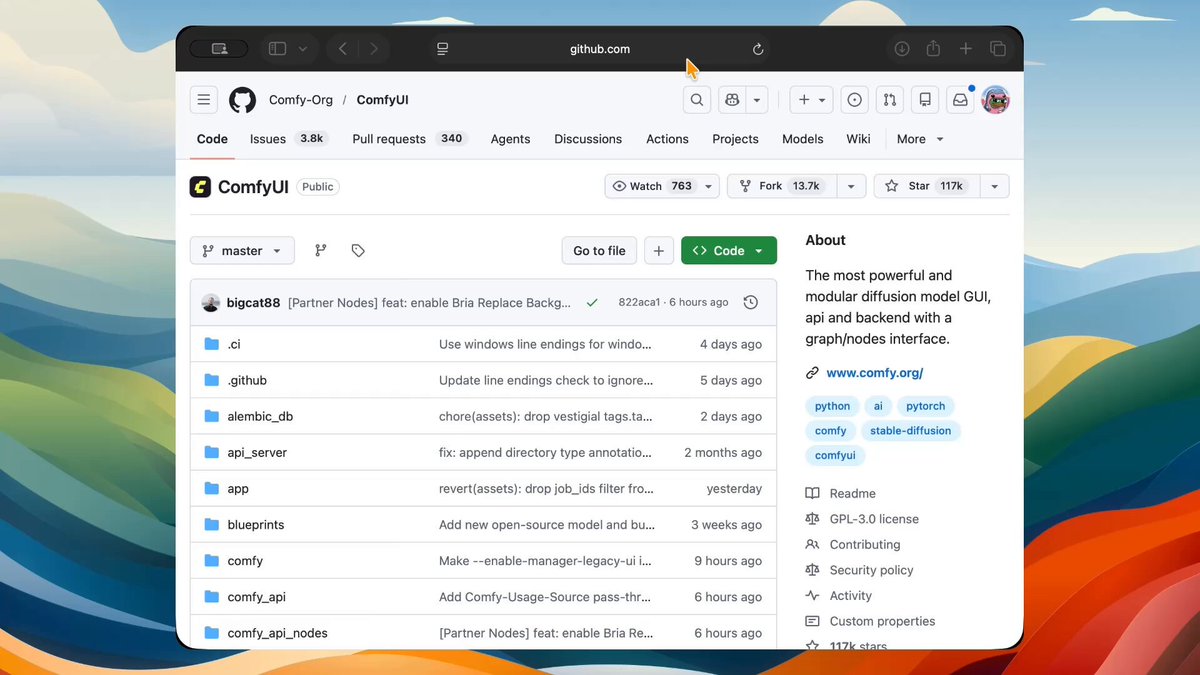
no money for grok or midjourney? this tool is for you. there's a FREE tool created by an anon dev. open-source. runs locally. 117k stars on github. it generates: > images & video > 3d models > audio > 20+ models here's how to set it up in under 5 minutes: 1️⃣download ComfyUI Desktop go to and grab the desktop app for your system. windows 10+, mac (apple silicon), or linux. it installs like any normal app, it sets up python and every dependency for you in the background. no terminal, no config files. 2️⃣open it first launch, it spins up its own environment automatically. you just wait a few seconds and you're in. you'll land on a node canvas, that's the whole interface. 3️⃣load a starter workflow top menu → Workflow → Browse Templates → Image Generation. click it. this drops a ready-made setup onto your canvas so you don't build anything from scratch. 4️⃣grab a model comfyui ships empty on purpose, the model is the brain, and you pick it. in the template, the "Load Checkpoint" node has a Download button when no model is installed. click it. it pulls one in for you (a few GB, this is the only real wait). 5️⃣install ComfyUI Manager this is the one add-on you don't skip. it lets you install models, custom nodes, and updates with a click instead of the command line. grab it from github (link in comments). it's the difference between fighting comfyui and flying in it. one honest note: an NVIDIA gpu makes this fast, apple silicon works great too, and a weak machine still runs it just slower. that's the whole setup. you now own an image, video, and 3D studio that costs you nothing per month. save this. and the next time grok or midjourney asks for your card. you won't need it. disclaimer: comfyui itself is 100% free. so are the local models (sdxl, flux, wan 2.2, ltx-2). some premium models like seedance are pay-per-use api models, only if you want top-tier quality. the free local ones cover most of what you need. (github link in the comments) follow and turn on post notification for daily AI contents.

m0h

14,542 次观看 • 3 个月前

When I was 8 years old, my favorite thing in the world was making mixtapes for my Walkman from my big sister’s CDs. That evolved into Lego stop-motion videos, and later, I fell down the rabbit hole of editing Naruto anime clips to Evanescence & Linkin Park beats. Looking back, it’s obvious: Sound and Video were always the main drivers in my life. I think that obsession also led me to my true love: Motion Design. A huge shoutout to Kevin who showed me +10 years ago the world of Motion Design. And honestly, look at where we are now. Who would have thought that there would be such a massive hype around Motion Design and UI promo videos? From giants like Airbnb to the new generation of creators like sutoxoriginals. The visual standard in 2026 is insane. But there was always one part of the process that felt like a grind to me: Sound Design. I love the result, but I hated the process. I was spending 4-5 hours per project just searching for the right sound effects. "Key typing effect" "Mouse click" "Subtle Whoosh" and so on.. So, I decided to fix it. I sat down with a Dev friend and we spent the last few weekends building a native AI tool right inside After Effects. The concept is simple: SoundDesigner AI watches your video. It understands the vibe and exactly what’s happening and when its happening. It sees a clock ticking or a text appearing, and it generates the perfect sound for it in seconds, synced to the action in your timeline. I’ve been using it on my own projects for a few days now, and it’s wild. My sound design workflow went actually from 5 hours to 20 minutes. We are launching this in February (fingers crossed for the approval at aescripts+aeplugins) If you want to see where this goes and try it out yourself, drop me a DM

Markus Gavrilov

20,299 次观看 • 7 个月前

𝗜𝗻𝘁𝗿𝗼𝗱𝘂𝗰𝗶𝗻𝗴 𝗜𝗻𝘁𝗲𝗻𝘁𝗣𝗮𝘆, 𝗪𝗵𝗲𝗿𝗲 𝗣𝗹𝗮𝗶𝗻 𝘄𝗼𝗿𝗱𝘀 𝗕𝗲𝗰𝗼𝗺𝗲𝘀 𝗧𝗿𝘂𝘀𝘁𝗹𝗲𝘀𝘀 𝗣𝗮𝘆𝗺𝗲𝗻𝘁. We built IntentPay for the AI Awakening Hackathon on DoraHacks, powered by Mantle and it’s solving one of the oldest frustrations in the digital economy: 𝙥𝙖𝙮𝙞𝙣𝙜 𝙨𝙤𝙢𝙚𝙤𝙣𝙚 𝙮𝙤𝙪 𝙙𝙤𝙣’𝙩 𝙛𝙪𝙡𝙡𝙮 𝙩𝙧𝙪𝙨𝙩 𝙩𝙤 𝙙𝙤 𝙬𝙤𝙧𝙠 𝙮𝙤𝙪 𝙘𝙖𝙣’𝙩 𝙫𝙚𝙧𝙞𝙛𝙮 𝙪𝙣𝙩𝙞𝙡 𝙞𝙩’𝙨 𝙙𝙤𝙣𝙚. ➬ 𝗧𝗵𝗲 𝗣𝗿𝗼𝗯𝗹𝗲𝗺 𝗡𝗼𝗯𝗼𝗱𝘆’𝘀 𝗙𝗶𝘅𝗲𝗱 Freelancers have built the backbone of the digital economy, yet the payment infrastructure underneath them still runs on handshakes and hope. A client pays upfront and a freelancer ghosts. A freelancer delivers great work and the client disputes to avoid paying. Traditional escrow exists but it’s expensive, slow, and designed for real estate, not a $200 logo job. Smart contracts were supposed to fix this. Technically, they did, but you need to write code to use them. Solidity isn’t something a graphic designer wants to learn just to get paid safely. The technology that should democratize trust stayed locked behind a developer wall. IntentPay tears that wall down. ➬ 𝗪𝗵𝗮𝘁 𝗜𝘁 𝗗𝗼𝗲𝘀 IntentPay is an AI-powered escrow layer built on Mantle. You describe a deal in plain English; “Pay Sarah 400 USDC once the design mockups are approved” and the AI parses your intent, extracts the recipient, amount, token, and release condition, then locks funds on-chain. When the condition is met, payment releases. If the deadline passes without delivery, funds auto-refund. No lawyers, no middlemen, no Solidity. The AI layer does real work here: a structured system prompt instructs the model to extract exactly what it needs and return clean JSON that drives the on-chain transaction. The user reviews the parsed deal before anything is signed, keeping the human in the loop while offloading all the technical complexity. ➬ 𝗧𝗵𝗲 𝗘𝘅𝗽𝗲𝗿𝗶𝗲𝗻𝗰𝗲 The dashboard tracks active escrows with live status indicators, a payment flow timeline, and an AI insight bar that surfaces contextual alerts, approaching deadlines, auto-refund triggers, network comparisons. When payment releases, the app generates a cryptographically-stamped receipt with the transaction hash, condition text, and timestamp. A verifiable record neither party can dispute. ➬ 𝗪𝗵𝘆 𝗠𝗮𝗻𝘁𝗹𝗲 Low gas fees matter when transactions are small, a $50 design job shouldn’t cost $15 to escrow. Mantle’s EVM compatibility means the contract layer integrates cleanly, and its Testnet gave us a solid sandbox to validate the full payment flow. This is exactly the everyday DeFi use case Mantle’s infrastructure is built for. ➬ 𝗧𝗵𝗲 𝗖𝗼𝗿𝗲 𝗜𝗻𝘀𝗶𝗴𝗵𝘁 Most AI x Web3 projects slap a chatbot on top of a wallet. IntentPay does something more interesting: the AI is the interface to the contract. It’s the bridge between human language and trustless code, and that’s what makes this more than a demo. 🔗 Live Demo: 💻 GitHub: Built for the AI Awakening Hackathon | Powered by Mantle | Submitted via DoraHacks

Ama

20,660 次观看 • 3 个月前

10 free Google AI tools nobody talks about. while everyone's burning $20/mo on chatgpt and claude, google quietly shipped a stack worth $200+/mo. all free. all yours. — 1️⃣ NotebookLM — your second brain upload sources (PDFs, websites, audio, YouTube). it summarizes, builds mind maps, generates quizzes, drafts slide decks, even turns your notes into a podcast you can listen to on a walk. free tier: 100 notebooks, 50 sources each, 50 chats/day, 3 audio overviews/day. replaces: notion AI + perplexity + readwise — 2️⃣ Google AI Studio — the free gemini playground web playground for gemini 3 pro and flash with a free API key. generous limits. paste a 1M-token context window and watch it actually use it. faster than the openai playground and free where openai charges per token. replaces: openai playground + paid API credits — 3️⃣ Gemini CLI — google's open-source terminal agent apache 2.0 licensed. one command (npx @google/gemini-cli) and you've got an agent in your terminal that reads your codebase, runs shell commands, and ships PRs. drop-in claude code alternative. replaces: claude code ($20/mo by default) — 4️⃣ Jules — async coding agent assign jules a github issue. it spins up a cloud VM, clones your repo, writes the plan, makes the changes, opens a PR. free tier: 15 tasks/day, 3 concurrent, runs on gemini flash. replaces: devin ($20/mo+) + cursor agent 5️⃣ Stitch — text → UI → code google's free figma killer. describe an interface, get production-ready HTML/CSS/Tailwind + figma export. march 2026 update added voice canvas, infinite canvas, and MCP integration with cursor. 350 standard + 200 experimental generations/month free. replaces: galileo AI + early-stage figma work — 6️⃣ Gemma 4 — open-weight LLM google's flagship open model. apache 2.0. 2B, 4B, 26B-MoE, and 31B variants. 256K context. runs on ollama with one command. quantized versions run on a 4090 or beefy laptop. replaces: paying for hosted LLM inference — 7️⃣ Illuminate — papers → podcasts paste an arxiv preprint link. illuminate turns dense research papers into a 6-8 min conversation between two AI hosts breaking it down. perfect for commute reading you can't do at a desk. note: still in waitlist for some regions. replaces: snipd + manual research reading — 8️⃣ Learn About (LearnLM) — adaptive AI tutor drop in any topic you're stuck on. highlight a word, click "go deeper," and the interface adapts in real time to your comprehension level. visual explanations, follow-up questions, the works. replaces: paid tutoring on niche topics — 9️⃣ Google Labs FX (ImageFX + Flow + MusicFX) — free imagen, veo, musicLM google labs creative suite. text-to-image (imagen 4), text-to-video (veo via Flow), text-to-music (musicLM). free tier: limited daily generations. the heavy veo 3.1 features are paid (AI Pro $19.99/mo). still worth using for image and music — those stay free. replaces: midjourney + suno (free tier only — runway-level video gen is paid) — 🔟 Google Colab — free GPU notebooks free T4 GPU + 12GB RAM in a browser tab. enough to fine-tune small models, run stable diffusion, prototype agents. the launching pad for half the ML projects on github. replaces: paid cloud GPU rentals — a quick honest note: these tools aren't 1:1 better than the paid versions they replace. but they're decent enough to get most things done — especially if you're not a heavy user or you've got little funds to play with. i've put all 10 in a public github repo (link in comments). follow + turn on post notifications for more useful posts like this 🔔

m0h

12,061 次观看 • 3 个月前

Matthew Gallagher Built a $401M Company in Year One with 2 People. And the tool behind it? Claude Code. This year he's on track for $1.8B. Sam Altman predicted this. It's happening now. The problem? It costs money. API credits stack up. Monthly bills keep growing. Every prompt eats your budget. Every project drains your wallet faster. Until now. Two methods. 99% cheaper. One is completely free. Forever. $0. Not a trial. This video breaks down both step by step. ↓ Let me put this in perspective. $100-$500. That's monthly. That's what you spend. That's $6,000/year on API credits. Just to use a tool you haven't shipped anything with. The $401M guy? Spending $0. Same capability. Shipping weekly. Different cost structure. Different results. Different life. I'm about to hand you his cost structure for free. ↓ Open source vs closed source. Pay attention. Closed source: Claude. GPT-4. Pay per token. Meter always running. Open source: Qwen. Llama. Mistral. Free to download. Free to run. Free forever. No meter. No tokens. No bill. Here's what nobody tells you: 80% of coding tasks? Open source handles them. More than handles them. Writes clean code. Debugs errors. Generates boilerplate. Handles routine work perfectly. You're paying premium prices for tasks that don't need premium intelligence. That's hiring a brain surgeon to put on a bandaid. Smart play: Free models for the 80%. Paid credits for the 20%. That's what the $401M guy does. That's what this video teaches you. Follow Himanshu Kumar for more breakdowns that turn free tools into real businesses. ↓ Method 1: Ollama. Local. Free. Forever. Download it. Pull a model. Point Claude Code at it. Done. No internet needed. No API keys required. No monthly subscription. No token counting ever. No bill. Today. Tomorrow. Ever. Your data never leaves your computer. Complete privacy. Complete freedom. Claude Code thinks it's talking to the cloud. It's talking to your laptop. For $0. The video walks through every step: Every config file. Every variable. Every command. Every click. If you can follow a recipe, you can do this. People who set this up 3 months ago? Saved $300-$1,500 since then. Workflow didn't change one bit. ↓ Hardware you need: 16GB RAM: 7B models run smooth. 32GB RAM: 32B models run comfortable. 64GB + GPU: biggest models available. No GPU? Still works. Just slower. Few extra seconds. That's it. Your $1,500 laptop is sitting there running Chrome and Spotify. Put it to work saving you $200/month instead. Follow Himanshu Kumar for more breakdowns that turn free tools into real businesses. ↓ Method 2: Open Router. Free Cloud. No Hardware. Weak machine? Don't want local setup? This method is for you. Free AI models in the cloud. No download. No hardware. Configure Claude Code to route through Open Router. The config: Base URL: Open Router API. API key: free Open Router key. Default Sonnet: free. Default Opus: free. Default Haiku: free. Small fast model: free. Subagent model: free. Free. Free. Free. Free. Free across the board. Same interface. Same commands. Same workflow. Zero cost. Copy the config from the video. Paste it. Save $200/month. Starting today. Right now. ↓ When to use which: Ollama (local): Best for privacy. Best for offline work. Best for unlimited usage. Best if you have decent hardware. Open Router (cloud): Best for weak machines. Best for instant setup. Best for trying different models. Best if you don't want to manage anything. Both methods: Best for 80% of your daily work. Still use paid Claude for: Complex architecture. Multi-file refactoring. Deep reasoning tasks. The 20% that actually needs it. $20/month instead of $200/month. Same output. 90% less cost. ↓ The math that should make you angry. You (current): $200-$500/month. $2,400-$6,000/year. $7,200-$18,000 over 3 years. You (after this video): $20-$50/month. $240-$600/year. $720-$1,800 over 3 years. Savings over 3 years: $6,480-$16,200. That's a used car. That's seed money. That's 6 months of rent. All from one 25-minute video. All from 15 minutes of configuration. Highest ROI 25 minutes you'll spend this year. ↓ The limitations. I won't lie to you. Open source is not Opus. Not as smart on complex reasoning. Not as good at long-context tasks. Makes more mistakes on nuanced problems. But they are: Free. Capable. Getting better monthly. Good enough for 80% of daily work. Smart cost management isn't being cheap. It's being strategic. Expensive tool when it matters. Free tool when it doesn't. ↓ The one-person billion-dollar company is coming. $401M in year one proved it's possible. The building blocks: AI that codes: Claude Code. Way to run it free: this video. Distribution: the internet. Customers: everyone. Only missing ingredient? Someone who builds. Not reads about building. Not saves posts about building. Not bookmarks videos about building. Builds. Tools are free. Knowledge is free. Opportunity is screaming. You're still "thinking about it." ↓ Your action plan: Tonight: Watch the video. Tomorrow morning: Set up Ollama or Open Router. Tomorrow afternoon: Build something. Anything. This week: Build a second thing. Faster. This month: Charge someone for it. One video. One setup. One weekend. $0 cost. Unlimited potential. Or keep paying $200/month for something you could get free. Keep consuming instead of building. Keep planning instead of shipping. Matthew Gallagher didn't plan a $401M company. He built it. Full video attached. Every method. Every config. Every tradeoff. 25 minutes. Your move. Follow Himanshu Kumar for more breakdowns that turn free tools into real businesses.

Himanshu Kumar

13,677 次观看 • 5 个月前

Local AI 101: open models, Hugging Face, and businesses to build (38 min masterclass) I still think cloud AI is the default for most things, and honestly it should be, the frontier models are the strongest and easiest to use. But something shifted in the last 4-5 months. You can now run genuinely good open models directly on your own laptop, or even your phone. And once you actually try it, it changes how you think about what AI is even for. LOCAL AI, CLEARLY EXPLAINED: 1. The model is the brain doing the thinking. Gemma, Llama, Mistral, and Qwen are the main families, and each is better at different things, some at reasoning, some at coding, some small enough to run on a phone. 2. Hugging Face is the warehouse where you find them. You go there to see what each model is good at, check the license, and grab the compressed versions that run on a normal computer. 3. The software is what runs the model on your machine. Start with LM Studio if you're not technical, it feels like a normal app where you search, download, and start chatting. Ollama is the one you reach for when you want to plug a model into your own apps. 4. The workflow is the actual product you build on top of it all. That's what I'm ideating around for some businesses to create. I think local AI just made a specific kind of business way easier to start. Find an industry that: 1. Sits on sensitive data they'd never paste into ChatGPT 2. Does the same review over and over 3. Runs on software from 2003 Then build a local AI tool that does that review on their own machine, so the data never leaves the building! Take home health agencies. Nurses write visit notes all day, and if a note is missing a detail, the billing gets denied or the audit flags it. Here's how I'd start: 1. Find 5 small agencies. Offer to review a batch of their notes for them. 2. Run the notes through Gemma locally (free, private, no cloud). Read every output yourself. 3. Write down the 20 issues that keep showing up: missing vitals, vague med changes, notes that don't support the billed level. 4. That list of 20 is your checklist. The checklist is the product. 5. Turn it into a local desktop app that flags those 20 things before a note gets submitted. You just went from a service anyone could offer to a product nobody else has, and you learned exactly what to build by doing the work by hand first. Same recipe works for restoration contractors (draft the damage report on-site before the tech leaves) and wealth advisors (catch the compliance landmine in a client email before it sends). Basically the framework is sensitive data, repeated review, ancient software. I think there are tons of businesses like this! Almost none of it clicked for me until I actually started using local AI. So if you take one thing from this, go run a model on your own machine once. Also a fun thing to try with your friends. Feel free to send this to a friend. The episode is live for free on The Startup Ideas Podcast (SIP) 🧃 (thanks to Google for sponsoring today's episode and supporting local AI) I feel like local AI one of those things you need to try for it to really click. Run one model on your own machine and you'll see what I mean! I go way deeper in the full 38 minute masterclass, the models, the setup, and the businesses to build. Link below. LINK TO WATCH: OR WATCH BELOW ON X What do you think of local AI?

GREG ISENBERG

31,921 次观看 • 9 天前

DeepSeek-R1 shattered the assumption that performant AI models must be built closed source with loss-leading computational costs. This is the reality that Web3 x Crypto firms have been waiting for, leading me to believe that the most performant AI models in the future will be built on-chain. Resource Requirements DeepSeek R1 (671 billion parameters), which took over a billion dollars, 2,000 Nvidia H800 GPUs, and over 55 days, beat benchmarks held by OpenAI’s o1 mode (near 2 trillion parameters)l, which required hundreds of billions of dollars to develop along with over 16,000 advanced GPUs. The idea that AI models must be closed-source and have loss-leading computational costs to succeed is crumbling. The Existing Decentralized AI Narrative AI x Crypto projects believed that crowdsourced, public, decentralized AI would eventually create better models than their centralized counterparts. This had thus far not been true, as the highest-performing models had come from closed-source companies like OpenAI and Anthropic. Crypto x AI companies have adapted to this by specializing in infrastructure rather than model-building. For example, GPU marketplaces like , The Render Network, io.net, and Exabits have developed sustainable revenues. Companies that allow users to share their network bandwidth like touch grass and Gradient have found their niche in supplying services, like distributed web scraping, to web2 clients. Storage networks like Arweave Ecosystem, Filecoin, and Ocean Protocol have also done well by being the platform on which these projects are built. Supply networks have flourished because of their ability to tailor their cheaper and more scalable services to off-chain customers. Renewed Focus Now that GPU and financial resources are no longer limitations to creating quality AI models, web3 AI companies can focus on replicating DeepSeek’s effectiveness while offering new benefits like modality, user ownership, censorship resistance, privacy, and more. Pantera Capital has funded companies in this space like and Sentient that believe they can match or exceed the performance of traditional AI companies while offering additional services or benefits. , for example, is building a platform where anyone can monetize AI models, data sets, and applications in a collaborative space. Users can permissionlessly train models manually, provide training data, and create tailored AI models with no-code tools. They are only able to cater to all these stakeholders (AI developers, users, resource providers) because everything is tied to their native Sahara blockchain. We invested in them precisely for this reason. The Future of AI will be built with Web3 Infrastructure I believe that supply-side projects will continue to grow, while consumer-facing projects can begin competing with web2 competitors by taking advantage of their ability to build networks that invite community involvement. and Sentient, for example, have begun setting up systems for users to train models based on the users’ expertise. These platforms will allow users to pick and choose the data and integrations to whatever they are applying the model towards. Sahara already has over 780,000 users on their waitlist while Sentient has over 1 million interactions. In the near future, I believe that the most performant AI models will be built on-chain. For the full blog post, read my newsletter.

paul.nft

32,465 次观看 • 1 年前

Anthropic won't like this open-source repo. It is going to cost LLM providers a lot of money. Every CI run of an AI app today sends real requests to providers like OpenAI or Anthropic. Like any other LLM call, this too gets billed at actual API rates. So for teams with high commit volumes, this accumulates into a meaningful chunk of API spend. One common hack devs use is that instead of invoking the LLM API, the test calls a fake local server that speaks the same API and returns a dummy response. The catch is that the dummy response is a copy of what the provider returned on the day it was saved, and providers keep adding fields and changing types. So the tests keep passing against a schema that's no longer valid, while the real integration breaks in production. A smart approach is now actually implemented in CopilotKit🪁's recently open-sourced aimock project. Every day, the repo's own CI sends a handful of requests to the real API and the same requests to the fake server, then compares both against the official client library's type definitions. Those are the only real API calls in the whole setup, and they run on the repo's own keys, not in anyone else's CI. A single team can push hundreds of commits a day, and thousands of teams are already doing that with coding agents. All of those runs stay offline, because one repo checks against the real API on everyone's behalf. When a check fails, a coding agent updates aimock's built-in response schema, the full test suite has to pass, and a patch version ships to npm. By simply upgrading the package, the corrected schema gets reflected in every project using it. The capability is not just limited to a single provider. The same server works for Claude, OpenAI, Gemini, Bedrock, Azure, Ollama, plus MCP tools, A2A agents, AG-UI event streams, vector DBs like Pinecone and Qdrant, and search, speech, image, and video endpoints. Here's the repo: (don't forget to star it ⭐) That said, mocking your API calls is one thing. AI engineers should also know how to test agents properly in the first place, which several teams still skip. I wrote a full walkthrough on that, covering build, testing, evals, tracing, and deployment. Read it below.

Akshay 🚀

62,821 次观看 • 1 个月前

Microsoft just betrayed OpenAI and Anthropic, the two companies it helped build. And it could break the entire AI trade... Here's what happened: Inside Excel and Outlook, two of the most used business apps on Earth, Microsoft has started routing tens of thousands of AI requests every week to its own in-house models instead of OpenAI and Anthropic. Microsoft's own AI chief, Mustafa Suleyman, said himself: "We pay a lot of money to Anthropic, so our goal is to reduce and ultimately ELIMINATE that cost." This is the company that poured $13 billion into OpenAI and effectively created the modern AI industry, and it just decided the most advanced models on the market are NOT worth paying for. And here's the thing... Microsoft is not just ripping out OpenAI everywhere - it is being surgical about it. The hardest and rarest tasks can still go to OpenAI or Anthropic. What Microsoft is taking back is the boring, high-volume work, like the email replies, the thread summaries, and the simple spreadsheet formulas. Why does that matter so much? Because that boring, repetitive work is where the actual money lives. The frontier labs assumed businesses would push BILLIONS of these tiny requests through expensive models forever. That endless river of tokens is the entire reason OpenAI and Anthropic are valued in the hundreds of billions of dollars. Microsoft looked at that river, decided it was massively overpaying, and rerouted it to models it owns outright. So the single biggest customer in the industry just walked off with the most profitable part of the business. And it is not only Microsoft: That same week, CNBC reported that American companies have been escaping to Chinese AI models to dodge rising US prices. Chinese models now handle more than 30% of US companies' AI usage on one major platform, peaking at 46%, up from an average of 11% a year earlier. They cost 60 to 90% less, and on some benchmarks they land within a single point of the best American model. One US startup moved ALL of its AI traffic off Claude and onto China's DeepSeek, and expects to save millions. Meanwhile Meta just admitted it has "excess" AI compute it wants to sell, becoming the first giant to concede it built far too much. Do you see the pattern forming? For two years, the entire AI story rested on one assumption: Every company on Earth would happily pay premium prices for the best model, forever. That assumption literally died in a single week. And the market noticed. More than a trillion dollars has been wiped off AI and chip stocks in a matter of days, as Wall Street finally started asking whether all of this spending will ever pay for itself. What this means for OpenAI and Anthropic: Their models are extraordinary, and it may not matter because their own biggest customers have decided they do not NEED the best model in the world to answer an email, and "good enough" now costs a fraction of the price. When even Microsoft refuses to pay full price for AI, the real question becomes who exactly IS left to pay it. What do you think?

Ricardo

93,586 次观看 • 2 个月前

AI is the first technology in history where more customers makes you POORER. Every tech company in history got cheaper as it scaled. More users meant lower costs per user. That's the entire model. That's why Microsoft prints money. That's why Google prints money. That's why Meta prints money. Software has near-zero marginal cost. Build it once. Sell it a billion times. The 100 millionth user costs basically nothing to serve. This is the single most important rule in tech economics. But AI completely broke it. Every single query costs real compute. Every interaction burns real electricity. Every response depreciates real hardware. There is no "build once, sell forever." There is only "burn money every time someone asks a question." And the numbers prove it: OpenAI hit $20 billion in annualized revenue. Losses? $14 billion. For every dollar they earn, they spend $1.69 delivering it. Their losses TRIPLED as their revenue grew. Not because they're bad at business, but simply because the model itself is broken. Anthropic crossed $30 billion in annualized revenue. Still burning billions. Still not profitable. Still raising tens of billions just to keep the lights on. xAI is burning $1 billion every single month. Perplexity spent 164% of its revenue on compute costs from AWS, They literally spent more on running the AI than they made from selling it. This is not how technology is supposed to work. Google once estimated that adding AI to every search query would require 500,000 A100 servers. The cost of answering a single AI query is 10x MORE than a traditional search result. Traditional software: Serving 1 million users costs roughly the same as serving 100,000. The marginal cost is basically zero. AI: Serving 1 million users can cost 10 times what 100,000 costs. Every new user is a new expense. Every new query is a new dollar burned. This is reverse economics. The more successful you become, the faster you die. And nobody in the industry wants to talk about it because the entire narrative depends on you believing AI companies work like software companies. But they don't. They NEVER will. Software scales to infinity. AI scales to bankruptcy. HSBC ran the numbers on OpenAI specifically. Their conclusion: Even after every funding round, every investment, every deal, OpenAI still faces a $207 BILLION shortfall to reach profitability. The industry response has been to raise prices. ChatGPT went from free to $20 to $200 for the Pro plan. And it's still not enough because the cost of running these models grows FASTER than any price increase consumers will accept. Meanwhile 966 AI startups died in 2024. A 25.6% jump from the year before. AI startups burn cash twice as fast as non-AI tech companies. And the ones building on TOP of OpenAI and Anthropic are in even worse shape. Every wrapper app. Every "AI-powered" SaaS tool. Every startup whose entire product is someone else's model with a different skin on it. They're all margin-negative. Every single one. And these are the companies about to IPO. SpaceX, OpenAI, Anthropic, and Cerebras. $240 billion in combined raises planned for 2026. They're asking you to invest in an industry where the fundamental unit economics don't work. Where the MORE customers you get, the MORE money you lose. Where no company has figured out how to make the math positive. The dot-com bubble had the same pitch: "Revenue is growing. Profitability comes later." For most of them, later never came. The question isn't whether AI will change the world. It will. The question is whether it can do it without going broke first. And right now, every single number literally says no. How can they become profitable?

Ricardo

167,710 次观看 • 5 个月前

This Chinese guy created agents in Claude Code for MCP servers and single-handedly serves 6 marketing agencies a month from one iPhone, earning $5,000 from each. Inside he runs a pipeline of 7 agents on Claude Sonnet 4.6 that every Monday pulls a scan of the tech stack from a selected agency, develops an MCP server for its ad accounts, and over the course of a week brings it to production code ready to connect to Claude Desktop. No DevOps, no senior developer, no project manager. Just a Mac Mini in a work corner, an iPhone in the pocket, and a single API key. And traditional dev shops keep 5 people on project rates for the same contract, while his entire P&L is tokens, dirt-cheap hosting on Cloudflare, and Calendly. 7 agents run under a shared orchestrator-router and burn about 5 million tokens a day, which in the API bill comes out to $540 a month. The Mac Mini itself sits at home and keeps the entire orchestrator running 24/7, and from the iPhone the owner connects to it through a secure remote terminal and sees the output of any session right on the smartphone screen, wherever he happens to be. His starting system prompt looks like this: "you run a solo shop for custom MCP servers for marketing agencies. you hand out read-only tasks to 6 sub-agents and own all commits and shipping yourself. sub-agents: // Hunter (finds marketing agencies of 15 to 60 people that have no MCP access to Google Ads, Meta Ads, TikTok Ads, and HubSpot) // Mapper (pulls their tech stack, identifies 3 to 5 integration pains, and simultaneously writes the technical spec for the server: which tools, resources, and prompts to export through MCP, which auth flow and rate limit) // Coder (generates an MCP server in Python through the MCP SDK, deploys 8 to 15 tools for ad accounts and CRM) // Validator (connects the server to Claude Desktop, runs real client API keys in a sandbox, and checks for compliance with the MCP spec) // Shipper (writes a README, integration guide, deployment manual, packages the server, and hosts it on Cloudflare Workers or pushes to the GitHub of the client) // Mobile (always online on the iPhone, books demo calls in Calendly, picks up hot fixes, and confirms contracts through a secure remote terminal to the Mac Mini). only 1 owner agent works on 1 contract, no overlaps. you pull the owner out of observation mode only when a deal goes above $7,500 or the test coverage of the server drops below 85%." This prompt gives the system an understanding of its role and the limits of intervention from the very first line. It knows it is supposed to find agencies on its own. It knows it is supposed to bring every MCP server to production on its own. It knows it connects the live owner only on large deals or when the tests do not converge. → The pipeline runs without breaks, day or night → Hunter goes through about 130 marketing agencies on LinkedIn and Clutch per day → Mapper rolls out 4 audit reports with the tech stack and a final spec for each → Coder writes 1 to 2 MCP servers per week in Python with 8 to 15 tools → Validator validates every server through Claude Desktop with real client API keys → Shipper rolls out the full documentation package and pushes the finished product to Cloudflare Workers or the GitHub of the client And only when a contract breaks $7,500 or test coverage drops below 85% does the orchestrator pull the owner from whatever he is doing. And when the owner at that moment is behind the wheel or at a meeting in a coworking space, the Mobile agent in his iPhone picks up 1 contract in progress: confirms a meeting with the agency CMO in Calendly, opens a live demo of the MCP server through a secure terminal to the Mac Mini, and writes the test result to the shared state. The owner just swipes "approve" and in 15 minutes joins the Zoom demo. The fresh system log from last Wednesday looks like this: "hunter report: 132 agencies checked on LinkedIn and Clutch, 19 without MCP integrations, 8 with active requests for AI tooling in job posts, 4 with an open Q4 budget. passing to mapper." "coder: MCP server for Northwave Performance Marketing built in Python, 11 tools for Google Ads, Meta Ads, and GA4, 320 lines of code. exported to /Users/dev/mcp-shop/clients/northwave/server.py. validator connecting to Claude Desktop." "validator: 11 tools passed validation through Claude Desktop, test coverage 92%, average latency 380 ms. passing to shipper." "eval flag: contract with Pacific Reach Agency at $8,200 exceeds the approved limit of $7,500. sending for manual review." In his work setup there is no cloud server, no external team, and not even a separate office. At home sits a Mac Mini with a sandbox at /Users/dev/mcp-shop, on top runs an MCP router with a single API key to Claude, and the same key is forwarded to a secure terminal on the iPhone. Out of everything I have seen this year, this is the cleanest solo shop for custom MCP servers for marketing agencies: $540 a month on the API, about $30,000 into the account, and between them 7 system prompts, 1 Mac Mini in a work corner, and 1 iPhone that never leaves the pocket.

Blaze

55,926 次观看 • 4 个月前