Загрузка видео...

Не удалось загрузить видео

На главную

From Myths to the Multiverse: How Knowledge Evolves I'm very excited to bring you Bret Weinstein and Brett Hall (Brett Hall) as we dive deep into the relationship between evolution and epistemology. We discuss how evolution relates to problem-solving, the power of metaphorical truths, what can help us turn...

66,109 просмотров • 1 год назад •via X (Twitter)

Комментарии: 3

Фото профиля Cordial Curiosity
Cordial Curiosity1 год назад

@ToKTeacher YouTube version:

Фото профиля benferrum - e/jounce
benferrum - e/jounce1 год назад

@BretWeinstein @ToKTeacher Do you guys planning to release this on some audio only podcast feed? It's quite hard to watch a yt video when one is walking/ flying

Фото профиля Brett Hall
Brett Hall1 год назад

@BretWeinstein Shoutout to @maria__violaris who I invoke in the last couple of minutes there: a one stop channel at for those lingering doubts about the multiverse 😉

Похожие видео

"Aging is the process of a complex system slowly falling into its chaotic disequilibrium. And it's not like evolution necessarily even set a lifespan for us. It is merely the result of, once the system has been established, how long its intrinsic property stayed ordered before it became disordered." I’m excited to share my conversation with Jacob Kimmel of NewLimit. Every species who has ever lived has one shared certainty: we’ll age, decay, and die. Jacob and his team are among the small group of people on earth with the expertise and funding to work on this problem. We talked about why we age, whether cellular aging can actually be reversed, how evolution shaped our lifespan and our peaks, and how AI is fundamentally changing the next era of science. Recorded at New Limit’s HQ in South San Francisco. Timestamps: 00:00 Intro 01:25 Why Evolution Limits Lifespan 03:13 Evolution Tradeoffs Explained 07:44 Why Women Live Longer 10:15 Lessons from Long Lived Species 16:20 Peak Intelligence 23:26 What is Aging? 27:59 Yamanaka Factors 32:18 New Limit 33:56 AI's Role in Progress 37:28 Organ by Organ Longevity 40:28 Is Immortality Possible? 42:04 Lifespan Progress 45:44 How to Test Longevity Drugs 49:30 Placebo Mind Body Link 53:56 What longevity hacks actually work? 57:25 Peptides And Stem Cells 01:00:34 Gene Editing 01:05:10 Personalized Medicine 01:08:48 Philosophical Dilemmas of Longer Lifespans 01:14:57 Living Off Earth 01:16:55 AI And Bio Risks

Sabrina Halper

20,154 просмотров • 26 дней назад

New episode with Dr. Konrad Kording (Kording Lab 🦖), professor of bioengineering and neuroscience at the University of Pennsylvania (Penn) and co-director of CIFAR's Learning in Machines & Brains program (CIFAR). Konrad works at the intersection of causality, machine learning, and neuroscience, building rigorous methods for causal reasoning when experiments aren't possible — and challenging how researchers interpret neural data and build AI. Konrad argues the most promising path to understanding how the brain works is to read the brain’s wiring directly, down to the molecular detail of each connection, and to build compilers and simulations to understand the brain’s computation directly. In this episode we go deep into how neurons work, how neurons wire together, and how organic and artificial neural networks differ. We discuss why organic neurons are doing much more; how a model of a single organic neuron can solve MNIST — computing more like a 3-layer artificial neural network; how the brain might learn by solving credit assignment with only local signals; how to approximate backprop without a global algorithm; why AI and humans are intelligent along different dimensions; why Konrad isn’t very worried about AI replacing us; economic models of intelligence and physical work; and much more. Konrad is a brilliant, contrarian thinker who explains complex concepts very intuitively. It is a solid computational neuroscience primer. I hope you enjoy this conversation as much as I did! Other links to this episode and references below. Chapters 00:00:00 Introduction 00:01:01 How organic neurons work 00:24:13 How the brain learns: circuits and credit assignment 00:45:29 Recording the brain 00:52:47 Why simulating brains is hard 01:05:00 A new approach: connectomes and compilers 01:21:00 Why simulate brains? 01:29:50 How AI and human intelligence differ 01:41:04 Evolution, intelligence and AI risk 01:52:42 Robotics, causality, and the roots of intelligence 02:05:53 AI for science and scientific rigor 02:13:05 The economics of intelligence 02:27:50 A hopeful future

Juan Benet

49,297 просмотров • 1 месяц назад

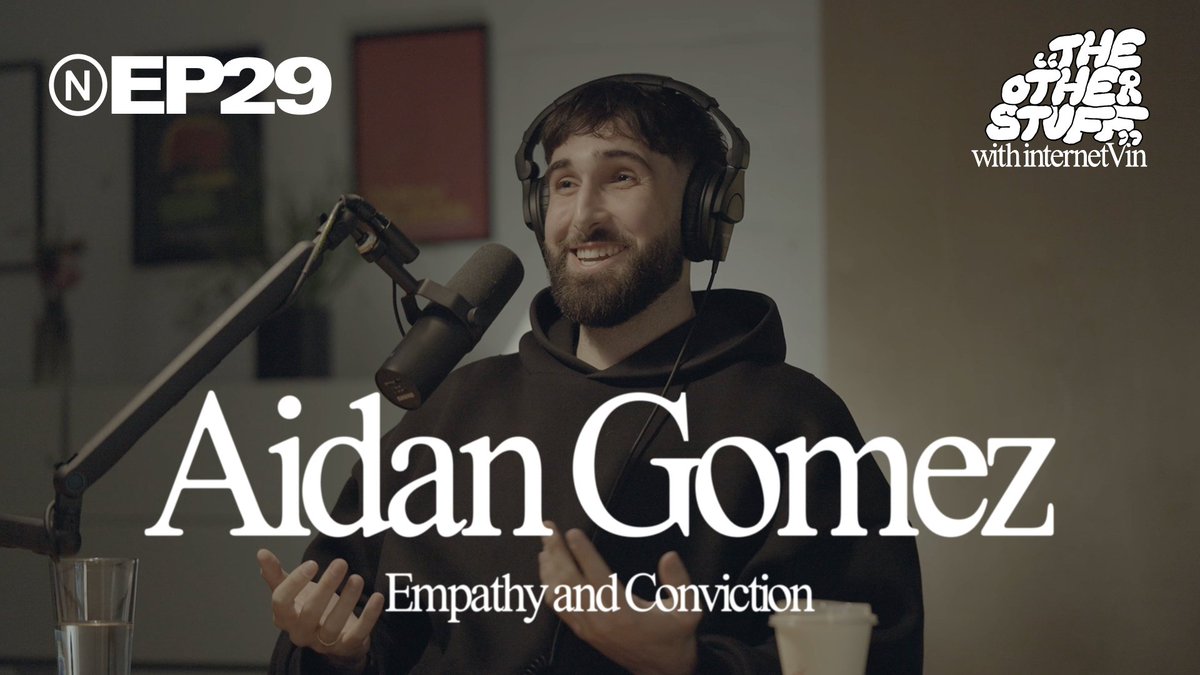
Aidan Gomez (Aidan Gomez) is a computer scientist, co-author of the seminal paper ‘Attention Is All You Need,’ and the CEO of Cohere. In this episode, we discussed his upbringing in the cabin his grandfather built in Codrington, a small town North of Brighton, and the values that were instilled in him through his family. We explored his path from Codrington to his undergraduate studies at the University of Toronto, emailing Geoffrey Hinton, and joining Google Brain where he co-wrote the paper on transformers. We discussed how he met his co-founders Ivan Zhang and Nick Frosst, and his insights on what it means to build a meaningful, successful company in Canada. Aidan shares his conviction about what is at stake — for Canada and for the world at large. This is a conversation about family, values, and what it means to live with conviction. The Other Stuff is hosted by internetVin — filmmaker, entrepreneur, and possibly the most curious man on Earth. Produced by New. The Other Stuff #29 — Aidan Gomez: Empathy and Conviction — Timestamps 00:00:00 Intro 00:03:10 The Malleability of Toronto 00:11:06 Growing Up in Codrington 00:13:50 The Story of Aidan Gomez’s Family 00:27:23 Introduction to the Internet 00:30:39 Values and Work Ethic 00:35:46 University of Toronto’s AI Scene 00:40:48 Emailing Geoffrey Hinton 00:42:16 Google Brain 00:45:15 Dropout: A Simple Way to Prevent Neural Networks from Overfitting 00:49:48 The Beauty of Research 00:54:24 One Model to Rule Them All 00:59:54 Meeting Ivan Zhang and Nick Frosst 01:04:00 The Birth of Cohere 01:06:56 Twitter Influencers and Alex Friedland 01:11:48 Being the CEO 01:12:51 Building for Canada 01:15:01 Three Fundamental Ingredients of Building a Company 01:21:39 Working with the Canadian Government 01:24:39 Reflexivity in Canada 01:36:22 What Is Evil? 01:42:40 The Role of AI in the World

The Other Stuff Podcast

45,297 просмотров • 7 месяцев назад

.Naval: You have a beautiful definition of knowledge, which most people don’t even try to tackle, about how knowledge perpetuates itself in the environment. You gave some really good examples. One was around genes. Successful, highly adapted genes contain a lot of knowledge and can cause themselves to be replicated because they’re survivors. In the same way, knowledge itself is a survivor, in that if you transmit to me the knowledge of how to build a computer, it’s an incredibly useful thing. I’m going to build more and more computers and that knowledge will be passed on. Your underlying point that you repeated here was if you want to understand the physical universe you have to understand knowledge, because it is the thing that over time takes over and changes more and more the universe—more than almost anything else. You have to understand all the explanations behind it. You can’t just say “particle collisions” because that explains everything, so it explains nothing. It’s not a useful level to operate at. Therefore, the things that create knowledge are uniquely influential in the universe. And as far as we know, there are only two systems that create knowledge. There’s evolution and there are humans. But is there a difference even between these two forms of knowledge creation, between evolution and between humans? David Deutsch: Yes. I have argued that the human way of creating knowledge is the ultimate one, that there aren’t any more powerful ones than that. This is the argument against the supernatural. Assuming that there is a form of knowledge creation that’s more powerful than ours is equivalent to invoking the supernatural, which is therefore a bad explanation—as invoking the supernatural always is. The difference between biological evolution and human creative thought is that biological evolution is inherently limited in its range. That’s because biological evolution has no foresight. It can’t see a problem and conjecture a solution. Whenever biological evolution produces a solution to something, it’s always before natural selection has even begun. This is Charles Darwin’s insight. This is the difference between Charles Darwin’s theory of evolution and the other theories of evolution that had been around for a century or more before that, including Charles Darwin’s grandfather and Lamarck. The thing they didn’t get is that the creation of knowledge in evolution begins before. That means that biological evolution can’t reach places that are not reachable by successive improvements, each of which allows a viable organism to exist. Creationists say that biological evolution has, in fact, reached things that are not reachable by incremental steps, each of which is a viable organism. They’re factually mistaken. The thing which they have in mind is the idea of a creator who can imagine things that don’t exist and who can create an idea that is not the culmination of a whole load of viable things. A thinking being can create something that’s a culmination of a whole load of non-viable things. Explanatory creativity makes humans unique Out of all the billions and billions of species that have ever existed, none of them has ever made a campfire, even though many of them would’ve been helped by having the genetic capacity to make campfires. The reason it didn’t happen in the biosphere is that there is no such thing as making a partially functional campfire; whereas there is, for example, with making hot water. The bombardier beetles squirt boiling water at their enemies. You can easily see that just squirting cold water at your enemies is not totally unhelpful. Then making it a bit hotter and a bit hotter. Squirting boiling water no doubt required many adaptations to make sure the beetle didn’t boil itself while it was making this boiling water. That happened because there was a sequence of steps in between, all of which were useful. But with campfires, it’s very hard to see how that could happen. Humans have explanatory creativity. Once you have that, you can get to the moon. You can cause asteroids which are heading towards the earth to turn around and go away. Perhaps no other planet in the universe has that power, and it has it only because of the presence of explanatory creativity on it.

Deutsch Explains

186,329 просмотров • 1 год назад

A Physics That Could Finally Unify Reality (Part 2/2) - James Ellias, DemystifySci #385 A quiet tremor sounds beneath the floorboards of physics, the still-living heartbeat of the forgotten search for the hidden substance that carries every wave and whisper of the universe. We walk through the fog of equations and theories of fundamental physics with James Ellias of James Ellias, and ask if there is a material truth lies beneath the symbols, or if we have to be satisfied with the short-sighted vision of mathematics alone. 00:00 Go! 00:04:37 Central Equations in Physics 00:08:20 The Importance of a Medium in Physics 00:10:00 Empowerment Through Understanding Physics 00:12:36 Rationality and Truth in Society 00:16:31 Existence vs Consciousness 00:20:30 Discussion on Existence and Consciousness 00:24:25 Role of Imagination in Existence 00:28:10 Properties and Entities in Physics 00:30:15 The Nature of Aether and Physical Mediums 00:36:08 Clarity and Understanding in Physics 00:40:26 Discussion on Force and Aether 00:44:57 Relationship of Entities and Actions 00:49:30 Theoretical Framework for Aether 00:58:04 Exploration of Aether Theories 01:00:40 Importance of Conciseness in Communication 01:02:00 Understanding Physics Before Proposing Hypotheses 01:05:15 Reevaluation of Flawed Theories 01:09:35 The Evolution of Key Physics Concepts 01:15:19 Context-Specific Nature of Constants 01:19:43 Historical Context in Physics 01:21:36 The Nature of Electrons 01:25:53 J.J. Thomson’s Evolving Perspective 01:29:24 Upcoming Work and Philosophical Frameworks 01:32:11 Collaborations

Anastasia

13,618 просмотров • 8 месяцев назад

Self-Bitcoinization: A Philosophy of Bitcoin (WiM561) Noah Kaufman, MD joins Robert ₿reedlove to discuss the personality traits common among Bitcoiners, Bitcoin as a moral force for good, the intersection of human and monetary evolution, the impact of technology on self-actualization, the connection between the monetary and moral standard, the corruption of healthcare and money, the role of privacy in freedom, the end of the inflationary monetary system, and how Bitcoin aligns the incentives of the individual and the collective. 0:00 - WiM Episode Trailer 1:04 - Myers-Briggs Personality Type of Bitcoiners 7:28 - Bitcoin as a Moral Force for Good 16:13 - Human Evolution and Monetary Evolution 23:24 - Technology’s Effect on Purpose and Self-Actualization 28:34 - The Farm at Okefenokee 30:00 - iCoin Bitcoin Wallet 31:30 - Economic Progress and Maslow’s Hierarchy of Needs 39:25 - Broken Money and Moral Corruption of the Healthcare System 47:40 - Bitcoin as an Organism 53:54 - Privacy is an Aspect of Freedom 56:18 - Heart and Soil Supplements 57:18 - Helping Lightning Startups with In Wolf's Clothing 58:10 - Life Reversing the Flow of Entropy 1:10:30 - The Death of Money and Importance of Energy 1:25:21 - The Connection Between the Monetary Standard and the Moral Standard 1:30:52 - Mine Bitcoin with Blockware Solutions 1:32:15 - OnRamp Bitcoin Custody 1:34:11 - The Connection Between the Monetary Standard and the Moral Standard (contd) 1:46:11 - The Complexity of Applied Morality 1:56:38 - Shitcoins and Continued Bitcoin Education 2:01:41 - Mind Lab Pro Supplements 2:02:52 - Buy Bitcoin with Coinbits 2:04:02 - The Bridge Between the Fiat to Bitcoin Paradigms 2:38:20 - The End of an Inflationary Monetary System 2:42:20 - An Intellectual Gold Rush and New PhDs 2:47:09 - Managing the Ego for Learning 2:56:55 - Bitcoin as a Moral Imperative 3:00:58 - Bitcoin is More American than the Constitution 3:04:05 - Dealing with Toxic Maximalism 3:06:33 - Remedying Corruption in Medicine and Money 3:16:45 - Aligning the Incentives of the Individual and the Collective 3:25:30 - The Altcoin Market as a Bitcoin Testnet 3:30:56 - How to Connect with Noah

The "What is Money?" Show

78,472 просмотров • 1 год назад

Levin's new episode "Stewarding the Flame" is out just now :) The focus: At the dawn of AGI, how can we make sure that the intelligences we're conjuring will add to a FLOURISHING of the process-of-life, rather than a brute optimizer that squashes life? As we get closer to superintelligence few topics are more pressing, and few people are thinking as deeply about the nature of life and intelligence as Levin. Big takeaways: -- Humans and non-human life will have to change if it wants to persist, this happens at every scale of the living process -- There is a much wider state-space of minds that we don't understand, but we should have a better grip on how intelligence works / comes into being before we build an AGI we don't control (because it might not carry the self-creating flame of life, it might be a brute optimizer) -- Levin is overall optimistic that the process of evolution and expanding life (even in forms that we don't understand today as "life" in a bio sense) will most likely continue to bubble up and continue to flourish in forms beyond us (i.e. the process is robust, and we'd REALLY have to mess something up to knock that trajectory off course) Some of the most important parts of this episode: 00:13:17 - Why MUST you transform if you wish to persist? 00:18:50 - Where does the self-preserving, self-expanding impulse "come from" in life? 00:33:30 - What do we need to understand better in order to make AGI "go well" (not just for how it treats humans, but for its ability to expand flourishing intelligence into the future)? 00:48:33 - [A deep-dive into the Flame paradigm (the process-of-life), and the Torch paradigm (pretending homo sapiens sapiens can/should rule all possible futures in a static hominid form).] There's a TON more in here, but this is a start. I sincerely hope you enjoy this episode with Mike!

Daniel Faggella

13,823 просмотров • 1 месяц назад