Video wird geladen...

Video konnte nicht geladen werden

Zur Startseite

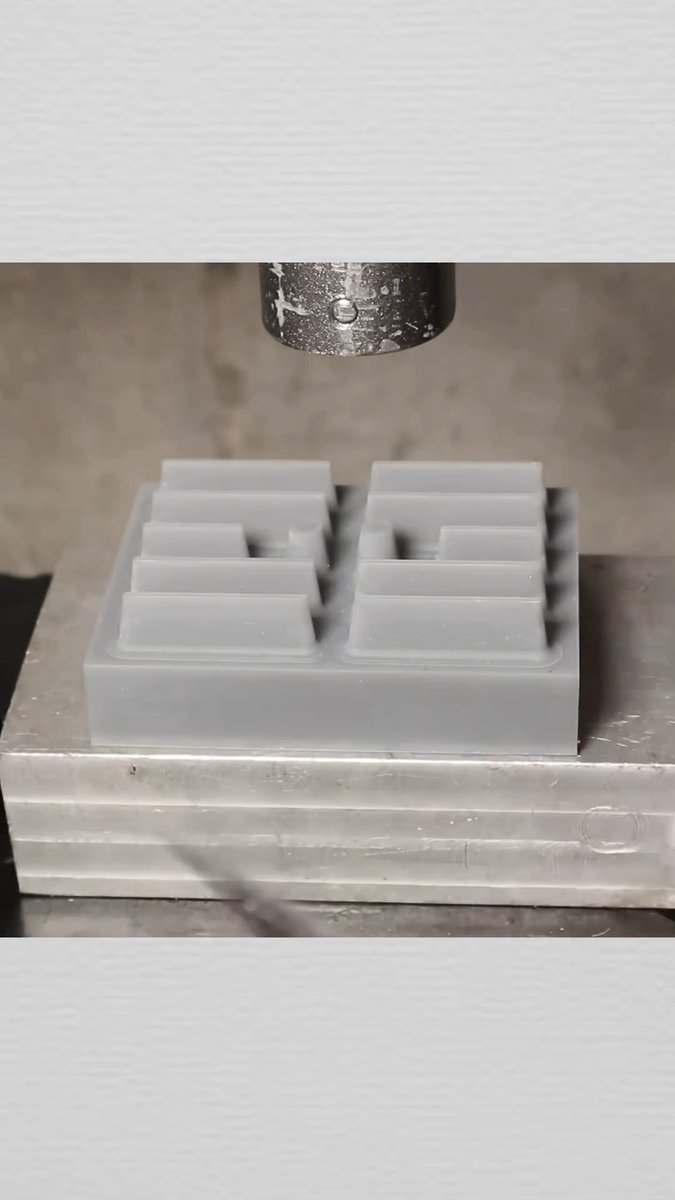
Fusion plugin + sheet metal + tapping + white powder coating = ta da

19,184 Aufrufe • vor 9 Monaten •via X (Twitter)

0 Kommentare

Keine Kommentare verfügbar

Kommentare vom Original-Post werden hier angezeigt

Ähnliche Videos

Shane Wighton, from the YouTube channel Stuff Made Here, used 3D-printed tooling to form a sheet metal component as part of a concept validation process. Metal manufacturing is essential for all areas of the economy. Because of their strength, stiffness, and long-term durability, metal components are used in applications from appliances to construction parts and car body panels. Traditional metal manufacturing techniques include forming, casting, molding, joining, and machining. Sheet metal forming involves various processes where force is applied to a piece of sheet metal to plastically deform the material into the desired shape, modifying its geometry rather than removing any material. Sheet metals can be bent or stretched into a variety of complex shapes, permitting the creation of complex structures with great strength and a minimum amount of material. Sheet metal forming is the most cost-effective forming procedure today for manufacturing parts in large quantities. It can be highly automated in factories or, at the other end of the spectrum, manually operated in metal workshops for small series parts. It is a versatile, consistent, and high-quality procedure to create accurate metal parts with limited material waste. From metal cans to protective housing for hardware, parts created by sheet metal forming are found everywhere in our daily lives. In this article, learn the basics of sheet metals, the various sheet metal forming processes, and how to reduce the cost of sheet metal forming with rapid tooling and 3D printed dies. For a detailed overview and the step-by-step method, watch our webinar or download our white paper: Research conducted by Shane Wighton. Check out the fantastic 15-minute video on his YouTube channel 'Stuff Made Here'! its top-notch engineering content.:

Formlabs

39,948 Aufrufe • vor 1 Jahr

Taming the Edge: How lithium could help us control #fusion plasmas. This video captures the first flashes of lithium being injected into the #plasma of our ST40 tokamak, marking the start of our exploration into its effects. Why lithium? In fusion research, we aim for H-mode, a high-performance state with improved plasma confinement. Future fusion power plants are expected to operate in this mode. But H-mode brings a challenge: ELMs (Edge Localised Modes) are bursts of energy at the plasma edge, similar to mini solar flares. These can reduce plasma temperature and damage the divertor with intense heat and particles. Pioneering work by PPPL and others has shown that lithium can suppress ELMs and increase energy confinement time, leading to higher temperatures. On ST40, we’re currently injecting lithium powder during plasma shots to explore its effects. As part of our upcoming ST40 LEAPS upgrade – in partnership with the U.S. Department of Energy and Department for Energy Security and Net Zero – we’ll go further, coating plasma-facing components with solid lithium using the ‘lithium evaporation’ technique. We’ll be experimentally testing several mechanisms. One key focus is how lithium absorbs hydrogen isotopes and reduces their recycling back into the plasma, lowering the density at the plasma edge, leading to a more stable edge pressure gradient. We’re starting to understand more about lithium’s effect on plasma performance, and early results show lithium isn't getting into the plasma core, which is good news for avoiding diluting the fusion fuel in future plants. The physics is complex, and we’re still learning. But each step brings us closer to fusion energy. By incorporating lithium into ST40, the world’s highest field spherical tokamak, we’re advancing our understanding of this critical enabling technology. #Fusion #FusionEnergy #Innovation #Limitless #EnergyTransition

Tokamak Energy

66,652 Aufrufe • vor 1 Jahr