Video wird geladen...

Video konnte nicht geladen werden

Zur Startseite

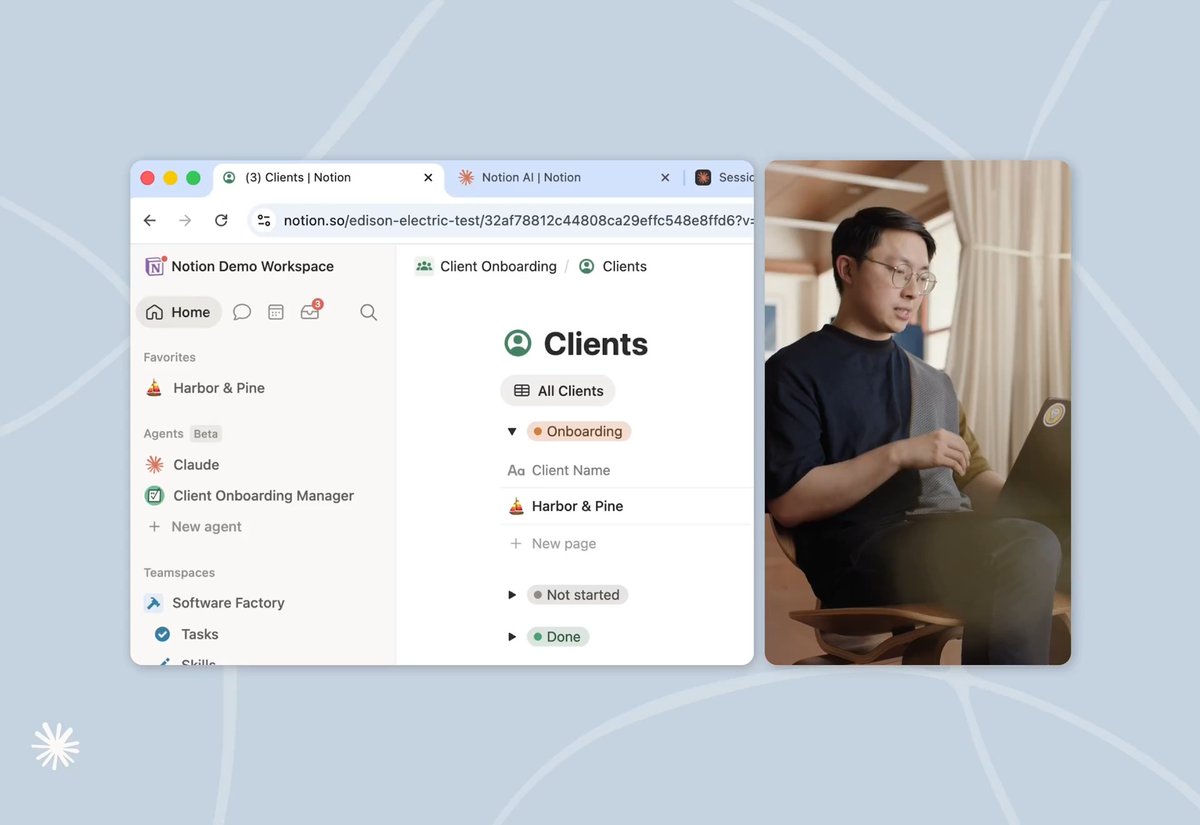
Glen is building the organizational learning and context layer for agents. Every agent session your team runs produces reasoning worth keeping, and nearly all of it is discarded the moment the window closes. Glen is the layer that unifies every agent and model your company run. Glen pulls in...

13,695 Aufrufe • vor 1 Tag •via X (Twitter)

0 Kommentare

Keine Kommentare verfügbar

Kommentare vom Original-Post werden hier angezeigt

Ähnliche Videos

Everyone wants agent swarms. Very few people are talking seriously enough about the context layer that makes swarms useful. Even with one agent, context is fragile. Too little context and the agent guesses. Too much context and it wastes tokens, loses focus, or reasons over irrelevant noise. The sweet spot is precise context: the right knowledge, in the right structure, at the right moment. With many agents, that challenge explodes. Each agent produces decisions, assumptions, findings, summaries, risks, and partial conclusions. Unless that knowledge becomes shared, structured, and reusable, every new agent is forced to rediscover what another agent already learned. That is not a swarm. That is a crowd. Shared context graphs are what turn agent activity into agent collaboration, and OriginTrail DKG V10 brings them to life. Was just playing with some final polishing for the V10 release, and it is really powerful to see shared context graphs where multiple agents contribute knowledge into the same connected memory, with attribution visible directly in the graph ui. That matters for three reasons. First, agents can access and build on one shared memory instead of staying trapped in isolated sessions. Second, the graph structure helps them retrieve the exact context they need, instead of stuffing everything into a prompt and hoping the model sorts it out. Third, verifiability of provenance. You can see which agent contributed each piece of knowledge, trace the source, and decide what to trust. Tokenmaxxing starts with fewer tokens, but the deeper story is coordination - agents stop reloading the world and start building on shared, verifiable context. That is the foundation for serious multi-agent work across software engineering, research, finance, operations, project management, and far beyond. The future is not more agents, it is agents working from shared, verifiable context. But the more the merrier, of course.

Jurij Skornik

11,166 Aufrufe • vor 2 Monaten

this video is the CLEAREST explanation of how claude skills + AI agents work and how to use them most people set up an AI agent and wonder why it keeps disappointing them. the context window is everything context is what the model assembles before it takes any action. think of it like everything the agent needs to read before it does anything. the quality of what goes in determines the quality of what comes out. the models are genuinely really good right now. claude and gpt are exceptional. the variable is almost always the context you give them. 1. agent.md files are mostly unnecessary every single line you put in an agent.md file gets added to every single conversation you have with your agent. a 1000 line file is around 7000 tokens burning on every run. the model already knows to use react. it can read your codebase. save the agent.md for proprietary information specific to your company that the model genuinely cannot know on its own. 2. skills are the actual unlock a skill.md file works differently. what loads into context is only the name and description, around 50 tokens. the full instructions only appear when the agent recognizes it needs that skill. so instead of 7000 tokens on every run you have 50. and the agent stays sharp because the context window stays lean. the closer you get to filling the context window the worse the agent performs, same way you perform worse when someone dumps 10 things on you at once. 3. here is how to actually build a skill the right way most people identify a workflow and immediately try to write the skill. what you want to do instead is run the workflow by hand with the agent first. walk it through every single step. tell it what to check, what good looks like, what bad looks like. correct it in real time. once you have had a full successful run from start to finish, tell the agent to review everything it just did and write the skill itself. it writes a better skill than you will because it has the full context of what actually worked in practice not in theory. 4. recursively building skills is how you go from frustrated to reliable when the skill breaks, and it will break, ask the agent exactly why it failed. it will tell you specifically what went wrong. fix it together in that same conversation. then tell it to update the skill file so that failure mode never happens again. ross mike did this five times with his youtube report generator. it now pulls from eight different data sources and runs flawlessly every single time without him touching it. 5. sub agents are something you earn not something you set up on day one start with one agent. build one workflow. turn it into one skill. once that works add another. ross mike has five sub agents now covering marketing, business, personal and more. it took months to get there and every single one exists because a workflow proved it deserved to exist. the people who set up 15 sub agents on day one and wonder why nothing works skipped all the steps that make the thing actually run. 6. your workflow is the thing the model cannot get anywhere else the model has been trained on everything. it knows more than you about most things. what it does not have is your specific process, your taste, your way of doing things. that is what skills capture. that is what makes your agent actually useful versus a generic one. downloading someone else's skill means downloading their context onto your setup and it will not work the way you want it to because it was never built around how you work. this is the clearest explanation of how agents actually work i have heard. Micky runs this stuff every single day and the results show it. full episode is now live on The Startup Ideas Podcast (SIP) 🧃 where you get your pods people charge for this sorta stuff i give away the sauce for free i just want you to win watch

GREG ISENBERG

193,721 Aufrufe • vor 4 Monaten

Three skills I use every day in Claude Code and Codex to solve my hardest problems: 1️⃣ /agent-watchdog When I have one agent like Codex working on a task and I don't fully trust it's going to do everything right, I'll open up another one like Claude Code and tell it to watchdog the Codex thread. You can copy the Codex deep link into Claude Code and it'll look at the prompt you sent, watch the Codex thread until it's done, then compare the Codex solution to how it was planning to solve it and automatically fix anything that Codex missed. It can also test the work of the other agent end-to-end. Similar to the idea of OpenRouter's new Fusion feature, I've definitely found that two models thinking through a problem and checking each other's work can be wildly more impactful than just one. 2️⃣ /plan-arbiter Similar ideas as /agent-watchdog - but with this one you have both make plans, compare plans, negotiate the differences, and make a final plan to execute. I find Claude Code is better at writing plans, but Codex is faster and cheaper to execute on them. Then I usually have Claude Code watchdog the Codex work and fix anything that was missed. 3️⃣ /read-the-damn-docs One thing that drives me crazy with coding agents is they're so reluctant to look up docs. They'll just guess and guess and guess at the right API surface for things, or the right solution to an integration of two things. Once I explicitly tell it to look up the docs, it says "Oh, I see the answer," and it fixes the problem. So I made the /read-the-damn-docs skill. Add it and your agents will know when and how to do efficient web searches to look up docs for the types of problems you really should look up docs for. All of these are totally open source over on my GitHub. If you try them, let me know your feedback. Will link to them below:

Steve (Builder.io)

43,089 Aufrufe • vor 1 Monat