正在加载视频...

视频加载失败

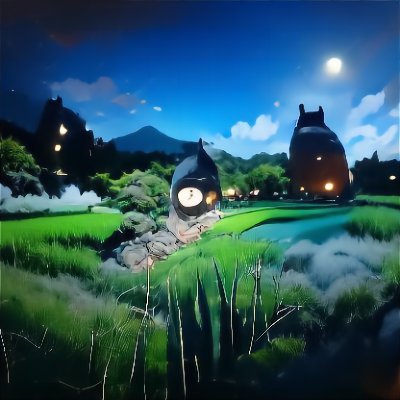
Google announces PALP Prompt Aligned Personalization of Text-to-Image Models paper page: Content creators often aim to create personalized images using personal subjects that go beyond the capabilities of conventional text-to-image models. Additionally, they may want the resulting image to encompass a specific location, style, ambiance, and more. Existing personalization...

90,199 次观看 • 2 年前 •via X (Twitter)

0 条评论

暂无评论

原始帖子的评论将显示在这里

相关视频

Multi-Track Timeline Control for Text-Driven 3D Human Motion Generation paper page: Recent advances in generative modeling have led to promising progress on synthesizing 3D human motion from text, with methods that can generate character animations from short prompts and specified durations. However, using a single text prompt as input lacks the fine-grained control needed by animators, such as composing multiple actions and defining precise durations for parts of the motion. To address this, we introduce the new problem of timeline control for text-driven motion synthesis, which provides an intuitive, yet fine-grained, input interface for users. Instead of a single prompt, users can specify a multi-track timeline of multiple prompts organized in temporal intervals that may overlap. This enables specifying the exact timings of each action and composing multiple actions in sequence or at overlapping intervals. To generate composite animations from a multi-track timeline, we propose a new test-time denoising method. This method can be integrated with any pre-trained motion diffusion model to synthesize realistic motions that accurately reflect the timeline. At every step of denoising, our method processes each timeline interval (text prompt) individually, subsequently aggregating the predictions with consideration for the specific body parts engaged in each action. Experimental comparisons and ablations validate that our method produces realistic motions that respect the semantics and timing of given text prompts.

AK

126,585 次观看 • 2 年前

Blended-NeRF: Zero-Shot Object Generation and Blending in Existing Neural Radiance Fields paper page: Editing a local region or a specific object in a 3D scene represented by a NeRF is challenging, mainly due to the implicit nature of the scene representation. Consistently blending a new realistic object into the scene adds an additional level of difficulty. We present Blended-NeRF, a robust and flexible framework for editing a specific region of interest in an existing NeRF scene, based on text prompts or image patches, along with a 3D ROI box. Our method leverages a pretrained language-image model to steer the synthesis towards a user-provided text prompt or image patch, along with a 3D MLP model initialized on an existing NeRF scene to generate the object and blend it into a specified region in the original scene. We allow local editing by localizing a 3D ROI box in the input scene, and seamlessly blend the content synthesized inside the ROI with the existing scene using a novel volumetric blending technique. To obtain natural looking and view-consistent results, we leverage existing and new geometric priors and 3D augmentations for improving the visual fidelity of the final result. We test our framework both qualitatively and quantitatively on a variety of real 3D scenes and text prompts, demonstrating realistic multi-view consistent results with much flexibility and diversity compared to the baselines. Finally, we show the applicability of our framework for several 3D editing applications, including adding new objects to a scene, removing/replacing/altering existing objects, and texture conversion.

AK

62,768 次观看 • 3 年前

🎥 Today we’re premiering Meta Movie Gen: the most advanced media foundation models to-date. Developed by AI research teams at Meta, Movie Gen delivers state-of-the-art results across a range of capabilities. We’re excited for the potential of this line of research to usher in entirely new possibilities for casual creators and creative professionals alike. More details and examples of what Movie Gen can do ➡️ 🛠️ Movie Gen models and capabilities Movie Gen Video: 30B parameter transformer model that can generate high-quality and high-definition images and videos from a single text prompt. Movie Gen Audio: A 13B parameter transformer model that can take a video input along with optional text prompts for controllability to generate high-fidelity audio synced to the video. It can generate ambient sound, instrumental background music and foley sound — delivering state-of-the-art results in audio quality, video-to-audio alignment and text-to-audio alignment. Precise video editing: Using a generated or existing video and accompanying text instructions as an input it can perform localized edits such as adding, removing or replacing elements — or global changes like background or style changes. Personalized videos: Using an image of a person and a text prompt, the model can generate a video with state-of-the-art results on character preservation and natural movement in video. We’re continuing to work closely with creative professionals from across the field to integrate their feedback as we work towards a potential release. We look forward to sharing more on this work and the creative possibilities it will enable in the future.

AI at Meta

2,264,759 次观看 • 1 年前

We've officially released and open-sourced HunyuanImage 2.1, our latest text-to-image model. The new model delivers on our commitment to balancing performance and quality. With native 2K image generation, HunyuanImage 2.1 is an advanced open-source text-to-image model.🎨 ✨ New in 2.1: 🔹Advanced Semantics: Supports ultra-long and complex prompts of up to 1000 tokens, and precisely controls the generation of multiple subjects in a single image. 🔹Precise Chinese and English Text Rendering with seamless image–text integration: The model naturally integrates text into images, making it suitable for a wide range of applications such as product covers, illustrations, and poster design to meet the needs of various fields. 🔹Rich Styles and High Aesthetic: Capable of generating images in various styles—including photorealistic portraits, comics, and vinyl figures—it delivers outstanding visual appeal and artistic quality. 🔹High-Quality Generation: Efficiently produces ultra-high-definition (2K) images in the same time other models take to generate a 1K image. HunyuanImage 2.1 uses two text encoders: a multimodal large language model (MLLM) to improve the model's image and text alignment capabilities, and a multi-language character-aware encoder to improve text rendering capabilities. The model is a single- and double-stream diffusion transformer with 17B parameters. We've also open-sourced the weights of the the accelerated version with meanflow which reduces inference steps from 100 to just 8, and PromptEnhancer, the first industrial-grade rewriting model that enhances your prompts for more nuanced and expressive image generation. Now, creators turn complex ideas—like posters with slogans or multi-panel comics—into visuals faster than ever. We’re just getting started. Stay tuned for our native multimodal image generation model coming soon. 🌐Website: 🔗Github: 🤗Hugging Face: ✨Hugging Face Demo:

Tencent Hy

89,257 次观看 • 10 个月前

InstantDrag Improving Interactivity in Drag-based Image Editing discuss: Drag-based image editing has recently gained popularity for its interactivity and precision. However, despite the ability of text-to-image models to generate samples within a second, drag editing still lags behind due to the challenge of accurately reflecting user interaction while maintaining image content. Some existing approaches rely on computationally intensive per-image optimization or intricate guidance-based methods, requiring additional inputs such as masks for movable regions and text prompts, thereby compromising the interactivity of the editing process. We introduce InstantDrag, an optimization-free pipeline that enhances interactivity and speed, requiring only an image and a drag instruction as input. InstantDrag consists of two carefully designed networks: a drag-conditioned optical flow generator (FlowGen) and an optical flow-conditioned diffusion model (FlowDiffusion). InstantDrag learns motion dynamics for drag-based image editing in real-world video datasets by decomposing the task into motion generation and motion-conditioned image generation. We demonstrate InstantDrag's capability to perform fast, photo-realistic edits without masks or text prompts through experiments on facial video datasets and general scenes. These results highlight the efficiency of our approach in handling drag-based image editing, making it a promising solution for interactive, real-time applications.

AK

71,232 次观看 • 1 年前

Google presents Still-Moving Customized Video Generation without Customized Video Data Customizing text-to-image (T2I) models has seen tremendous progress recently, particularly in areas such as personalization, stylization, and conditional generation. However, expanding this progress to video generation is still in its infancy, primarily due to the lack of customized video data. In this work, we introduce Still-Moving, a novel generic framework for customizing a text-to-video (T2V) model, without requiring any customized video data. The framework applies to the prominent T2V design where the video model is built over a text-to-image (T2I) model (e.g., via inflation). We assume access to a customized version of the T2I model, trained only on still image data (e.g., using DreamBooth or StyleDrop). Naively plugging in the weights of the customized T2I model into the T2V model often leads to significant artifacts or insufficient adherence to the customization data. To overcome this issue, we train lightweight Spatial Adapters that adjust the features produced by the injected T2I layers. Importantly, our adapters are trained on "frozen videos" (i.e., repeated images), constructed from image samples generated by the customized T2I model. This training is facilitated by a novel Motion Adapter module, which allows us to train on such static videos while preserving the motion prior of the video model. At test time, we remove the Motion Adapter modules and leave in only the trained Spatial Adapters. This restores the motion prior of the T2V model while adhering to the spatial prior of the customized T2I model. We demonstrate the effectiveness of our approach on diverse tasks including personalized, stylized, and conditional generation. In all evaluated scenarios, our method seamlessly integrates the spatial prior of the customized T2I model with a motion prior supplied by the T2V model.

AK

40,474 次观看 • 2 年前