Loading video...

Video Failed to Load

Go Home

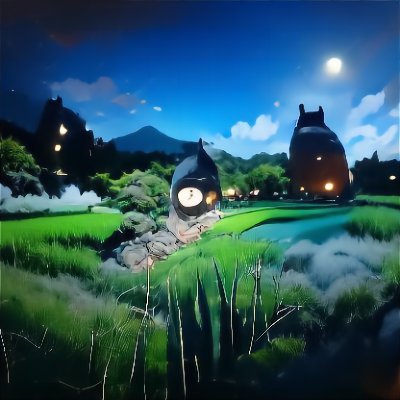
StyleDrop: Text-to-Image Generation in Any Style introduce StyleDrop, a method that enables the synthesis of images that faithfully follow a specific style using a text-to-image model. The proposed method is extremely versatile and captures nuances and details of a user-provided style, such as color schemes, shading, design patterns, and...

56,357 views • 3 years ago •via X (Twitter)

5 Comments

AP's profile picture
AP3 years ago

Imagen about to be OP. Great work @natanielruizg !

8pm's profile picture
8pm3 years ago

CSS generation would save a lot of time.

CubanHodLer🇨🇺's profile picture
CubanHodLer🇨🇺3 years ago

Why are you sharing only HG hosted papers and not Arxiv anymore? 🤔

𝘓𝘶𝘪𝘴 𝘎𝘰𝘮𝘦𝘻-𝘎𝘶𝘻𝘮𝘢𝘯's profile picture
𝘓𝘶𝘪𝘴 𝘎𝘰𝘮𝘦𝘻-𝘎𝘶𝘻𝘮𝘢𝘯3 years ago

So is StableDifusion dead? Is this new method the new path to go?

Mitchell Stooksbury's profile picture
Mitchell Stooksbury3 years ago

Now I'm curious why we don't have style transfer for images that's this good yet.

Related Videos

We've officially released and open-sourced HunyuanImage 2.1, our latest text-to-image model. The new model delivers on our commitment to balancing performance and quality. With native 2K image generation, HunyuanImage 2.1 is an advanced open-source text-to-image model.🎨 ✨ New in 2.1: 🔹Advanced Semantics: Supports ultra-long and complex prompts of up to 1000 tokens, and precisely controls the generation of multiple subjects in a single image. 🔹Precise Chinese and English Text Rendering with seamless image–text integration: The model naturally integrates text into images, making it suitable for a wide range of applications such as product covers, illustrations, and poster design to meet the needs of various fields. 🔹Rich Styles and High Aesthetic: Capable of generating images in various styles—including photorealistic portraits, comics, and vinyl figures—it delivers outstanding visual appeal and artistic quality. 🔹High-Quality Generation: Efficiently produces ultra-high-definition (2K) images in the same time other models take to generate a 1K image. HunyuanImage 2.1 uses two text encoders: a multimodal large language model (MLLM) to improve the model's image and text alignment capabilities, and a multi-language character-aware encoder to improve text rendering capabilities. The model is a single- and double-stream diffusion transformer with 17B parameters. We've also open-sourced the weights of the the accelerated version with meanflow which reduces inference steps from 100 to just 8, and PromptEnhancer, the first industrial-grade rewriting model that enhances your prompts for more nuanced and expressive image generation. Now, creators turn complex ideas—like posters with slogans or multi-panel comics—into visuals faster than ever. We’re just getting started. Stay tuned for our native multimodal image generation model coming soon. 🌐Website: 🔗Github: 🤗Hugging Face: ✨Hugging Face Demo:

Tencent Hy

89,257 views • 9 months ago

We’re excited to announce the release and open-source of HunyuanImage 3.0 — the largest and most powerful open-source text-to-image model to date, with over 80 billion total parameters, of which 13 billion are activated per token during inference.The effect is completely comparable to the industry’s flagship closed-source model.🚀🚀🚀 HunyuanImage 3.0 originates from our internally developed native multimodal large language model, with fine-tuning and post-training focused on text-to-image generation. This unique foundation gives the model a powerful set of capabilities: ✅Reason with world knowledge ✅Understand complex, thousand-word prompts ✅Generate precise text within images Different from traditional DiT architecture image generation models, HunyuanImage 3.0’s MoE architecture uses a Transfusion-based approach to deeply couple Diffusion and LLM training for a single, powerful system. Built on Hunyuan-A13B, HunyuanImage 3.0 was trained on a massive dataset: 5 billion image-text pairs, video frames, interleaved image-text data, and 6 trillion tokens of text corpora. This hybrid training across multimodal generation, understanding, and LLM capabilities allows the model to seamlessly integrate multiple tasks. Whether you're an illustrator, designer, or creator, this is built to slash your workflow from hours to minutes. HunyuanImage 3.0 can generate intricate text, detailed comics, expressive emojis, and lively, engaging illustrations for educational content. The current release focuses solely on text-to-image generation and future updates will include image-to-image, image editing, multi-turn interaction, and more. 👉🏻Try it now: 🔗GitHub: 🤗Hugging Face:

Tencent Hy

412,523 views • 8 months ago

Google presents Still-Moving Customized Video Generation without Customized Video Data Customizing text-to-image (T2I) models has seen tremendous progress recently, particularly in areas such as personalization, stylization, and conditional generation. However, expanding this progress to video generation is still in its infancy, primarily due to the lack of customized video data. In this work, we introduce Still-Moving, a novel generic framework for customizing a text-to-video (T2V) model, without requiring any customized video data. The framework applies to the prominent T2V design where the video model is built over a text-to-image (T2I) model (e.g., via inflation). We assume access to a customized version of the T2I model, trained only on still image data (e.g., using DreamBooth or StyleDrop). Naively plugging in the weights of the customized T2I model into the T2V model often leads to significant artifacts or insufficient adherence to the customization data. To overcome this issue, we train lightweight Spatial Adapters that adjust the features produced by the injected T2I layers. Importantly, our adapters are trained on "frozen videos" (i.e., repeated images), constructed from image samples generated by the customized T2I model. This training is facilitated by a novel Motion Adapter module, which allows us to train on such static videos while preserving the motion prior of the video model. At test time, we remove the Motion Adapter modules and leave in only the trained Spatial Adapters. This restores the motion prior of the T2V model while adhering to the spatial prior of the customized T2I model. We demonstrate the effectiveness of our approach on diverse tasks including personalized, stylized, and conditional generation. In all evaluated scenarios, our method seamlessly integrates the spatial prior of the customized T2I model with a motion prior supplied by the T2V model.

AK

40,467 views • 1 year ago

InstantDrag Improving Interactivity in Drag-based Image Editing discuss: Drag-based image editing has recently gained popularity for its interactivity and precision. However, despite the ability of text-to-image models to generate samples within a second, drag editing still lags behind due to the challenge of accurately reflecting user interaction while maintaining image content. Some existing approaches rely on computationally intensive per-image optimization or intricate guidance-based methods, requiring additional inputs such as masks for movable regions and text prompts, thereby compromising the interactivity of the editing process. We introduce InstantDrag, an optimization-free pipeline that enhances interactivity and speed, requiring only an image and a drag instruction as input. InstantDrag consists of two carefully designed networks: a drag-conditioned optical flow generator (FlowGen) and an optical flow-conditioned diffusion model (FlowDiffusion). InstantDrag learns motion dynamics for drag-based image editing in real-world video datasets by decomposing the task into motion generation and motion-conditioned image generation. We demonstrate InstantDrag's capability to perform fast, photo-realistic edits without masks or text prompts through experiments on facial video datasets and general scenes. These results highlight the efficiency of our approach in handling drag-based image editing, making it a promising solution for interactive, real-time applications.

AK

71,201 views • 1 year ago