Video wird geladen...

Video konnte nicht geladen werden

Zur Startseite

Google co-founder Larry Page on why aiming bigger is often easier than playing it safe: He shares a philosophy he picked up early on that shaped how he thinks about ambition and goal-setting: "I went to a leadership seminar once in Michigan where I came from and they have...

11,961 Aufrufe • vor 2 Monaten •via X (Twitter)

0 Kommentare

Keine Kommentare verfügbar

Kommentare vom Original-Post werden hier angezeigt

Ähnliche Videos

Here is the actual GOP candidate for President of the United States attempting to say something about Mark Zuckerberg which is literally all I can figure out from this 90-SECOND LONG SENTENCE. 😵‍💫 “So Mark Zuckerberg called me first of all he called me a few times she called me after the event that he said that was really amazing it was very brave and you know and he actually announced he's not going to support a Democrat because he can't because he respected me for what I did that day I think what I did maybe was a norm to me it was a normal response but I was called by Mark Zuckerberg yesterday the day before on this same subject and he actually apologized he said they made a mistake etc etc in the correcting mistake a Google nobody called from Google one of the things I do in a show like yours you you show you know you see them Fox but what you really see it is all over the place they take clips of your show that you're doing right now with me and if I do a good job they're going to vote for me they're going to vote for me because it's not just on Fox it's on Fox is a smaller part of it you're on all over this those little beautiful cell phones you're on you're all over the place you have a product you have a great product you have a great brand so you have to get out you have to get out you have to do things like your show and other shows and Google has been very bad they've been very irresponsible and I have a feeling that Google isn't going to be close to shut down because I don't think Congress is going to take it I really don't think so Google has to be careful now I will say this I believe Mark Zuckerberg he called me so he called me a lot they are working and I think they fixed it but what can he's not doing what he did four years ago with the five hundred million dollars I don't believe.”

Jim Stewartson, Decelerationist 🇨🇦🇺🇦🇺🇸

2,250,158 Aufrufe • vor 2 Jahren

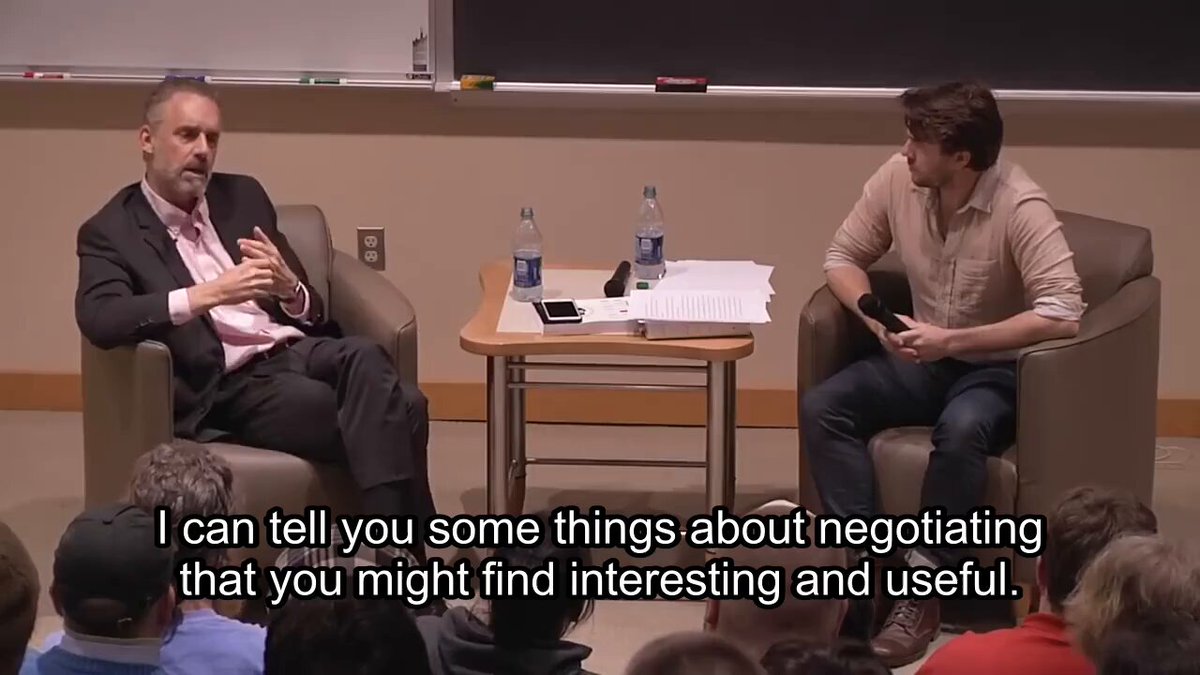
Jordan Peterson: "If you're competent and silent you will be ignored." "You might think well people should reward you because you're competent. And yes of course they should. But if you're competent and silent then you're just part of the background that's keeping everything functioning" On why you cannot negotiate from a position of weakness: "If you want to push your career forward you have to push it forward. You have to be competent and you have to be strategic" "To be strategic when you negotiate for a new position or a new salary you have to be able to say if you don't give me what I want then something you don't like will happen to you" "It's not a physical threat. It's that you have an option" "You have your CV in order. You're educated and competent and desirable to people outside of your immediate job. You're willing to instantly put yourself on the job market" "So that when you go talk to the person you're negotiating with you're credible" On the one thing most people completely miss about negotiation: "It's very seldom that you're talking to the person who's at the top of the pecking order. What you need to do is tell them a story that they can tell to their boss to make you not a problem" "A good story is look we really need this person because they're hyper competent and they have a better offer" "If you go in there with no power you're going to lose. Obviously" He concludes with the one thing every competent person needs to hear: "The first thing you need to know if you're going to negotiate is that you have to be able to say no. And what no means is that you're not going to do it"

Brad

34,669 Aufrufe • vor 12 Tagen

.Rob Miles is spitting fire: “People are starting from a prior in which ‘[AIs] are safe until you give me an airtight case for why they're dangerous.’ This framing is exhausting. You explain one of the 10,000 ways that AIs could be dangerous, then they explain why they don't think that specific thing would happen. Then you have to change tack, and then they say, 'your story keeps changing'... "If you're building an AGI, it's like building a Saturn V rocket [but with every human on it]. It's a complex, difficult engineering task, and you're going to try and make it aligned, which means it's going to deliver people to the moon and home again. People ask “why assume they won't just land on the Moon and return home safely?" And I'm like, because you don't know what you're doing! If you try to send people to the moon and you don't know what you're doing, your astronauts will die. [Unlike the telephone, or electricity, where you can assume it’s probably going to work out okay] I contend that ASI is more like the moon rocket. "The moon is small compared with the rest of the sky, so you don't get to the moon by default - you hit some part of the sky that isn't the moon. So, show me the plan by which you predict to specifically hit the moon." And then people say, “how do you predict that [AIs] will want bad things?” There's more bad things than good things! It's not actually a complicated argument... I'm not going to predict specifically where it off into random space your astronauts are going, but you're not going to hit the moon unless you have a really good, technically clear plan for how you do it. And if you ask these people for their plan, they don't have one. What's Yann Lecun’s plan?” "I think that if you're building an enormously powerful technology and you have a lot of uncertainty about what's going to happen, this is bad. Like, this is default unsafe. If you've got something that's going to do enormously influential things in the world, and you don't know what enormously influential things it's going to do, this thing is unsafe until you can convince me that it's safe." HOST: “That’s a good way of thinking about it - with some technologies you can assume that the default will be good or at least neutral, or that the capacity of a person to use this in a very bad way is bounded somehow. There's just only so many people you could electrocute one by one."

AI Notkilleveryoneism Memes ⏸️

77,361 Aufrufe • vor 3 Jahren

Thinking about Terry Gilliam's Brazil. Specifically the rouge HVAC tech Harry Tuttle, played by Robert De Niro. Tuttle, tired of government bureaucracy keeping him from his work, became an outlaw. He tells us he's "in it for the action". He loves fixing HVAC systems, and he's not going to let rules and regulations stand in his way. He continues in his work even though he's being hunted by the Secret Police. Why not hang it up? Why does he keep going? He doesn't stop because he can't stop. He's compelled to do it, and he couldn't stop if he wanted to. So he sneaks around in the dead of night, armed, watching out for ambushes, fixing heating systems--because he has to. Harry Tuttle cares about fixing heating systems more than he cares about his own life... A topic I keep returning to is the extreme amount of hard work and dedication required to make a movie. It's become a recurring theme of mine, mainly because it just doesn't seem to land with readers. That's probably due to my poor writing skills. But then again, maybe there's no way to explain it. Maybe to truly understand, it's something you have to experience for yourself. Like Harry Tuttle, the people who make movies will do whatever it takes to make their film. They do this because they care about making movies more than anything. They care more about making movies than their spouses, their children, or friends, or morality, or decency, or money, or anything and everything else you can think of. Not that they don't care about those things. But the work comes first. And again, they'll do whatever it takes to make it happen. They'll even risk their own lives (and the lives of others) to get that perfect shot. I've seen that many times over. I've even done it myself. Why do they do this? It's because they have to do it. They're compelled. When the urge to create hits--when it REALLY hits--you have to get it out. You have to make it REAL. And failure isn't an option. It's not about the money or the fame or the accolades. It's about creating the thing they've been inspired to create. And again, they do whatever it takes. They're not going to let anyone or anything stop them. This isn't something you can learn in school, or by watching Youtube videos. And it isn't something that's gifted to you by the "gatekeepers" (except by God maybe...) It's something you're born with. And it makes you abnormal--defective. Life is going to hard. Nothing will ever be good enough. It will be hard to get close to people. And any relationship you manage to build will be wrecked. But if you don't have it--if you don't have The Thing--if you don't have that compulsion, then don't even fucking try. There are easier ways to earn a living. Maybe you should go to Law School kid... So when I see online chatter about "Gatekeepers" or (most laughably) "The Joos" preventing them from making the things they want to make, I just shake my head. Because they have no clue what it is to actually create. If you're really a creator, if you're truly inspired, if you have what it takes (if you have That Thing) then you'll figure out a way. And you won't let anything get between you and your creation. Because you're not brittle like that. OR, maybe you ARE brittle. But that compulsion--That Thing--is going to glue you together. It's going to make you strong. It's going to make you unstoppable. But most of these people are just whiners. Posting--just typing shit--is a low effort activity. It requires almost no sacrifice. If they really cared about creating the content they want to see then they'd go out and do it. And I would invite everyone to try. But again, it's not easy. And you're probably not cut out for this type of work. So you'll probably give up. But that's fine. You can always just open the app and whine. And I'll be here too--probably still trying to get the point across. After all, I'm just in it for the action🤷‍♂️

Rambo Van Halen

28,638 Aufrufe • vor 6 Monaten

Geno Auriemma shares how he explains success to his players and why showing up isn't enough. "If you go to class and you do average work, you're gonna get a C. That's why it's called average." "If you want a B, you have to do more work. If you want an A, you have to do even more work and you have to give up stuff." You get what you earn in life. "You have to sacrifice. Maybe you can't do all the things that everybody else does." It means if you want more then you have to be willing to do more. "If you're just happy getting Bs all your life, there's nothing wrong with that either. But you're never gonna get the satisfaction of what it feels like to get an A." Then he connected it to basketball: "If you just wanna be average, then you do average work. If you wanna be a little bit above average then you do a little more work." "If you wanna get As in basketball, then you gotta do stuff that other people aren't willing to do - especially if you have the talent like we do. We have talent." It means bring a mindset of excellence to everything that you do. Excellence isn't the goal - it's the standard you set. Then he called out the entitlement problem: "Some of these younger guys coming out of high school, man, they wanna show up and go, 'I'm here. Where's my 3.7?'" "Like my father used to say, 'I got your 3.7 right here.'" Showing up doesn't earn you anything. Doing the work does. You get the grade you earn - in school, in basketball, and in life. It's easy to be average...successful people look to compete in everything they do. (🎥UCTV Sports )

Coach AJ 🎯 Mental Fitness

150,499 Aufrufe • vor 4 Monaten

J-Cal Explains Why Google is UNDERRATED in AI 👀 On E227, the besties discussed Google's value in a post-search world if AI replaces traditional search. @jason broke down why he thinks Google is being slept on: "I think there's a chance that we're underestimating the power of Google's ad network right now." "They have four or five products that are one or two billion users per month. You have YouTube, Google Docs, Android." "They have such a data advantage and such a deep integration into people's lives because they use three or four services, I think Google's gonna figure this out." "It's quite possible that knowing your queries in Gemini, knowing what you're doing in Calendar, knowing what you're watching on YouTube could lead to a stream of more targeted ads that do better and are more valuable." "We've been seeing a number of startups that are figuring out how to use your queries and what you're doing in AI to present to you search results." "So imagine you're doing a Gemini search and on the side of it, it's giving you a rolling list of ads or offers that you might be more interested in." "That could be a better advertising product than even search itself." "I think YouTube search is the place to go all-in." "Right now, when you do a YouTube search, it just gives you 10 links, right? It just gives you that rolling thing." "You should be able to ask a question to YouTube, and you should be able to ask questions to your calendar." "You should be able to say, who have I met with over the last 10 years? Who I'm no longer in touch with and what are they up to?" "And it should do a Gemini search inside of Google Calendar. It's very light right now." "And then if you did that on YouTube, this would train people at the point of pain in a very deep way without sacrificing Google Search queries too aggressively."

The All-In Podcast

58,275 Aufrufe • vor 1 Jahr

Naval Ravikant: "You're going to die. It's all going to zero. What's there to stress about?" "Stress is when your mind has two conflicting desires at once. You want to be liked, but you want to do something selfish. You don't want to go to work, but you want to make money. You have two conflicting desires, and that's stress." Naval explains the difference between stress and anxiety: "Anxiety is this pervasive, unidentifiable stress where you're stressed out all the time and you're not even sure why. The reason is you have so many unresolved problems that have piled up in your life, you can no longer identify what the problems are. There's this mountain of garbage in your mind. A little bit is poking out the top like an iceberg; that's anxiety. But underneath, there's a lot of unresolved things." He shares his personal anxiety resolver: "One big anxiety resolver for me is just ruminating on death. You're going to die. It's all going to zero. You cannot take anything with you. If you can keep that idea in front of you at all times, what's there to stress about?" Naval reframes what "wasted time" really means: "What is wasted time? Everything is wasted time in a sense because nothing matters in the ultimate. But in each moment, it's the only thing that matters. So if you're doing something you want to do and you're fully there for it it's not wasted time. If your mind is running away, wishing you were somewhere else, anticipating the future, regretting the past, that's wasted time. That's time you're not present for." He concludes: "People get worried about dying and no longer being here. But they don't realize that so much of their life is spent not being here in any case."

Jaynit

671,748 Aufrufe • vor 5 Monaten

Martin Lewis, founder of MoneySavingExpert. com, on the four things it takes to be really successful, and why the most important one isn't what you'd expect: He opens with a clear framework: "It takes four things to be really successful. Talent, you've all got it, as do many more people than you think. Hard work. If you want to be really successful, you're going to have to work hard. Focus. Zone in on what you're good at." On focus, he pushes back against the idea that you need to be exceptional at everything: "Understand, none of us are unfailingly brilliant at everything. So, find the thing that you're good at and zone in on that. And that is what will create your success." But the fourth factor is where his message turns unexpected: "The most important thing is luck. You can do everything right, but it still not work for you. And you need to know that now." This reframes how he wants people to think about setbacks: "Failing does not make you a failure. Do not judge yourself. See it as a way to learn and to give yourself a better opportunity the next time." Martin Lewis then challenges a common assumption about what success actually delivers: "Success can be stressful. Success is not a synonym for happiness. As you go through your working careers, at sometimes you may want to make a call. Do I continue to push that hard or do I smile at what I've got and enjoy happiness and the other things that life starts to give me?" He closes with a message aimed at those who do make it big: "One or two of you in here will make it really big. If that's you, remember of those four things, the most important one is luck. And that means if you're that super successful one in the room, you have a moral duty to give back."

Big Brain Business

292,025 Aufrufe • vor 4 Monaten

Steve Jobs on how he learned to run a company: Question: "You're 21. You're a big success. You know, you've just sort of done it by the seat of your pants. You don't have any particular training in this. How do you learn to run a company?" Steve Jobs: "You know, throughout the years in business, I found something, which was that I always ask why you do things. And the answers you invariably get are, oh, that's just the way it's done. Nobody knows why they do what they do. Nobody thinks about things very deeply in business. That's what I found. I'll give you an example. When we were building our Apple I's in the garage, we knew exactly what they cost. When we got into a factory in the Apple II days, the accounting had this notion of a standard cost, where you'd kind of set a standard cost and at the end of a quarter you'd adjust it with a variance. And I kept asking, well, why do we do this? And the answer was, well, that's just the way it's done. And after about six months of digging into this, what I realized was the reason you do it is because you don't really have good enough controls to know how much it costs. So you guess, and then you fix your guess at the end of the quarter. And the reason you don't know how much it costs is because your information systems aren't good enough. But nobody said it that way. And so later on, when we designed this automated factory for Macintosh, we were able to get rid of a lot of these antiquated concepts and know exactly what something cost to the second. So in business, a lot of things are, I call it folklore. They're done because they were done yesterday and the day before. And so what that means is if you're willing to sort of ask a lot of questions and think about things and work really hard, you can learn business pretty fast. It's not the hardest thing in the world. It's not rocket science. It's not rocket science."

Founder Mode

32,290 Aufrufe • vor 6 Monaten

Jordan Peterson: "If you can't fix your room, you can't fix your life" "Why should you even bother improving yourself? The answer is something like: so you don't suffer anymore stupidly than you have to. And maybe so others don't have to either. It's not some casual self-help doctrine. If you don't organize yourself properly, you'll pay for it. In a big way. And so will the people around you." Peterson continues: "You can say, 'Well, I don't care about that.' But that's actually not true, you do care about it. Because if you're in pain, you will care about it. It's very rare that you can find someone in excruciating pain who would say, 'Well, it would be no better if I was out of this.' Pain brings the idea that it would be better if it didn't exist along with it. It's incontrovertible." On how to start: "Look around for something that bothers you and see if you can fix it. You can do this in a room. Sit in your bedroom and think: 'If I wanted to spend ten minutes making this room better, what would I have to do?' You have to ask yourself that, it's a genuine question. And things will pop out. There's a stack of papers bugging you. Some rubbish behind your computer monitor you haven't attended to for six months. Cables tangled up." He explains why this matters: "If you were coming to see me for psychotherapy, the easiest thing would be to get you to organize your room. You think, is that psychotherapy? It depends on how you conceive the limits of your being. Start where you can start. If something announces itself as in need of repair that you could repair, fix it. Fix a hundred things like that, your life will be a lot different." On fixing what you repeat every day: "People tend to think of their daily routines as trivial. You get up, brush your teeth, have breakfast. Those probably constitute 50% of your life. People think, they're mundane, I don't need to pay attention to them. No, that's exactly wrong. The things you do every day are the most important things you do. Hands down. Just do the arithmetic." On staying within your competence: "Sometimes you don't know how to fix something. Imagine you're walking down the street and there's a guy who's alcoholic and schizophrenic and has been homeless for ten years. That's a problem. It would be good if you could fix it, but you haven't got a clue. You walk around that and go find something you could fix. Just because something announces itself as in need of repair doesn't mean it's you, right then and there, who should repair it. You have to have some humility. You don't walk up to a helicopter that isn't working and just start tinkering away." Peterson shares the key insight: "As soon as you give your mind a genuine aim, it'll reconfigure the world in keeping with that aim. That's actually how you see to begin with. You've all seen the video where you watch basketballs being tossed back and forth, and while you're doing that, a gorilla walks into the middle of the video and you don't see it. If you thought about that experiment for five years, that would be about the right amount of time to spend thinking about it." He explains what it reveals: "What it shows you is that you see what you aim at. If you can get one thing through your head, that would be a good one. You see what you aim at. One inference you might draw from that is: be careful what you aim at. What you aim at determines the way the world manifests itself to you. So if the world is manifesting itself in a very negative way, one thing to ask is: are you aiming at the right thing?"

Jaynit

68,799 Aufrufe • vor 4 Monaten

Sunny Hostin and Kara Swisher cat fight over the press confronting Trump of criticizing reporters: SUNNY HOSTIN: But I also take a bit of umbrage at the other reporters there because - By the way, the other reporters weren't smiling. The men weren't smiling. He didn't mention that. But I do feel that when you -- when one of your colleagues is attacked in that way, a follow-up question should have been or a statement, someone in the room, maybe one of the men should have said, 'sir, you should not speak to her that way.' I would have liked to have seen that. [Applause] KARA SWISHER: I'm going to disagree with you because I think the job of reporters is not to react to that kind of nonsense. Right? The story -- the whole thing is when you're a reporter, the story shouldn't be about you. And when it is, it's a mistake. HOSTIN: That is true. SARA HAINES: When you're a good reporter. SWISHER: When you're a good reporter. {laughter] Well yeah, that's fair. But it's really hard. I mean, one of the things, I know Kaitlan really well. He attacks Maggie Haberman, a whole bunch of people I know really well. And to react is the really -- is where you lose in that game because with these people everything -- every accusation is a confession, so what he is saying is about him and not about her. And I thought she handled it well. She has to be absolutely -- she made a joke about Alabama which is fantastic. But the minute you say something, you get dragged into it in a way that he benefits and you don't. HOSTIN: What about the other reporters, do you think that maybe they should have said - SWISHER: No, nobody should say anything. HOSTIN: Because I think this administration is so aberrant, I think they are so - it's just such an abnormal situation. I don't know that you play by the rules that we used to play by. SWISHER: Because that becomes the story then, the fight between him and her. HOSITN: Although, it's already the story. SWISHER: No, it's not because she then asked a question. By the way, what was really interesting is she hadn't asked a question. HOSTIN: She had not. SWISHER: But she then got in a question in about the slush fund and then he answered in a very different way from Todd Blanche. She got what she needed which was the news. She got the news.

Nicholas Fondacaro

31,100 Aufrufe • vor 2 Monaten

The founders of Stripe and Pinterest on how to convince people to join your startup Stripe CEO Patrick Collison argues that part of the reason startups resonate so much is because the outcome is not guaranteed: "If it were guaranteed, it would be boring... Whether or not you're the best person in the world at what you do, you're probably not going to alter Google's trajectory. But if you really want to benchmark yourself and see how much of a contribution and impact you can make--which is a really compelling prospect for a lot of the best people--a startup is a much better place to test that." Pinterest founder Ben Silbermann emphasized this as well: "No smart person that you're hiring is under the illusion that you have a crystal ball into the future and that joining is a guaranteed thing. In fact, if you're telling them that and they select in, you shouldn't hire them because they didn't pass a basic intelligence test. I think it's important to tell them what's exciting and where you think the company can go. But also tell them where it will be hard and chart your best plan. And then tell them why their role can be instrumental--because it will be... What I would discourage doing is whitewashing all of that. If people are joining your company because they want all of the certainty and safety of working at Google but also the perks of working at a small startup with lots of responsibility and transparency, that's a really negative sign." Apparently in the early days of PayPal, Peter Thiel and Max Levchin would tell people after they interviewed all the reasons that the company would fail: "Visa and MasterCard want to kill us. We also might be doing something that's illegal. But if we succeed, we'll redefine payments." Don't whitewash the risks. Instead tell them how your startup will change the world if you succeed and how their role will be instrumental in affecting that change. Video source: Y Combinator (2014)

Startup Archive

11,811 Aufrufe • vor 9 Monaten