Video wird geladen...

Video konnte nicht geladen werden

Zur Startseite

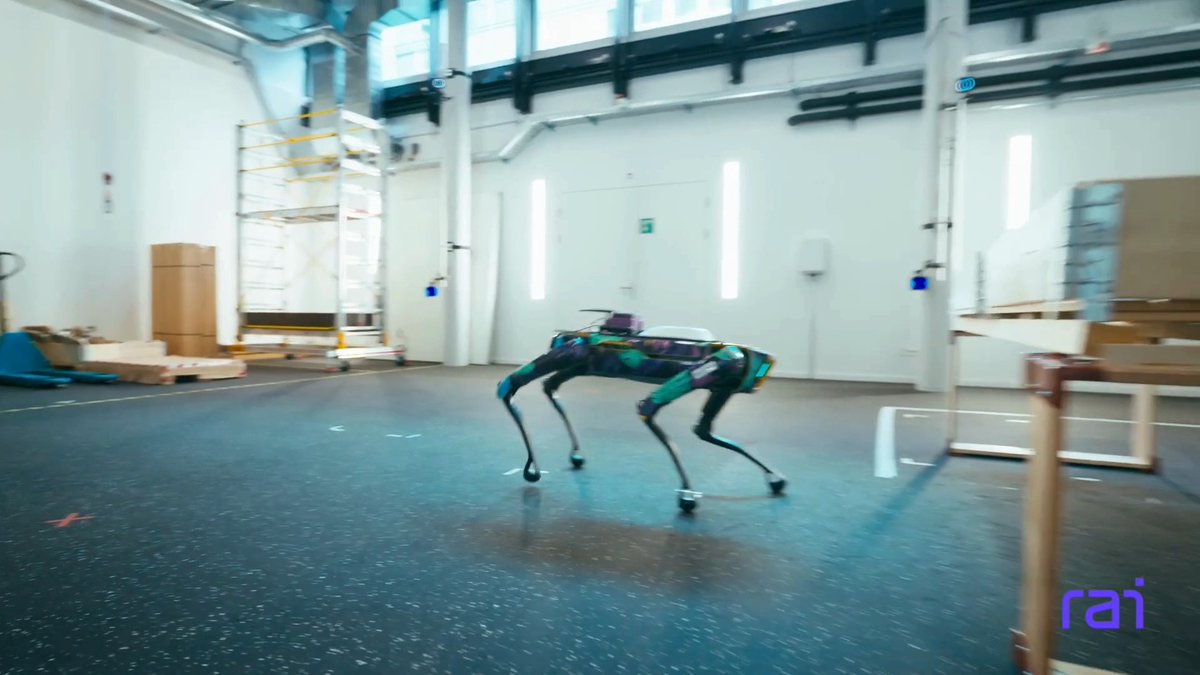
Google's first rule for machine learning: don't use machine learning. A 3-line PID equation beats a neural network at balancing a robot. Proportional error, integral of accumulated error, derivative of error change rate - three terms, hand-tuned gains, no training data. The same control theory running inside every GPU...

29,627 Aufrufe • vor 2 Tagen •via X (Twitter)

3 Kommentare

Profilbild von hiroko watanabe
hiroko watanabevor 1 Tag

@0xEronn Great Video, indeed. Very interesting and understandable, not easy of course, but quite helpful to learn physics.

Profilbild von Emmanuel Nwachukwu 💙🥶
Emmanuel Nwachukwu 💙🥶vor 1 Tag

Good reminder that a simple rule can beat a complex model. As a beginner I like seeing the basics get respect before the fancy stuff.

Profilbild von The Chieftain A
The Chieftain Avor 1 Tag

Great video

Ähnliche Videos

A 91-year-old professor is why Nvidia is worth $4 trillion. His name is Gilbert Strang. He teaches linear algebra at MIT. Every AI model on Earth runs on his course. The course has been free on YouTube since 2005. The videos have earned him nothing. MIT 18.06 opens with "The Geometry of Linear Equations." No advanced math. Strang takes a system of two equations, draws it two ways, and shows the class that a matrix is a picture, not an abstraction. The row picture is two lines that cross. The column picture is two arrows that sum to a target. Every neural network on Earth operates on the column picture. Strang first taught linear algebra at MIT in 1962. He wrote the textbook in 1976. It is on every serious engineer's shelf. Every quant fund, every ML lab, every rendering engine at Pixar is running his math. His central insight is that most people are taught matrices as bookkeeping. That is the first thing to unlearn. A matrix is a linear transformation. A linear transformation is a way of moving space. Once you see the space move, the math stops being algebra and becomes geometry. The Kalman filter is a linear system. PCA is a linear system. Every gradient step in a neural net is a matrix-vector product. GPT is a stack of matrix-vector products, each one a scene from MIT 18.06 running on a Blackwell GPU. He retired in 2023 after 61 years at MIT. The course is still up. Watched tens of millions of times. The chip is $40,000. Strang never asked for a royalty.

Ochob

131,686 Aufrufe • vor 3 Monaten

if you're struggling on where to start learning ML, here’s a playlist of 30 youtube videos to learn machine learning fundamentals from scratch "Machine Learning: Teach by Doing" is a solid choice to learn both theory and code. (1) Introduction to Machine Learning Teach by Doing: (2) What is Machine Learning? History of Machine Learning: (3) Types of ML Models: (4) 6 steps of any ML project: (5) Install Python and VSCode and run your first code: (6) Linear Classifiers Part 1: (7) Linear Classifiers Part 2: (8) Jupyter Notebook, Numpy and Scikit-Learn: (9) Running the Random Linear Classifier Algorithm in Python: (10) The oldest ML model - Perceptron: (11) Coding the Perceptron: (12) Perceptron Convergence Theorem: (13) Magic of features in Machine Learning: (14) One hot encoding: (15) Logistic Regression Part 1: (16) Cross Entropy Loss: (17) How gradient descent works: (18) Logistic Regression from scratch in Python: (19) Introduction to Regularization: (20) Implementing Regularization in Python: (21) Linear Regression Introduction: (22) Ordinary Least Squares step by step implementation: (23) Ridge regression fundamentals and intuition: (24) Regression recap for interviews: (25) Neural network architecture in 30 minutes: (26) Backpropagation intuition: (27) Neural network activation functions: (28) Momentum in gradient descent: (29) Hands on neural network training in Python: (30) Introduction to Convolutional Neural Networks (CNNs):

ℏεsam

109,764 Aufrufe • vor 1 Jahr

a playlist of 30 youtube videos to learn machine learning fundamentals from scratch if you're struggling on where to start learning ML, this list goes this "Machine Learning: Teach by Doing" is a solid choice to learn both theory and code. (1) Introduction to Machine Learning Teach by Doing: (2) What is Machine Learning? History of Machine Learning: (3) Types of ML Models: (4) 6 steps of any ML project: (5) Install Python and VSCode and run your first code: (6) Linear Classifiers Part 1: (7) Linear Classifiers Part 2: (8) Jupyter Notebook, Numpy and Scikit-Learn: (9) Running the Random Linear Classifier Algorithm in Python: (10) The oldest ML model - Perceptron: (11) Coding the Perceptron: (12) Perceptron Convergence Theorem: (13) Magic of features in Machine Learning: (14) One hot encoding: (15) Logistic Regression Part 1: (16) Cross Entropy Loss: (17) How gradient descent works: (18) Logistic Regression from scratch in Python: (19) Introduction to Regularization: (20) Implementing Regularization in Python: (21) Linear Regression Introduction: (22) Ordinary Least Squares step by step implementation: (23) Ridge regression fundamentals and intuition: (24) Regression recap for interviews: (25) Neural network architecture in 30 minutes: (26) Backpropagation intuition: (27) Neural network activation functions: (28) Momentum in gradient descent: (29) Hands on neural network training in Python: (30) Introduction to Convolutional Neural Networks (CNNs):

ℏεsam

117,748 Aufrufe • vor 1 Jahr

Ten million people have watched an MIT professor teach a course whose first lecture is literally titled "What is a Derivative?" Almost none have written down the two-line answer. He filmed the lecture once in the fall of 2007 and it has been on YouTube ever since. Math tutors charge $200 an hour to teach a diluted version of what he covered in 50 minutes for free. His name is David Jerison. He is a professor of mathematics at MIT and the instructor of 18.01 Single Variable Calculus, one of the most-watched math courses in the history of the internet. The 50-minute clip in this video is Lecture 1, filmed at MIT in the fall of 2007. Jerison is deriving the definition of a derivative from a single tangent line. The whole framework fits on a napkin. A derivative is just how much y changes when x moves a tiny bit. Draw a tangent line to any curve at any point. The slope of that line is the derivative. Memorize one formula, the power rule, and you can differentiate every polynomial on earth in your head. Chain that with a handful of exceptions and you can differentiate almost every function humanity has ever written down. That single set of rules is what every neural network runs on gradient descent, what every rocket landing at SpaceX solves in real time, and what every options desk at Goldman Sachs is running behind every quote you see on the screen. "In mathematics you don't understand things. You just get used to them." That is John von Neumann, the mathematician who helped design the atomic bomb and invent the modern computer. Jerison returns to the same idea in every lecture. Almost no student giving up on calculus has heard von Neumann say it out loud. Every quant fund on Wall Street pays entry-level analysts $250,000 to know the same power rule Jerison derives on the board. Every AI bootcamp charges tens of thousands to teach a diluted version of the same equation on a laptop. The lecture is free on MIT OpenCourseWare. The textbook is under sixty dollars. Almost none of the millions who watched have ever taken the power rule and applied it to their own numbers on their own paper. The math is free. The willingness to actually take one derivative before your next model, trade, or engineering trade-off is the entire edge.

Lumen

31,497 Aufrufe • vor 1 Monat

MIT FILMED THE LECTURE WHERE THEIR MOST LEGENDARY LINEAR ALGEBRA PROFESSOR EXPLAINS WHY EVERY GPS SIGNAL EVERY MEDICAL SCAN AND EVERY AI MODEL ON EARTH IS SECRETLY SOLVING A PROBLEM THAT HAS NO SOLUTION This is Gilbert Strang, MIT, 18.06 Linear Algebra, lecture 15. The professor whose textbooks sit in over 3,000 universities across 135 countries and whose course has been watched by millions of engineers and mathematicians worldwide. He opens with one claim - when equations have no solution, you do not give up. You solve the closest problem that can be solved. He starts with a vector b and a line through a. The projection of b onto that line is the point closest to b that actually lives on the line. The key is a right angle. The error - the gap between b and its projection - must be perpendicular to a. That one geometric fact produces the entire formula. The projection is a times a transpose b divided by a transpose a. One fraction. The numerator is a matrix. The denominator is a number. Then the projection matrix. Every projection is carried out by a matrix P that multiplies b and lands on the line. That matrix has two properties that define all projections everywhere. First, P transpose equals P - the matrix is symmetric. Second, P squared equals P - project twice and you stay where you are. The first projection moves you onto the line. The second leaves you there. Then higher dimensions. Instead of projecting onto a line, project onto a plane. Instead of one vector a, you have a matrix A with two columns spanning the plane. The error vector must now be perpendicular to both columns - perpendicular to the entire plane. That condition produces one matrix equation. A transpose times the error equals zero. The error lives in the null space of A transpose, which is exactly perpendicular to the column space of A. The four fundamental subspaces appear without being called. Then the formula for n dimensions. The projection matrix is A times A transpose A inverse times A transpose. Strang warns the room not to simplify it by canceling A inverse against A - A is not square, it has no inverse, and the formula cannot be pulled apart. The only case where it simplifies to the identity is when A spans the whole space and the projection is b itself. Watch the moment he applies the formula to fitting a line through three points that no line can pass through. Three equations, two unknowns, no solution. He writes the matrix, writes the right-hand side, and shows that multiplying both sides by A transpose produces an equation that always has a solution. That equation is the foundation of least squares, GPS triangulation, and every regression model trained in 2026. A data scientist I know rewatched this lecture before building a recommendation system from scratch. Said it was the first time the normal equations felt like geometry rather than a formula someone handed down to memorize. Free on YouTube, MIT OpenCourseWare, filmed over 20 years ago. bookmark this and watch later - after this lecture every unsolvable equation you meet will feel like a projection waiting to be found

Lupen

24,677 Aufrufe • vor 2 Monaten