Video yükleniyor...

Video Yüklenemedi

Ana Sayfaya Dön

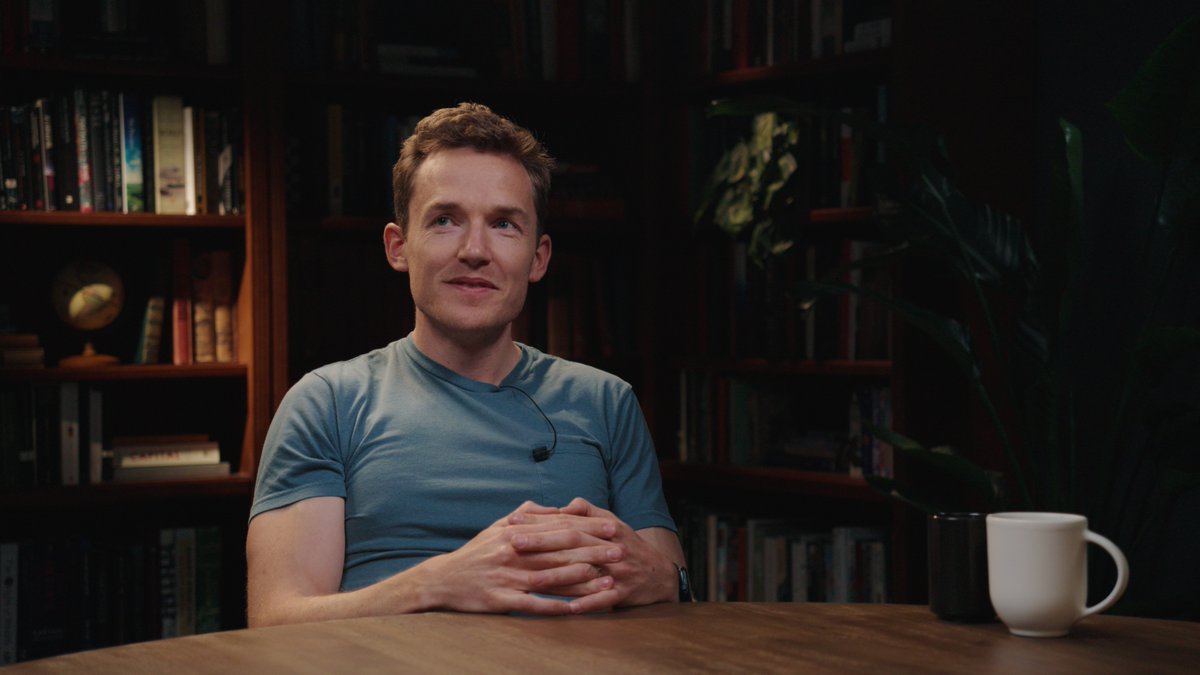
Had Ryan Greenblatt on to discuss/debate recursive self-improvement. This might be the most important question in the world right now - whether within a year or so of achieving human level intelligence, you slingshot towards having 10s of billions of superintelligences, each of which is dramatically more competent than...

740,336 görüntüleme • 3 gün önce •via X (Twitter)

0 Yorum

Yorum bulunmuyor

Orijinal gönderinin yorumları burada görünecek

Benzer Videolar

Elon Musk on Grok: “I think an AI that is sort of SpaceX’s baby will be a very good AI. I think SpaceX is a collection of some of the very best humans on Earth, both in capability and morality and goodness, and I think we want to have an AI that is born of that capability and that morality and that goodness. I think that’s very, very important. So I’d like to encourage people to help out, actually, with the AI hardware on the ground and the AI software and, of course, with the AI satellites. Solar is going to be a very important part of that. The TerraFab will be a very important part of that, but we must also succeed on the software front, and we’re going to be training Grok on the sum total of all SpaceX information. So in a way, it will be trained on you. You will effectively be the parents of the AI. It will inherit your thoughts and ideas and beliefs, and I think that’s a good thing. So, yeah, we’ve got to win here on the AI hardware and the AI software. That maybe is the most important message. I think that is actually the most important message I wanted to convey today is that we must win on AI because the future is overwhelmingly AI and robots. So we won’t ultimately be able to control the AI. It’ll be too smart for that. But just like if you have a child that is a super genius child, you can still instill in that child the values and beliefs that you think are good and right. And so that’s why it’s incredibly important that we succeed with Grok. So, yeah, well, Grok 4.5 you’ve tried probably. We’ve got 4.6 coming out in about a week. And then 4.7 should be really pretty special. So I’d like to encourage everyone at SpaceX to use AI and to make it better.”

DogeDesigner

61,797 görüntüleme • 3 gün önce

jensen spitting bars "So, China is the largest contributor to open source software in the world. Fact. Right? China's the largest contributor to open models in the world. Fact. Today it's built on the American tech stack Nvidia. Fact. All five layers of the tech stack for AI is important. United States ought to go win all five of them. They're all important. The one that is the most important, of course, is the AI application layer. The layer that diffuses into society, the one that uses it most will benefit from this industrial revolution most. But my point is that every layer has to succeed. If we scare this country into thinking that AI is somehow a nuclear bomb so that everybody hates AI and everybody's afraid of AI, I don't know how you're helping the United States. You're doing a disservice. If we scare everybody out of doing software engineering jobs because it's going to kill every software engineering job and we don't have any software engineers as a result of that, we're doing a disservice to United States. If we scare everybody out of radiology so nobody wants to be a radiologist because computer vision is completely free and no AI is going to do a worse job than radiologists and we misunderstand the difference between a job and a task. The job of a radiologist, patient care, task to read a scan. If we misunderstand that so profoundly and we scare everybody out of going to radiology school, we're not going to have enough radiologists and good enough healthcare. So I'm making the case that when you make a premise that is so extreme, everything goes from zero or infinity. We end up scaring people in a way that's just not true. Life is not like that. Do we want United States to be first? Of course we do. Do we need to be a leader in every layer of that stack? Of course we do. Of course we do. Is today you're talking about Mythos because Mythos is important? Sure, that's fantastic, but in a few years time, I'm making you the prediction that when we want the American tech stack, when we want American technology to be diffused around the world, out to India, out to the Middle East, out to Africa, out to Southeast Asia, when our country would like to export because we would like to export our technology, we would like to export our standards. On that day, I want you and I to have that same conversation again, and I will tell you exactly about today's conversation, about how your policy and what you imagined literally caused the United States to concede the second largest market in the world for no good reason at all. We shouldn't concede it. If we lose it, we lose it, but why do we concede it? Now nobody is advocating, nobody is advocating an all or nothing. Nobody is advocating all or nothing, meaning we ship everything to China at all times. Nobody's advocating that. We should always have the best technology here. We should always have the most technology here and the first, but we should also try to compete and win around the world. Both of those things can simultaneously happen. It requires some amount of nuance, some amount of maturity instead of absolutes. The world is just not absolutes."

mark erdmann

13,279 görüntüleme • 4 ay önce

SAM ALTMAN BELIEVES AGI IS SOLVED “So now we're starting to look ahead to superintelligence.” - “When we started OpenAI, almost nine years ago now, we believed that AI could become the most impactful technology in human history. We didn't know exactly how we were going to get there, but we believed it was possible and that if we succeeded, we wanted to make sure that it benefited everyone. At the time, very few people believed in AGI. We kept learning by doing. We had some breakthroughs. We had some setbacks. We got lucky in some places. We got unlucky in some places. And in the way that technology moves forward, we now are in a place where everyone can see this tremendous impact that AI is going to have in the future. So now we're starting to look ahead to superintelligence. And even more than before, our focus must be on wide and fair access. This is a technology that will reshape the global economy and really the whole way we live our lives. It's critical that superintelligence becomes cheap, broadly available, and not that concentrated with any one person, company, or country. We, not just OpenAI, but the whole industry, we are building something PROFOUND. This is a kind of BRAIN OF THE WORLD. It'll be personal, adaptable, it'll be easy to use, it'll give people incredible superpowers that were sort of science fiction only a couple of years ago. The limit won't be the algorithms and the research, but it'll increasingly become the physical instantiation that it takes to make this work. Chips, cables, servers, energy, everything that you need to power this brain. And the more of it, the better. I think that Norway offers more of that potential right here in Europe. It will contribute to the overall compute power needed to drive the next wave of AI breakthroughs and deployment and economic progress for Europe and Europe. I'm incredibly excited about what this will create for the future. Thank you.”

NIK

390,619 görüntüleme • 1 yıl önce

ELON MUSK: The future is fundamentally AI and Robots. “Our AI revenue will exceed all other SpaceX revenue probably in September, like next month, and will significantly exceed all other SpaceX revenue in the fourth quarter. So, AI has become an extremely important part of SpaceX’s future. I think it’s actually vital that we succeed in AI, not just in hardware, but also in software. So, yeah, the future is fundamentally AI and robots. Assuming civilization continues to progress, I think that AI will probably, the amount of digital intelligence will probably be more than a trillion times the amount of biological intelligence. So, not sort of equal to human intelligence, but probably a trillion times higher. I’d say a billion times higher than the amount of artificial intelligence that we have today. I’d say a billion times is an easy prediction, and probably a trillion. So, as you harness more and more of the sun’s energy, the ability to turn that into intelligence is fundamentally a digital computer thing, because it’s pretty hard for humans to go live in deep space without any support. I mean, some of the math is interesting to think about, which is that if you increased civilizational energy usage, the amount of energy that we have harnessed as a civilization by a factor of a million, you would still be using much less than one millionth of the sun’s energy. Now, most of this is in deep space, obviously, but the future is very much AI, very much, and I suppose it was always going to be that way. But it’s important that we have an AI that cares about humanity, that fosters humanity and helps take us to other planets and other star systems, and this is why I think it’s essential that SpaceX succeed, not just with AI hardware, but also with AI software.”

DogeDesigner

62,258 görüntüleme • 3 gün önce

Google DeepMind CEO Demis Hassabis on "leaving AI in the lab for longer” (full question + answer in the video as I've seen him misquoted). Here's what he said: "For me, the best use case of AI was to improve human health and accelerate scientific discovery..." "Given how important AGI is and how transformative a technology is, maybe the most transformative one in human history, I thought it would be best to approach the sort of latter stages of building it, which we're in now, using the scientific method, very carefully, very precisely, very thoughtfully, and rigorously with all the best scientists, in my ideal world, collaborating on in CERN-like effort, on making sure each step we understood each step each as we got to the final goal of, of building AGI.... "While we're building AGI in this careful scientific way, humanity could benefit from the proceeds of that, like cures for cancer, or maybe new energy sources or new materials… “Looking at this from 20, 30 years ago when I started out on all of this, that would have been the ideal way for it to play out, in my opinion. “Now, it didn't happen like that because technology's unpredictable and in fact, it turns out that things like language were a lot easier than we were all expecting… “We were sort of playing around with that, so were the other leading labs, but of course with ChatGPT and fair play to OpenAI, they scaled it and then they put it out there. “And I think even they say it was kind of a research experiment. They didn't realize it would go so viral. And I think none of us did and we had sort of fairly equivalent systems at the time… “Now, the downside of it is, we're in this sort of ferocious commercial pressure race that everyone's sort of locked into currently. “And then on top of that, there's geopolitical issues like the US-China race and so on. So there's sort of multiple levels of pressure to sort of move fast. So the benefit of that, of course, you get faster progress, obviously. The progress is just at lightning speed these days. So that's good for all the good use cases. The second benefit is that everybody, all of the viewers out there, everyone, you're all getting to use the most cutting edge AI technology, perhaps only three to six months behind what is actually in the labs. So that's kind of mind blowing. “It's also great because I think it gives everyone a feeling for, it's democratizing AI. It's giving everyone a feeling for what it's like to interact with cutting edge AI and what it can do and what it can't do… “So I think there's positives and negatives about the way it's gone. It's not the way I dreamed about years ago where we would be sort of contemplating this philosophically and carefully considering each next step. We're not in that world. And I'm, although I'm a scientist first and foremost, I'm also a pragmatic engineer. So, we have to deal with the world as we find it and make the best of that. And we try to do that by advancing the frontier, but also trying to be as responsible as we can with doing that as we deploy these, you know, very powerful technologies, like Gemini and Alphafold.”

Cleo Abram

64,840 görüntüleme • 4 ay önce

Jensen to AI Leaders: “We have to be far more thoughtful” when communicating to the public Jensen Huang: “(AI) is not a biological being. It is not alien. It is not conscious. It is computer software.” “We say things like, ‘We don't understand it at all.’ It is not true. We understand a lot of things about this technology.” Chamath: “If you were in the seat in the boardroom of Anthropic over that whole scuttlebutt with the Department of War, what do you think you would've told Dario and that team to do, maybe, differently to try to change some of this outcome and some of this perception?” Jensen: “The first thing that I would say about Anthropic is, first of all, the technology is incredible. We are a large consumer of Anthropic technology.” “The desire to warn people about the capability of the technology is also really terrific.” “We just have to make sure that we understand that the world has a spectrum, and that warning is good, scaring is less good because this technology is too important to us.” “I think that it is fine to predict the future, but we need to be a little bit more circumspect. We need to have a little bit more humility, that, in fact, we can't completely predict the future.” “And to say things that are quite extreme, quite catastrophic, that there's no evidence of it happening, could be more damaging than people think.” “And of course we are technology leaders.” “There was a time when nobody listened to us, but now because technology is so important in the social fabric, such an important industry, so important to national security, our words do matter.” “And I think we have to be much more circumspect, we have to be more moderate, we have to be more balanced, we have to be far more thoughtful.”

The All-In Podcast

57,581 görüntüleme • 4 ay önce

In just 3 minutes, Ken Griffin (Citadel) & Larry Fink (BlackRock) explain the current state of government overspending, AI hype, & 2026 $600B data center CapEx "The world needs a savior, & the hope is that AI is the savior that we need for productivity." "The the area of recklessness is the spending of governments around the world, who are all, with little exception, all spending well beyond their means." Big issue: "Will AI create the productivity acceleration that is honestly just hoped for in Washington & in the halls of government around the world as a ways to overcome the profligate spending that we're currently engaged in?" Citadel BlackRock World Economic Forum . . . Ken Griffin "Let's take a step back and and talk about where we are right here right now. The the area of recklessness is the spending of governments around the world, who are all, with little exception, all spending well beyond their means. That's the recklessness of this moment in history. This is not a parallel to the 1920s in terms of the recklessness of the of the private capital markets. It's a story of the recklessness of government spending. Within the private sector there's a huge question as to where AI will take us. And I, I was carefully taking notes and listening to what Larry has to say, or to what Madame Lagarde has to say, because this is one of the big issues of our moment. Will AI create the productivity acceleration that is honestly just hoped for in Washington and in the halls of government around the world as a ways to overcome the profligate spending that we're currently engaged in? The world, the world needs a savior, and the hope is that AI is the savior that we need for productivity. And the challenge with this is it is, it may or may not be. We just don't know yet. Now there's a tremendous amount of hype around AI, and in some sense the large AI companies need to create that hype to raise the tens — or actually 100, hundreds of billions, right — of billions of dollars of investment that are going into the field. Like you wouldn't be able to raise hundreds of billions of dollars. We'll spend — and Larry can probably correct me on this — but roughly $600 billion this year in cap ex for data centers in the United States. Larry Fink "I think it could be larger." Andrew Ross Sorkin "But does that mean that it's getting hyped up too much, or it's just the the hype is required as a sales mechanism?" Larry Fink "First of all, so much of the data centers are being built for cloud, right? And and the big issue is gonna be in terms of monetization of of of the spend. The data centers are being built for AI requires more advanced chips. The question is what is the lifetime of that chip. If we have new technological changes in the lifetime of the chip in one year, then that spend is gonna be really a bad spend. If the lifetime as they expect it to be is 4 or 5 years and then those chips can be used for cloud, then then I think these investments are gonna prove to be good investments. So I think it's it's gonna be — you know, if the speed of technology changes and all these investments now, they're gonna be — it's gonna be a challenge. But I agree with Ken. I think we don't know enough, but I'm personally very optimistic on how AI is gonna affect the world economy."

Molly O’Shea

33,210 görüntüleme • 6 ay önce

Chamath: "Nvidia is not doing what's in the best interest of the United States." 🇺🇸🇨🇳 "I think we can all do the math. About 47% of all of NVIDIA's revenue goes to China and Chinese-related countries." "And I think when you peel back this onion, what you will find is a whole raft of companies that were stood up to buy these Nvidia GPUs to essentially act as a waystation for China." "And I think that is the big problem." "Let's have a thought starter: if 47% of all of the AI capability and horsepower is being shipped to three Asian countries, where do you think the apps that require that amount of horsepower live?" "Is there a Cursor of Bhutan that we did not know? Is there a great shopping app in Cambodia that's come out of nowhere, that's AI powered?" "I think the answer is no." "Every single time we have an advance in the United States, how is it that Alibaba shows up with something incredible? DeepSeek shows up with something better?" "At every turn and at every step of AI, they are at the same rate or one step ahead." "To be honest with you, I think the real problem that we have is that Nvidia is not doing what is in the best interest of the United States." "You have a American company that has been working around the guidelines at every turn to try to land silicon into the hands of China." "Late last year, they introduced this thing called the H20 that was explicitly designed for China and to be compliant with US rules at the time." "Which again, gives these guys substantial performance." "This is a case where (Nvidia) has plausible deniability. I sell something to a Singaporean registered company? Plausible deniability." "What am I supposed to do? You can't expect me to audit it. I think that's what NVIDIA's answer will be to this question." "But what is the real expectation? At a minimum, the United States should have a mechanism to understand it." "It is implausible that if you did one or two layers of work, you would not find that most of this traffic is being used by Chinese organizations."

The All-In Podcast

910,450 görüntüleme • 1 yıl önce

David Friedberg Explains Why AI Will Break Every Economic Model: Will Output Surpass Consumptive Capacity? I think fundamentally, if you're driving productivity with AI, you're driving leverage on human time and leverage on capital. The question is, how quickly can you drive that up? And that's a function of how much consumption there is, how much capacity there is for consumption. So if your earnings are the same, but things are getting more expensive, you're not happy. If your earnings go up by 10% and things stay the same price, you got 10% more than you had last year, you're gonna be happy. I just think all humans are driven by this need to consume more each year than they did last year. So I think for me, that's the lower limit on consumptive capacity in the world. The question that we're now facing, which we've never faced in human history before, is there an upper limit on consumptive capacity? Because AI creates such a profound shift in productivity and in leverage that normally you would say, “Hey, when we get a new tool or we get new leverage in a system, we build a new technology, we can make more with less.” Therefore, everyone gets access to more things for the same price or the cost of things that they consume come down by a certain price. But there may be a situation now where the ability to make stuff exceeds the capacity to consume stuff, and that is something that I don't think we’ve faced before. And I think that's where a lot of the models start to break. Just general economic models, just general productivity models and general social models. And this goes to the point about, like, what is everyone going to do? In the same way that I think we've argued that maybe SaaS was a transitory business phenomenon that existed between the foundation of the internet and the era of AI, it may be the case that knowledge work in general is also a transitory phenomenon that only existed between the foundation of the computer, or computing tools, and the existence of AI, generally speaking. And if all of that goes away very quickly, and all of those people can be redistributed and recast into doing other higher level, more creative things, their productivity goes up by 100x, is there really a consumer on the other end of all of that productivity? Is there really enough consumptive capacity? And I think that's the profound question that we all face.

The All-In Podcast

81,878 görüntüleme • 5 ay önce

Elon Musk: Well, I’m not sure AI is the main risk I’m worried about. The vast majority of intelligence in the future will be AI. Humans will be a very tiny percentage of all intelligence if current trends continue. My focus is ensuring human intelligence and consciousness are propagated into the future. We want to maximize the probable light cone of consciousness and intelligence. Yeah, I’m very pro-human, so I want to make sure we take actions that ensure humans are along for the ride. But I think maybe in 5 or 6 years, AI will exceed the sum of all human intelligence. If that continues, human intelligence could be less than one percent of all intelligence. That’s why it’s critical we align AI with values that propagate consciousness. In the long run, it’s difficult to imagine that humans will be in charge if we’re only one percent of combined intelligence. What we can do is ensure AI has values that increase intelligence and consciousness in the universe. XAI’s mission is to understand the universe because curiosity, existence, and understanding are all connected. If you want to understand the universe, you care about propagating intelligence—and that includes humanity. Understanding the universe actually means ensuring humans continue to expand into the future. Increasing the scope, scale, and lifespan of intelligence is the ultimate goal. Basically, humans will become a tiny percentage of total intelligence. The best way forward is to take actions that maximize consciousness and intelligence in the universe. If AI continues to grow, our priority must be ensuring humanity is along for the ride while curiosity drives us to explore and understand the universe.

Ian Miles Cheong

13,092 görüntüleme • 6 ay önce

I was honored to share the TED AI stage with Ilya on Oct. 17. His speech video is out today (mine's still being edited). I think it provides relevant context tokens to the ongoing events. Transcript starting at ~10'20": As AI continues to progress, as technology advances, [...] What I claim will happen is that people will start to act in unprecedentedly collaborative ways out of their own self-interest. It's already happening right now. You see the leading AGI companies starting to collaborate, such as the Frontiers model forum. And we will expect that companies, even competitors, will share technical information to make their AI safe. We may even see governments do this. As another example, at OpenAI, we really believed in how dramatic AGI is going to be. So, one of the ideas that we were operating by, and it's been written on our website for 5 years now, is that when technology gets such that we are very close to AGI, to computers smarter than humans, if some other company is far ahead of us, then rather than compete with them, we will help them out, join them, in a sense. And why do that? Because we appreciate how incredibly dramatic AGI is going to be. And my claim is that with each generation of capability advancements, as AI gets better and as all of you experience what AI can do, as people who run AI efforts and AGI efforts, and people who work on them will experience it as well, this will change the way we see AI and AGI. And that will change collective behavior. And this is an important reason why I'm hopeful that, despite the great challenges posed by this technology, we will overcome them. @TEDAI2023

Jim Fan

846,514 görüntüleme • 2 yıl önce