Загрузка видео...

Не удалось загрузить видео

На главную

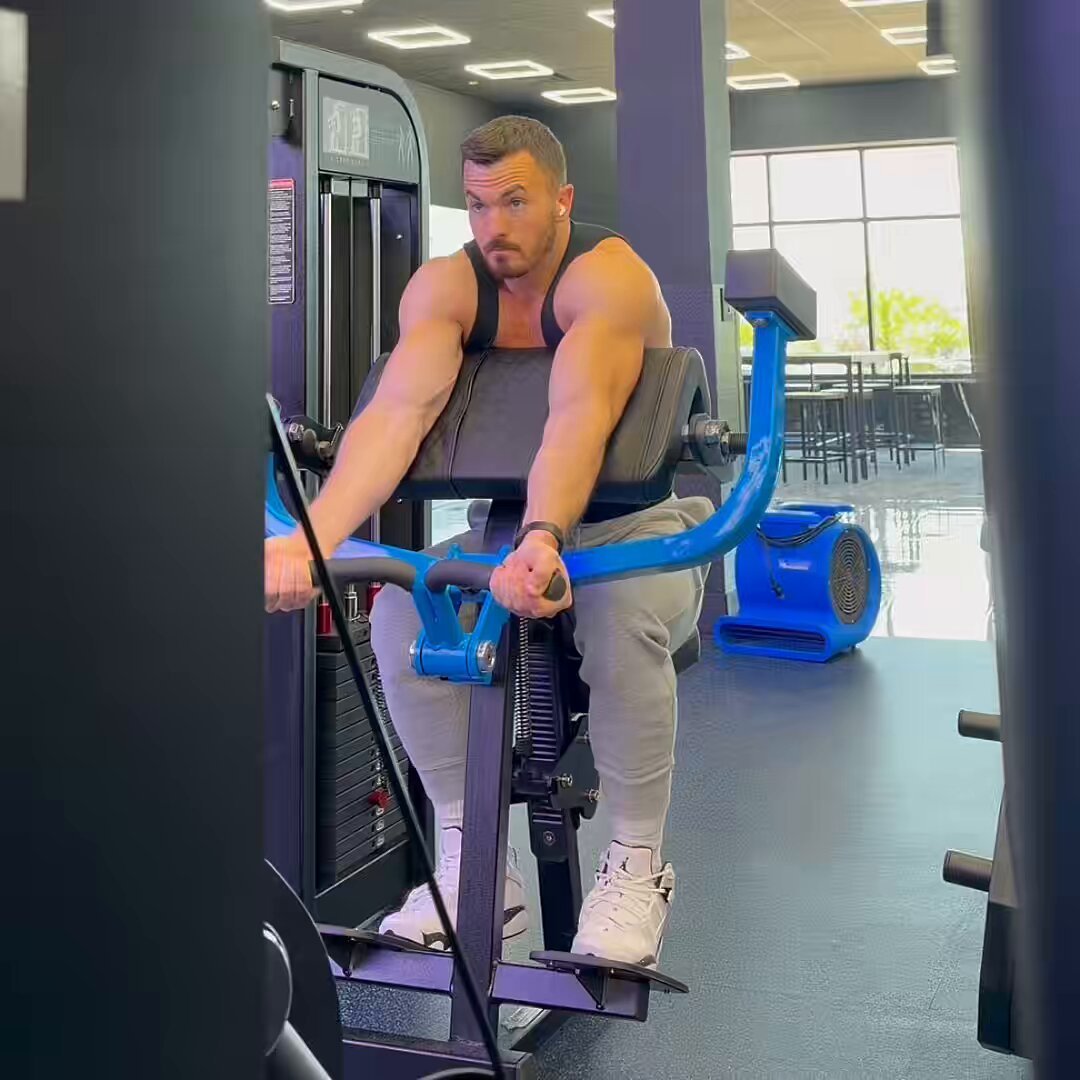
Here’s all the low rep sets from my shoulder session yesterday using the Swole Method Barbell- 9x2 at 225 Single arm- 6x3 at 120 Both arm DBs- 3x6 at 100 11,670 lbs lifted All reps near failure Took 35 minutes

10,626 просмотров • 7 месяцев назад •via X (Twitter)

Комментарии: 0

Нет доступных комментариев

Здесь появятся комментарии из оригинального поста

Похожие видео

Benefits of strengthening our shoulder blade muscles: - Improves your posture. - Relieves neck and shoulder stiffness. - Resolves chronic pain. - Increases push and pull power. Focus on these forgotten heroes for the rest of December. You'll feel and look different by the end of the year. Scapular imbalances are typical in my assessments of clients with chronic pain and posture problems. They have so little muscle mass and strength there that they can barely support their shoulder blades. One side is often way too strong compared to the other. It's normal to have a more dominant side, but too much of a difference will affect you negatively over time. Do 3-5 sets of these exercises twice a week: - DB = Dumbbell. - BW = Body weight. - Rest 60s between exercises. - Rest 48-72 hours between workouts. - All exercises can be done without equipment. Week 1 and Week 3 Day 1 1 - DB Side-Lying External Rotations, 10-12 reps/arm (0:02) 2 - DB Bent-Over Scapular Retractions, 10-12 reps/arm (0:07) Day 2 3 - Unilateral DB T3 Raises, 10-12 reps/arm (0:12) 4 - Bench-Supported Reverse Flys, 10-12 reps (0:16) Week 2 and Week 4 Day 3 5 - Cable Standing 90 Degree External Rotation, 15-20 reps/arm (0:22) 6 - Standing Scapular Retraction, 15-20 reps with a 3s hold each rep (0:27) Day 4 7 - Lying Prone Y Raises, 10-12 reps with a 3s hold at the top of each rep (0:31) 8 - Bent-Over Reverse Fly, 15-20 reps (0:37) // I often discuss these exercises on my timeline because they have helped so many of my clients over the years. Focus on your shoulder blade muscles, and watch your body transform for the new year.

Alex Bernier

21,924 просмотров • 1 год назад

Here’s my controversial opinion why you technically don’t need reps near failure for driving serious muscle hypertrophy This training style truly isn’t for everyone. It’s for the few that are obsessed with getting as big as humanly possible especially for those who have made the decision to stay natty. I have other traditional bodybuilding programs, let me know in the comments if you would like a structured program that uses a more foundational approach I’ll send you a free week. The low rep stuff is what I use, and I like to talk about it, but it’s not even close to the only program or training method I use for others. The people who say it takes too long have never tried this style of training The people who say it takes too long are wrongfully assuming you’re lifting weight that is so heavy you need 3-5 minutes between sets to recover. There are many ways to recruit high threshold motor units, and for hypertrophy doing 7-9 reps to build up fatigue so that the last 2-3 reps your body is forced to recruit these motor units might be the absolute worst way to recruit them The easiest way is to add more weight, then add the effort into the concentric phase of the reps. This way you don’t need reps near failure, and by not needing to train so close to failure, you’re able to repeat sets quicker. Some sets as soon as 30 seconds, some later or last top sets up to 2-3 minutes Regardless, when you use this method you are trading junk volume for meaningful reps. You’re also managing your time in the gym around this concept to cut out all the other exercises you normally have to do This is why people finish these sessions in 75 min or so. If you start a free week of a low rep set program just click the link in bio to start. When you do start, don’t look at just the numbers, the coaching notes are where the most value is when you start the session

Official Strength Debates

18,424 просмотров • 1 месяц назад

🏠 CHEST DAY – At-Home Execution Breakdown Chest doesn’t grow from reps. It grows from controlled tension. Today’s focus: activating both the clavicular head (upper chest) and sternal head (mid/lower chest) of the pec major while stabilizing through the anterior deltoids and triceps. 🔹 1. Dumbbell Flat Press 4–5 sets (bulk) / 3–4 sets (tone) 10–12 reps • Feet planted. • Shoulder blades retracted (pinch them into the bench). • Lower dumbbells 2–3 seconds until elbows hit ~90°. • Press up and slightly inward to increase pec engagement. • Do NOT lock elbows hard at the top — keep tension on chest. 👉 Cue: “Drive your biceps toward each other.” ⸻ 🔹 2. Incline Dumbbell Press Targets upper chest. • Bench at 30–45° (not too steep). • Keep chest lifted, ribs down. • Lower with control. • Press up on a slight arc — not straight vertical. 👉 If you feel it mostly in shoulders, lower the incline. ⸻ 🔹 3. Cable Chest Fly Isolation movement. • Set cables at mid-chest height. • Soft bend in elbows (don’t turn it into a press). • Stretch fully — let pec fibers lengthen. • Bring handles together and squeeze 1–2 seconds at midline. 👉 Think “hug a tree” not “push forward.” ⸻ 🔹 4. Chest Press Machine Controlled overload. • Keep lower back slightly arched. • Chest up. • Slow eccentric (3 sec down). • Drive through palms, not shoulders. 👉 Stop 1–2 reps before form breaks if bulking. 👉 Go to near failure if toning. ⸻ 🔹 5. Push-Up Finisher Burnout set. • Hands slightly wider than shoulders. • Lower chest to floor with control. • Core tight, glutes engaged. • Push until 1–2 reps shy of failure. ⸻ 📊 Programming Guide 🔸 Toning → 3–4 sets, 10–12 reps, last set near failure 🔸 Bulking → 4–5 sets, progressive overload weekly 🔸 Rest: 60–90 sec 🔸 Tempo: Control the negative. Explode the positive. Muscle responds to tension, not ego. If you train at home, there’s no excuse. Save this for your next chest day. If you want your at-home setup programmed specifically for YOUR physique goals, tap in.

Y A V

1,276,823 просмотров • 5 месяцев назад

Example of a true working set... You’re probably doing way more sets than you need Trust me ⁠ Back in high school and college, I would lift 7 days a week, doing anywhere from 30 to 50 sets per day I used to think those 30-50 sets were the key to growth, but over time, I realized that most of those weren’t true working sets ⁠ Here’s the thing... If you can do 4 sets of 8 reps with the same weight each set, you’re probably not pushing yourself hard enough A true working set should leave you near failure within the target rep range ⁠ For example, let’s say your plan calls for 2 sets of 6-8 reps After a few warm up sets, you try 135 lbs and hit 8 reps, but you know you could have done 6 more That’s still a warm up set since you’re not reaching failure in the 6-8 rep range You’d then go up to 145 lbs and aim to fail around 6-8 reps If 145 still feels too light, that’s another warm up set You keep going up in weight until you find the load that challenges you to fail within that 6-8 range If you don’t have a spotter, leaving one or two reps in the tank is okay ⁠ This is where true muscle growth happens, by pushing close to your limit Sleep and diet is actually where muscle growth occurs but you never push yourself hard enough in the gym and give your body a reason to grow, hypertrophy will never happen The gym is just the stimulus to give the muscle a reason to grow We then get bigger through sleep and diet ⁠ Back to the working sets... For example, in the video, I hit 540 lbs for 8 reps on this hack squat Looking back, I feel I had one or two reps left, but it’s a solid starting point and it was a new PR for me at the time The next week, I would aim for 540 for 9-10 reps or bump up the weight to 545-550 and try to hit 8 reps aka progressive overload ⁠ I typically keep my quad and hamstring workouts separate and do only about 4-7 sets per muscle group, but each set is intense, and I’m struggling by the last few reps on each set ⁠ Give this approach a shot, and I promise you won’t need nearly as many sets as you think

Bailey Schober | Men’s Fitness & Nutrition Coach

23,353 просмотров • 5 месяцев назад

🚨 SPACEX IS DONE? It opened at $150, ripped to $225 in three days, and everyone called it the buy of the decade. Now it's at $145 - an all-time low, below the open, sitting a few dollars above the IPO price. Down 35% from the top. The chart isn't breaking. It already broke. And this was the easy part. Here's where it goes from here: $145 → $135 → $120 → $100 Why this has to happen the math is brutal and public: → Only ~4% of shares actually trade. Nasdaq bent the float rule just to let this listing through. → It got jammed into the indexes, and every passive fund on the planet was forced to buy near the top. → Insiders still hold 96% of the supply. → The first unlock hits on August 6 - right at Q2 earnings. About 20% of insider shares go free, and the float doubles overnight. → Then it doubles again through the fall, all the way to a full unlock. Sit with that. This entire 35% collapse happened on a tiny float, with no supply. The actual wall of stock hasn't even arrived yet. And look at the backdrop: Apple's printing new all-time highs while SPCX bleeds to fresh lows. That's not a market problem that's a SpaceX problem. The hype died, the capex is enormous, the valuation is priced at ~100x sales, and the unlock cliff is dead ahead. Everything I said would happen is happening. No surprises. The next leg is where the real money gets made but not on the long side yet. Save this. Turn on notifications. Or come back in 30 days wishing you had.

Shelpid.WI3M

351,385 просмотров • 18 дней назад

People always ask me how I’m so good at pull ups given I’m 280+ pounds. My simple answer is bc I started treating them and training them just like my barbell strength exercises. Here are 3 variations to improve muscle density and strength The key IMO got real density should start at training muscles at end range. There are 3 approaches that I use and that I program for others. First, you’ll see a traditional rep. The important thing is the rep is using full range of motion. The traditional rep allows me to utilize the stretch shortening cycle to improve my elastic strength. Next, you’ll see me using Deadhang Pull Ups. Think of this like a paused rep on bench or squat. You are eliminating the stretch shortening cycle and improving rate of force development WHILE your feet are suspended and the lats are fully loaded and have tension. This is a key distinction from the 3rd approach Power Pull Up. This is the same idea the I use on the Power Row, or some may be more familiar with the Pendlay Row. The difference you will see is I’m standing on a pad. This allows me to pause at the bottom BUT my lats are lengthened but UNLOADED. There’s no weight or tension when I start and initiate my pull up. You’ll even see I remove my fingers completely got each rep Using the all together in an intelligent program that organizes stress and variation appropriately is the key to maxing your pull up potential.

Official Strength Debates

91,696 просмотров • 3 месяцев назад

Training to failure isn’t needed to max gains? Some people believe that you must take every set to failure in order to maximize muscle gains, but emerging literature suggests this may not be the case A new study examined training to failure vs stopping 1 to 2 reps shy of failure & found that the participants gained the same amount of muscle mass from both training styles There are several strengths to this study. First of all, they used a unilateral design where each participant was their own control by training one leg taking each set to failure and stopping 1-2 reps shy on the other. This helps negate any genetic induced differences since each person is acting as their own control Second, they matched training volumes to the participants previous volumes. This is a HUGE strength that is often overlooked in other studies Third, they used participants that were well trained (at least 3 years resistance training experience) Fourth, they had them all eat in a slight calorie surplus This adds to a growing body of literature demonstrating that training to absolute failure isn’t needed for gains & is likely counterproductive for optimal strength gains due to excess fatigue Interestingly, each group had no difference in total reps performed. That may seem strange when one group is going to failure but the other is stopping 1-2 reps shy. This can be explained by lower inter-set fatigue in the non failure group. For example if a failure group hits failure at 10 reps in set 1, they may only get 8 on the next set, and 6 on the next set. Whereas they might have been able to do 8 reps every set if they didn’t go to all out failure. As such, if you do train to failure I recommend only going to failure on your very last set of an exercise If you want to know how to implement this sort of programming make sure you check out the Biolayne Workoit Builder to get access to all my evidence based programs to help you get strong AF & build muscle 👊

Layne Norton, PhD

48,374 просмотров • 2 лет назад

Here’s EVERYTHING you need to know about warm up sets: Most people are doing warm up sets ALL wrong and they’re costing themselves from an efficiency/effectiveness standpoint as a result Warm ups are designed to A) guard against injury B) prepare you for your working sets Warm up sets should NEVER be taken in close proximity to failure…most should see you leaving 6, 7, 8+ reps in reserve (the lone exception to this = sets performed for 1-2 reps @ ~90+ of your intended working weight) This is in STARK CONTRAST to working sets which should all end around 0-2 RIR You probably need about ~2 warm up sets before your first exercise or two depending on the specifics of your programming Here is an example of a typical warm up protocol: - a 5-10 minute brisk walk on the treadmill (optional) - 50% of your working weight on your first exercise for ~12 reps (mandatory) - 75% of your working weight on your first exercise for ~6 reps (mandatory) - 90% of your working weight on your first exercise for ~2 reps (optional) After you complete the working sets for your first exercise, you may want to repeat the last 3 steps prior to performing your next exercise IF it is an antagonist exercise (Ex: Lat Pull-Down after Sternal Pecs Machine Press OR Seated Leg Curls after Hack Squats) After that, you probably don’t need any additional warm up sets unless you are just using them as “primers” (sets to make sure your movement pattern / the machine settings / etc. are on point) - If doing a PUSH workout, I’m probably using 2-3 warm up sets before my first exercise only (assuming it’s a multi joint movement) - If doing a PULL workout, I’m probably using 2-3 warm up sets before my first exercise only (assuming it’s a multi joint movement) - If doing an UPPER workout, I’m probably using 2-3 warm up sets before my first exercise and 1-2 warm up sets before my second exercise (assuming they’re antagonist multi joint movements) - If doing an LOWER workout, I’m probably using 2-3 warm up sets before my first exercise and 1-2 warm up sets before my second exercise (assuming they’re antagonist multi joint movements) - If doing a FULL BODY workout, I’m probably using 2-3 warm up sets before my first exercise, 1-2 warm up sets before my second exercise, and may even 1-2 warm up sets before my third and fourth exercises as well (assuming they’re all multi joint movements — antagonist push/pull movements for both upper & lower) (As you can see, the major downside of FULL BODY workouts is often the excess warm up time needed — this is why they work best for beginners much of the time) General rule of thumb: If your first set of an exercise is NOT your best set of that exercise in terms of performance (assuming we equate RIR), you are NOT warming up properly You should see a fall off in performance as sets transpire on a given exercise…this is a feature, not a bug of productive/effective resistance exercise WHEN WARMED UP PROPERLY

Dean Turner

53,653 просмотров • 5 месяцев назад