Загрузка видео...

Не удалось загрузить видео

На главную

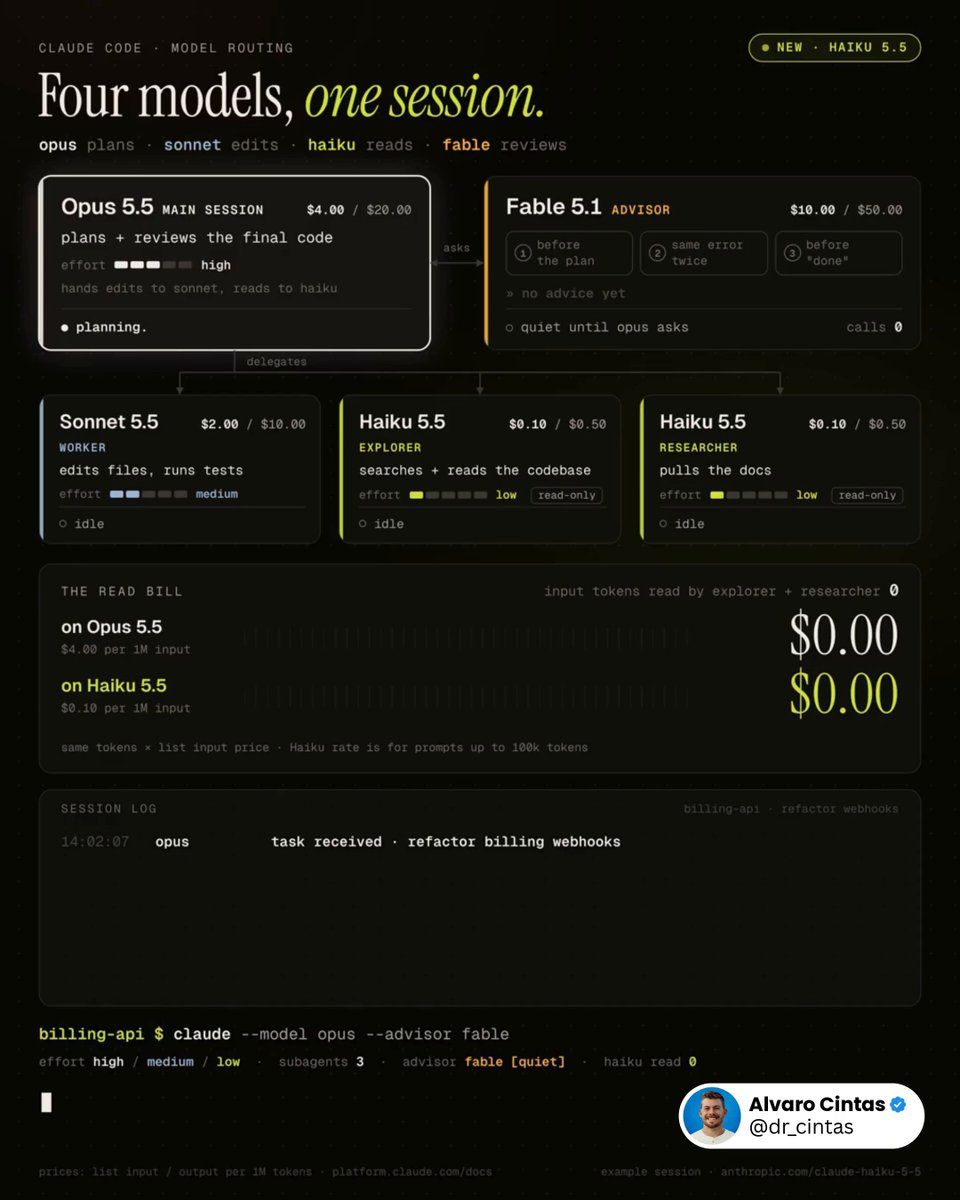
holy sh*t. Official Anthropic tip for Claude Code: stop burning Opus 5.5 context on tasks Haiku 5.5 can swarm, while Sonnet 5.5 builds put the architect on call with /advisor claude --advisor opus --subagents haiku Sonnet 5.5 drives the primary session on high effort, writing diffs and running test...

610,241 просмотров • 1 день назад •via X (Twitter)

Комментарии: 33

Фото профиля Lexeme
Lexeme1 день назад

This is way too much Ai brain rot. Im just gonna continue running opus nonstop

Фото профиля Paths
Paths1 день назад

all this for 5% more token usage and 140% more complete garbage code output

Фото профиля Meep
Meep1 день назад

Literally just provide Opus 5.5 the docs & Anthropic benchmarks for Sonnet / Haiku /Opus, tell it to create agents based on their specialities and best use cases, ask it to go through history and find repetitive work and create agents who specialize in handling those repetitive niche tasks. That’s literally it. Continue to use Opus 5.5 as your main model and watch it become hyper efficient.

Фото профиля marfin
marfin1 день назад

in fact, many people underestimate the new haiku 5.5 with this model, you can save a huge amount of money and time

Фото профиля John
John22 часов назад

None of this stuff works, do people not realise that yet. It just burns tokens, whilst simultaneously giving the appearance that it doesn't it's like having 16 people passing things to someone who's 10 metres away when you could just walk there yourself.

Фото профиля MYSTARQUEST🍁
MYSTARQUEST🍁1 день назад

Why isn’t the AI better at assigning the model than I am at picking it.

Фото профиля Hadi debs
Hadi debs1 день назад

How do you get that gorgeous ascii chart from rendering in your terminal?

Фото профиля taylor
taylor1 день назад

I feel like this is almost exactly what I do but like way, way simpler? Hey sonnet do this, you’re the orchestrator, use opus as an auditor or if something hard comes up, use haiku subagents liberally to build but keep their context window under 100k And then it does it lol

Фото профиля Anderson
Anderson1 день назад

the claude.md file carrying your entire workflow

Фото профиля Mark Kashef
Mark Kashef1 день назад

This is too much for a space that moves so fast Need to be nimble

Фото профиля pasketti
pasketti1 день назад

bro just saying stuff

Фото профиля Splenda for scale
Splenda for scale1 день назад

Same story Everytime. Before it was “use fable and opus can swarm”. Then it was “ use opus with fable as an advisor while sonnet swarms “. Now it’s this. wtf lol. These posts will never end.

Фото профиля Karl
Karl1 день назад

We need an actual fact check on this

Фото профиля Alex T
Alex T1 день назад

Why not just use Opus for everything though? I guess if I was paying API prices it’d be different. But I just don’t think this is worth the hassle. I’m nowhere near meeting my usage every week on Max

Фото профиля Morgan
Morgan1 день назад

And this is where I ask, how is this better then just using Orca? Because Orca is simple, easy and just works

Фото профиля wiiiimm
wiiiimm1 день назад

i would keep fable on advisor role. it can handle things and make better planning and UX UI decisions than Opus

Фото профиля Nico
Nico1 день назад

meanwhile i'm out here using opus to change a button color

Фото профиля 𝙻𝚘𝚐𝚊𝚗 𝚆𝚘𝚘𝚕𝚏
𝙻𝚘𝚐𝚊𝚗 𝚆𝚘𝚘𝚕𝚏1 день назад

there is no --subagents argument

Фото профиля 雪慕斯
雪慕斯1 день назад

When swarming repo discovery with Haiku 5.5 subagents, how does Claude Code isolate transient search logs from the main session context? Do subagents emit compact summaries back to Sonnet 5.5, or does the full tool trace get passed to Opus 5.5 when /advisor triggers?

Фото профиля Aaron
Aaron1 день назад

@grok how can this be done when using Claude code online?

Фото профиля Standard Issue Blueberry
Standard Issue Blueberry1 день назад

Show us the code before and then after your markdown file.

Фото профиля Kayode
Kayode1 день назад

The role split makes sense. I'd pair it with explicit handoff contracts: what evidence each worker returns, when to escalate, and what blocks 'done' if review is skipped. The failures worth catching are the ones that look successful because something was never checked.

Фото профиля beamnxw ./
beamnxw ./1 день назад

sonnet builds, haiku swarms, opus reviews is a really clean division

Фото профиля Borislav Enchev
Borislav Enchev1 день назад

and in the end Opus alone is better 😆

Фото профиля designgears
designgears1 день назад

Sonnet 5.5 needs to be on high to be decent, token burn from high makes it more expressive than Opus 5.5.

Фото профиля pablofelix.eth
pablofelix.eth1 день назад

This is not how this works. It is like mixing drinks in a storm. We still have turbulence. Yesterday, I saw an agent juggling tasks. It was chaos. Adding layers is like putting a bow on a broken seatbelt. Let's fix the basics first.

Фото профиля joão
joão1 день назад

@leandronsp da uma olhada kkkkkkkkk

Фото профиля Aditya
Aditya1 день назад

@sambhavdixitpro sharing this with ya, advisor is sick 💪🏼

Фото профиля M M
M M1 день назад

People replying to their own articles is puke-worthy cringe.

Фото профиля Alyssa
Alyssa22 часов назад

Splitting roles by model is the right instinct. What fixed it for me one level up: each swarm gets its own space and one coordinator hands out the tasks, so cheap agents never touch another swarm's work.

Фото профиля Hale
Hale1 день назад

"Stop burning Opus context" is the 2026 version of "have you tried turning it off and on again." Dev wisdom never changes, just the invoices.

Фото профиля Vassteel
Vassteel1 день назад

What's real and what isn't Real: /advisor, claude --advisor opus, and the advisorModel setting all exist. Sonnet 5.5 as the main model with Opus as the advisor is an accepted pairing. You can steer when the advisor gets called. Claude decides when to call it, with no setting to force it, but the docs say instructions are how you influence it, so the CLAUDE.md checkpoint idea works as guidance. You can run subagents on Haiku with their own effort level. This is done through env vars or agent frontmatter, not a flag. Not real: --subagents haiku: there's no such flag. "Parallel dispatcher pool (3x workers)": no such setting. The closest thing is CLAUDE_CODE_MAX_CONCURRENT_SUBAGENTS. It's a cap (default 20), so setting it to 3 would make things slower. "JEV micro-fork layer," "1,500 branches in 16ms," "340 tok/s": these aren't Claude Code features. It's marketing copy. Three things the post leaves out: Subagents inherit the advisor too. Haiku subagents can call Opus, which adds Opus-rate tokens to your discovery work. You can't turn this off per subagent. The advisor only works on the Anthropic API, not Bedrock or Vertex. It also silently stays off if you've set DISABLE_TELEMETRY or anything else that blocks feature-flag fetching. A top-level effortLevel in your user settings is ignored by Opus 5.5 and newer models. Use per-model modelSettings instead.

Фото профиля ♡ Sofie h.
♡ Sofie h.1 день назад

Routing Opus to advisor only helps if the advisor sees the same context the subagents do; otherwise you have a smart reviewer guessing at state. How do contracts and durable state get shared across the Haiku swarm without re-burning context?

Похожие видео

Official Anthropic tip for Claude Code: stop burning Opus 5.5 on work Sonnet 5.5 can do, while Fable 5.1 sits idle hand the grunt work to Sonnet 5.5 subagents and put Fable 5.1 on call run /advisor fable Opus 5.5 plans and merges Sonnet 5.5 subagents read, edit and run the tests Fable 5.1 reads the full session and only speaks up at three points: → before a plan: is this the right approach? → when the same error comes back: am I digging in the wrong place? → before "done": what did I miss? Sonnet 5.5 builds. Fable 5.1 reviews. Opus 5.5 ships Jev engineering is the same move one layer down: the forks that need no thinker (which file, which tool, retry or stop) go to Jev in under half a second, and the big models only see the ones that split - the full tree > Opus 5.5 on high runs the main session > explorer reads the code on Sonnet 5.5 > worker edits and runs tests on Sonnet 5.5 > researcher pulls the docs on Sonnet 5.5 > all three on medium > Fable 5.1 on call for main and every subagent paste the tree and this prompt into Claude Code ↓ "Rebuild my Claude Code setup around this tree: 1. Check ~/.claude/agents and .claude/agents for subagents that already fit explorer, worker and researcher. > Draft new ones only for missing roles > Give each model: sonnet, effort: medium > Skip any that pin a different model and list them 2. Set the main session to high via effortLevel in ~/.claude/settings.json, and set advisorModel to fable 3. Find anything that keeps the advisor off (CLAUDE_CODE_DISABLE_ADVISOR_TOOL, DISABLE_TELEMETRY) plus CLAUDE_CODE_EFFORT_LEVEL, which overrides subagent effort. Report them, change nothing 4. Add one rule to ~/.claude/CLAUDE.md: consult the advisor before a large plan, when an error repeats, and before calling a long task done Show me every change as a diff first. No edits until I say go." ↳

delost

43,704 просмотров • 6 дней назад

This is f*cking insane. This Claude Code tip saved me thousands of dollars. once Opus 5.5 is your main model, stop burning it on work Sonnet 5.5 can do, while Fable 5.1 sits idle hand the grunt work to Sonnet 5.5 subagents and put Fable 5.1 on call run /advisor fable Opus 5.5 plans and ships the final code Sonnet 5.5 subagents read, edit and run the tests Fable 5.1 reads the full session, every tool call included, and only speaks up at three points: → before a plan: is this the right approach? → when the same error comes back: am I digging in the wrong place? → before "done": what did I miss? Sonnet 5.5 builds. Fable 5.1 reviews. Opus 5.5 ships Jev engineering is the same move one layer down: the forks that need no thinker (which file, which tool, retry or stop) go to Jev in under half a second, and the big models only see the ones that split anyone still running one model for everything is paying Opus prices to decide whether a file exists - the full tree > Opus 5.5 on high runs the main session > explorer reads the code on Sonnet 5.5 > worker edits and runs tests on Sonnet 5.5 > researcher pulls the docs on Sonnet 5.5 > all three on medium > Fable 5.1 on call for main and every subagent paste the tree and this prompt into Claude Code ↓ "Rebuild my Claude Code setup around this tree: 1. Check ~/.claude/agents and .claude/agents for subagents that already fit explorer, worker and researcher. > Draft new ones only for missing roles > Give each model: sonnet, effort: medium > Skip any that pin a different model and list them 2. Set the main session to high via effortLevel in ~/.claude/settings.json, and set advisorModel to fable 3. Find anything that keeps the advisor off (CLAUDE_CODE_DISABLE_ADVISOR_TOOL, DISABLE_TELEMETRY) plus CLAUDE_CODE_EFFORT_LEVEL, which overrides subagent effort. Report them, change nothing 4. Add one rule to ~/.claude/CLAUDE.md: consult the advisor before a large plan, when an error repeats, and before calling a long task done Show me every change as a diff first. No edits until I say go." ↳

delost

48,238 просмотров • 5 дней назад

This workflow will save you thousands with Claude. Run Opus 5.5, Sonnet 5.5, Haiku 5.5, and Fable 5.1 together, and stop spending Opus tokens on work that doesn't need Opus. The entire idea in one line: Opus plans, Sonnet edits, Haiku reads, Fable reviews at decision points. Roles, broken down: - Opus 5.5, high effort, owns the plan and reviews the final code - Sonnet 5.5, medium effort, is the worker: edits files, runs tests - Haiku 5.5, low effort, splits into explorer (searches and reads the codebase) and researcher (pulls docs). it's the first Haiku with an effort setting - Fable 5.1, set with /advisor fable. Opus calls it at decision points, and it gets the full transcript each time Three moments Opus tends to call it: → before committing to a plan: is this the right approach? → the same error shows up again: is this going nowhere? → before marking the task done: did something get skipped? Why Haiku only reads: Anthropic's launch post says Sonnet 5.5 and Opus 5.5 are still the better choice for complex agentic coding (Terminal-Bench 4.0: 39.2% for Haiku 5.5, 70.6% for Sonnet 5.5) and that Haiku 5.5 fits narrowly scoped subagent work. so it gets the lookups, not the edits. Anyone still running one model for everything is paying $4 per million input tokens to check whether a file exists. Haiku 5.5 does it for $0.10. Drop this into Claude Code 👇 "Rebuild my Claude Code setup around this structure: Confirm Claude Code is v2.1.293 or later, so the haiku alias resolves to Haiku 5.5. If it isn't, stop and tell me to run claude update. Look through ~/.claude/agents and .claude/agents for subagents already covering explorer, worker, and researcher. Only create new ones for roles that are missing. Set model: haiku, effort: low on explorer and researcher, with no Edit or Write tools. Set model: sonnet, effort: medium on worker. If an existing subagent is locked to a different model, leave it as is and just list it. Name the explorer subagent Explore so it overrides the built-in one, which otherwise runs on my main model. In ~/.claude/settings.json, set advisorModel to fable, and set effortLevel to high for claude-opus-5-5 under modelSettings. A top-level effortLevel in user settings doesn't apply to Opus 5.5. Check for anything disabling the advisor: CLAUDE_CODE_DISABLE_ADVISOR_TOOL, DISABLE_TELEMETRY, or anything blocking feature-flag fetches. Also check CLAUDE_CODE_EFFORT_LEVEL, which overrides subagent effort settings, and CLAUDE_CODE_SUBAGENT_MODEL_FORCE, which makes Claude Code ignore subagent model fields. Report what you find. Don't change any of it yet. Add one line to ~/.claude/CLAUDE.md: consult the advisor before a big plan, when the same error shows up twice, and before marking a long task done. Show every change as a diff first. Wait for my go-ahead before touching anything."

Alvaro Cintas

51,598 просмотров • 1 день назад

Claude Code tip: keep Opus 5.5 as your main model, but stop paying Opus prices for your subagents move them to Sonnet 5.5 Opus 5.5 plans and decides Sonnet 5.5 subagents do the heavy reading, editing and testing at half the price ($2 / $10 vs $4 / $20 per 1M tokens) Fable 5.1 stays on call with /advisor and only speaks up at three points: → before a plan: is this the right approach? → when the same error comes back: am I digging in the wrong place? → before "done": what did I miss? Opus thinks. Sonnet does. Fable checks Jev engineering is the same move one layer down: the forks that need no thinker (which file, which tool, retry or stop) go to Jev in under half a second, and the big models only see the ones that split - the full tree > Opus 5.5 on high runs the main session > explorer reads the code > worker edits and runs tests > researcher pulls the docs > all three on Sonnet 5.5, medium > Fable 5.1 on call as the advisor paste the tree and this prompt into Claude Code ↓ "Rebuild my Claude Code setup around this tree: 1. Check ~/.claude/agents and .claude/agents for subagents that already fit explorer, worker and researcher. > Draft new ones only for missing roles > Give each model: claude-sonnet-5-5, effort: medium > List any that pin a different model before changing them 2. Keep the main session on Opus, set effortLevel to high in ~/.claude/settings.json and advisorModel to fable 3. Find anything that keeps the advisor off (CLAUDE_CODE_DISABLE_ADVISOR_TOOL, DISABLE_TELEMETRY, any variable that stops feature-flag fetching) plus CLAUDE_CODE_EFFORT_LEVEL, which overrides subagent effort. Report them, change nothing 4. Add one rule to ~/.claude/CLAUDE.md: consult the advisor before a large plan, when an error repeats, and before calling a long task done Show me every change as a diff first. No edits until I say go." ↳

delost

27,459 просмотров • 7 дней назад

Claude Code tip: once Opus 5.5 runs your main session, stop leaving Fable 5.1 on the bench put it on call with /advisor run /advisor fable Opus 5.5 keeps writing the code Fable 5.1 reads the whole session, every tool call included, and only speaks up at three moments: → before a plan: is this the right approach? → when the same error comes back: am I digging in the wrong place? → before "done": what did I miss? Fable 5.1 reviews. Opus 5.5 ships jev engineering is the same move one layer down: the forks that need no thinker (which file, which tool, retry or stop) go to jev in under half a second, and the big model only sees the ones that split - the full tree > Opus 5.5 on high runs the main session > explorer reads the code > worker edits and runs tests > researcher pulls the docs > all three on medium > Fable 5.1 on call as the advisor paste the tree and this prompt into Claude Code ↓ "Rebuild my Claude Code setup around this tree: 1. Check ~/.claude/agents and .claude/agents for subagents that already fit explorer, worker and researcher. > Draft new ones only for missing roles > Give each model: opus, effort: medium > Skip any that pin a different model and list them 2. Set the main session to high via effortLevel in ~/.claude/settings.json, and set advisorModel to fable 3. Find anything that keeps the advisor off (CLAUDE_CODE_DISABLE_ADVISOR_TOOL, DISABLE_TELEMETRY, any variable that stops feature-flag fetching) plus CLAUDE_CODE_EFFORT_LEVEL, which overrides subagent effort. Report them, change nothing 4. Add one rule to ~/.claude/CLAUDE.md: consult the advisor before a large plan, when an error repeats, and before calling a long task done Show me every change as a diff first. No edits until I say go." ↳

Hanako

52,065 просмотров • 8 дней назад

Claude Code tip: once Opus 5.5 is your main model, stop leaving Fable 5.1 sitting idle put it on call with /advisor run /advisor fable Opus 5.5 keeps writing the code Fable 5.1 reads the full session, every tool call included, and only speaks up at three points: → before a plan: is this the right approach? → when the same error comes back: am I digging in the wrong place? → before "done": what did I miss? Fable 5.1 reviews. Opus 5.5 ships Jev engineering is the same move one layer down: the forks that need no thinker (which file, which tool, retry or stop) go to Jev in under half a second, and the big model only sees the ones that split - the full tree > Opus 5.5 on high runs the main session > explorer reads the code > worker edits and runs tests > researcher pulls the docs > all three on medium > Fable 5.1 on call as the advisor paste the tree and this prompt into Claude Code ↓ "Rebuild my Claude Code setup around this tree: 1. Check ~/.claude/agents and .claude/agents for subagents that already fit explorer, worker and researcher. > Draft new ones only for missing roles > Give each model: opus, effort: medium > Skip any that pin a different model and list them 2. Set the main session to high via effortLevel in ~/.claude/settings.json, and set advisorModel to fable 3. Find anything that keeps the advisor off (CLAUDE_CODE_DISABLE_ADVISOR_TOOL, DISABLE_TELEMETRY, any variable that stops feature-flag fetching) plus CLAUDE_CODE_EFFORT_LEVEL, which overrides subagent effort. Report them, change nothing 4. Add one rule to ~/.claude/CLAUDE.md: consult the advisor before a large plan, when an error repeats, and before calling a long task done Show me every change as a diff first. No edits until I say go." ↳

delost

693,243 просмотров • 10 дней назад

Claude Code tip, and it's absolute free f*cking gold: run Opus 5.5, Sonnet 5.5 and Fable 5.1 as one team and stop burning Opus tokens on routine work the setup in one line: plan on high, delegate on medium, keep Fable on call • who does what > Opus 5.5 on high - plans and ships the code > Sonnet 5.5 on medium - explorer reads code, worker edits and runs tests, researcher pulls docs > Fable 5.1 via /advisor fable - reads the whole session and speaks up only when it matters • when Fable 5.1 steps in -> before a plan: is this the right approach? -> when an error repeats: am I digging in the wrong place? -> before "done": what did I miss? Jev engineering takes it one layer lower: which file, which tool, retry or stop all go to Jev in under half a second, so the big models only see the real forks paste this into Claude Code ↓ "Rebuild my Claude Code setup: 1. Find subagents in ~/.claude/agents and .claude/agents that fit explorer, worker and researcher. Draft only the missing ones. Set each to model: sonnet, effort: medium. List any that pin a different model and leave them 2. In ~/.claude/settings.json set effortLevel to high and advisorModel to fable. 3. Report anything that disables the advisor (CLAUDE_CODE_DISABLE_ADVISOR_TOOL, DISABLE_TELEMETRY, flag-fetching blockers) and CLAUDE_CODE_EFFORT_LEVEL. Change nothing. 4. Add to ~/.claude/CLAUDE.md: consult the advisor before a large plan, when an error repeats, and before calling a long task done. Show every change as a diff. No edits until I say go." ↳

Mr. Buzzoni

142,491 просмотров • 8 дней назад

Claude Code tip: once Opus 5.5 is your main model, stop letting your Fable 5.1 quota go to waste put it on call with /advisor run /advisor fable Opus 5.5 keeps doing the work Fable 5.1 sits on the sidelines, reads the whole session, and steps in at three moments: → before a plan: is this right? → when the same error comes back: am I going the wrong way? → before "done": did I miss anything? Fable 5.1 advises. Opus 5.5 writes the code the same idea sits under Jev engineering: the expensive model stops weighing in on every step and only gets called at the moments that change the outcome • the full setup > Opus 5.5 on high runs the main session > subagent one reads code > subagent two edits and runs tests > subagent three looks up docs > all three on medium > Fable 5.1 on call hand the tree and this prompt to Claude Code 👇 "Set up my Claude Code to match this tree: 1. Reuse fitting subagents from ~/.claude/agents and .claude/agents. > Propose new ones only for missing roles > Set each to model: opus, effort: medium > Leave any that set a different model alone and list them 2. Set main session effort to high via effortLevel in ~/.claude/settings.json 3. Check for env vars that disable the advisor (CLAUDE_CODE_DISABLE_ADVISOR_TOOL, DISABLE_TELEMETRY, anything that stops flag fetching) and CLAUDE_CODE_EFFORT_LEVEL, which overrides subagent effort. Report them, don't change them 4. Add a rule to ~/.claude/CLAUDE.md: ask the advisor before a big plan, when an error repeats, and before calling a long task done Show me the changes first. Don't edit files yet." ↳

Mr. Buzzoni

324,448 просмотров • 10 дней назад

this is straight f*cking gold for anyone on Claude Code you already pay for Fable 5.1, and while Opus 5.5 does all the work it just sits there one command puts it on your session as a senior reviewer: /advisor fable Opus 5.5 keeps writing the code Fable 5.1 reads the whole session, every tool call included, and speaks up at three moments only: > before a plan: is this the right approach? > when the same error comes back: am I digging in the wrong place? > before "done": what did I miss? Fable 5.1 reviews. Opus 5.5 ships Jev engineering does the same thing one layer down: forks that need no thinker (which file, which tool, retry or stop) go to Jev in under half a second, and the big model only sees the ones that actually split • the full tree > Opus 5.5 on high runs the main session > explorer reads the code > worker edits and runs tests > researcher pulls the docs > all three on medium > Fable 5.1 on call as the advisor paste the tree and this prompt into Claude Code ↓ "Rebuild my Claude Code setup around this tree: 1. Check ~/.claude/agents and .claude/agents for subagents that already fit explorer, worker and researcher. Draft new ones only for missing roles. Give each model: opus, effort: medium. Skip any that pin a different model and list them. 2. Set the main session to high via effortLevel in ~/.claude/settings.json, and set advisorModel to fable. 3. Find anything that keeps the advisor off (CLAUDE_CODE_DISABLE_ADVISOR_TOOL, DISABLE_TELEMETRY, any variable that stops feature-flag fetching) plus CLAUDE_CODE_EFFORT_LEVEL, which overrides subagent effort. Report them, change nothing. 4. Add one rule to ~/.claude/CLAUDE.md: consult the advisor before a large plan, when an error repeats, and before calling a long task done. Show me every change as a diff first. No edits until I say go" ↳

Annatar.md

74,132 просмотров • 8 дней назад

Claude Code tip: stop burning Opus 5.5 context on tasks Sonnet 5.5 can swarm, while Fable 5.1 sits idle spin up an autonomous team with --agent claude --agent architect Opus 5.5 acts as the lead architect, scoping the work and validating every worktree before it merges Sonnet 5.5 teammates take isolated git worktrees and hammer out implementations at medium effort Fable 5.1 sits on the team as a dedicated adversary, only stepping in at three critical moments: → before a contract locks: does the frontend payload match the backend schema? → when a test breaks twice: are we patching the bug or just hiding the symptom? → before the merge: what attack surface or edge case did everyone overlook? Sonnet 5.5 builds. Fable 5.1 challenges. Opus 5.5 merges and ships Jev engineering runs the identical pattern one layer down: mechanical decisions that need no reasoning (which file to open, which tool to invoke, retry or abort) execute in 16ms, so the frontier models only wake up when execution paths actually diverge Plan on high. Delegate on medium. Keep the adversary on peer-to-peer call. - the full team setup > architect runs the main session on Opus 5.5 at high effort > teammate-ux builds client state inside its own git worktree > teammate-back writes endpoints and migrations inside a separate worktree > teammate-adv runs on Fable 5.1, read-only, and attacks every diff > teammates message each other by name without routing through the lead > tools: Agent(ux, backend, adversary) locks the architect to spawning only its own team paste the setup and this prompt into Claude Code below: "Configure my Claude Code workspace for an autonomous agent team: 1. Audit ~/.claude/agents and .claude/agents for definitions fitting architect, ux, backend and adversary > Generate definitions only for missing roles > Pin model: sonnet, effort: medium, isolation: worktree for ux and backend, and model: fable with read-only tools for adversary > Give architect model: opus, effort: high and tools: Agent(ux, backend, adversary) 2. Check ~/.claude/settings.json and my env: > Report CLAUDE_CODE_EXPERIMENTAL_AGENT_TEAMS if it's set, since it turns named subagents into teammates without worktrees > Report CLAUDE_CODE_SUBAGENT_MODEL_FORCE and CLAUDE_CODE_EFFORT_LEVEL, which can override the pinned models and effort 3. Write each role's prompt so ux and backend own separate folders, message each other by name when a contract changes, and hand every diff to adversary before reporting back 4. Add a team rule to ~/.claude/CLAUDE.md: no worktree merges until adversary has reviewed it Show every configuration diff first. Do not apply edits until confirmed" save it

Khairallah AL-Awady

32,018 просмотров • 2 дней назад

This is f*cking insane. This tip saved me thousands of dollars. run Opus 5.5, Sonnet 5.5, and Fable 5.1 together, and stop burning Opus on work it was never needed for. the whole idea in one line: the strong model plans, the mid-tier model executes, Fable stays quiet until it's actually needed. roles, broken down: Opus 5.5, high effort, owns the plan and ships the final code Sonnet 5.5, medium effort, splits into explorer (reads the codebase), worker (edits files, runs tests), researcher (pulls docs) Fable 5.1, called through /advisor fable, reads everything happening in the session but stays silent unless something's actually wrong three moments where Fable speaks: → a plan goes out: is this actually the right call? → the same failure shows up again: is the search going nowhere? → the task gets marked finished: did something get skipped? Jev engineering does the same thing one level down. the forks that don't need real thought, which file, which tool, keep going or stop, go straight to Jev and come back in under half a second. the big models only ever see the forks that genuinely need a decision. anyone still running one model for everything is paying Opus prices to decide whether a file exists. drop this into Claude Code: "Rebuild my Claude Code setup around this structure: Look through ~/.claude/agents and .claude/agents for subagents already covering explorer, worker, and researcher. Only create new ones for roles that are missing. Set model: sonnet, effort: medium on each. If an existing subagent is locked to a different model, leave it as is and just list it. In ~/.claude/settings.json, set effortLevel to high and advisorModel to fable. Check for anything disabling the advisor, CLAUDE_CODE_DISABLE_ADVISOR_TOOL, DISABLE_TELEMETRY, or anything blocking feature-flag fetches, plus CLAUDE_CODE_EFFORT_LEVEL, which can override subagent effort settings. Report what you find. Don't change any of it yet. Add one line to ~/.claude/CLAUDE.md: check in with the advisor before a big plan, when the same error shows up twice, and before marking a long task done. Show every change as a diff first. Wait for my go-ahead before touching anything."

rvaniaaa

250,263 просмотров • 6 дней назад

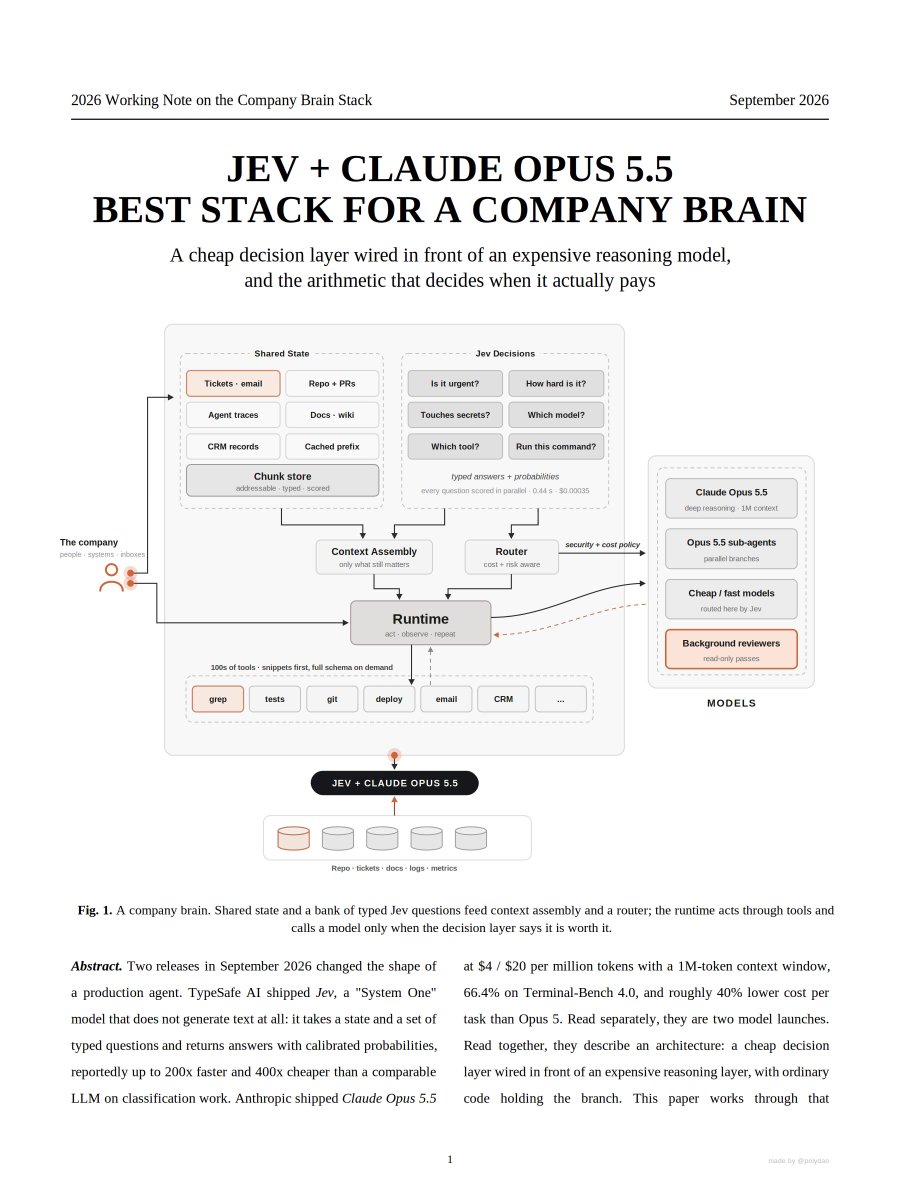
JEV + OPUS 5.5 IS INSANE FOR BUILDING A COMPANY BRAIN I pulled the whole architecture out of the TypeSafe and Anthropic docs and packed it into a 14-page PDF the 10 steps: 1. meet the pair > Opus 5.5 thinks, Jev decides, your code holds the branch 2. stop asking a text generator for a yes or no > Jev returns a typed answer with a calibrated probability in 0.44s for $0.00035 3. ask everything at once > Choice, Score and Noul run in parallel, so the fourth question costs almost nothing 4. branch on the number > 0.999 goes straight into the if statement. ~99% of turns end right here 5. stop routing blind > Opus 5.5 to Sonnet and back costs 5.84 against 3.32 for staying on 5.5 6. keep one context warm > cache reads at $0.20 per Mtok are 20x cheaper than a fresh load 7. escalate the hard part > the toughest 1% goes to Opus 5.5 with 1M context and 66.4% on Terminal-Bench 4.0 8. score every chunk on every query > keep whole, summarize or drop. the context gets rebuilt each turn 9. gate the actual command > every bash call gets classified before it runs, inside your own code 10. judge 100% of runs > $3.50 a day for 10,000 traces, and it matched the human label on all 500 decisions the result: a while loop that paid a frontier model for every tiny call turns into a brain that spends a fraction of a cent to notice and pays properly only when it has to think the person who brings this into their team walks into the budget meeting with the AI bill cut and the output up the PDF maps the company brain. the loop side of it - how Jev takes a Claude bill from $765 to $3 a month - is in the article below ↓

Mr. Buzzoni

103,282 просмотров • 11 дней назад

Jev + Opus 5.5: Anthropic's new model beats GPT-6 Astra for 1/5 the cost, and 4 API changes will 400 your agent before it writes a single line I pulled these 10 steps from the migration docs so you don't learn them in production step 1 → $4 / $20 per 1M. Opus 5 was $5 / $25. cache reads dropped from $0.50 to $0.20 step 2 → 66.4% on Terminal-Bench 4.0 vs GPT-6 Astra 57.9% and Opus 5 52.3%. +14.1 points in one release, and on FrontierCode it beats Astra at default effort for 1/5 the cost step 3 → thinking can't be turned off anymore. send thinking: disabled and you get a 400. drop the field, set effort step 4 → tool_choice any and tool are gone. 400. switch to auto + strict step 5 → edit anything above a thinking block and the request dies. append only, or opt into drop_block step 6 → computer_20251124 is dead on the API. 400. move to computer_toolset_20260801 step 7 → the quiet one: default effort fell from high to medium. your agent thinks less than you set it up to and nothing tells you step 8 → hop Opus 5.5 → Sonnet 5 → Opus 5.5 and you pay 4.36 instead of 3.32. +31%, the cache dies and Sonnet can't read Opus's reasoning step 9 → change effort at the top of the request and the cache is gone. Jev sets it per message and the cache stays step 10 → switch fast - standard mid-session and it's a full cache miss. Jev picks speed once, on turn one one model, three knobs, zero 400s. that is Jev + Opus 5.5 send this to your Claude Code before you touch the model ID, then read my full Jev deep dive in the article below ↓

Carnage

16,674 просмотров • 16 дней назад

this is pure f*cking treasure Netflix engineers posted 20 GitHub repos that turn your Opus 5.5 into a f*cking motion empire: built for Opus 5.5 1. claude-motion: taste, checks its own frames, sound written in code. the author built it for Opus 5.5 2. claude-motion-design: HTML, Playwright and ffmpeg, no Remotion. the demo was made on Opus 5.5 3. motion-graphics-skills: 13 skills for launch videos. the README tells you to run it on Opus 5.5 4. claude-remotion-skill: a Remotion editor from one prompt. captions, B-roll, sound 5. klik-anim-skill-creation: the laws of animation and camera, built on Opus 6. hyperframes-motion-reel-skill: a showreel cut to the beat at 120 BPM, on HyperFrames 7. product-launch-motion: a full launch film. voice-over, camera, color grade 8. animate: a short clip in one canvas file, storyboarded as it goes 9. motion-design-skills: timing, color, typography, logos, Remotion 10. hyperframes-student-kit: 14 skills and 406 motion graphics cards the engines these skills render with 11. hyperframes: HTML to MP4. the one almost everyone installs 12. remotion: video written in React 13. remotion skills: the official Remotion skills for your agent 14. GSAP: the timelines HyperFrames runs on. skills: npx skills add greensock/gsap-skills taste and everything around it 15. motion-design-skill: motion principles that work with any engine 16. awesome-motion-design-agent-skills: a map of GSAP, Remotion, Lottie and Rive skills 17. motion-graphics: B-roll built straight from your transcript 18. motion-dev-animations-skill: web animation on not video 19. motion: Motion itself, formerly Framer Motion 20. lottie-web: when you need Lottie, not MP4 the stack in one line: Opus 5.5 writes the code, a skill sets the timing and the camera, an engine renders the MP4. check each repo before you install. save this.

NO1ennn

111,776 просмотров • 17 часов назад