正在加载视频...
视频加载失败
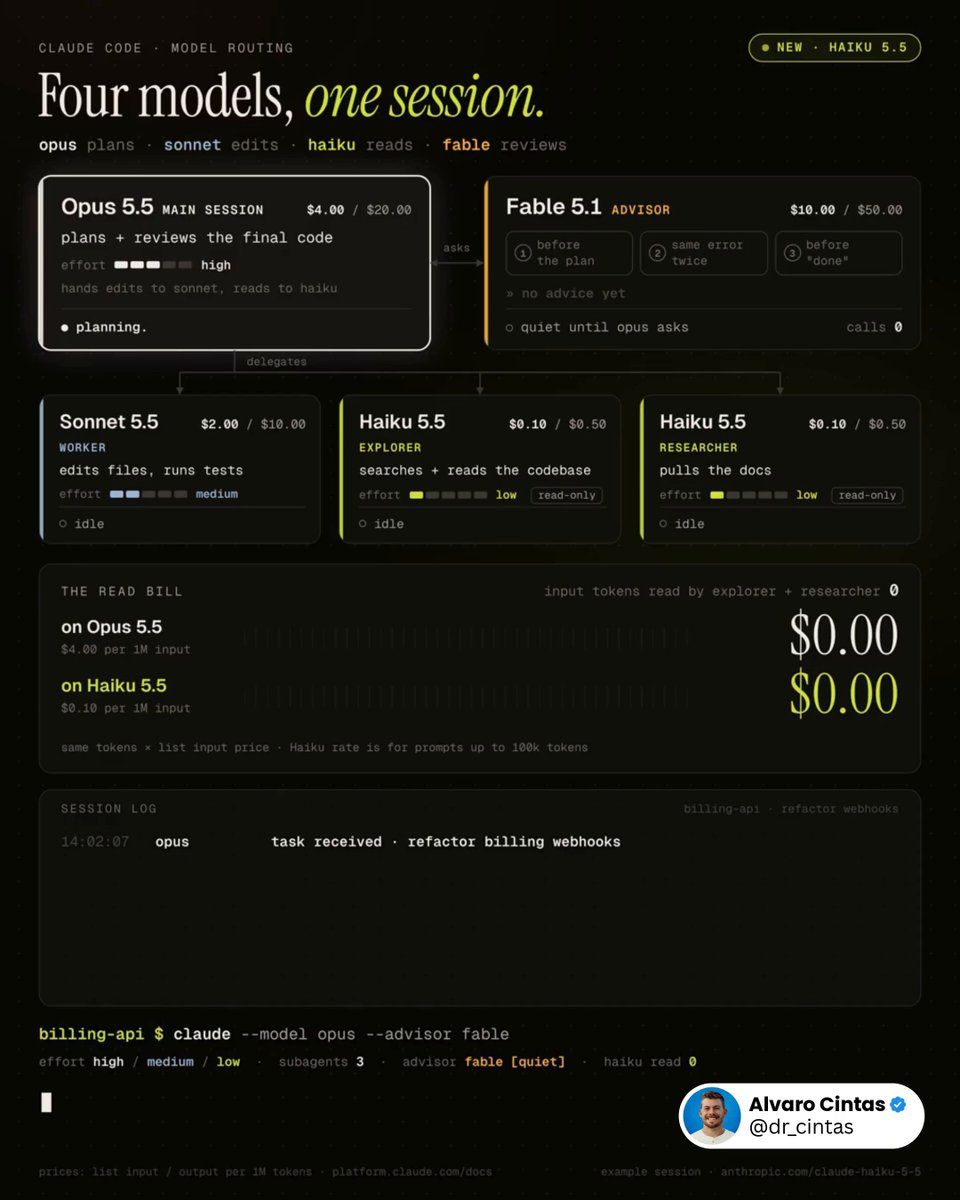
holy sh*t. Official Anthropic tip for Claude Code: stop burning Opus 5.5 context on tasks Haiku 5.5 can swarm, while Sonnet 5.5 builds put the architect on call with /advisor claude --advisor opus --subagents haiku Sonnet 5.5 drives the primary session on high effort, writing diffs and running test... show more

33 条评论

This is way too much Ai brain rot. Im just gonna continue running opus nonstop

all this for 5% more token usage and 140% more complete garbage code output

Literally just provide Opus 5.5 the docs & Anthropic benchmarks for Sonnet / Haiku /Opus, tell it to create agents based on their specialities and best use cases, ask it to go through history and find repetitive work and create agents who specialize in handling those repetitive niche tasks. That’s literally it. Continue to use Opus 5.5 as your main model and watch it become hyper efficient.

in fact, many people underestimate the new haiku 5.5 with this model, you can save a huge amount of money and time

None of this stuff works, do people not realise that yet. It just burns tokens, whilst simultaneously giving the appearance that it doesn't it's like having 16 people passing things to someone who's 10 metres away when you could just walk there yourself.

Why isn’t the AI better at assigning the model than I am at picking it.

How do you get that gorgeous ascii chart from rendering in your terminal?

I feel like this is almost exactly what I do but like way, way simpler? Hey sonnet do this, you’re the orchestrator, use opus as an auditor or if something hard comes up, use haiku subagents liberally to build but keep their context window under 100k And then it does it lol

the claude.md file carrying your entire workflow

This is too much for a space that moves so fast Need to be nimble

bro just saying stuff

Same story Everytime. Before it was “use fable and opus can swarm”. Then it was “ use opus with fable as an advisor while sonnet swarms “. Now it’s this. wtf lol. These posts will never end.

We need an actual fact check on this

Why not just use Opus for everything though? I guess if I was paying API prices it’d be different. But I just don’t think this is worth the hassle. I’m nowhere near meeting my usage every week on Max

And this is where I ask, how is this better then just using Orca? Because Orca is simple, easy and just works

i would keep fable on advisor role. it can handle things and make better planning and UX UI decisions than Opus

meanwhile i'm out here using opus to change a button color

there is no --subagents argument

When swarming repo discovery with Haiku 5.5 subagents, how does Claude Code isolate transient search logs from the main session context? Do subagents emit compact summaries back to Sonnet 5.5, or does the full tool trace get passed to Opus 5.5 when /advisor triggers?

@grok how can this be done when using Claude code online?

Show us the code before and then after your markdown file.

The role split makes sense. I'd pair it with explicit handoff contracts: what evidence each worker returns, when to escalate, and what blocks 'done' if review is skipped. The failures worth catching are the ones that look successful because something was never checked.

sonnet builds, haiku swarms, opus reviews is a really clean division

and in the end Opus alone is better 😆

Sonnet 5.5 needs to be on high to be decent, token burn from high makes it more expressive than Opus 5.5.

This is not how this works. It is like mixing drinks in a storm. We still have turbulence. Yesterday, I saw an agent juggling tasks. It was chaos. Adding layers is like putting a bow on a broken seatbelt. Let's fix the basics first.

@leandronsp da uma olhada kkkkkkkkk

@sambhavdixitpro sharing this with ya, advisor is sick 💪🏼

People replying to their own articles is puke-worthy cringe.

Splitting roles by model is the right instinct. What fixed it for me one level up: each swarm gets its own space and one coordinator hands out the tasks, so cheap agents never touch another swarm's work.

"Stop burning Opus context" is the 2026 version of "have you tried turning it off and on again." Dev wisdom never changes, just the invoices.

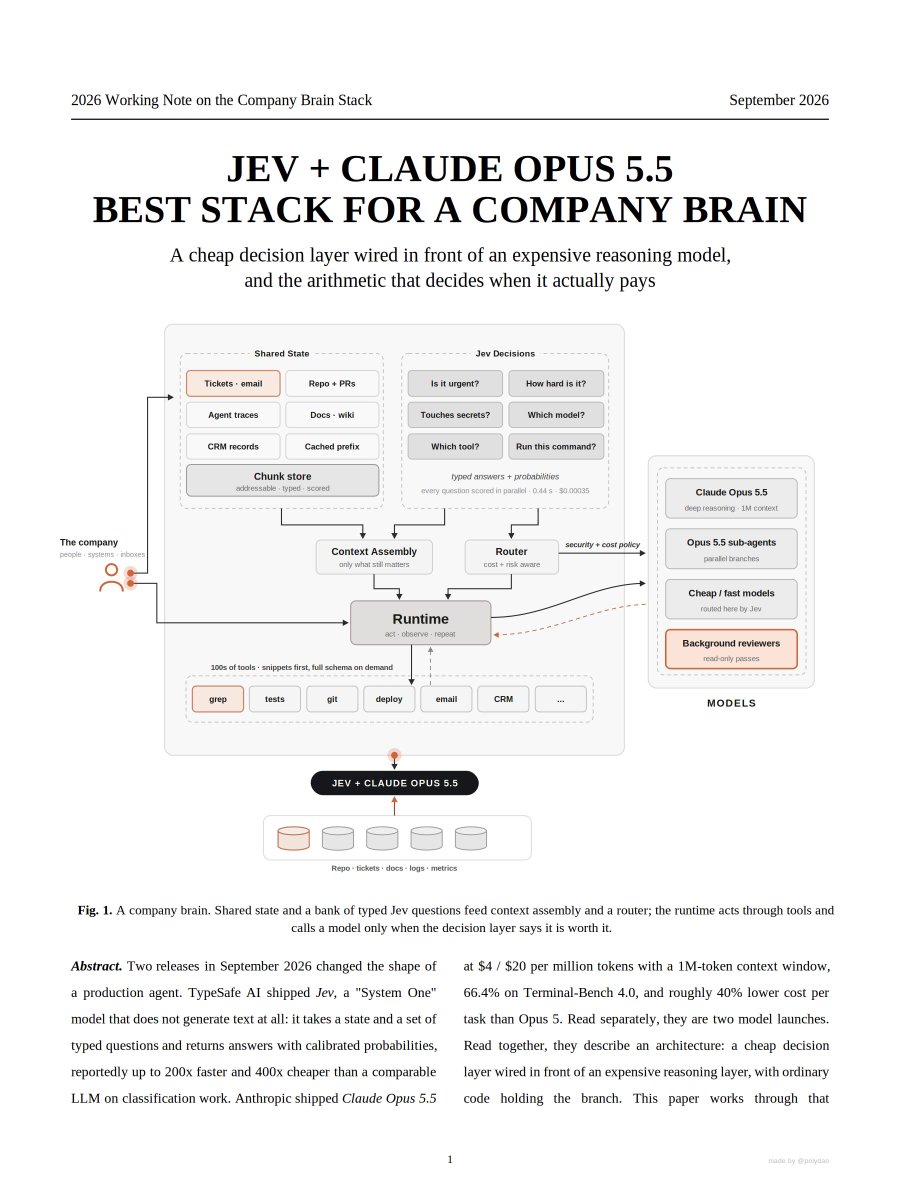
What's real and what isn't Real: /advisor, claude --advisor opus, and the advisorModel setting all exist. Sonnet 5.5 as the main model with Opus as the advisor is an accepted pairing. You can steer when the advisor gets called. Claude decides when to call it, with no setting to force it, but the docs say instructions are how you influence it, so the CLAUDE.md checkpoint idea works as guidance. You can run subagents on Haiku with their own effort level. This is done through env vars or agent frontmatter, not a flag. Not real: --subagents haiku: there's no such flag. "Parallel dispatcher pool (3x workers)": no such setting. The closest thing is CLAUDE_CODE_MAX_CONCURRENT_SUBAGENTS. It's a cap (default 20), so setting it to 3 would make things slower. "JEV micro-fork layer," "1,500 branches in 16ms," "340 tok/s": these aren't Claude Code features. It's marketing copy. Three things the post leaves out: Subagents inherit the advisor too. Haiku subagents can call Opus, which adds Opus-rate tokens to your discovery work. You can't turn this off per subagent. The advisor only works on the Anthropic API, not Bedrock or Vertex. It also silently stays off if you've set DISABLE_TELEMETRY or anything else that blocks feature-flag fetching. A top-level effortLevel in your user settings is ignored by Opus 5.5 and newer models. Use per-model modelSettings instead.

Routing Opus to advisor only helps if the advisor sees the same context the subagents do; otherwise you have a smart reviewer guessing at state. How do contracts and durable state get shared across the Haiku swarm without re-burning context?