Загрузка видео...

Не удалось загрузить видео

На главную

HOW ARE THE PANIC BUTTONS GOING TO STOP CRIME IN PROGRESS? “Unless the button shoots a bullet, the NYPD is a bunch of DEI overweight women.”- @AlexStein99 The buttons don’t do anything to deter the criminals, just notify the police. Jobob

15,245 просмотров • 1 год назад •via X (Twitter)

Комментарии: 3

Фото профиля Robbie
Robbie1 год назад

@alexstein99 @JobobTaeleifi The crime fighter we need:

Фото профиля Standing for Freedom Center
Standing for Freedom Center2 лет назад

Like the plot to a dystopian movie, New York will now monitor social media writings, collect data, and use law enforcement to crack down on any expression it deems to be hate speech.

Фото профиля Kelly Grzesiak
Kelly Grzesiak1 год назад

@alexstein99 @JobobTaeleifi Amnesty for BB latinas.

Похожие видео
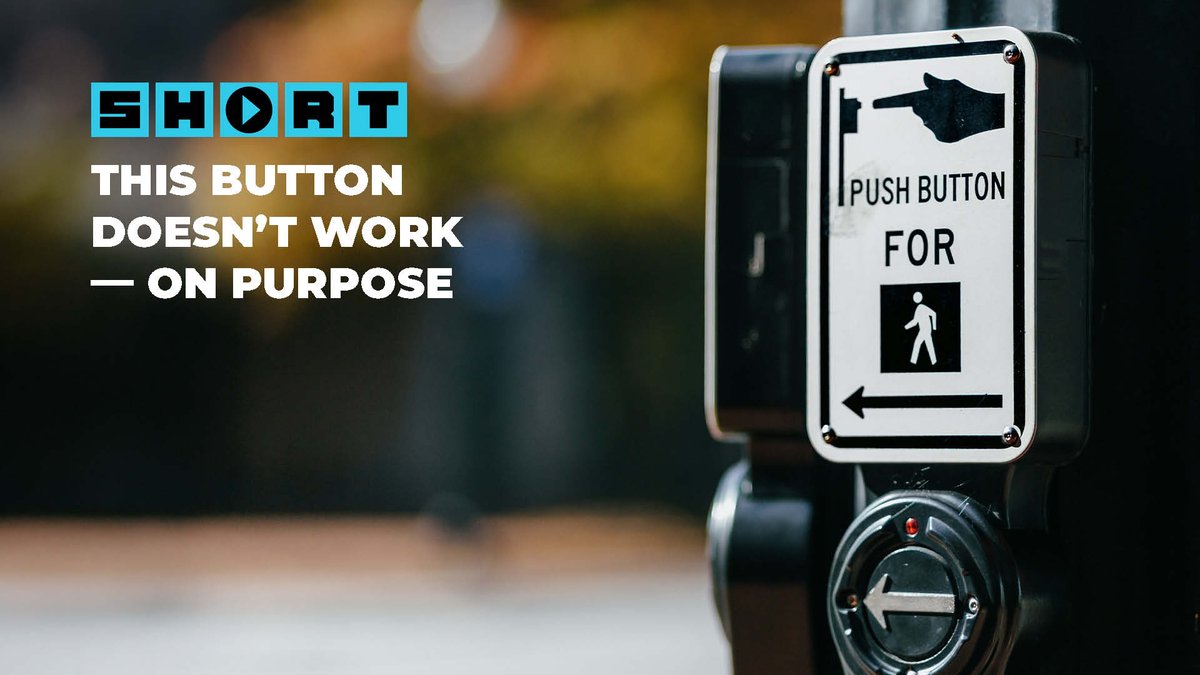
In most countries, half the buttons you press in a day might be placebos. The walk button at the crossing, the close-door button in the elevator, the thermostat on the office wall. They click, they light up, and many of them are not actually wired to anything. Take New York, in the United States. Of the roughly 3,250 buttons at its pedestrian crossings, fewer than 120 actually do anything. The rest click when you press them, they look like working buttons, but they have not been connected to the traffic lights for more than thirty years. The city quietly deactivated them in the late 1980s when the signals moved to a computer system. Nobody told the public, because the public kept pressing them anyway. The close-door button in most American elevators is in the same condition. It has been doing nothing since 1990. That was the year the Americans with Disabilities Act passed, which required elevator doors to stay open long enough for someone in a wheelchair or on crutches to get in. The button stayed on the panel, but the wiring was cut. Karen Penafiel, who ran the National Elevator Industry trade group, confirmed this plainly to the New York Times a few years ago. In Hong Kong, the walk button at many pedestrian crossings is real during quiet hours and a placebo during rush hour. A central traffic computer decides which one it is, depending on how busy the road is. The same button, pressed by the same person at the same crossing, might or might not be doing anything, depending on the time of day. Parts of the UK and Australia use the same system. Office thermostats have their own version of this. A 2003 piece in the Wall Street Journal revealed that landlords in the US had been installing dummy thermostats in commercial buildings for years. A tenant would complain about the temperature, an engineer would walk over, turn a dial that controlled nothing, and the complaints would stop. One HVAC specialist estimated that as many as ninety percent of office thermostats in the country were fake. Other engineers said it was closer to two percent. Either way, it was widespread enough to be a known trick of the trade. These are only the places where someone has bothered to investigate and report it. Nobody has done a proper audit of the buttons in Lagos, or Nairobi, or Jakarta, or Mexico City, or Karachi. The crossings, elevators, and thermostats in those cities were installed by the same manufacturers, run by the same kinds of building managers, governed by the same kinds of traffic computers. There is no particular reason to assume the buttons there are any more honest than the ones in New York. A Harvard psychologist named Ellen Langer has a name for what is going on. She calls it the illusion of control. When you press the button, even if nothing happens, your brain registers that you took an action, and the waiting becomes easier. The door closes eventually, the light changes, the office cools down. And every time, your brain credits the button.

Lemma the Optimist

101,846 просмотров • 26 дней назад